
Ever written the sentence “she has a real flare for design” and then paused, finger hovering over the keyboard, wondering if that’s actually right? You’re not alone. Flair and flare are two of the most commonly confused word pairs in the English language.
Why does this mix-up happen so often? Simple the two words are homophones. They sound exactly the same when spoken out loud, but they mean completely different things and are spelled differently. This is exactly the kind of trap that trips up native speakers and English learners alike, especially in fast-typed emails, social media captions, and even published articles (yes, really).
If you’ve ever typed one when you meant the other, don’t worry by the end of this article, you’ll never make that mistake again. 🎯
Quick Answer: Flair vs Flare 🚀
Flair (noun) means a natural talent, style, or elegance like “she has a flair for cooking.” Flare (noun/verb) means a sudden burst of light, flame, or emotion like “the match flared up” or “a distress flare.”
That’s the core difference in a nutshell. Now let’s dig deeper. 👇
What Does “Flair” Mean? 🎨

Flair is a noun that refers to:
- A natural talent or ability to do something well
- A stylish, distinctive quality a sense of elan or panache
- An instinctive knack for spotting or handling something
Examples of “Flair” in a Sentence
- She has a natural flair for painting portraits.
- His writing has a certain flair that makes it fun to read.
- The chef added a bit of flair to the classic recipe.
- You need a flair for languages if you want to work as a translator.
- The restaurant’s interior design shows real flair.
Key point: Flair is always a noun. You can’t “flair up” or “flair out” that’s not how this word works.
What Does “Flare” Mean? 🔥
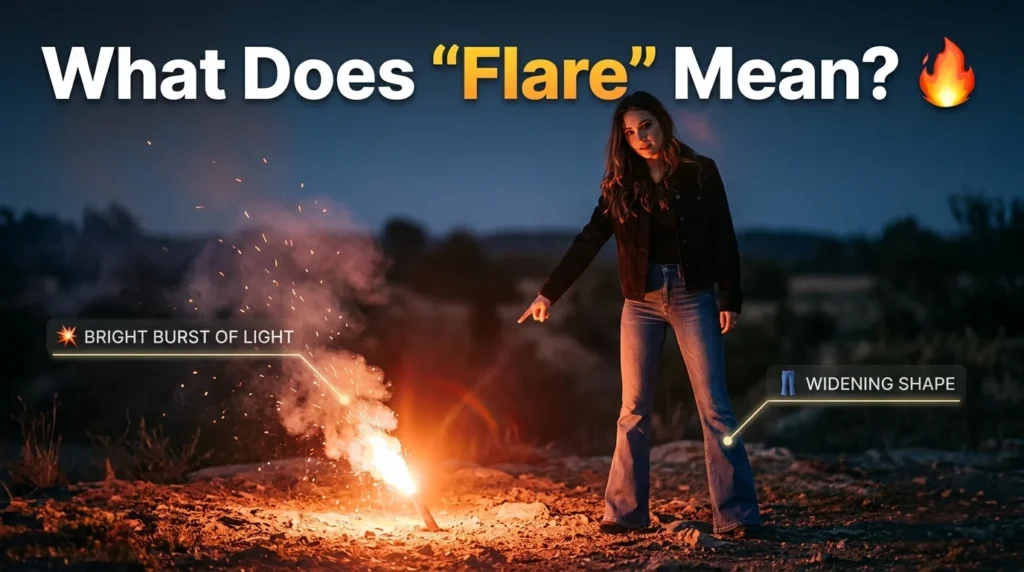
Flare can be both a noun and a verb, and it’s all about sudden bursts of light, fire, emotion, or shape.
As a Noun
- A flare is a device that produces a bright flame, often used as a distress signal or warning light.
- It can also describe a sudden spreading or widening shape (like “flare-leg jeans”).
As a Verb
- To flare means to burn suddenly and brightly, or to suddenly increase in intensity (emotions, symptoms, conflicts).
Examples of “Flare” in a Sentence
- The sailors set off a flare to signal for help.
- Her nostrils flared in anger.
- Tempers flared during the heated debate.
- The dress has a flared skirt that swishes when you walk.
- His arthritis symptoms flare up in cold weather.
- The candle flared briefly before settling into a steady flame.
Key point: Flare often pairs with “up” flare-up, flared up, flaring up to describe sudden intensification.
Flair vs Flare: Comparison Table 📊
| Feature | Flair ✨ | Flare 🔥 |
| Part of speech | Noun only | Noun and verb |
| Meaning | Natural talent, style, elegance | Sudden burst of light/flame/emotion |
| Common phrases | “flair for,” “with flair” | “flare up,” “distress flare,” “flared jeans” |
| Example (noun) | She has a flair for design. | He lit a flare during the emergency. |
| Example (verb) | N/A (not a verb) | Her temper flared instantly. |
| Related words | Talent, style, panache, elan | Blaze, burst, ignite, widen |
| Typical topics | Skills, personality, creativity | Emotions, fire, medical symptoms, fashion |
Common Mistakes with Flair and Flare ❌
Here are the most frequent slip-ups people make:
- ❌ “She has a flare for cooking.” → ✅ “She has a flair for cooking.”
- ❌ “His anger began to flair up.” → ✅ “His anger began to flare up.”
- ❌ “The designer added some flare to the outfit.” → ✅ “The designer added some flair to the outfit.”
- ❌ “The emergency crew launched a flair.” → ✅ “The emergency crew launched a flare.”
Why This Mistake Happens
- Both words are pronounced identically (a homophone pair).
- Autocorrect doesn’t always catch it, since both are real, correctly spelled words.
- People associate “flare” with dramatic, flashy things and mistakenly think “flair” (which relates to style) should follow the same spelling logic.
Memory Trick: How to Remember Flair vs Flare 🧠
Here’s a simple mnemonic to lock this in for good:
“Flair” has an “AI” like tAlent and stAyle. “Flare” has an “ARE” like fiARE and burn.
Or try this one:
🎨 Flair = Artistic (both have “AI” and relate to talent/style) 🔥 Flare = Fire (both start with “F” and relate to flames/bursts)
Another fun trick: think of flair as something you wear with pride (style), and flare as something that flares (burns/bursts) literally sounds like the fire crackling.
Real-Life Examples: Where You’ll See These Words 📱
In Emails
“Thanks for adding your creative flair to this project the client loved the presentation!”
On Social Media
“New year, new flare jeans 👖✨ #fashion #90sstyle” (Correct usage flare pants/jeans is the accepted term for this style.)
In News Headlines
“Tensions Flare at Border Amid Diplomatic Standoff”
In Academic Writing
“The researcher demonstrated a remarkable flair for statistical analysis in her dissertation.”
In Everyday Speech
“Ugh, my back pain is flaring up again. I think I need to see a doctor.”
British vs American English: Any Differences? 🇬🇧🇺🇸
Good news this one’s the same on both sides of the pond! Both British English and American English use:
- Flair for talent/style
- Flare for sudden bursts of light, flame, or emotion, and for the fashion term (flare pants/flares)
There’s no regional spelling variation here, unlike words such as “colour/color” or “organise/organize.” So whether you’re writing for a UK or US audience, the flair vs flare rule stays exactly the same. 🌍
Bonus: Related Word Forms 📝
| Word | Meaning |
| Flair | Noun talent, style |
| Flare | Noun bright burst of light/flame |
| Flare | Verb to burn suddenly, to widen |
| Flared | Past tense/adjective widened or ignited |
| Flare-up | Noun sudden increase in intensity (anger, illness, conflict) |
| Flaring | Present participle currently bursting/widening |
Note: There is no verb form of “flair.” If you’re describing an action (something suddenly happening), you always want flare.
FAQs: People Also Ask 🙋
1. Is it “flair for fashion” or “flare for fashion”?
It’s “flair for fashion” because you’re talking about a natural talent or stylish sense, not a burst of flame.
2. What is a “flare gun”?
A flare gun is a device that shoots a bright, burning signal flare into the sky, typically used in emergencies at sea or in the wild.
3. Can “flair” ever be used as a verb?
No. Flair is only a noun. If you want a verb form for sudden action or emotion, use flare (e.g., “tempers flared”).
4. What are “flare jeans”?
Flare jeans (or flares) are pants that widen out from the knee down, a popular style from the 1970s that’s made several comebacks.
5. What does “nostrils flared” mean?
When someone’s nostrils flare, they widen suddenly often a physical sign of anger, exertion, or strong emotion.
6. Is “flare up” one word or two?
“Flare up” is generally written as two words when used as a verb (“his rash flared up”), but as a hyphenated noun, “flare-up” (“she had a flare-up of eczema”).
7. Why do spellcheckers not catch flair/flare mistakes?
Because both words are spelled correctly spellcheckers only catch misspelled words, not wrong-word choices. This is why understanding the actual meaning matters more than relying on autocorrect.
Conclusion:
In conclusion, flair and flare are two different words, even though they sound exactly the same. Flair usually refers to a natural talent, special style, or distinctive quality that makes someone stand out. Flare, on the other hand, can mean a sudden burst of light, a signal, or something that spreads outward. It can also describe a sudden worsening of a problem.
Understanding the difference between these words helps you choose the correct one based on context. When you mean style or talent, use flair. When you mean light, spreading, or a sudden increase, use flare. This simple distinction improves clear writing.

James Carter is an English language enthusiast and content writer who loves making grammar simple and easy to understand. He creates clear, beginner-friendly guides on spelling, grammar rules, confusing words, and everyday English usage. His goal is to help readers write with confidence through practical examples, easy explanations, and accurate language tips.