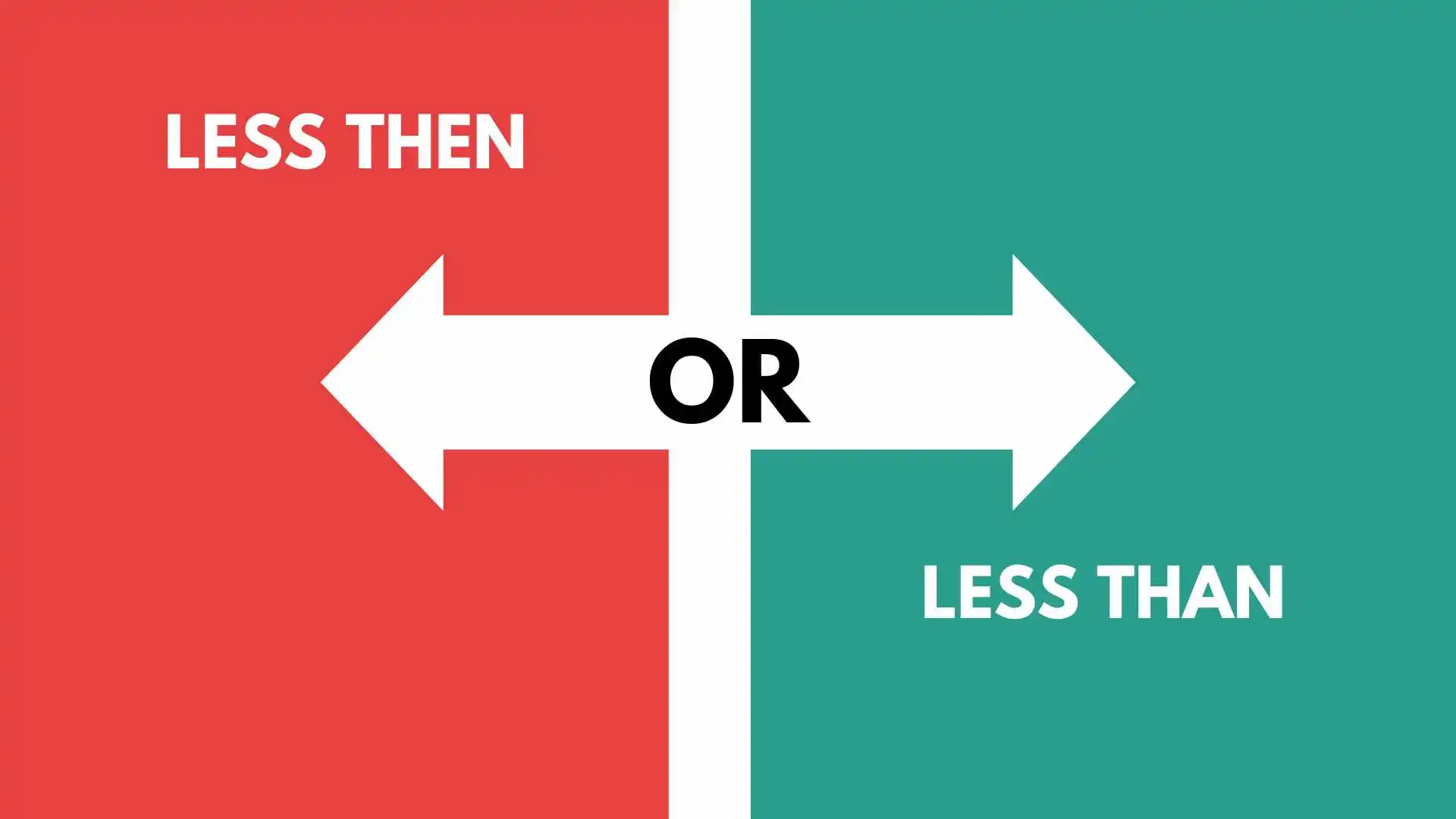
Have you ever typed “less then 10 minutes” in a text message and then paused, wondering, “Wait… is that even right?” 🤔 You’re definitely not alone.
“Less then” vs “less than” is one of the most common spelling mix-ups in English and honestly, it’s an easy trap to fall into because “then” and “than” sound almost identical when we speak.
The good news? Once you understand the simple difference, you’ll never mix them up again. Let’s clear this up once and for all. 🎉
Quick Answer 🎯
“Less than” is the correct phrase used for comparisons (e.g., less than 5 apples). “Less then” is a common misspelling “then” is a completely different word used for time or sequence, not comparison. So, whenever you’re comparing amounts, sizes, or numbers, always use “less than.”
Understanding the Basics 🧠
What Does “Less Than” Mean? 📉
“Less than” is used to compare two things, showing that one amount is smaller than another. It’s a comparison word, just like “greater than,” “more than,” or “equal to.”
Examples of “less than” in real life:
- “I have less than $20 left in my wallet.” 💵
- “The temperature today is less than yesterday.” 🌡️
- “She scored less than 80% on the test.” 📊
- “There are less than ten people in the room.” 🚶♂️🚶♀️
- In math: 5 < 10 means “5 is less than 10.”
Key point: “Less than” always involves a comparison you’re measuring one thing against another.
What Does “Then” Mean? ⏳
“Then” is a completely different word. It’s related to time, sequence, or consequence not comparison at all.
Examples of “then” in real life:
- “First, mix the flour and sugar. Then, add the eggs.” 🥚
- “I finished my homework, and then I watched a movie.” 🎬
- “If it rains, then we’ll stay indoors.” ☔
- “Back then, phones didn’t even have cameras.” 📱
- “She smiled, and then walked away.”
Key point: “Then” is about what happens next or what happened at a certain time never about comparing quantities.
“Less Then” vs “Less Than”: Comparison Table 📊
| Feature | Less Than ✅ | Then ⏳ |
| Meaning | Used for comparison (smaller amount) | Used for time, sequence, or result |
| Part of Speech | Comparative phrase | Adverb/conjunction |
| Used With Numbers? | Yes, often (e.g., less than 10) | No |
| Example Sentence | “I have less than five minutes.” | “First eat, then sleep.” |
| Opposite Word | More than / greater than | N/A (not a comparison word) |
| Common Mistake | Writing “less then” instead | Confusing it with “than” |
| Math Symbol Use | Yes (< symbol) | No |
How to Remember the Difference 🔑
Here’s a simple memory trick (mnemonic) to keep “less than” and “then” straight forever:
🅰️ “Than” is for compAArison both words have an A. ⏳ “Then” is for whEN both words have an E and relate to time (whEN something happens).
Another fun way to remember:
- Than = compare (both have the letter “a”)
- Then = time (both have the letter “e”)
So next time you’re unsure, just ask yourself: “Am I comparing two things, or talking about time/sequence?” If it’s a comparison, it’s “than.” If it’s about time, it’s “then.”
Common Mistakes People Make 🙈
- Typing “less then” instead of “less than.” This is the #1 mistake usually because the words sound similar when spoken quickly.
- Using “then” in comparisons. Example: ❌ “She is taller then me.” ✅ “She is taller than me.”
- Using “than” for sequence. Example: ❌ “I ate breakfast, than went to work.” ✅ “I ate breakfast, then went to work.”
- Autocorrect confusion. Many phone keyboards don’t catch this error since both words are spelled correctly just used incorrectly.
- Assuming they’re interchangeable. They are NOT interchangeable one is about comparison, the other about time.
Real-Life Examples 💬
From a text message:
“Hey, I’ll be there in less than 10 minutes, then we can head out together!”
From a social media caption:
“Woke up feeling better than yesterday. Then I remembered it’s Monday 😩”
From a news headline:
“Unemployment rate drops to less than 4% for the first time in a decade.”
From academic writing:
“The results indicate that Group A performed significantly better than Group B, and the data was then analyzed using a t-test.”
From everyday speech:
“I’d rather walk than drive in this traffic. Then again, it looks like it might rain.”
These examples show how naturally both words appear together in daily communication as long as you use the correct one in the correct place! ✅
Usage Notes: British vs American English 🌍
Good news there’s no difference between British and American English when it comes to “less than” vs “then.” Both phrases are used exactly the same way in both regions.
| Term | British English | American English |
| Less than | Less than | Less than |
| Then | Then | Then |
| Common confusion | Same (then/than mix-up) | Same (then/than mix-up) |
This is a universal English spelling issue, not a regional one so the tips in this article apply no matter where you’re learning English. 🌎
Related Keywords & Search Insights 🔍
If you’re researching this topic, here are some related terms and LSI keywords worth knowing:
- Then vs than difference
- Grammar tips for beginners
- Common English mistakes
- Correct spelling rules
- Comparative words in English
- English usage guide
- Than vs then examples
Understanding these related terms can help you strengthen your overall grammar skills, not just this one specific rule.
FAQs: People Also Ask ❓
1. Is “less then” ever correct?
No, “less then” is always incorrect. The correct phrase for comparisons is always “less than.”
2. What’s the easiest way to remember “than” vs “then”?
Remember: “than” = compArison (has an A), and “then” = timE (has an E, like whEN).
3. Can “less than” be used with people, not just numbers?
Yes! Example: “There were less than twenty people at the meeting.”
4. Is it “fewer than” or “less than”?
It depends on what you’re counting. Use “fewer than” for countable items (fewer than 5 apples) and “less than” for uncountable amounts (less than water, less than time).
5. Why do people confuse “than” and “then” so often?
Because they sound almost identical when spoken quickly, and both are short, common words making it easy to type the wrong one without noticing.
6. Does autocorrect fix “less then” automatically?
Not always. Since both “then” and “than” are correctly spelled words, most spell-checkers won’t flag them only grammar-checking tools usually catch this mistake.
7. Is this mistake common in professional writing?
Yes, it’s a surprisingly frequent error even in emails, reports, and social media posts which is why understanding the difference is so useful.
Final Takeaway
In conclusion, “less than” is the correct phrase when comparing two amounts, numbers, or quantities. “Less then” is incorrect because “then” is used to show time, sequence, or what happens next. Remembering this simple difference can help you avoid a common grammar mistake in both writing and everyday communication.
Use “less than” for comparisons, such as “less than five minutes” or “less than $20.” On the other hand, use “then” when describing an order of events, such as “Finish your work, then go home.” With this easy rule, choosing between “less than” and “less then” becomes simple and clear.

Olivia Bennett is a passionate English grammar writer at GrammBoost.com who loves making grammar simple and easy to understand. She specializes in spelling, word differences, punctuation, and everyday English usage. Through clear explanations and practical examples, Olivia helps students, writers, and professionals write with greater confidence and accuracy.