
Have you ever wondered how much an average cow weighs? You are a farmer, livestock owner, cattle buyer, student, or simply curious about farm animals, understanding cow weight can be surprisingly useful. A cow’s weight affects its health, feeding requirements, growth, milk production, breeding, and overall farm management. However, not every cow weighs the same. Some cattle breeds are naturally smaller, while others grow into large, heavy animals.
The average cow weight depends on several factors, including breed, age, gender, diet, genetics, and living conditions. For example, a mature dairy cow generally weighs less than a large beef cow. Similarly, bulls are usually heavier than cows because they have larger bodies and more muscle mass. Calves also have significantly different weights depending on their age and development.
Knowing the average weight of a cow helps farmers make better decisions about nutrition, breeding, livestock transportation, and veterinary care. It can also help buyers estimate the value of cattle when purchasing animals. In this guide, we will explore average cow weights by breed, age, gender, and purpose. You will also learn what affects cattle weight, how to measure it, and how much weight a healthy cow should gain over time.
What Is the Average Cow Weight?

The average weight of a mature cow is approximately 1,000 to 1,500 pounds (454 to 680 kilograms). However, this is a general estimate rather than a fixed measurement. Some smaller cattle breeds weigh considerably less, while larger beef breeds can exceed this range.
A cow’s weight depends mainly on its breed and purpose. Dairy cows are often bred to produce milk efficiently, while beef cattle are generally developed for meat production. These different breeding goals influence their body size, muscle development, and overall weight.
For example, a mature Holstein dairy cow commonly weighs between 1,300 and 1,500 pounds. In comparison, an Angus cow may weigh approximately 1,100 to 1,400 pounds, depending on genetics and management.
Farmers also consider body condition when evaluating cow weight. An animal that weighs more is not necessarily healthier. Excess body fat can create health and reproductive problems, while insufficient weight may indicate poor nutrition or illness.
Therefore, understanding the average cow weight requires looking beyond one number. Breed, age, gender, and body condition all play important roles.
Average Cow Weight by Breed
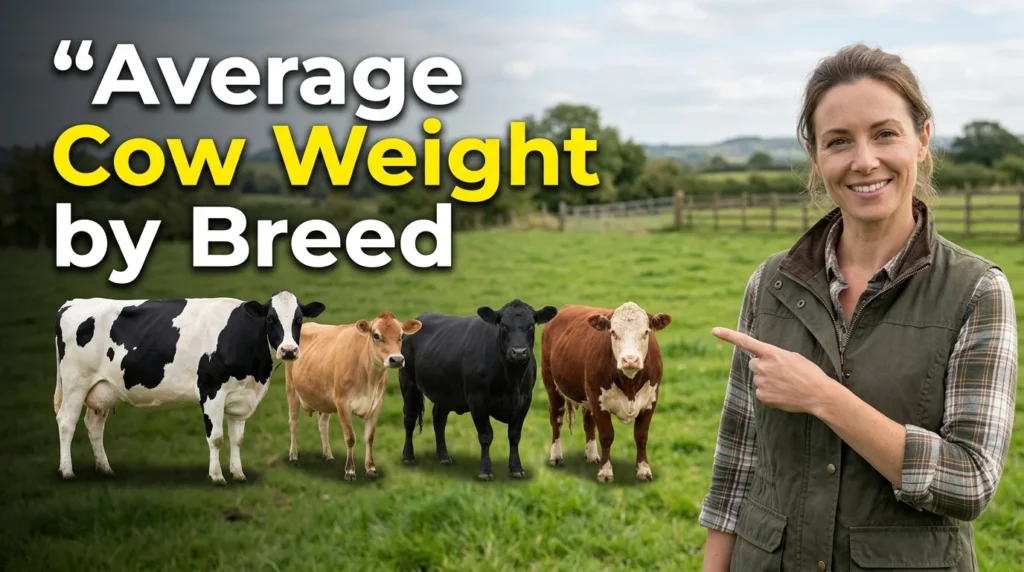
Different cattle breeds have different body structures and growth characteristics. Some breeds are naturally large and muscular, while others are smaller and better suited to particular climates or farming conditions.
Here is an overview of the approximate mature weights of popular cattle breeds.
| Cow Breed | Average Mature Weight |
| Holstein | 1,300–1,500 lbs |
| Angus | 1,100–1,400 lbs |
| Hereford | 1,200–1,400 lbs |
| Jersey | 800–1,000 lbs |
| Guernsey | 1,000–1,200 lbs |
| Charolais | 1,400–1,700 lbs |
| Simmental | 1,300–1,500 lbs |
| Limousin | 1,100–1,500 lbs |
| Brahman | 1,000–1,400 lbs |
| Shorthorn | 1,200–1,400 lbs |
These figures are approximate ranges for mature cows. Individual animals may weigh more or less depending on their genetics, age, feeding program, and health.
1. Holstein Cow Weight
Typical mature weight: 1,300–1,500 pounds
Holstein cattle are among the most recognizable dairy breeds in the world. They are famous for their black-and-white markings and high milk production.
A mature Holstein cow generally weighs between 1,300 and 1,500 pounds. Some larger individuals may weigh more, particularly when they receive excellent nutrition and proper farm management.
Holstein cows have relatively large frames and require balanced diets to maintain their body condition while producing milk. Their feeding programs usually include quality forage, grains, minerals, and sufficient clean water.
Because of their milk-producing ability, Holsteins are commonly raised on commercial dairy farms.
2. Angus Cow Weight
Typical mature weight: 1,100–1,400 pounds
Angus cattle are popular beef animals known for their black or red coats, strong bodies, and meat quality.
A mature Angus cow generally weighs between 1,100 and 1,400 pounds. Their body structure supports good muscle development, making them valuable in beef production.
Angus cattle are also known for their adaptability to different farming environments. With appropriate nutrition and management, they can maintain healthy growth and reproductive performance.
Their popularity among cattle farmers comes from their meat quality, fertility, and ability to perform under various conditions.
3. Hereford Cow Weight
Typical mature weight: 1,200–1,400 pounds
Hereford cattle are easily recognized by their reddish-brown bodies and distinctive white faces.
A mature Hereford cow usually weighs between 1,200 and 1,400 pounds. These animals are commonly raised for beef production because of their manageable temperament, hardiness, and productive characteristics.
Herefords can adapt to different climates and grazing conditions. They are often considered a practical option for farmers who want cattle that can perform well on pasture.
Their weight can vary depending on the quality of their feed, genetics, and overall management.
4. Jersey Cow Weight
Typical mature weight: 800–1,000 pounds
Jersey cattle are smaller dairy animals known for producing milk with relatively high butterfat content.
A mature Jersey cow generally weighs between 800 and 1,000 pounds. Compared with Holstein cows, Jerseys have smaller frames and require less feed to maintain their body weight.
Their milk is often used for butter, cheese, and other dairy products because of its rich composition.
Although Jersey cows are smaller, they can be highly productive when provided with balanced nutrition, proper housing, and regular veterinary care.
5. Guernsey Cow Weight
Typical mature weight: 1,000–1,200 pounds
Guernsey cattle are dairy animals recognized by their golden-red and white coats.
A mature Guernsey cow usually weighs between 1,000 and 1,200 pounds. They are medium-sized animals that produce milk containing useful levels of butterfat and protein.
Their moderate body size makes them suitable for different dairy farming systems. However, their nutritional needs still depend on milk production, age, and reproductive stage.
6. Charolais Cow Weight
Typical mature weight: 1,400–1,700 pounds
Charolais cattle originated in France and are well known for their large frames, muscular bodies, and white or cream-colored coats.
Mature Charolais cows commonly weigh between 1,400 and 1,700 pounds. They are popular in beef production because of their ability to develop significant muscle mass.
Their large body size means farmers must pay close attention to feeding requirements and body condition.
Charolais cattle are also used in crossbreeding programs to improve growth and carcass characteristics.
7. Simmental Cow Weight
Typical mature weight: 1,300–1,500 pounds
Simmental cattle are versatile animals raised for beef and, in some production systems, dairy purposes.
A mature Simmental cow commonly weighs between 1,300 and 1,500 pounds. They are known for their large frames, growth potential, and muscular development.
Their adaptability makes them suitable for several livestock production environments.
8. Limousin Cow Weight
Typical mature weight: 1,100–1,500 pounds
Limousin cattle are a beef breed originally developed in France.
Mature cows commonly weigh between 1,100 and 1,500 pounds. They are recognized for their muscular bodies and ability to produce lean beef.
Their weight varies considerably depending on breeding lines and management practices.
9. Brahman Cow Weight
Typical mature weight: 1,000–1,400 pounds
Brahman cattle are particularly valued in hot climates because of their heat tolerance and ability to adapt to challenging environmental conditions.
A mature Brahman cow generally weighs between 1,000 and 1,400 pounds. These cattle have distinctive humps, loose skin, and long ears.
They are commonly raised in tropical and subtropical regions, including parts of South Asia.
10. Shorthorn Cow Weight
Typical mature weight: 1,200–1,400 pounds
Shorthorn cattle are versatile animals used in beef and dairy production.
Mature Shorthorn cows commonly weigh between 1,200 and 1,400 pounds. Their body size and production characteristics make them useful for different farming systems.
They are also used in crossbreeding programs to improve cattle performance.
Average Cow Weight by Age
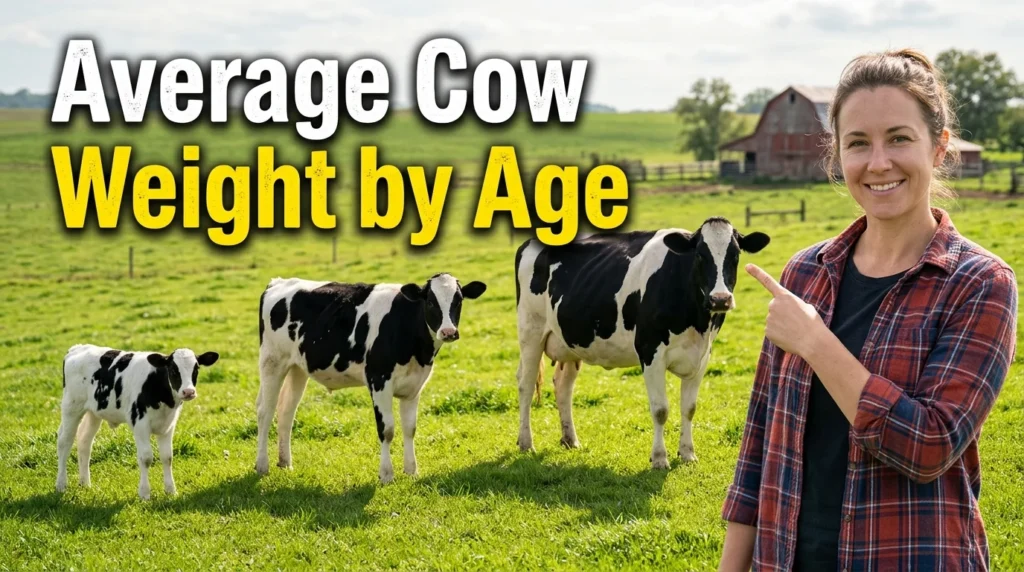
A cow’s weight changes throughout its life. Calves begin at a relatively low birth weight and gradually grow as they receive milk, forage, and other nutritious feed.
The growth rate depends on genetics, breed, nutrition, health, and management.
The following table provides general weight estimates for cattle at different ages.
| Age | Approximate Weight |
| Newborn calf | 60–100 lbs |
| 1 month | 80–130 lbs |
| 3 months | 150–250 lbs |
| 6 months | 300–500 lbs |
| 9 months | 400–650 lbs |
| 12 months | 500–800 lbs |
| 18 months | 700–1,000 lbs |
| 24 months | 800–1,200 lbs |
| Mature cow | 1,000–1,500 lbs |
These numbers are broad estimates, not guaranteed growth targets. Some breeds mature earlier or remain smaller, while others continue gaining weight for longer.
Newborn Calf Weight
A newborn calf generally weighs between 60 and 100 pounds, although birth weight varies significantly by breed and the size of its mother.
Large beef breeds may produce heavier calves, while smaller breeds usually have lighter newborns.
The first hours after birth are especially important. Calves need colostrum, the first milk produced by their mothers, because it provides antibodies that help protect them against disease.
Proper early nutrition supports healthy development and future growth.
One-Month-Old Calf Weight
At one month of age, a healthy calf may weigh approximately 80 to 130 pounds.
During this period, milk remains an important part of its diet. Calves also begin exploring solid feed and developing their digestive systems.
Clean water, suitable calf feed, comfortable housing, and regular monitoring help support healthy growth.
Three-Month-Old Calf Weight
A three-month-old calf may weigh approximately 150 to 250 pounds.
Its weight depends on milk intake, breed, genetics, and the availability of nutritious feed.
At this stage, calves gradually become more capable of digesting solid foods. Farmers often introduce calf starter feed and good-quality forage to encourage rumen development.
Six-Month-Old Calf Weight
A six-month-old calf may weigh approximately 300 to 500 pounds.
By this age, many calves are ready for weaning or have already been weaned, depending on the farming system.
Their diets increasingly depend on forage, pasture, and suitable supplemental feed.
Regular weight checks can help farmers identify whether calves are developing properly.
One-Year-Old Cow Weight
A one-year-old animal may weigh approximately 500 to 800 pounds.
However, this depends heavily on its breed and whether it is being raised for dairy or beef production.
Young cattle need sufficient energy, protein, minerals, and vitamins to support bone development and muscle growth.
Two-Year-Old Cow Weight
At two years of age, many cattle weigh between 800 and 1,200 pounds.
Some animals may already be close to their mature body weight, while larger breeds may continue growing.
Farmers often evaluate body condition, reproductive development, and overall health before deciding whether an animal is ready for breeding.
Average Weight of a Cow vs. Bull
One important difference in cattle weight is gender. Bulls generally weigh more than cows because they tend to have larger frames, stronger muscles, and greater overall body mass.
A mature cow may weigh between 1,000 and 1,500 pounds, while a mature bull can weigh approximately 1,500 to 2,400 pounds or more.
| Cattle Type | Approximate Mature Weight |
| Dairy cow | 1,000–1,500 lbs |
| Beef cow | 1,100–1,600 lbs |
| Mature bull | 1,500–2,400 lbs |
| Young heifer | 500–900 lbs |
| Steer | 1,000–1,500 lbs |
Why Are Bulls Heavier Than Cows?
Bulls are generally heavier because of their hormonal development and physical structure.
Testosterone contributes to muscle development, making mature bulls larger and more muscular than females of similar breeds.
Their shoulders, necks, and overall frames are often more developed.
Cows, on the other hand, have bodies adapted for pregnancy, calving, and milk production.
Although these differences are common, individual animals can vary considerably.
Average Dairy Cow Weight
Dairy cows are raised primarily for milk production. Their body weight depends on their breed, age, stage of lactation, and nutritional management.
The average mature dairy cow generally weighs between 1,000 and 1,500 pounds.
Holstein cows are usually among the heavier dairy breeds, while Jersey cows are considerably smaller.
| Dairy Breed | Average Mature Weight |
| Holstein | 1,300–1,500 lbs |
| Jersey | 800–1,000 lbs |
| Guernsey | 1,000–1,200 lbs |
| Brown Swiss | 1,200–1,400 lbs |
| Ayrshire | 1,000–1,300 lbs |
Dairy farmers monitor cow weight because it can influence milk production, reproductive performance, and feed requirements.
A dairy cow that loses too much weight after calving may need nutritional attention. Similarly, excessive body fat can create problems during pregnancy and calving.
Maintaining a healthy body condition is more important than simply achieving a particular weight.
Average Beef Cow Weight
Beef cows are raised primarily for meat production. They are generally bred for muscle development, growth, reproductive performance, and the ability to raise healthy calves.
A mature beef cow often weighs between 1,100 and 1,600 pounds.
Some breeds, such as Charolais and larger Simmental cattle, can weigh more than smaller beef breeds.
Beef cattle weight is important because it helps farmers estimate feeding needs, breeding suitability, and livestock market value.
However, farmers should not evaluate beef cattle based on weight alone. Muscle development, body condition, health, and structural soundness also matter.
How Much Does a Cow Weigh in Kilograms?
Although pounds are commonly used in some countries, many farmers around the world measure cattle weight in kilograms.
One pound equals approximately 0.4536 kilograms.
Here are some common cow weight conversions.
| Weight in Pounds | Weight in Kilograms |
| 500 lbs | 227 kg |
| 600 lbs | 272 kg |
| 700 lbs | 318 kg |
| 800 lbs | 363 kg |
| 900 lbs | 408 kg |
| 1,000 lbs | 454 kg |
| 1,100 lbs | 499 kg |
| 1,200 lbs | 544 kg |
| 1,300 lbs | 590 kg |
| 1,400 lbs | 635 kg |
| 1,500 lbs | 680 kg |
| 1,600 lbs | 726 kg |
| 1,700 lbs | 771 kg |
| 1,800 lbs | 816 kg |
| 2,000 lbs | 907 kg |
For example, if a mature cow weighs 1,200 pounds, its approximate weight in kilograms is 544 kg.
This conversion is helpful for international cattle trading, livestock management, and veterinary records.
What Factors Affect a Cow’s Weight?
Several factors influence how much a cow weighs. Even cattle belonging to the same breed may have different body weights because of variations in genetics, feeding, health, and environmental conditions.
Understanding these factors helps farmers manage their animals more effectively.
1. Breed and Genetics
Breed is one of the most important factors affecting cattle weight.
Some breeds naturally have larger bodies and heavier frames. Others are smaller and reach maturity at lower weights.
For example, a mature Holstein cow usually weighs more than a mature Jersey cow.
Genetics also influence muscle development, growth rate, body structure, and the animal’s ability to use available feed efficiently.
Farmers often select breeding animals based on desirable genetic characteristics.
2. Nutrition and Feeding
Nutrition plays a major role in cattle growth and body condition.
Cows need balanced diets containing energy, protein, fiber, minerals, and vitamins. Insufficient nutrition can slow growth, reduce milk production, and cause weight loss.
Common cattle feed sources include:
- Fresh pasture grass
- Hay
- Silage
- Corn
- Grains
- Legume forage
- Protein supplements
- Mineral mixtures
The correct feeding program depends on the animal’s age, weight, production purpose, and physiological condition.
For example, a lactating dairy cow has different nutritional requirements from a dry cow or a growing beef heifer.
3. Age
Age influences body weight because cattle continue developing throughout their early lives.
Young calves gain weight as their muscles, bones, and digestive systems develop.
Most cattle approach mature size over their first few years, although the exact timing varies by breed.
Older cattle may also lose body condition because of dental problems, reduced feed intake, or age-related health issues.
4. Gender
Male and female cattle usually have different average body weights.
Bulls generally develop larger frames and more muscle than cows.
Steers, which are castrated male cattle, also have different growth and body composition patterns compared with intact bulls.
These differences are important when comparing cattle weights.
5. Health Conditions
Healthy cattle generally have better opportunities for normal growth and weight maintenance.
Parasites, infections, digestive problems, and other illnesses can reduce appetite and interfere with nutrient absorption.
Animals experiencing health problems may lose weight even when sufficient feed is available.
Regular veterinary examinations, vaccination programs, parasite management, and clean living conditions help maintain cattle health.
6. Climate and Environment
Environmental conditions can affect cattle weight.
Extreme heat may reduce feed intake, while cold weather can increase energy requirements.
In hot climates, cattle may spend more time resting and less time grazing during the hottest parts of the day.
Shade, ventilation, clean drinking water, and suitable shelter help animals cope with changing weather conditions.
7. Pregnancy and Milk Production
Pregnancy can influence a cow’s weight because the developing calf, placenta, and associated fluids add weight.
After calving, a cow may experience changes in body weight as it begins producing milk.
Milk production also increases nutritional requirements.
Farmers must provide sufficient energy and protein to support milk production without allowing excessive loss of body condition.
How to Measure a Cow’s Weight
Knowing how to measure cattle weight is useful for farmers, livestock buyers, and animal caretakers.
Although a livestock scale provides the most direct measurement, other methods can estimate an animal’s weight when a scale is unavailable.
1. Using a Livestock Weighing Scale
A livestock scale is one of the most accurate ways to measure cow weight.
The animal is guided into a weighing platform or enclosed weighing area. Once it stands properly, the scale displays its body weight.
This method is useful for:
- Monitoring growth
- Calculating medication doses with veterinary guidance
- Evaluating feeding programs
- Preparing cattle for sale
- Maintaining farm records
Farmers should use a suitable scale and ensure the animal is positioned safely.
2. Using a Weight Tape
A livestock weight tape is a practical tool for estimating cattle weight.
It is wrapped around the animal’s body behind the front legs and around the chest.
The tape provides an estimated weight based on the animal’s heart girth.
However, weight tapes are not perfectly accurate. Their estimates can be affected by breed, body shape, age, and body condition.
They are most useful for routine monitoring rather than situations requiring an exact measurement.
3. Estimating Weight Through Body Measurements
Farmers can also estimate cattle weight using body measurements.
Two common measurements are heart girth and body length.
Heart girth is measured around the chest just behind the front legs. Body length is generally measured from the point of the shoulder to the pin bone.
A commonly used estimation formula is:
Estimated weight in pounds = (Heart girth² × Body length) ÷ 300
Both measurements must be taken in inches.
For example, if a cow has a heart girth of 75 inches and a body length of 65 inches:
757565300=1,218.75
The estimated weight is approximately 1,219 pounds.
This is only a rough estimate. The formula may be less accurate for certain breeds, body types, and ages.
Why Is Knowing Average Cow Weight Important?
Cow weight is more than just a number. It provides useful information about an animal’s growth, health, and production performance.
Farmers use weight information to make important livestock management decisions.
1. Better Feeding Management
Weight helps farmers estimate how much feed an animal needs.
A larger cow generally requires more feed to maintain its body condition than a smaller cow.
However, feed requirements also depend on milk production, pregnancy, activity, and environmental conditions.
Monitoring weight can help farmers identify animals that need nutritional adjustments.
2. Monitoring Animal Health
Unexpected weight loss may indicate health problems, poor nutrition, or parasites.
Regular weight measurements allow farmers to identify changes before they become severe.
Weight should be considered alongside appetite, behavior, body condition, and veterinary observations.
3. Breeding Decisions
Cow weight can help farmers evaluate whether an animal has developed sufficiently for breeding.
Breeding decisions should consider more than age or body weight. Reproductive maturity, body condition, breed characteristics, and overall health are also important.
Healthy breeding animals are more likely to support successful pregnancies and raise strong calves.
4. Estimating Livestock Market Value
Cattle are often sold according to live weight, although market prices also depend on breed, age, condition, location, and demand.
Knowing the animal’s weight helps buyers and sellers estimate its value.
For beef producers, weight records can also help evaluate growth performance and production costs.
5. Transportation and Handling
Cow weight is important when arranging livestock transportation.
Trucks and trailers must have appropriate weight capacities.
Overloading can create safety risks for animals, handlers, and drivers.
Accurate weight information helps farmers plan suitable transportation arrangements.
How Much Weight Should a Cow Gain Per Day?
Daily weight gain varies according to breed, age, diet, and production system.
Growing beef cattle may gain approximately 1 to 3 pounds per day under suitable feeding and management conditions.
Some intensively managed cattle may gain more, while animals raised on limited pasture may gain less.
Young calves have different growth patterns from older cattle.
Farmers commonly calculate average daily gain (ADG) to evaluate growth performance.
The formula is:
Average Daily Gain = Total Weight Gain ÷ Number of Days
For example, if a calf gains 120 pounds over 90 days:
12090=1.33
Its average daily gain is approximately 1.33 pounds.
This measurement helps farmers evaluate feeding programs and identify whether animals are growing as expected.
What Is the Heaviest Cow Breed?
Some cattle breeds are naturally larger and heavier than others.
Charolais, Chianina, and large Simmental cattle are known for their substantial body size.
The Chianina is particularly famous for its impressive height and large frame. Mature females can weigh approximately 1,500 to 1,800 pounds, with some individuals exceeding typical breed averages.
However, the heaviest breed is not necessarily the best choice for every farm.
Farmers must consider climate, feed availability, housing, reproductive performance, and production goals before selecting a cattle breed.
Average Cow Weight in Pakistan
Cattle farming is an important part of agriculture in Pakistan. Farmers raise cattle for milk, meat, breeding, and other agricultural purposes.
Common cattle breeds include Sahiwal, Red Sindhi, Cholistani, Tharparkar, and various local crossbreeds.
Their weights differ according to breed characteristics, feeding practices, age, and farming conditions.
Some approximate mature female weight ranges are:
| Cattle Breed | Approximate Mature Cow Weight |
| Sahiwal | 350–450 kg |
| Red Sindhi | 300–400 kg |
| Cholistani | 350–450 kg |
| Tharparkar | 350–450 kg |
These figures are general estimates, and individual animals may fall outside these ranges.
Sahiwal Cow Weight
Sahiwal cattle are among Pakistan’s well-known dairy breeds.
A mature Sahiwal cow commonly weighs around 350 to 450 kilograms, depending on its genetics and management.
They are valued for their milk production and ability to tolerate hot weather.
Red Sindhi Cow Weight
Red Sindhi cattle are known for their reddish coat and adaptability to warm environments.
A mature Red Sindhi cow may weigh approximately 300 to 400 kilograms.
They are raised for dairy production and are particularly valued for their ability to perform under challenging climatic conditions.
Cholistani Cow Weight
Cholistani cattle originate from the Cholistan region of Pakistan.
Mature females may weigh approximately 350 to 450 kilograms.
They are known for their ability to survive in relatively harsh environments when suitable feed and water are available.
Tharparkar Cow Weight
Tharparkar cattle are valued for their adaptability and dairy characteristics.
A mature female may weigh around 350 to 450 kilograms.
Their ability to tolerate hot and dry conditions makes them useful in parts of Pakistan with challenging climates.
Frequently Asked Questions About Average Cow Weight
1. What Is the Average Weight of a Full-Grown Cow?
A full-grown cow generally weighs between 1,000 and 1,500 pounds (454 to 680 kilograms). However, its weight depends on breed, genetics, nutrition, age, and body condition. Smaller dairy breeds may weigh less, while larger beef breeds can exceed this range.
2. How Much Does a Cow Weigh in Kilograms?
An average mature cow may weigh approximately 454 to 680 kilograms. Smaller breeds can weigh around 350 kilograms, while larger cattle may exceed 700 kilograms. One kilogram equals approximately 2.2 pounds.
3. Do Bulls Weigh More Than Cows?
Yes, bulls generally weigh more than cows. A mature bull may weigh between 1,500 and 2,400 pounds or more, while a mature cow often weighs between 1,000 and 1,500 pounds. Their larger frames and greater muscle development contribute to this difference.
4. How Much Does a Newborn Calf Weigh?
A newborn calf usually weighs between 60 and 100 pounds. Its exact birth weight depends on breed, genetics, and the size of its mother. Larger cattle breeds generally produce heavier calves than smaller breeds.
5. How Much Does a Holstein Cow Weigh?
A mature Holstein cow generally weighs between 1,300 and 1,500 pounds. Holsteins are large dairy cattle known for their distinctive black-and-white coats and high milk production.
6. How Much Does an Angus Cow Weigh?
A mature Angus cow typically weighs between 1,100 and 1,400 pounds. Angus cattle are popular beef animals because of their muscle development, meat quality, and adaptability to different farming environments.
7. What Is the Average Weight of a Dairy Cow?
The average mature dairy cow weighs approximately 1,000 to 1,500 pounds. Holstein cows are generally heavier, while Jersey cows often weigh between 800 and 1,000 pounds.
8. What Is the Average Weight of a Beef Cow?
A mature beef cow commonly weighs between 1,100 and 1,600 pounds. The exact weight depends on its breed, genetics, age, feeding program, and body condition.
9. How Can I Tell If My Cow Is Underweight?
Signs of an underweight cow may include visible ribs, prominent hip bones, reduced muscle coverage, and a poor body condition score. However, appearance alone cannot confirm a health problem. A veterinarian can help evaluate the animal and identify possible causes of weight loss.
10. What Is the Best Way to Measure a Cow’s Weight?
Using a livestock weighing scale is generally the most accurate method. A livestock weight tape or body measurement formula can provide a rough estimate when a scale is unavailable.
Conclusion
The average cow weight generally ranges from 1,000 to 1,500 pounds, although some breeds are naturally smaller or larger. Holstein, Angus, Hereford, Jersey, Charolais, and Brahman cattle all have different weight characteristics. Age, gender, genetics, nutrition, health, and environmental conditions also influence how much a cow weighs.
Understanding average cow weight helps farmers manage feeding programs, monitor animal health, make breeding decisions, and estimate livestock market value. Whether you raise dairy cattle, beef cattle, or local breeds, regular weight monitoring can support better livestock management. Ultimately, maintaining a healthy body condition is more important than simply achieving a particular number on the scale.

James Carter is an English language enthusiast and content writer who loves making grammar simple and easy to understand. He creates clear, beginner-friendly guides on spelling, grammar rules, confusing words, and everyday English usage. His goal is to help readers write with confidence through practical examples, easy explanations, and accurate language tips.