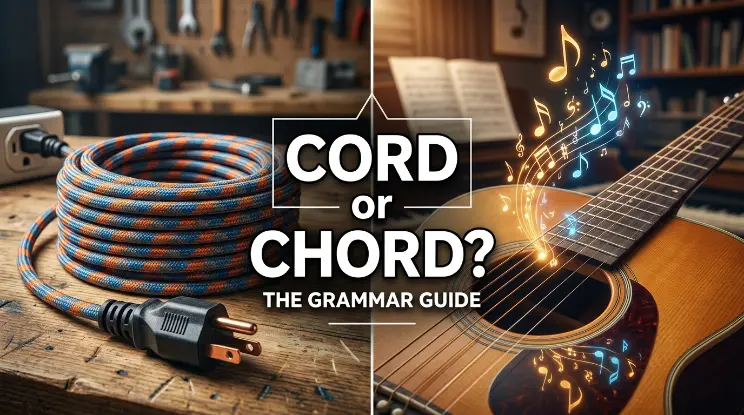
Have you ever typed “spinal chord” and had that little nagging feeling something wasn’t right? Or maybe you’ve seen someone write “guitar cord” and wondered if that was actually correct? You’re definitely not alone! Cord vs chord is one of those sneaky English word pairs that trips up even confident writers, native speakers included.
These two words sound exactly the same when spoken out loud (they’re homophones 👋), but they mean completely different things. One belongs in your toolbox and electronics drawer, and the other belongs in a music studio or a math classroom. Mixing them up isn’t just a small typo it can genuinely confuse your reader.
In this guide, we’ll break down everything you need to know about cord and chord, with examples, tables, memory tricks, and real-life scenarios so you’ll never second-guess yourself again. Let’s dive in! 🚀
Quick Answer: Cord vs Chord in a Nutshell
Cord is a noun referring to a length of rope, string, or a flexible electrical cable (like your phone charger). Chord refers to a group of musical notes played together, or a straight line connecting two points on a curve in geometry. Same sound, totally different meaning! 🎵🔌
What Does “Cord” Mean? 🧵

Cord is the more commonly used of the two words in everyday life. It’s a noun that generally means:
- A thin length of rope, string, or twisted fibers
- A flexible electrical or power cable
- A unit of measurement for firewood (yes, really!)
- An anatomical structure in the body (like the spinal cord or umbilical cord)
Examples of “Cord” in a Sentence
- Please plug the cord into the wall socket before turning on the lamp. 💡
- She tied the package together with a thick piece of cord.
- The electrician replaced the frayed extension cord.
- We ordered a cord of firewood for the winter.
- The baby’s umbilical cord was clamped shortly after birth.
- His injury damaged part of his spinal cord.
Key Things to Remember About “Cord”
- It’s almost always related to something physical and tangible you can touch, coil, or plug in a cord.
- Common compound words include: power cord, extension cord, spinal cord, umbilical cord, vocal cords (yes, even your voice box uses this spelling!).
- Think: Cord = Cable. Both start with C and both are things you can wrap up. 🔌
What Does “Chord” Mean? 🎶
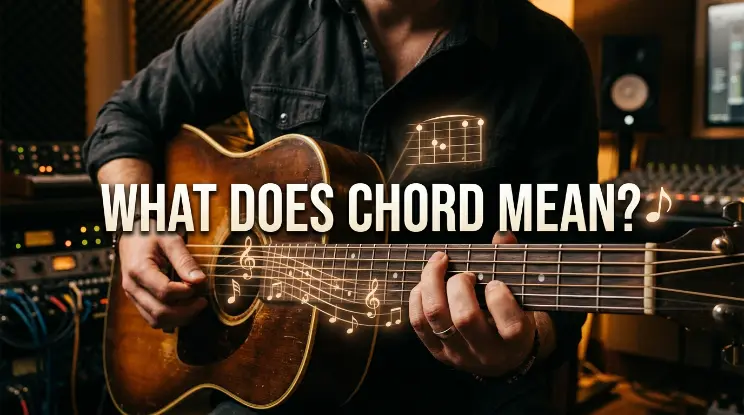
Chord is mostly used in two specific contexts:
- Music a combination of three or more musical notes played simultaneously
- Geometry a straight line segment connecting two points on a curve or circle
- Idiomatic expression “to strike a chord” (meaning to evoke an emotional response)
Examples of “Chord” in a Sentence
- The guitarist strummed a beautiful chord to open the song. 🎸
- Learning basic chords like C, G, and D is the first step for beginner guitar players.
- In geometry class, we learned how to calculate the length of a chord in a circle.
- Her speech really struck a chord with the audience.
- The pianist’s fingers moved effortlessly between chords.
- That song’s opening chord progression is iconic.
Key Things to Remember About “Chord”
- It’s almost always tied to music or math, not physical objects.
- Common phrases: major chord, minor chord, chord progression, strike a chord.
- Think: CHord = CHoir or CHorus. Both involve music and both start with “CH.” 🎵
Cord vs Chord: Comparison Table 📊
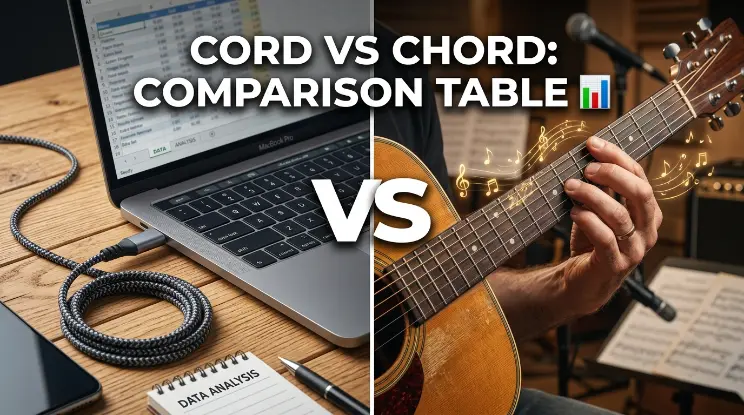
| Feature | Cord 🔌 | Chord 🎵 |
| Part of Speech | Noun | Noun |
| Meaning | Rope, string, or electrical cable | Group of musical notes or geometric line |
| Common Context | Electronics, physical objects, anatomy | Music, math |
| Example Sentence | “Plug in the charging cord.” | “Play a C chord on the piano.” |
| Related Words | Cordage, cordless, extension cord | Chordal, chord progression, polychord |
| Memory Trick | Cord = Cable (both start with C) | Chord = Choir (both start with CH, both musical) |
Common Mistakes People Make ❌
Even great writers slip up sometimes! Here are the most frequent errors:
- ❌ “The doctor examined her spinal chord.” → ✅ “The doctor examined her spinal cord.”
- ❌ “He learned three new cords on guitar.” → ✅ “He learned three new chords on guitar.”
- ❌ “The chord was too short to reach the outlet.” → ✅ “The cord was too short to reach the outlet.”
- ❌ “That story really struck a cord with me.” → ✅ “That story really struck a chord with me.”
Why Does This Mistake Happen So Often?
Because cord and chord are true homophones they’re pronounced identically (/kɔːrd/), so your ears can’t help you here. You have to rely on context and meaning, not sound. This is exactly the kind of mix-up that spell-checkers often miss too, since both are correctly spelled words just used in the wrong place!
Memory Trick / Mnemonic 🧠
Here’s a simple trick to lock this in forever:
“CH” is for CHoir and CHords. If it has no CH, it’s just a Cord you plug in.
Another fun one:
Cord has a C like Cable. Chord has an H like Harmony.
Real-Life Examples 🌍
Let’s look at how these words show up in everyday communication:
📧 In Emails
“Hi team, the projector cord is missing from the conference room. Can someone check the supply closet?”
📱 On Social Media
“Just learned my first three guitar chords and I’m SO proud of myself 🎸🙌 #beginnerguitar”
📰 In News Articles
“Doctors say the patient’s spinal cord injury will require months of physical therapy.”
🎓 In Academic Writing
“The chord of a circle is a line segment whose endpoints lie on the circle’s circumference.”
💬 In Everyday Speech
“Can you hand me that cord? I need to charge my phone.” “That last chord in the song gave me chills.”
British English vs American English: Any Difference? 🇬🇧🇺🇸
Good news this one’s simple! Both cord and chord are spelled and used the same way in British and American English. There’s no regional variation here, unlike words such as “colour/color” or “organise/organize.”
However, one small nuance worth noting:
- In British English, “cord” is also sometimes used informally to refer to corduroy fabric (e.g., “a pair of cords” meaning corduroy trousers). This usage is less common in American English.
| Region | Cord | Chord |
| 🇺🇸 American English | Rope/cable | Musical/geometric term |
| 🇬🇧 British English | Rope/cable + corduroy trousers slang | Musical/geometric term |
Bonus: Related Words to Know 🔍
To really master English usage around this word pair, here are some related terms:
- Cordless – without a cord (e.g., cordless phone, cordless drill)
- Cordage – ropes or cords collectively, especially on a ship
- Chordal – relating to or characterized by chords
- Chord progression – a sequence of chords played in a piece of music
- Vocal cords – note: despite being about sound, this is spelled with a “C,” not “CH”! This one confuses a LOT of people. 🎤
⚠️ Special Case: Vocal Cords
This is the ultimate curveball. Even though vocal cords are used to make sound and are often associated with music and singing, the correct spelling is vocal cords, not “vocal chords.” Why? Because they’re actual physical, cord-like structures (ligaments) in your throat not musical notes. Many dictionaries do note “vocal chords” as a common variant, but “vocal cords” remains the standard, correct spelling in professional and academic writing.
FAQs: People Also Ask 🙋
1. What is the difference between cord and chord?
Cord refers to a rope, string, or electrical cable. Chord refers to a set of musical notes played together or a line connecting two points on a curve.
2. Is it spinal cord or spinal chord?
It’s always spinal cord. This refers to the bundle of nerves in your spine, not a musical term.
3. Is it vocal cords or vocal chords?
The correct and standard spelling is vocal cords, even though it relates to sound and singing.
4. How do you remember the difference between cord and chord?
Use this mnemonic: “CH” is for CHoir and music. No “CH”? Then it’s just a Cord you plug in.
5. Do cord and chord sound the same?
Yes! They are homophones, meaning they’re pronounced identically but spelled and used differently.
6. Is “strike a chord” spelled with cord or chord?
It’s “strike a chord,” meaning something resonates emotionally with someone this idiom always uses the musical spelling.
7. Is cord used differently in British and American English?
Not significantly. Both dialects use “cord” for rope/cable, though British English sometimes uses “cords” informally for corduroy trousers.
8. What are guitar chords called cords or chords?
They’re called chords a group of notes played together, like a C chord or G chord.
Final Thoughts: Cord or Chord? 🎯
In conclusion, cord and chord are two different words with different meanings and uses. Cord usually refers to a thick string, rope, wire, or something that connects or ties things together. For example, you might use a cord to connect an electronic device. Chord, on the other hand, is commonly used in music to describe several notes played together.
It can also refer to a straight line connecting two points on a circle. Remembering this simple difference can help you avoid confusion in writing and speaking. Always choose cord for a rope, wire, or string, and chord for music or geometry.

Olivia Bennett is a passionate English grammar writer at GrammBoost.com who loves making grammar simple and easy to understand. She specializes in spelling, word differences, punctuation, and everyday English usage. Through clear explanations and practical examples, Olivia helps students, writers, and professionals write with greater confidence and accuracy.