
Choosing the right players for your fantasy football lineup can make a major difference during the NFL season. Week 6 is an important point because teams have started showing their strengths and weaknesses, player performances are becoming easier to evaluate, and fantasy managers have more information to consider. However, deciding who deserves a starting spot and who belongs on the bench is not always simple. A popular player might have a difficult matchup, while a less famous player could offer excellent scoring potential.
The question of start or sit Week 6 is especially important for fantasy football managers in the United States and the United Kingdom who follow the NFL and participate in fantasy leagues. American fans may be familiar with traditional fantasy football terminology, while British readers who follow American football may still be learning how player rankings, positions, and weekly matchups affect fantasy scores. Fortunately, the basic strategy remains the same in both countries.
You play in a standard league, a half-PPR league, or a full-PPR competition, understanding player matchups and weekly opportunities can help you make better decisions. Instead of selecting players only because of their names or previous performances, you should consider their recent production, playing time, opponent strength, injuries, and expected workload.
Quick Answer: How to Approach Start or Sit Week 6
The best approach to Week 6 start-or-sit decisions is to prioritise players with consistent playing time, reliable opportunities, favourable matchups, and strong roles in their offences. Do not automatically start a famous player if his recent performance, health, or matchup suggests a lower fantasy ceiling.
Before finalising your lineup, check the latest injury reports, depth charts, weather conditions, and weekly rankings. Also, remember that your league’s scoring system matters. A wide receiver who catches several short passes might be more valuable in a PPR league than in a standard scoring league.
Important: Start-or-sit recommendations depend on the specific NFL season, fixtures, injuries, and player availability. The following guide explains how to evaluate Week 6 decisions rather than presenting unverified player rankings or pretending that every matchup has the same conditions.
What Does Start or Sit Week 6 Mean?
The phrase start or sit Week 6 refers to the weekly fantasy football decision of choosing which players should be included in your active lineup and which should remain on your bench during Week 6 of the NFL season.
Fantasy football managers build teams using real NFL players. These players earn fantasy points based on their performances in actual games. Depending on the league rules, points may come from passing yards, rushing yards, receiving yards, touchdowns, receptions, interceptions, and other statistical achievements.
Every week, managers must decide which available players have the best opportunities to produce fantasy points.
For example, imagine that you have two wide receivers:
- Receiver A regularly receives eight targets per game.
- Receiver B has recently scored two touchdowns but receives only three targets per game.
At first glance, Receiver B might look more exciting because of his recent touchdowns. However, Receiver A could offer a more dependable opportunity because he receives the ball more frequently.
Therefore, the start-or-sit decision requires more than looking at the previous week’s fantasy points.
Why Week 6 Decisions Matter
Week 6 can be an important stage of the fantasy football season for several reasons.
1. You have more performance information.
By Week 6, you have several weeks of player statistics to examine. You can identify players who consistently receive targets, carry the football, or participate in important offensive plays.
2. Team roles become clearer.
Some players start the season with limited opportunities but gradually earn larger roles. Others lose playing time because teammates improve or return from injuries.
3. Injuries affect fantasy value.
NFL teams regularly update injury reports. A starting running back might become unavailable, creating an opportunity for another player to receive additional carries.
4. Matchups become important.
Some defences struggle against particular positions. For example, a defence might allow considerable production to opposing running backs but perform well against wide receivers.
5. Your fantasy standings may become more competitive.
By Week 6, some managers are trying to recover from slow starts, while others want to protect their winning records. Making sensible lineup decisions can help you stay competitive.
Understanding Fantasy Football Positions for Week 6
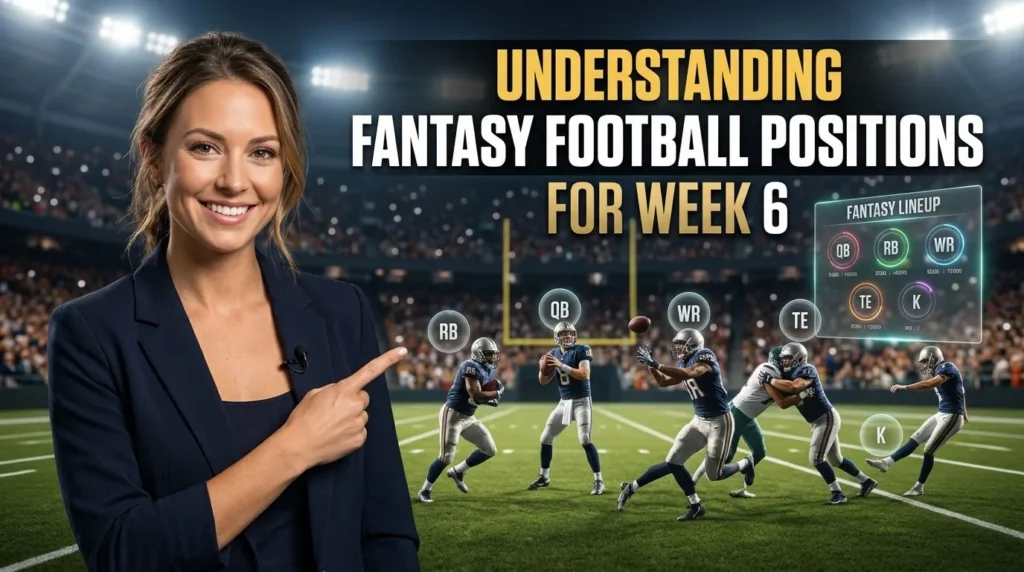
Before deciding whom to start or sit, you should understand the main fantasy football positions.
Each position has different responsibilities, scoring opportunities, and matchup considerations.
Quarterbacks (QB)
Quarterbacks are responsible for leading offensive plays and throwing passes. Some quarterbacks also earn valuable fantasy points through rushing yards and rushing touchdowns.
When evaluating quarterbacks for Week 6, consider:
- Passing yards per game.
- Passing touchdown production.
- Interception frequency.
- Rushing ability.
- Offensive line performance.
- Opposing pass defence.
- Expected game conditions.
A quarterback who regularly produces passing and rushing yards can offer a higher fantasy ceiling than a player who depends entirely on passing touchdowns.
For example, a mobile quarterback may remain valuable even when his passing performance is average because he can collect additional points through rushing.
However, avoid choosing a quarterback only because he had an excellent previous game. Check whether he faces a strong defence in Week 6.
Running Backs (RB)
Running backs are among the most important players in fantasy football because they can earn points through rushing attempts, receiving opportunities, and touchdowns.
When comparing running backs, examine:
- Total carries.
- Rushing yards.
- Targets and receptions.
- Red-zone opportunities.
- Goal-line carries.
- Competition from other running backs.
- Defensive strength against the run.
A running back who receives consistent opportunities is generally more dependable than someone who needs a long touchdown to produce meaningful fantasy points.
In addition, pay attention to backup running backs. If the starting player is injured or unavailable, the backup could receive more playing time.
Nevertheless, do not assume every backup automatically becomes a valuable fantasy starter. Some teams use multiple running backs, which can limit individual production.
Wide Receivers (WR)
Wide receivers catch passes from quarterbacks and can earn fantasy points through receptions, receiving yards, and touchdowns.
For Week 6, examine the following:
- Targets per game.
- Receptions.
- Receiving yards.
- Red-zone targets.
- Route participation.
- Quarterback performance.
- Opposing cornerbacks and pass defence.
A receiver who receives regular targets is often a safer option than someone who depends on occasional deep passes.
However, big-play receivers can be excellent choices when they face defences that struggle to prevent long completions.
Tight Ends (TE)
Tight ends are often difficult to evaluate because their fantasy production can vary significantly.
Some tight ends receive frequent targets and play important roles in their teams’ passing offences. Others spend more time blocking and receive fewer opportunities.
Before starting a tight end, consider:
- Target share.
- Receptions per game.
- Red-zone involvement.
- Route participation.
- Offensive play volume.
- Opponent performance against tight ends.
A tight end who receives regular short passes may be particularly useful in PPR leagues.
Kickers (K)
Kickers earn fantasy points by successfully making field goals and extra points.
Their opportunities depend on offensive efficiency, scoring situations, and coaching decisions.
Consider these factors:
- Expected offensive scoring.
- Field-goal attempts.
- Kicker accuracy.
- Weather conditions.
- Opponent defensive performance.
A kicker attached to a productive offence may receive more scoring opportunities. However, weather and game conditions can affect performance.
Defence and Special Teams (D/ST)
Fantasy defences earn points through defensive achievements such as sacks, interceptions, fumble recoveries, and defensive touchdowns.
When selecting a defence for Week 6, consider:
- Opposing quarterback performance.
- Offensive line injuries.
- Turnover history.
- Sack production.
- Defensive consistency.
- Home or away conditions.
A defence facing an inexperienced quarterback or an offensive line with several injuries may offer an attractive fantasy opportunity.
Meaning of the Correct Start-or-Sit Decision
A correct start-or-sit decision means choosing the player who offers the strongest combination of expected production, playing time, opportunity, and matchup value.
It does not necessarily mean selecting the player who scored the most points last week.
Fantasy football involves uncertainty. Even an excellent player can have a disappointing performance because of injuries, defensive pressure, game scripts, or unexpected coaching decisions.
Therefore, the goal is not to predict every result perfectly. Instead, you should make decisions based on the best available information.
What Makes a Player a Good Start?
A player becomes a stronger starting option when several positive factors support his fantasy value.
Consistent playing time: Players who remain on the field regularly have more opportunities to collect fantasy points.
Reliable workload: Running backs who receive consistent carries and receivers who regularly earn targets are often safer choices.
Favourable matchup: Players facing weaker opposing defences may have more opportunities to produce.
Healthy status: A player who is fully available is generally easier to trust than someone dealing with a significant injury.
Offensive involvement: Players who participate in red-zone plays and important scoring situations can offer additional upside.
What Makes a Player a Sit?
A player may deserve a bench spot when his situation creates too much uncertainty or reduces his expected production.
Common warning signs include:
- Reduced playing time.
- Limited offensive involvement.
- A difficult defensive matchup.
- An injury that affects performance.
- Competition from teammates.
- Poor recent opportunities.
- An unpredictable offensive role.
However, sitting a player does not mean he is permanently unsuitable for your fantasy team. His value could improve when his circumstances change.
Meaning of the Incorrect Form: Is There an Incorrect Start-or-Sit Choice?
The phrase “start or sit” does not have a grammatically incorrect form in this context. It is a standard fantasy football expression.
However, managers can make incorrect decisions when they misunderstand player value or ignore important information.
For example:
Incorrect decision: Starting a running back simply because he scored a touchdown last week.
Better decision: Checking his carries, receiving opportunities, injury status, and upcoming opponent before selecting him.
Another mistake involves benching a reliable wide receiver because he failed to score a touchdown in one game.
A player can still produce valuable fantasy points through receptions and receiving yards.
Confusing Player Popularity With Fantasy Value
Famous NFL players often attract attention from fantasy managers. Nevertheless, popularity does not guarantee weekly production.
A well-known player might have:
- A difficult defensive matchup.
- A reduced role.
- An injury concern.
- A struggling quarterback.
- Limited scoring opportunities.
Meanwhile, a less popular player might have a larger workload and a better matchup.
Therefore, always evaluate the player’s current situation instead of relying only on his reputation.
Start or Sit Week 6: Key Differences Between Starting and Benching Players
Understanding the difference between starting and sitting a player can make lineup decisions easier.
| Factor | Start | Sit |
| Playing time | Consistent | Limited or uncertain |
| Workload | Reliable | Reduced |
| Matchup | Favourable | Difficult |
| Injury status | Healthy or cleared | Injured or questionable |
| Fantasy potential | Strong opportunity | Lower expected opportunity |
| Team role | Important | Limited or unpredictable |
These differences are general guidelines rather than strict rules.
For example, a superstar might still deserve a starting position against a difficult defence because his talent and workload remain exceptional.
Similarly, a backup player might deserve consideration when an injury creates an unusually large opportunity.
Safe Starts vs High-Upside Starts
One of the most useful fantasy football strategies is understanding the difference between a safe start and a high-upside start.
A safe start is a player who has a relatively dependable role and can produce consistent points.
A high-upside start is a player who might score significantly more points but carries additional risk.
Consider two hypothetical wide receivers.
| Category | Receiver A | Receiver B |
| Targets | 8 per game | 4 per game |
| Recent production | Consistent | Unpredictable |
| Touchdown potential | Moderate | High |
| Fantasy role | Safer | Riskier |
| Best situation | Need reliable points | Need a potential breakout |
If your team is expected to win, Receiver A might be the better choice because consistency matters.
On the other hand, if your team is projected to lose and needs a big performance, Receiver B could be worth considering.
Common Start-or-Sit Mistakes Fantasy Managers Make
Even experienced fantasy football managers make lineup mistakes. Fortunately, many of these problems can be avoided with a consistent decision-making process.
1. Relying Too Much on Last Week’s Performance
A player might score 25 fantasy points one week and only five the next.
This does not automatically mean that his ability has changed.
Touchdowns can create large differences in weekly fantasy scores. Therefore, examine the player’s underlying opportunities rather than focusing only on the final number.
For example, a receiver who catches seven passes for 75 yards may have a valuable role even without scoring a touchdown.
2. Ignoring Injury Reports
Injuries can dramatically change fantasy football lineups.
A player listed as questionable might be active on game day but still receive fewer opportunities than usual.
Check official team updates and reliable injury reports before finalising your lineup.
Also, pay attention to players who return from injuries. Their availability does not always mean they are ready for a full workload.
3. Choosing Players Only Because of Their Names
A famous player is not automatically the best weekly option.
Consider two hypothetical running backs:
- Running Back A is a recognised star but faces a strong rushing defence.
- Running Back B is less popular but receives regular carries against a weaker opponent.
Running Back B might offer better value in that particular week.
However, do not overlook talent and long-term consistency when making close decisions.
4. Ignoring the League Scoring System
Different fantasy leagues award points differently.
In a standard league, receptions usually do not earn additional points.
In a half-PPR league, each reception generally earns half a point.
In a full-PPR league, each reception generally earns one point.
This difference can change player rankings.
For example, a receiver who catches eight passes for 60 yards could be more valuable in a full-PPR league than a receiver who catches three passes for 90 yards without scoring.
5. Forgetting About Bye Weeks
NFL teams do not all play during every regular-season week.
A player on a bye week will not participate in an NFL game, so he cannot earn normal game-related fantasy points that week.
Always check the NFL schedule before selecting your lineup.
A talented player on a bye week cannot help your team in that week’s matchup.
6. Making Last-Minute Decisions Without Research
Some managers change their lineups shortly before kickoff because they hear rumours or see social media discussions.
Although breaking news can be useful, not every online prediction is reliable.
Use trustworthy sources and confirm important updates before making changes.
7. Overreacting to One Bad Game
Fantasy football requires patience.
A starting running back might have a disappointing game against an excellent defence. That performance does not necessarily mean he has lost his role.
Look for patterns across several games before making major changes.
How to Evaluate Week 6 Matchups
Matchup analysis is one of the most important parts of fantasy football.
The same player can have different fantasy value depending on the opponent.
For example, a running back facing a defence that struggles against rushing attacks might have a better opportunity than when playing against a strong defensive front.
Examine Defensive Rankings
Check how many fantasy points opposing defences allow to each position.
Look at:
- Fantasy points allowed to quarterbacks.
- Rushing yards allowed to running backs.
- Receiving yards allowed to wide receivers.
- Targets and receptions allowed to tight ends.
- Sacks and turnovers generated against opposing offences.
However, defensive rankings should not be your only consideration.
A defence might allow many points to running backs because it has faced several elite players. Therefore, examine the wider context rather than relying on one statistic.
Consider Game Script
Game script describes how a game develops based on the score and teams’ strategies.
For example, if a team is expected to lead comfortably, it might run the football more frequently to control the clock.
This situation could benefit its running backs.
On the other hand, a team expected to trail might throw the ball more often. That could increase opportunities for its quarterback and wide receivers.
Game script is not guaranteed, but it can help you understand possible opportunities.
Check Weather Conditions
Weather can affect passing and kicking performance.
Heavy rain, strong winds, and poor playing conditions may make passing more difficult.
However, weather does not automatically mean that every quarterback or receiver should be benched.
Look at the severity of the conditions and how the teams normally play.
Running backs may benefit from a game that involves more rushing attempts, but defensive strength and offensive strategy still matter.
Correct Usage in Real-Life Fantasy Football Decisions
Here are several practical examples of how managers can apply start-or-sit strategies.
These examples use fictional players to demonstrate the decision-making process.
Example 1: Choosing Between Two Quarterbacks
Suppose your fantasy team has two quarterbacks.
- Quarterback A averages 19 fantasy points and faces a defence that regularly allows passing touchdowns.
- Quarterback B averages 16 fantasy points but faces a defence that creates frequent interceptions.
Quarterback A might be the stronger starting option because his matchup offers better scoring potential.
However, consider rushing ability, injury status, and recent offensive performance before making the final decision.
Example 2: Choosing Between Two Running Backs
Imagine that Running Back A receives 18 carries per game, while Running Back B receives only seven.
Running Back B recently scored two touchdowns, but Running Back A has produced consistent rushing yards.
If both players are healthy, Running Back A might offer a safer fantasy floor because his workload is more dependable.
Nevertheless, goal-line opportunities and receiving work could make Running Back B more attractive in certain scoring formats.
Example 3: Choosing Between Two Wide Receivers
Suppose Receiver A receives nine targets per game, while Receiver B receives five.
Receiver B has scored more touchdowns recently, but Receiver A regularly catches passes.
In a full-PPR league, Receiver A could be the better starting option because receptions contribute directly to fantasy points.
In a standard league, the difference might be smaller.
Example 4: Deciding Whether to Start a Backup Running Back
A starting running back becomes unavailable before Week 6.
His backup could receive additional carries and become an interesting fantasy option.
Before starting him, check:
- Whether he is expected to lead the backfield.
- Whether another running back will share carries.
- Whether he receives goal-line opportunities.
- Whether the team has a favourable matchup.
If the backup is expected to receive a meaningful workload, he could become a useful starter.
Example 5: Choosing a Tight End
You have one tight end who regularly receives short passes and another who mainly depends on touchdowns.
If you play in a PPR league, the player who receives consistent targets may provide a more reliable score.
However, if the touchdown-dependent player faces a defence that struggles against tight ends, he might offer greater upside.
Start or Sit Week 6: Strategy for Different Fantasy League Formats
Your fantasy football league format should influence your decisions.
Standard Scoring Leagues
Standard leagues generally do not award additional points for receptions.
As a result, touchdowns, rushing yards, and receiving yards become especially important.
When choosing players:
- Prioritise running backs with strong rushing workloads.
- Look for receivers with touchdown opportunities.
- Evaluate red-zone involvement.
- Consider players who can produce explosive plays.
A receiver who catches many short passes might be less valuable than a player who regularly gains significant yardage.
Half-PPR Leagues
Half-PPR leagues award half a fantasy point for each reception.
This format rewards players who regularly catch passes without giving receptions as much value as full-PPR leagues.
Running backs who participate in passing offences can become especially useful.
Similarly, wide receivers with consistent target volume can provide dependable production.
Full-PPR Leagues
Full-PPR leagues award one fantasy point per reception.
This scoring system makes receiving volume extremely important.
Players who catch frequent passes can produce valuable fantasy scores even without touchdowns.
For example, a running back who receives five targets and catches four passes might offer additional value compared with a player who only receives rushing opportunities.
Superflex Leagues
Superflex leagues allow managers to start a quarterback in an additional flexible position.
Because quarterbacks usually have significant fantasy scoring opportunities, their value can increase in this format.
When making Week 6 decisions, examine your quarterback depth and available alternatives.
Avoid leaving a productive starting quarterback on the bench without a strong reason.
How British and American Fantasy Football Audiences Use Start-or-Sit Advice
Fantasy football is particularly popular in the United States, but interest in the NFL continues to grow in the United Kingdom.
Both audiences use the same fundamental fantasy football principles. However, certain terminology and everyday spelling conventions can differ.
American English Usage
American fantasy football websites commonly use terms such as:
- Start or sit.
- Fantasy football lineup.
- Waiver wire.
- Matchup.
- Touchdown.
- Running back.
- Wide receiver.
American English also commonly uses spellings such as:
- Favorite.
- Analyze.
- Defense.
- Offense.
- Center.
For example:
“Analyze the Week 6 matchups before choosing your favorite players.”
British English Usage
British English follows many of the same football-related terms because the NFL has an established international audience.
However, general spelling differences include:
| American English | British English |
| Favorite | Favourite |
| Analyze | Analyse |
| Defense | Defence |
| Offense | Offence |
| Center | Centre |
| Color | Colour |
| Practice | Practise (verb) |
For example:
“Analyse the Week 6 matchups before choosing your favourite players.”
The fantasy football expression start or sit remains the same in both varieties of English.
One important distinction is that British readers may use the word “football” primarily for association football (soccer). In an NFL fantasy context, however, the term refers to American football.
Therefore, including clear references to the NFL, quarterbacks, running backs, and wide receivers helps avoid confusion.
Tips to Remember the Best Start-or-Sit Decisions
You do not need complicated statistical models to improve your fantasy football decisions.
A few simple habits can make your weekly lineup process much easier.
1. Follow the Workload
Remember this simple rule:
More opportunities generally create more chances to score fantasy points.
Look at carries, targets, receptions, and playing time.
A player who consistently participates in offensive plays may offer more dependable value than someone who only appears during occasional scoring situations.
2. Check Matchups Before Selecting Players
A strong player can face a difficult opponent.
Compare the defensive strengths and weaknesses of the teams involved.
However, never bench an elite player automatically because his opponent has a good defence.
3. Understand Your Scoring System
Before making a decision, check whether your league uses standard, half-PPR, full-PPR, or another format.
This step prevents you from comparing players incorrectly.
4. Keep an Eye on Injuries
Check official injury reports before kickoff.
Pay attention to:
- Out.
- Doubtful.
- Questionable.
- Active.
- Inactive.
Remember that an active player might still have limited playing time.
5. Use Reliable Rankings
Weekly fantasy rankings can help you compare players at the same position.
However, treat rankings as guidance rather than guaranteed predictions.
Compare multiple factors before making your decision.
6. Consider Your Opponent
Your fantasy matchup can influence your risk tolerance.
If you are projected to win, a consistent player may be a better choice.
If you are projected to lose, a high-upside player could give you a chance to produce a larger score.
7. Do Not Forget Your Bench
Your bench players are important because they provide alternatives when injuries, bye weeks, or unexpected changes affect your starting lineup.
Keep players who offer genuine upside and useful position coverage.
8. Make Decisions Based on Evidence
Avoid choosing players only because of social media predictions or personal favourites.
Use statistics, team updates, matchup information, and reliable analysis.
A Practical Week 6 Start-or-Sit Checklist
Before submitting your fantasy football lineup, work through this checklist.
- Confirm that every selected player has a scheduled game.
- Check the latest injury reports.
- Review expected playing time.
- Compare recent carries and targets.
- Examine the opposing defence.
- Check your league’s scoring format.
- Review bye weeks.
- Consider weather conditions where relevant.
- Compare your starting options with your bench.
- Check late injury and inactive-player announcements.
This process can help you avoid unnecessary lineup mistakes.
It is especially useful when you have several players with similar fantasy projections.
Frequently Asked Questions About Start or Sit Week 6
1. What does start or sit Week 6 mean in fantasy football?
Start or sit Week 6 refers to choosing which NFL players should be included in your active fantasy football lineup and which should remain on your bench. Managers consider player performance, injuries, matchups, workload, and scoring rules before making these decisions.
2. How do I decide which players to start in Week 6?
Start players who have reliable playing time, consistent opportunities, favourable matchups, and healthy status. Review recent statistics and expected workloads before finalising your lineup. You should also consider your league’s scoring format because it can change player values.
3. Should I start a player who performed poorly last week?
Not necessarily. One disappointing performance does not mean a player has lost his fantasy value. Examine his targets, carries, playing time, and upcoming matchup. If his role remains strong, he might still be a good starting option.
4. Is matchup more important than player talent?
Both factors matter. Elite players can produce valuable fantasy points even against strong defences. However, a favourable matchup can increase the potential value of an otherwise average player. Consider talent, workload, team role, and defensive strength together.
5. What is the difference between standard, half-PPR, and full-PPR leagues?
Standard leagues generally do not award additional points for receptions. Half-PPR leagues award half a point per reception, while full-PPR leagues award one point per reception. Consequently, players who catch frequent passes often have greater value in PPR formats.
6. Should I start a backup running back in Week 6?
A backup running back can become a valuable fantasy option when the starter is injured or unavailable. However, check the expected workload, competition from teammates, goal-line opportunities, and matchup before selecting him. Not every backup receives enough opportunities to become a dependable starter.
7. Do British and American fantasy football managers use different start-or-sit rules?
No. The basic fantasy football rules and start-or-sit strategies are the same for British and American managers. The main differences involve general English spelling and terminology preferences. Both audiences evaluate player performance, injuries, matchups, and scoring opportunities.
8. When should I finalise my Week 6 fantasy lineup?
You should finalise your lineup before the relevant players’ NFL games begin. Check injury reports, inactive lists, and late team announcements before kickoff. If your league allows late changes for players whose games have not started, monitor updates throughout the week.
9. Should I always start my highest-ranked player?
Not automatically. Rankings provide useful guidance, but they cannot account for every individual situation. Consider your scoring system, player health, workload, matchup, and available alternatives. A slightly lower-ranked player might offer better value under specific circumstances.
10. Can weather affect Week 6 fantasy football decisions?
Yes. Heavy rain, strong winds, and other challenging weather conditions can affect passing and kicking opportunities. However, weather should be considered alongside player ability, team strategy, and defensive matchups rather than used as the only reason to bench someone.
Conclusion
Making smart start or sit Week 6 decisions requires preparation, research, and an understanding of fantasy football scoring. Instead of choosing players only because of their popularity or previous performances, examine their workloads, recent statistics, injuries, offensive roles, and upcoming matchups. These factors provide a clearer picture of their potential fantasy value.
Remember that different league formats can change player rankings. Running backs and wide receivers who receive regular targets may become particularly valuable in PPR competitions, while touchdown opportunities and rushing production can carry greater importance in standard leagues. British and American fantasy managers can follow the same strategies, even when their general English spelling preferences differ.

James Carter is an English language enthusiast and content writer who loves making grammar simple and easy to understand. He creates clear, beginner-friendly guides on spelling, grammar rules, confusing words, and everyday English usage. His goal is to help readers write with confidence through practical examples, easy explanations, and accurate language tips.