
Understanding the ideal weight for a 5’5 female can help women learn more about healthy body weight, fitness, and overall well-being. However, there is no single number that is perfect for every woman because weight can vary depending on age, body composition, muscle mass, bone structure, and lifestyle. A woman who is 5 feet 5 inches tall may have a different healthy weight from someone with the same height because everyone’s body is unique.
For a general reference, adult women who are 5’5″ often fall within a healthy weight range of approximately 114 to 150 pounds (52 to 68 kilograms) according to standard adult Body Mass Index (BMI) categories. Still, BMI is only a screening tool and cannot measure body fat directly or determine someone’s overall health. Factors such as physical activity, nutrition, sleep, and individual health circumstances also matter when understanding weight.
You want to maintain your current weight, build muscle, or develop healthier habits, knowing the general weight range for your height can provide a useful starting point. In this guide, we will explore the average and healthy weight for a 5’5 female, explain the factors that influence body weight, and share practical ways to support long-term health.
Quick Answer: What Is the Healthy Weight for a 5’5 Female?
Finding the right weight for your height can be confusing, especially when different websites recommend different numbers. If you are a woman who is 5 feet 5 inches tall, you may wonder whether 120, 130, or 150 pounds is a healthy weight. The answer depends on more than your height and the number displayed on a weighing scale.
According to standard adult Body Mass Index (BMI) guidelines, the healthy weight range for a 5’5 female is approximately 111 to 150 pounds (50 to 68 kilograms). This range corresponds to a BMI between 18.5 and 24.9.
However, this is a general screening guideline rather than a perfect measurement for every woman. Muscle mass, bone structure, age, genetics, and overall health can influence what weight is appropriate for an individual.
For example, a woman weighing 125 pounds may have a naturally smaller frame, while another woman weighing 145 pounds may have more muscle mass or a broader body structure. Both deserve an assessment that considers their complete health rather than weight alone.
In this guide, you will learn about the ideal weight for a 5’5 woman, BMI calculations, weight comparisons, age-related changes, body composition, and practical ways to maintain a healthy lifestyle.
What Is the Ideal Weight for a 5’5 Female?
There is no single ideal weight for every woman who is 5 feet 5 inches tall. However, the standard adult BMI calculation provides a useful starting point for understanding a healthy weight range.
A woman who is 5’5 has a height of approximately 165 centimeters or 1.65 meters. Based on the standard adult BMI categories, her healthy weight range is approximately 111 to 150 pounds.
Here is a quick overview:
| Measurement | Details |
| Height | 5 feet 5 inches |
| Height in centimeters | 165 cm |
| Height in meters | 1.65 m |
| Lower healthy BMI boundary | Approximately 111 lbs |
| Upper healthy BMI boundary | Approximately 150 lbs |
| Healthy weight in kilograms | Approximately 50–68 kg |
| Standard healthy BMI | 18.5–24.9 |
This range does not mean every woman should aim for 130 pounds or another specific number.
Your natural body structure, muscle development, and medical history can influence your individual weight.
For instance, a woman who regularly performs strength training may weigh more than someone who does not exercise, even when both have similar body proportions.
Therefore, the ideal body weight for a 5’5 woman should be considered in relation to her overall physical condition, not simply her appearance.
BMI for 5’5 Female: How to Calculate Your Body Mass Index
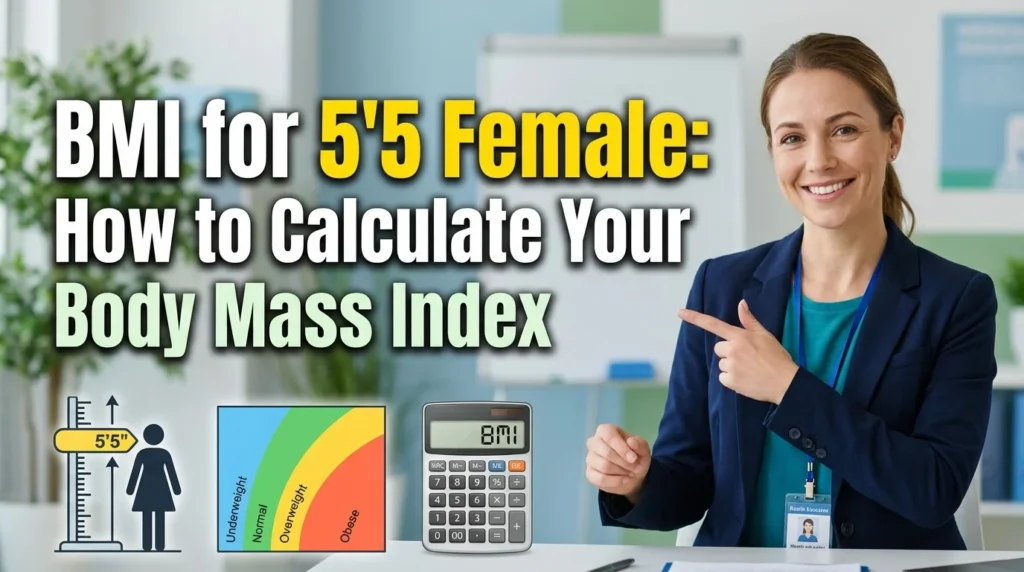
Body Mass Index, commonly known as BMI, is a measurement that compares body weight with height. Healthcare professionals use it as a screening tool to identify possible weight-related health concerns.
Calculating BMI for a 5’5 female is relatively simple.
The standard formula is:
BMI = Weight in kilograms ÷ Height in meters squared
For example, suppose a woman weighs 60 kilograms and has a height of 1.65 meters.
Her calculation would be:
60 ÷ (1.65 × 1.65) = 22.0
Her estimated BMI is 22.0, which falls within the standard healthy adult BMI category.
Standard Adult BMI Categories
The following categories are generally used for adults aged 20 and older.
| BMI Category | BMI Range |
| Underweight | Below 18.5 |
| Healthy weight | 18.5–24.9 |
| higher weight | 25.0–29.9 |
| Obesity | 30.0 or higher |
These categories help explain how height and weight relate to one another.
However, BMI does not directly measure body fat. It also cannot distinguish between muscle and fat.
For example, an athletic woman with considerable muscle mass may have a higher BMI without having excessive body fat.
Similarly, someone within the healthy BMI category may still have other health concerns.
For this reason, BMI should be considered alongside other measurements, such as waist circumference, blood pressure, blood sugar, and medical history.
Weight Chart for a 5’5 Female in Pounds and Kilograms
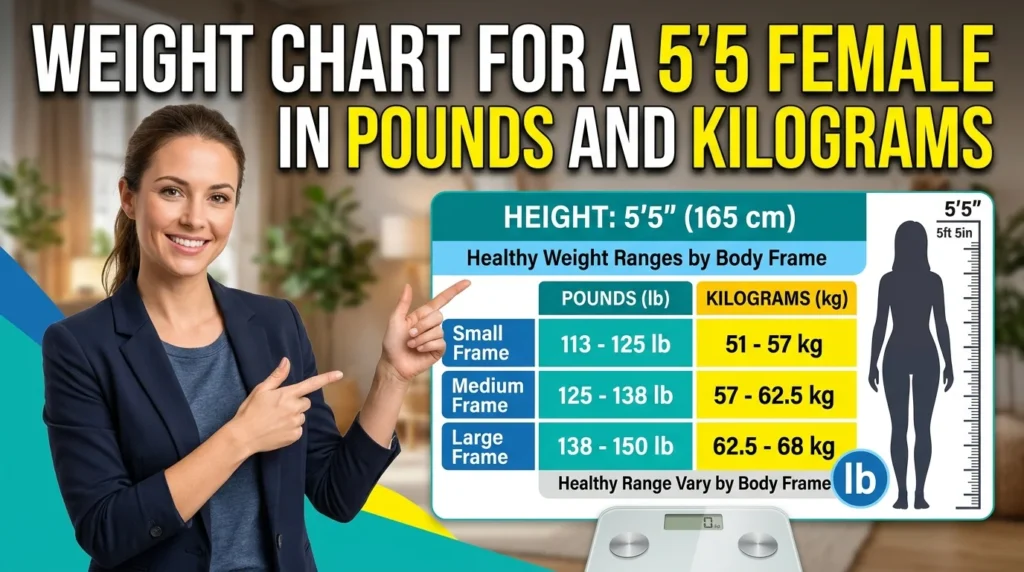
A weight chart makes it easier to understand different measurements without repeatedly converting pounds into kilograms.
The following chart includes common weights for women who are 5 feet 5 inches tall.
| Weight in Pounds | Weight in Kilograms | Approximate BMI |
| 105 lbs | 47.6 kg | 17.5 |
| 110 lbs | 49.9 kg | 18.3 |
| 115 lbs | 52.2 kg | 19.1 |
| 120 lbs | 54.4 kg | 20.0 |
| 125 lbs | 56.7 kg | 21.0 |
| 130 lbs | 59.0 kg | 21.6 |
| 135 lbs | 61.2 kg | 22.5 |
| 140 lbs | 63.5 kg | 23.3 |
| 145 lbs | 65.8 kg | 24.1 |
| 150 lbs | 68.0 kg | 24.9 |
| 155 lbs | 70.3 kg | 25.8 |
| 160 lbs | 72.6 kg | 26.6 |
| 165 lbs | 74.8 kg | 27.5 |
| 170 lbs | 77.1 kg | 28.3 |
The BMI values are approximate and use a height of 5 feet 5 inches.
This weight chart for a 5’5 female helps you understand how different measurements relate to standard BMI categories.
For example, someone weighing 135 pounds has an estimated BMI of 22.5, which falls within the healthy adult category.
A woman weighing 160 pounds has an estimated BMI of 26.6, which falls within the higher weight category. However, this measurement alone does not establish her overall health.
Is 120 Pounds a Good Weight for a 5’5 Female?
Yes. A weight of 120 pounds is generally within the healthy adult BMI range for a woman who is 5’5.
At this height and weight, the estimated BMI is approximately 20.0.
This falls comfortably within the standard healthy category of 18.5 to 24.9.
A woman weighing 120 pounds may naturally have a smaller body frame or a particular distribution of muscle and body fat.
However, another woman at the same height may maintain a higher weight because of differences in bone structure and muscle development.
There is no reason to assume that a woman weighing 120 pounds is automatically healthier than someone weighing 130 or 140 pounds.
If your weight is stable and you maintain healthy eating habits, regular physical activity, and good energy levels, those are useful signs to consider alongside your BMI.
Is 130 Pounds Healthy for a 5’5 Female?

Yes. A weight of 130 pounds is generally considered healthy for a 5’5 adult woman according to standard BMI guidelines.
The estimated BMI at this weight is approximately 21.6.
This measurement falls within the healthy adult BMI category.
Women weighing 130 pounds may have different body shapes because of their genetics, muscle development, and physical activity.
For example, someone who performs resistance training regularly may have more developed muscles than someone who does not exercise.
If you currently weigh 130 pounds, there may be no reason to pursue additional weight loss simply because you want to reach a lower number.
Your individual health, fitness, and nutritional needs are more important than following an arbitrary weight goal.
Is 140 Pounds Healthy for a 5’5 Female?
Yes. A weight of 140 pounds is within the standard healthy adult BMI range for a woman who is 5’5.
At this weight, the estimated BMI is approximately 23.3.
Some women naturally maintain a weight around 140 pounds because of their body structure, genetics, and lifestyle.
Others may weigh less because of differences in muscle mass, activity levels, and natural body composition.
It is important not to assume that every woman weighing 140 pounds needs to lose weight.
If you are physically active, eat a balanced diet, and have no concerning health indicators, your weight may be appropriate for your individual circumstances.
Is 150 Pounds Healthy for a 5’5 Female?
A weight of 150 pounds is approximately at the upper boundary of the standard healthy adult BMI range for a woman who is 5’5.
Using a height of exactly 5 feet 5 inches, the estimated BMI is approximately 24.9.
This places the measurement near the upper limit of the healthy adult category.
However, BMI is only one screening measurement. It cannot determine whether an individual woman has a healthy body composition or identify every possible health concern.
Other factors, including waist circumference, blood pressure, blood sugar, cholesterol, and medical history, provide additional information.
If you are close to the upper BMI boundary, there is no need to panic or make sudden changes to your diet. A healthcare professional can help you understand your individual health measurements.
How Does Age Affect the Weight of a 5’5 Female?
Age can influence muscle mass, metabolism, hormones, and body composition. However, standard adult BMI categories do not establish a separate healthy weight range for every adult age group.
A woman’s body naturally changes throughout different stages of life.
Weight in Your 20s
During your 20s, your body may experience changes in muscle development, lifestyle, and daily activity.
Some women maintain a relatively stable weight, while others experience gradual changes because of work schedules, eating habits, and exercise routines.
Developing healthy habits during this stage can support long-term well-being.
Focus on balanced meals, regular physical activity, sufficient sleep, and maintaining muscle strength.
Weight in Your 30s
Women in their 30s may experience changes related to pregnancy, parenting, work responsibilities, and physical activity.
Some may become less active because of busy schedules, while others develop more consistent fitness routines.
Pregnancy and the postpartum period can also influence body weight.
Rather than comparing your current weight with your measurements from your 20s, consider your present nutritional needs and overall health.
Weight in Your 40s
During your 40s, hormonal changes and shifts in muscle mass may influence body composition.
Some women notice changes in appetite, energy levels, and fat distribution.
Strength training can help maintain muscle, while regular movement supports cardiovascular health.
Eating enough protein, vegetables, fruits, and whole grains can also contribute to good nutrition.
Weight in Your 50s and Beyond
During and after menopause, changes in estrogen levels and muscle mass may influence body composition.
Some women notice that fat distribution changes, particularly around the abdominal area.
Maintaining muscle strength becomes especially important as women grow older.
Walking, resistance exercises, balanced meals, and sufficient sleep can help support mobility and physical function.
Older adults should also discuss unexplained weight changes with a healthcare professional rather than assuming they are simply a normal part of aging.
Does Body Frame Affect the Ideal Body Weight for a 5’5 Woman?
Yes. Natural body structure can influence how much a woman weighs at the same height.
Two women who are both 5’5 may have different shoulder widths, bone structures, muscle mass, and body proportions.
These differences can influence their appearance and weight.
Small Body Frame
Women with smaller frames may have narrower shoulders, smaller wrists, and a naturally lighter body structure.
They may maintain a lower weight without following a restrictive diet.
However, having a small frame does not mean someone should aim for the lowest possible weight.
Adequate nutrition and muscle strength remain important.
Medium Body Frame
Women with medium frames generally fall between smaller and broader body structures.
Their healthy weight can vary depending on muscle development, genetics, and lifestyle.
Two women with medium frames may still have different body compositions.
Large Body Frame
Women with broader shoulders or naturally larger bone structures may weigh more than women with smaller frames.
This does not automatically indicate excess body fat or poor health.
A larger frame can contribute to natural differences in weight, which is why a single ideal number cannot accurately describe every woman.
How Much Should a 5’5 Female Weigh to Look Slim?
Many women search for a specific weight because they want to look slim or achieve a particular body shape.
However, there is no universal number that makes every 5’5 woman look slim.
Appearance depends on several factors:
- Muscle mass and development.
- Body fat distribution.
- Genetics.
- Bone structure.
- Posture.
- Physical activity.
- Natural body proportions.
For example, two women who weigh 130 pounds may look different because one has more developed muscles while the other has a different distribution of body fat.
This is why focusing only on the scale can create unrealistic expectations.
If your goal is to improve your fitness or feel stronger, consider activities that support muscle strength and cardiovascular health.
Walking, swimming, cycling, dancing, and resistance training are all useful options.
A healthy appearance does not require reaching the lowest possible weight.
What Factors Influence the Average Weight for a 5’5 Female?
Body weight is influenced by several biological and lifestyle factors. Understanding these influences can help explain why women with the same height may have different weights.
1. Genetics
Genetics influence body structure, natural fat distribution, and muscle development.
Some women naturally have smaller frames, while others have broader body structures.
Family genetics may also influence how easily someone gains or loses weight.
Although genetics play an important role, everyday habits still influence overall health.
2. Muscle Mass
Muscle tissue contributes to body weight.
A woman who regularly performs resistance training may weigh more than someone who does not exercise, even if both have similar body measurements.
Muscle development also supports physical strength, balance, and everyday activities.
3. Diet and Nutrition
Eating habits influence body weight and overall health.
A balanced eating pattern can include vegetables, fruits, whole grains, protein sources, and healthy fats.
Consuming more energy than the body uses over time can contribute to weight gain. Similarly, consistently consuming too little energy can result in unhealthy weight loss.
The goal should be to provide your body with enough nutrients rather than follow extreme food restrictions.
4. Physical Activity
Daily movement influences energy use, cardiovascular health, and muscle strength.
Women who walk regularly, exercise, or participate in sports may have different body compositions from those who spend most of their day sitting.
Physical activity does not always require an intense workout. Walking, cycling, gardening, and household activities can also contribute to a more active lifestyle.
5. Hormonal Changes
Hormones influence appetite, metabolism, reproductive health, and body composition.
Menstrual cycles, pregnancy, menopause, and certain medical conditions can contribute to weight changes.
Some fluctuations are temporary, while others may require medical attention.
Sudden or unexplained changes should be discussed with a healthcare professional.
6. Sleep and Stress
Sleep and stress can influence appetite, eating patterns, energy levels, and physical activity.
Poor sleep may make it more difficult to maintain healthy routines.
Long-term stress can also affect food choices and everyday habits.
Maintaining a regular sleep schedule and finding enjoyable ways to manage stress can support overall well-being.
How Can a 5’5 Female Maintain a Healthy Weight?
Maintaining a healthy weight does not require complicated diets or hours of exercise every day.
Consistent, realistic habits are generally more sustainable than short-term plans.
Eat Balanced and Nutritious Meals
Try to include different food groups in your daily meals.
For example, a balanced eating pattern may include:
- Vegetables such as spinach, carrots, broccoli, and cucumbers.
- Fruits such as apples, oranges, bananas, and berries.
- Protein sources such as eggs, fish, chicken, beans, and yogurt.
- Whole grains such as oats, brown rice, and whole-wheat bread.
- Healthy fats from nuts, seeds, and olive oil.
You do not need to eliminate your favorite foods.
Instead, focus on eating a variety of nutritious foods and maintaining regular eating habits.
Include Protein in Your Diet
Protein supports muscle maintenance and tissue repair.
Good food sources include eggs, fish, chicken, beans, lentils, yogurt, and tofu.
Including protein in meals can also help make them satisfying.
Your individual protein needs depend on your age, activity level, and health circumstances.
Stay Physically Active
Adults are generally advised to aim for at least 150 minutes of moderate-intensity aerobic activity each week.
Muscle-strengthening activities are also recommended on two or more days each week.
You can divide this activity into manageable sessions.
For example, a 30-minute walk five days a week can help meet the weekly aerobic activity recommendation.
Choose activities you enjoy so that physical activity becomes a regular part of your lifestyle.
Drink Enough Water
Water supports digestion, circulation, temperature regulation, and many other body functions.
Your hydration needs depend on activity levels, climate, diet, and individual health.
Drinking water regularly throughout the day is a simple habit that supports general well-being.
Get Enough Sleep
Most adults need approximately seven to nine hours of sleep each night.
Good sleep supports physical recovery, concentration, mood, and general health.
Try to maintain a consistent bedtime and create a comfortable sleeping environment.
Avoid Extreme Dieting
Very restrictive diets can make it difficult to obtain essential nutrients.
They may also be difficult to maintain over time.
Instead of skipping meals or following unrealistic food rules, focus on balanced nutrition and sustainable lifestyle changes.
If weight management is a concern, a registered dietitian can help you develop an appropriate eating plan.
What Exercises Are Good for a 5’5 Female?
Exercise recommendations should depend on personal fitness, health, and physical ability rather than height alone.
A 5’5 woman can benefit from different types of physical activity.
Walking
Walking is an accessible way to increase daily movement.
It supports cardiovascular health and can help establish a consistent exercise routine.
Beginners can start with short walks and gradually increase their duration.
Strength Training
Strength training helps develop and maintain muscle.
Examples include:
- Squats.
- Lunges.
- Push-ups.
- Resistance-band exercises.
- Dumbbell exercises.
- Bodyweight workouts.
Beginners should start with manageable resistance and focus on proper technique.
Cycling
Cycling provides cardiovascular exercise and can be adjusted to different fitness levels.
You can cycle outdoors or use a stationary bike at home.
It is also an enjoyable way to include more movement in your daily routine.
Swimming
Swimming works several muscle groups and provides cardiovascular exercise.
The water supports body weight during movement, making swimming a lower-impact option for many people.
Yoga and Stretching
Yoga and stretching can improve flexibility, balance, and body awareness.
They may also help some people relax and manage everyday stress.
Combining aerobic exercise, strength training, and flexibility activities creates a balanced fitness routine.
When Should a 5’5 Female Be Concerned About Weight?
Weight fluctuations are normal. Hydration, digestion, food intake, menstrual cycles, and other everyday factors can influence the number on the scale.
However, certain changes deserve attention.
Consider speaking with a healthcare professional if you experience:
- Sudden or unexplained weight loss.
- Rapid or unexplained weight gain.
- Persistent fatigue or weakness.
- Long-lasting changes in appetite.
- Difficulty maintaining adequate nutrition.
- Unusual physical symptoms alongside weight changes.
- Concerns about restrictive eating or frequent overeating.
A medical professional can evaluate possible causes and recommend appropriate support.
It is also important to understand that BMI is not suitable for assessing every person in exactly the same way. pregnant people require different weight assessment approaches, while children and teenagers need age- and sex-specific growth charts.
Common Myths About Weight for a 5’5 Female
Many misconceptions about healthy weight can create unnecessary pressure. Understanding the facts helps women make informed decisions.
Myth 1: Every 5’5 Woman Should Weigh 125 Pounds
This is incorrect.
A woman who is 5’5 can have a healthy weight across a broader range. Body composition, genetics, and individual health all influence natural weight.
Myth 2: A Lower Weight Always Means Better Health
A lower number on the scale does not automatically indicate better health.
Being underweight can also create health concerns. Adequate nutrition, muscle strength, and physical function are important parts of overall well-being.
Myth 3: BMI Measures Body Fat Directly
BMI uses height and weight to calculate a numerical value.
It does not directly measure body fat or distinguish between fat and muscle.
Therefore, it should be treated as a screening tool rather than a complete health assessment.
Myth 4: Exercise Is Only for Losing Weight
Exercise offers many benefits beyond weight management.
It supports cardiovascular health, muscle strength, mobility, balance, and mood.
You can benefit from regular movement even when your weight remains unchanged.
Myth 5: Weight Should Stay Exactly the Same Every Day
Daily weight fluctuations are normal.
Hydration, food intake, digestion, hormones, and other factors can change the number on the scale.
A single measurement does not provide a complete picture of your health.
Frequently Asked Questions
1. What Is the Healthy Weight for a 5’5 Female?
The standard healthy adult BMI range corresponds to approximately 111–150 pounds (50–68 kg) for a woman who is 5’5. However, individual body composition, genetics, and health circumstances can influence the most appropriate weight.
2. Is 125 Pounds a Good Weight for a 5’5 Woman?
Yes. A weight of 125 pounds corresponds to an estimated BMI of approximately 20.8, which falls within the standard healthy adult BMI category.
3. Is 135 Pounds higher weight for a 5’5 Female?
No. At 135 pounds, a 5’5 adult woman has an estimated BMI of approximately 22.5. This is within the standard healthy BMI category.
4. Is 145 Pounds Healthy for a 5’5 Female?
Yes. A weight of 145 pounds corresponds to an estimated BMI of approximately 24.1, which falls within the standard healthy adult BMI category.
5. How Much Should a 5’5 Female Weigh in Kilograms?
The standard healthy adult BMI range for a woman who is 5’5 corresponds to approximately 50–68 kilograms. This is a general guideline rather than a personal medical recommendation.
6. Can a 5’5 Female Weigh 160 Pounds and Still Be Healthy?
Yes, it is possible. A weight of 160 pounds gives an estimated BMI of approximately 26.6, which falls within the standard higher weight category. However, BMI alone cannot determine someone’s overall health. Muscle mass, waist circumference, and other medical indicators should also be considered.
7. Does Age Change the Ideal Weight for a 5’5 Woman?
Age can influence muscle mass, hormones, and body composition. Older women may benefit from additional attention to muscle strength, nutrition, and mobility. Standard adult BMI categories, however, are not divided into separate weight ranges for every age.
8. Should a 5’5 Female Try to Lose Weight?
Not necessarily. Whether weight loss is appropriate depends on individual health, body composition, and medical circumstances. A woman already within a healthy range may benefit more from maintaining her weight and improving fitness.
9. What Is the Best Exercise for a 5’5 Female?
There is no single best exercise for every woman. Walking, cycling, swimming, strength training, and yoga support different aspects of physical health. Combining aerobic activity with muscle-strengthening exercises provides a balanced approach.
10. Is 5’5 Considered an Average Height for Women?
Whether 5’5 is considered average depends on the country and population being measured. Average female height differs around the world because of genetics, nutrition, and other population characteristics.
Conclusion
The healthy weight for a 5’5 female generally falls between 111 and 150 pounds (50–68 kg) according to standard adult BMI guidelines. However, this range is a general reference rather than a strict rule for every woman. Whether you weigh 120, 130, or 145 pounds, your overall health depends on more than the number on the scale. Genetics, muscle mass, body frame, age, nutrition, and physical activity all influence individual weight.
Focus on balanced meals, regular exercise, sufficient sleep, and sustainable habits instead of chasing an unrealistic body goal. If you have concerns about weight changes or your personal health, consult a qualified healthcare professional for an individual assessment.

James Carter is an English language enthusiast and content writer who loves making grammar simple and easy to understand. He creates clear, beginner-friendly guides on spelling, grammar rules, confusing words, and everyday English usage. His goal is to help readers write with confidence through practical examples, easy explanations, and accurate language tips.