
Language differences often create confusion when two words have nearly identical meanings but slightly different regional preferences. “Enquire” and “inquire” are perfect examples because both are correct English words used when someone wants to ask a question, obtain information, or investigate a matter. However, their preferred usage can vary between British and American English.
In British English, enquire is commonly used for general questions, such as asking about prices, services, or appointments, while inquire may be preferred for more formal investigations. In American English, inquire is generally the standard spelling for both meanings. For instance, you might write, “I would like to enquire about the available courses” in British English, but an American writer would typically use “inquire” in the same sentence. Although this distinction can be helpful, modern British usage sometimes treats the two forms interchangeably.
Understanding these regional preferences can make your writing clearer and more consistent, especially in professional communication, academic assignments, and everyday conversations. This guide explores the meanings, spelling differences, grammatical rules, and practical examples of enquire and inquire to help you use both words correctly
Quick Answer: Enquire or Inquire?
Both enquire and inquire are correct English spellings. The main difference comes from regional preferences and traditional usage.
- Enquire: Traditionally preferred in British English when asking a general question or requesting information.
- Inquire: Commonly used in American English for asking questions and investigating something. It is also used in British English, particularly for formal investigations.
Easy rule: If you are writing in American English, choose inquire. If you are writing in British English, you can use enquire for general questions and inquire for formal investigations.
What Does Enquire Mean?
Enquire is a verb that means to ask someone for information, details, or an explanation about something. It is traditionally associated with British English, where writers often use it in everyday conversations and professional communication.
When you enquire about something, you want to learn more about it. You might ask about a product, request information about a job, check the availability of a service, or ask someone for directions.
For example, imagine that you want to book a hotel room. You might contact the hotel receptionist and ask about available rooms, prices, and facilities. In British English, you can say that you are enquiring about room availability.
The word works naturally in both formal and informal situations. However, it appears particularly often in British business correspondence.
Simple Definition of Enquire
Enquire means:
- To ask a question.
- To request information.
- To seek clarification.
- To find out more about something.
- To ask someone for details.
Examples:
- I would like to enquire about your available courses.
- She called the office to enquire about her application.
- We contacted the company to enquire about its services.
- He stopped at the reception desk to enquire about the meeting.
- They emailed the school to enquire about admission requirements.
In these sentences, each person wants to receive information. Nobody is necessarily investigating a serious issue or conducting an official examination.
Enquire in British English
British English traditionally distinguishes between enquire and inquire according to their meanings.
British writers commonly use enquire when asking ordinary questions or requesting information.
For example:
- I am writing to enquire about the position advertised on your website.
- Could you please enquire about the delivery date?
- She visited the university to enquire about admission.
- We would like to enquire about your membership options.
- He called the restaurant to enquire about its opening hours.
These examples sound natural in British English because they describe everyday requests for information.
However, British English also accepts inquire in general contexts. The distinction is a traditional preference rather than an absolute grammatical rule.
Enquire in Professional Communication
The word enquire frequently appears in professional British correspondence.
For example, you might use it when:
- Asking about job vacancies.
- Requesting information about a service.
- Contacting a university.
- Asking about product prices.
- Checking appointment availability.
- Requesting details about business opportunities.
Here are some professional examples:
Example 1: Job application
“I am writing to enquire whether your company currently has any vacancies.”
Example 2: University admission
“I would like to enquire about the admission process for international students.”
Example 3: Customer service
“I am contacting you to enquire about the status of my recent order.”
Example 4: Business partnership
“Our team would like to enquire about potential partnership opportunities.”
In each example, the writer politely requests information. Therefore, enquire is an appropriate choice in traditional British usage.
Word Forms of Enquire
Understanding different forms of a verb helps you use it correctly in sentences.
| Word form | Example |
|---|---|
| Enquire | I want to enquire about the course. |
| Enquires | She enquires about the service. |
| Enquired | He enquired about the price. |
| Enquiring | They are enquiring about admission. |
| Enquiry | I made an enquiry yesterday. |
Remember that enquiry is the noun form traditionally associated with British English.
For example:
- I sent an enquiry to the customer service department.
- The company received several enquiries.
- She made an enquiry about the scholarship.
These forms are particularly useful when writing emails, reports, and formal documents.
What Does Inquire Mean?

Inquire is a verb that means to ask questions, request information, or investigate a particular subject or situation.
It is the preferred spelling in American English. American writers generally use inquire regardless of whether they are asking a simple question or conducting a formal investigation.
British English also uses inquire, particularly when referring to official investigations, examinations, or formal attempts to discover the truth.
For example, a journalist might inquire about a public announcement, while an official committee might inquire into the reasons behind a serious incident.
The word can therefore describe both ordinary information-seeking and more detailed investigations.
Simple Definition of Inquire
Inquire means:
- To ask for information.
- To investigate a situation.
- To seek an explanation.
- To examine something through questions.
- To discover facts about a particular subject.
Examples:
- I called the bank to inquire about my account.
- The police will inquire into the incident.
- She wants to inquire about the new position.
- The manager decided to inquire about the complaint.
- We contacted the university to inquire about the results.
Notice that these sentences describe different situations. Some involve simple questions, while others involve more formal investigations.
Inquire in American English
American English generally uses inquire instead of enquire.
This preference applies to both casual and professional writing.
For example:
- I would like to inquire about your services.
- She called the school to inquire about enrollment.
- He wants to inquire about the application process.
- We contacted the company to inquire about the price.
- They decided to inquire about the available opportunities.
In American English, these sentences use the standard spelling.
If you are writing for an American audience, choosing inquire consistently is usually the safest option.
Inquire for Formal Investigations
One important traditional use of inquire involves investigating something carefully.
Unlike a simple request for information, an investigation usually involves examining facts, asking several questions, or trying to understand what happened.
For example:
Example 1: Police investigation
“The police will inquire into the circumstances surrounding the accident.”
Example 2: Official examination
“The committee decided to inquire into the financial irregularities.”
Example 3: Workplace investigation
“The company will inquire into the employee’s complaint.”
Example 4: Public investigation
“The government appointed a panel to inquire into the matter.”
In these examples, the word communicates a more formal process of discovering information.
Word Forms of Inquire
Like enquire, the verb inquire has several grammatical forms.
| Word form | Example |
|---|---|
| Inquire | I want to inquire about the service. |
| Inquires | She inquires about the results. |
| Inquired | He inquired about the position. |
| Inquiring | They are inquiring about the details. |
| Inquiry | I submitted an inquiry yesterday. |
The noun form is inquiry.
American English commonly uses this spelling in sentences such as:
- I submitted an inquiry to the company.
- The school received several inquiries.
- The committee launched an inquiry.
- She made an inquiry about the course.
Enquire vs Inquire: Key Differences
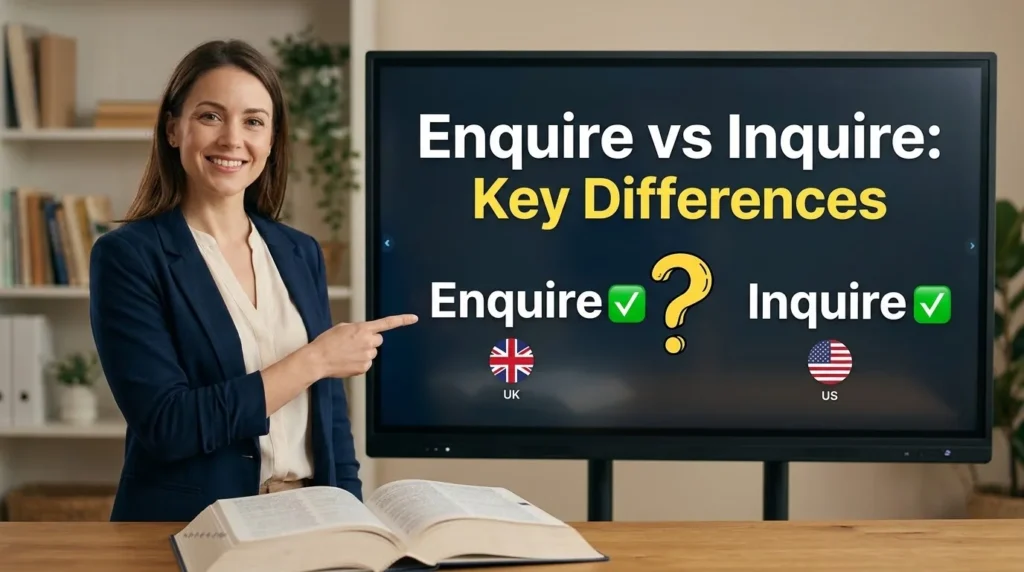
The main difference between enquire and inquire is not their pronunciation or basic meaning. Both words describe asking for information.
Instead, their differences relate primarily to regional spelling preferences and traditional distinctions in meaning.
British and American English do not always follow the same spelling conventions. This is one example of how the same language can develop different writing preferences across countries.
Comparison Table
| Feature | Enquire | Inquire |
|---|---|---|
| Part of speech | Verb | Verb |
| Basic meaning | Ask for information | Ask or investigate |
| British English | Common for general questions | Common for formal investigations |
| American English | Less common | Standard preference |
| Formal writing | Accepted | Accepted |
| Pronunciation | Same in most accents | Same in most accents |
| Noun form | Enquiry | Inquiry |
Both spellings are grammatically correct. However, your choice should depend on the audience and type of writing.
Difference in British English
British English traditionally makes a distinction between the two words.
- Enquire: Used for ordinary questions and requests for information.
- Inquire: Used for formal investigations and official examinations.
Consider these examples:
Using enquire:
“I would like to enquire about the available courses.”
This sentence describes someone requesting information.
Using inquire:
“The government decided to inquire into the financial allegations.”
This sentence describes a formal investigation.
The distinction can help British writers communicate the nature of an action more clearly.
Nevertheless, modern British English does not always maintain this separation. Many writers use inquire for general questions too.
Difference in American English
American English generally prefers inquire in almost every context.
For example:
- I want to inquire about the job.
- She called to inquire about the appointment.
- We inquired about the delivery.
- The authorities will inquire into the matter.
American writers usually do not need to switch between the two spellings based on the type of question.
Therefore, if your article targets American readers, inquire is the more suitable choice.
Difference Between Enquiry and Inquiry
The same regional distinction applies to the noun forms.
| British English | American English |
|---|---|
| Enquiry | Inquiry |
| Enquiries | Inquiries |
In traditional British usage:
- An enquiry is a request for information.
- An inquiry is a formal investigation.
In American English, inquiry is commonly used for both meanings.
British example:
“I sent an enquiry about the university’s admission requirements.”
American example:
“I sent an inquiry about the university’s admission requirements.”
Both sentences communicate the same message.
Which Word Is More Formal?
Neither word is automatically more formal than the other.
Both can appear in professional emails, business letters, academic documents, and official communication.
The level of formality depends more on the sentence structure and situation than on the spelling.
For example:
- “I want to enquire about your services.”
- “I would like to enquire about your services.”
The second sentence sounds more polite and professional because of its wording.
Similarly:
- “I want to inquire about the position.”
- “I would appreciate further information regarding the position.”
The second version sounds more formal, even though it avoids both words.
Therefore, do not assume that inquire is always more professional or that enquire is only suitable for casual questions.
Is Enquire Incorrect?
No. Enquire is not an incorrect spelling.
It is a recognized English word, particularly associated with British English.
Some American readers may find it unusual because American English strongly prefers inquire. However, that does not make enquire grammatically wrong.
For example:
“I would like to enquire about the available membership plans.”
This is a correct sentence in British English.
However, if you are preparing content for an American publication, you should generally write:
“I would like to inquire about the available membership plans.”
The important point is consistency. Choose the spelling that matches your target audience instead of switching between forms without a reason.
Why Do People Think Enquire Is Wrong?
Several reasons contribute to this confusion.
1. American spelling preferences
Many English-learning resources focus on American English. Consequently, learners become more familiar with inquire.
2. Online spelling checkers
Some spelling tools use American English as their default language. They may flag enquire even though it is accepted in British English.
3. Different regional writing standards
British and American English use different spellings for many words.
Examples include:
- Colour and color.
- Favourite and favorite.
- Centre and center.
- Organise and organize.
- Enquiry and inquiry.
4. Limited knowledge of British usage
Some learners assume that every word has only one correct spelling. However, English includes several accepted regional variations.
Understanding these differences makes it easier to recognize correct spelling across different English-speaking countries.
Common Mistakes People Make
Although enquire and inquire are both correct, writers sometimes use them incorrectly or inconsistently.
Understanding these common mistakes can help you improve your writing.
Mistake 1: Thinking Enquire Is Always Wrong
Some learners believe that enquire is a spelling mistake because they regularly see inquire in American publications.
Incorrect assumption:
“Enquire is not a real English word.”
Correct understanding:
“Enquire is an accepted British English spelling.”
For example:
- Correct: I would like to enquire about the course.
- Also correct: I would like to inquire about the course.
The first is traditionally British, while the second is common in both British and American English.
Mistake 2: Using Both Spellings Randomly
Consistency is important in professional writing.
Imagine that you are writing a British English article and use enquire in the introduction but inquire throughout the remaining sections for general questions.
Although both forms are accepted, switching randomly can make the article look inconsistent.
A better approach is to choose a spelling convention and follow it throughout the document.
For British English, use enquire for general questions if you want to maintain the traditional distinction.
For American English, use inquire consistently.
Mistake 3: Confusing the Verb and Noun Forms
The verb and noun forms have different endings.
- Enquire is a verb.
- Enquiry is a noun.
- Inquire is a verb.
- Inquiry is a noun.
Incorrect: I sent an enquire yesterday.
Correct: I sent an enquiry yesterday.
Incorrect: She wants to make an inquire.
Correct: She wants to make an inquiry.
Remember that you can enquire or inquire, but you make an enquiry or an inquiry.
Mistake 4: Using the Wrong Regional Spelling
Regional consistency matters when writing for a specific audience.
For example, if you are preparing an American business email, using enquire may look unfamiliar to some readers.
Similarly, if you are following traditional British conventions, enquiry may be more suitable for a general request for information.
Choose the spelling according to your audience.
Mistake 5: Assuming Inquire Always Means Investigate
Although inquire can describe a formal investigation, it does not always have that meaning.
For example:
“I called to inquire about the delivery.”
This sentence describes a simple request for information.
You do not need to investigate anything.
Therefore, remember that inquire can be used for both ordinary questions and formal investigations.
Mistake 6: Forgetting the Correct Verb Tense
Both words follow regular verb patterns.
For example:
- Present: I enquire about the service.
- Past: I enquired about the service.
- Continuous: I am enquiring about the service.
The same pattern applies to inquire:
- Present: I inquire about the service.
- Past: I inquired about the service.
- Continuous: I am inquiring about the service.
Avoid creating incorrect forms by changing the spelling unnecessarily.
Correct Usage in Sentences
Examples make it easier to understand how these words work in everyday communication.
Below are practical sentences for British and American English readers.
Enquire Examples in British English
- I would like to enquire about the available job vacancies.
- She visited the office to enquire about her application.
- We contacted the hotel to enquire about room prices.
- He called the university to enquire about admission.
- They want to enquire about the new membership programme.
- Please enquire at the reception desk for further information.
- I am writing to enquire about your delivery services.
- My friend emailed the company to enquire about its products.
- She stopped at the information desk to enquire about directions.
- We would like to enquire whether the tickets are still available.
These examples demonstrate how enquire works naturally in British English.
Inquire Examples in American English
- I would like to inquire about the available job openings.
- She contacted the office to inquire about her application.
- We called the hotel to inquire about room prices.
- He emailed the university to inquire about admission.
- They want to inquire about the new membership program.
- Please inquire at the front desk for more information.
- I am writing to inquire about your delivery services.
- My friend contacted the company to inquire about its products.
- She visited the information desk to inquire about directions.
- We would like to inquire whether the tickets are still available.
Notice that the meaning remains the same. The main difference is the preferred spelling.
Also notice other regional differences, such as programme/program and programme/program conventions in related contexts.
Inquire Examples for Formal Investigations
The following sentences show how inquire can describe a formal investigation.
- The committee will inquire into the allegations.
- The authorities decided to inquire into the financial records.
- The government appointed an independent panel to inquire into the incident.
- The manager will inquire about the reasons behind the delay.
- The organisation launched an inquiry into the complaint.
- Investigators are inquiring into the cause of the accident.
- The board agreed to inquire into the employee’s concerns.
- Officials will inquire whether the regulations were followed.
These examples are particularly relevant to traditional British usage, although American English also uses inquire in these situations.
Enquire and Inquire in Email Writing
Emails are among the most common places where people use these words.
Here are some practical examples.
British English email:
Subject: Enquiry About Course Availability
“Dear Admissions Team,
I am writing to enquire about the availability of your upcoming courses. Could you please provide information about the application requirements and fees?
Thank you for your assistance.”
American English email:
Subject: Inquiry About Course Availability
“Dear Admissions Team,
I am writing to inquire about the availability of your upcoming courses. Could you please provide information about the application requirements and fees?
Thank you for your assistance.”
Both versions are correct for their respective regional conventions.
Enquire and Inquire in Everyday Conversations
These words are not limited to formal communication.
You can also use them when talking about ordinary situations.
Examples:
- I want to enquire about the bus schedule.
- She went to the shop to inquire about the new phone.
- Can you enquire whether the restaurant has available tables?
- He called to inquire about the weather conditions.
- We stopped to enquire about the nearest petrol station.
However, in casual conversation, most people simply say ask.
For example:
“Can I ask about the price?”
This sentence sounds natural and is often shorter than saying:
“Can I enquire about the price?”
Both expressions are understandable, but ask is more direct.
Enquire or Inquire in Different Situations
Choosing the right spelling becomes easier when you understand the context.
Let’s look at some common situations.
1. Business Communication
Business communication often involves requesting information about products, services, prices, and opportunities.
In British English:
“I would like to enquire about your business services.”
In American English:
“I would like to inquire about your business services.”
Both sentences are appropriate.
2. Education and Admissions
Students frequently contact schools, colleges, and universities to ask about admissions.
British English:
“She contacted the university to enquire about the scholarship.”
American English:
“She contacted the university to inquire about the scholarship.”
The spelling changes according to the regional preference, not the meaning.
3. Customer Service
Customers often ask companies about orders, refunds, deliveries, and product details.
British English:
“I am writing to enquire about my recent order.”
American English:
“I am writing to inquire about my recent order.”
Both versions sound professional and polite.
4. Official Investigations
When someone examines an issue or tries to discover the facts, inquire is traditionally preferred in British English and is also the standard American spelling.
Example:
“The authorities decided to inquire into the circumstances of the incident.”
Here, inquire communicates an investigative meaning.
5. Academic Writing
Academic writers may use either spelling depending on their regional style guide.
For example:
- British academic writing: The researcher made an enquiry about the available data.
- American academic writing: The researcher made an inquiry about the available data.
However, formal investigations and research examinations may use inquiry in both varieties.
Always follow the spelling guidelines provided by your university, journal, or publisher.
Enquire vs Inquire: Tips to Remember the Correct Usage
Remembering the difference does not need to be difficult.
You can use these simple tips to choose the correct spelling.
Tip 1: Remember Your Audience
The easiest way to choose is to identify who will read your writing.
- British audience: Enquire is a traditional choice for general questions.
- American audience: Inquire is the preferred choice.
If your readers come from different countries, inquire is widely understood and accepted.
Tip 2: Remember the Traditional British Difference
If you write in British English, remember this simple distinction:
- Enquire = Ask for information.
- Inquire = Investigate something.
For example:
“I want to enquire about the price.”
“The committee will inquire into the complaint.”
This distinction is useful, although modern British usage sometimes overlaps.
Tip 3: Learn the Noun Forms Together
Do not learn the verbs without learning their corresponding nouns.
Remember these pairs:
- Enquire → Enquiry.
- Inquire → Inquiry.
This helps you avoid mistakes when writing sentences.
For example:
“I want to enquire about the service.”
“I want to make an enquiry about the service.”
Tip 4: Follow Your Spelling Checker Settings
Most word-processing tools allow you to choose a language variety.
If you regularly write for British readers, select British English.
If you create content for American readers, select American English.
This can help you maintain consistent spelling throughout your documents.
Tip 5: Use a Simple Memory Trick
Think of the letter E in enquire as representing England.
This is not a historical spelling rule, but it can help you remember the traditional British preference.
Similarly, remember that American English generally uses inquire.
The trick is simple:
E = Enquire = England (traditional British preference).
I = Inquire = Internationally understood and standard American spelling.
Related Words: Enquiry and Inquiry
Understanding the nouns is just as important as understanding the verbs.
Although enquire and inquire are verbs, enquiry and inquiry are nouns.
A noun refers to the question, request, or investigation itself.
What Does Enquiry Mean?
Enquiry is the noun traditionally used in British English for a request for information.
Examples:
- I made an enquiry about the course.
- The company received several enquiries.
- Her enquiry concerned the delivery date.
- Please send your enquiry to our customer service team.
What Does Inquiry Mean?
Inquiry is the noun commonly used in American English for both a request for information and a formal investigation.
Examples:
- I submitted an inquiry about the product.
- The school received several inquiries.
- The government launched an inquiry into the incident.
- We received an inquiry about our services.
Enquiry vs Inquiry Comparison
| Word | British English | American English |
|---|---|---|
| Enquiry | Common for general questions | Less common |
| Inquiry | Often used for investigations | Common for both meanings |
| Enquiries | British plural form | Less common |
| Inquiries | Used for investigations | Standard plural form |
The most important point is that both noun spellings are correct. Your choice should match your preferred English variety.
Why Are There Two Spellings?
English contains many words with alternative spellings. These differences developed over time through historical language changes and regional writing conventions.
Enquire and inquire are closely related words with a shared linguistic history. Their spellings have developed alongside different patterns of usage in British and American English.
Over time, American English adopted inquire as its standard preference. British English retained both forms, with a traditional distinction between general questions and formal investigations.
This explains why dictionaries and writing guides may present both words as correct.
It also explains why you might see enquire on a British company’s website but inquire on an American company’s website.
Neither spelling represents a completely different word. Instead, the choice reflects regional preference and context.
FAQs: Enquire or Inquire
Here are answers to some frequently asked questions about these two spellings.
1. Is enquire or inquire correct?
Both enquire and inquire are correct English words. British English traditionally prefers enquire for general questions, while American English generally uses inquire for all types of questions and investigations.
2. Is enquire British or American English?
Enquire is traditionally associated with British English. British writers commonly use it when asking for information. American English generally prefers inquire, making enquire less common in the United States.
3. Is inquire British or American English?
Inquire is used in both British and American English. However, it is the standard preference in American English. British writers traditionally use it more often for formal investigations.
4. What is the difference between enquire and inquire?
Both words mean to ask for information. Traditionally, British English uses enquire for ordinary questions and inquire for formal investigations. American English generally uses inquire for both situations.
5. Is enquire grammatically incorrect?
No, enquire is not grammatically incorrect. It is an accepted English spelling, particularly in British English. However, American writers usually prefer inquire.
6. Should I use enquire or inquire in a formal email?
Your choice depends on your audience. Use enquire if you are following traditional British English conventions. Choose inquire for American English. Both spellings are appropriate in professional emails.
7. Is it enquiry or inquiry?
Both are correct noun forms. British English traditionally uses enquiry for general requests for information and inquiry for formal investigations. American English generally uses inquiry for both meanings.
8. Which spelling should I use for a British audience?
For a British audience, enquire is a suitable choice when requesting general information. You can use inquire when referring to an investigation. However, modern British English accepts both spellings more broadly.
9. Which spelling should I use for an American audience?
Use inquire when writing for American readers. It is the standard American spelling and works for general questions, professional communication, and formal investigations.
10. Do enquire and inquire have the same pronunciation?
Yes, the two words generally have the same pronunciation in British and American English. Their main differences relate to spelling preferences and traditional usage rather than pronunciation.
11. What is the past tense of enquire and inquire?
The past tense of enquire is enquired, while the past tense of inquire is inquired. Both follow regular verb patterns.
Examples:
- She enquired about the price.
- She inquired about the price.
12. Can I use enquire in an American English article?
You can, because enquire is a recognized English spelling. However, American publications generally prefer inquire. For consistency and to meet American readers’ expectations, use inquire throughout your article.
Conclusion
Choosing between enquire or inquire becomes simple when you understand British and American English preferences. Both spellings are correct, and both relate to asking questions or seeking information. However, their traditional usage differs slightly.
British English commonly uses enquire for general questions and inquire for formal investigations. American English generally prefers inquire in both situations. Similarly, British writers traditionally distinguish between enquiry and inquiry, while American writers usually use inquiry.

Olivia Bennett is a passionate English grammar writer at GrammBoost.com who loves making grammar simple and easy to understand. She specializes in spelling, word differences, punctuation, and everyday English usage. Through clear explanations and practical examples, Olivia helps students, writers, and professionals write with greater confidence and accuracy.