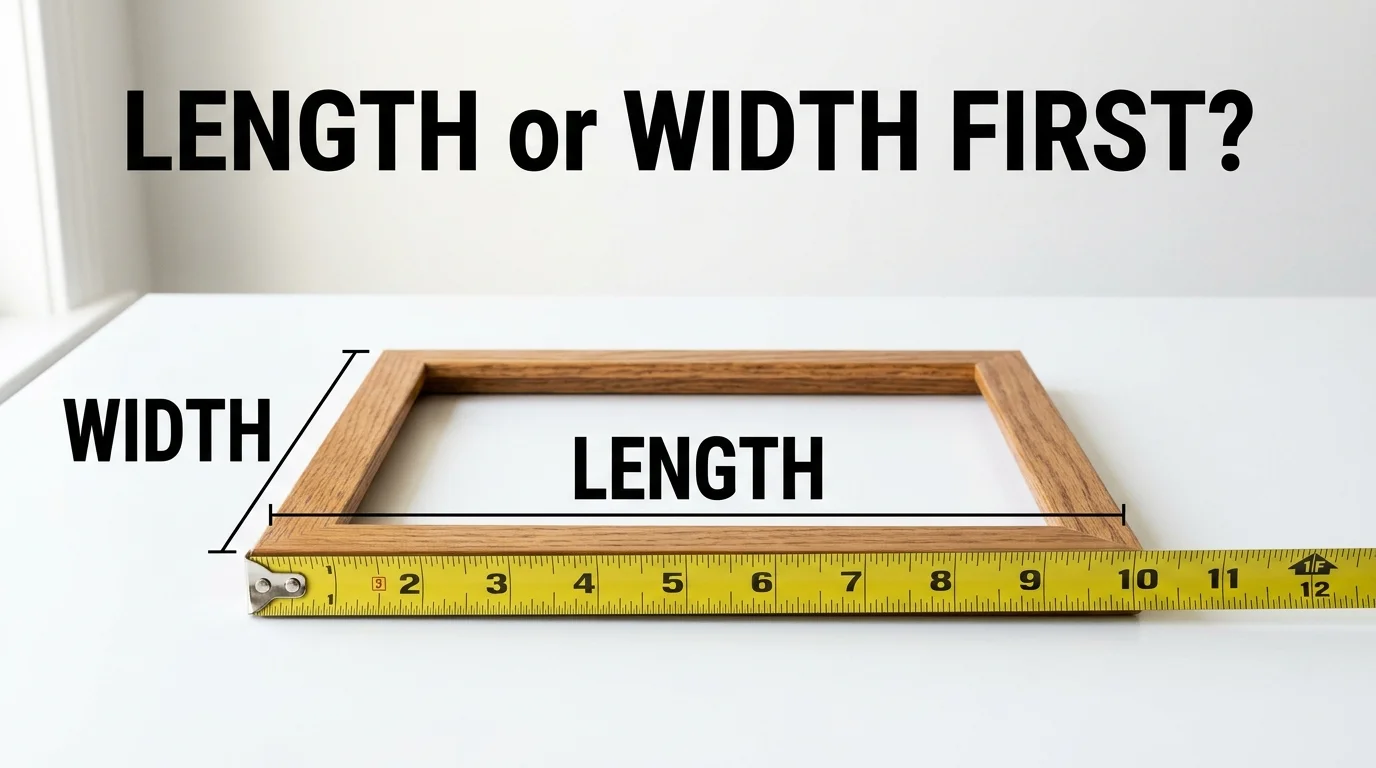
Ever stared at a product listing that says “24 x 36 inches” and wondered… wait, is that the length first or the width first? 🤔
You’re not alone. You’re measuring a picture frame, filling out a shipping form, or writing a school assignment, this tiny detail trips up almost everyone at some point. And here’s the annoying part: different industries don’t always agree on the answer!
In this article, we’ll clear up the confusion once and for all, with real examples, a handy comparison table, and a memory trick you’ll never forget.
Quick Answer 🎯
In most standard usage (especially in the U.S.), the convention is Length x Width x Height (L x W x H) length comes first, followed by width, then height if applicable. However, some fields (like fabric, real estate, or certain international standards) may flip the order, so it’s always smart to check the context.
What Do “Length” and “Width” Actually Mean?
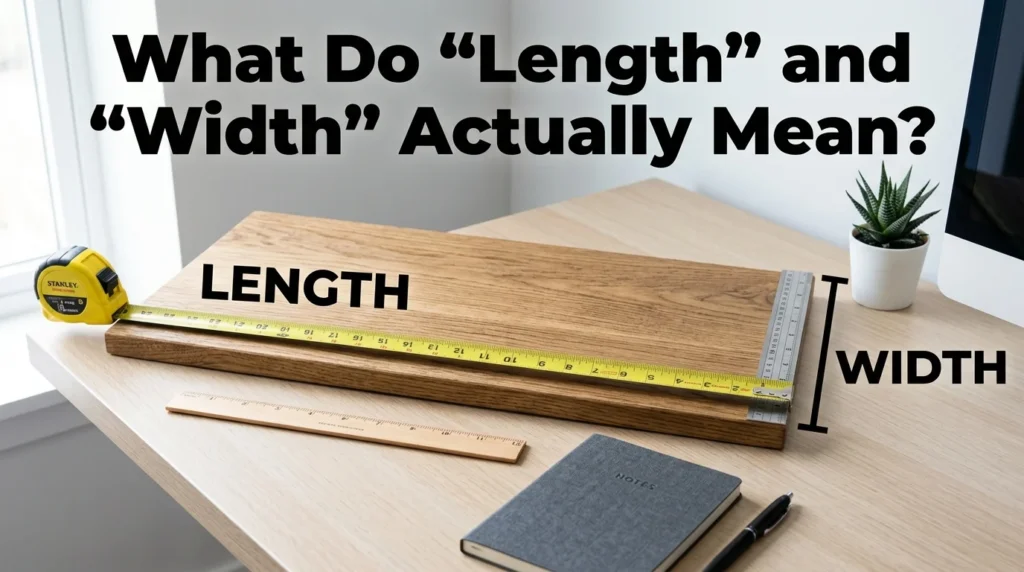
Before we dig into the ordering rules, let’s make sure we’re crystal clear on the definitions themselves. This is where a lot of the confusion actually starts.
Length 📐
Length refers to the longest side of an object or the distance from one end to the other, usually measured horizontally or along the greatest dimension.
Examples:
- The length of the dining table is 6 feet.
- Please measure the length of the hallway before buying a rug.
- The swimming pool has a length of 25 meters.
- Her essay’s length should be around 1,500 words. (Yes, “length” applies to non-physical things too!)
Width 📏
Width refers to the shorter side, or how wide something is from side to side basically, the measurement perpendicular to the length.
Examples:
- The width of the door is 32 inches.
- This desk’s width is too narrow for a monitor.
- The river’s width varies from 10 to 50 meters.
- Check the width of the box before shipping it.
💡 Simple way to remember it: Length = how long it is (front to back or end to end). Width = how wide it is (side to side).
Length or Width First? The Core Rule
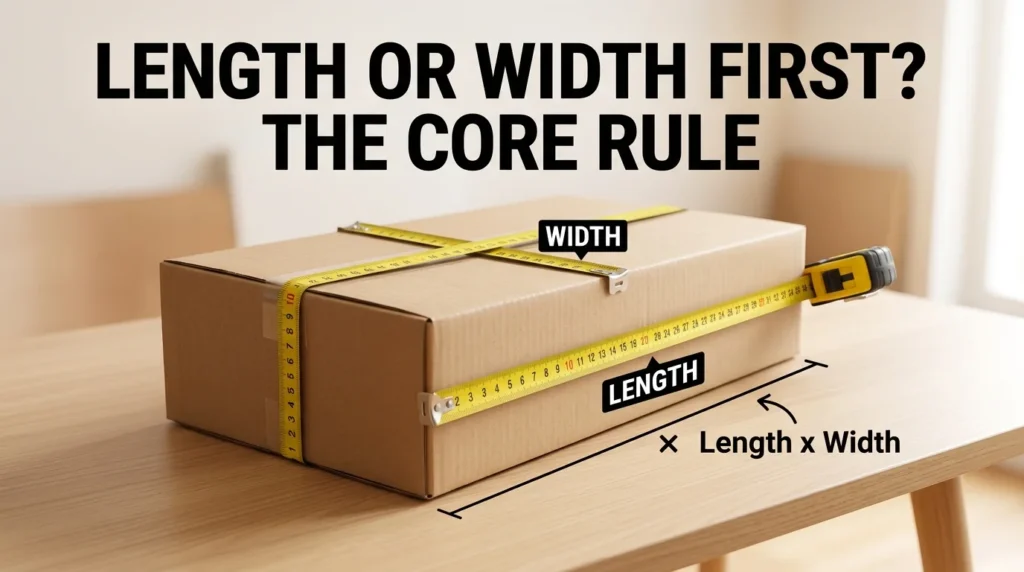
Here’s the heart of the matter. When writing dimensions (like “10 x 5 x 3”), which number goes first?
The Standard Convention: L x W x H
In most general contexts shipping, packaging, furniture, and everyday measurements the accepted order is:
Length x Width x Height
So if a box is 12 inches long, 8 inches wide, and 6 inches tall, you’d write it as:
12 x 8 x 6 inches
This is the order used by most shipping carriers (like USPS, FedEx, and UPS), furniture retailers, and general product listings.
Why Length Comes First
There’s a practical reason behind this: length is usually the largest or most defining dimension, so it makes sense to lead with it. It’s also just become the widely accepted standard, similar to how we always write “height x weight” in a certain order out of habit.
When the Order Changes (Yes, It Sometimes Does!)
Here’s where things get tricky not every industry follows L x W x H strictly. Let’s break down the exceptions. 👇
1. Real Estate & Room Dimensions
Rooms are often measured as Width x Length, especially in listings.
Example: “Living room: 12′ x 15′” here the first number is often the width of the wall you’re facing.
2. Fabric & Textiles
In fabric measurements, it’s common to see Width x Length, since fabric bolts are sold by width first.
Example: “Fabric roll: 45″ wide x 10 yards long”
3. Paper & Printing
Standard paper sizes like 8.5 x 11 (Letter size) follow Width x Length in the U.S., but international paper sizes (like A4) use Length x Width.
4. Screens & Displays
TV and monitor sizes are usually measured diagonally, but resolution (like 1920 x 1080) is always Width x Height, not length at all!
5. Shipping & Packaging
As mentioned earlier, this is the most consistent almost always Length x Width x Height.
Comparison Table: Length vs. Width 📊
| Feature | Length | Width |
| Definition | The longest side or distance end-to-end | The shorter side, measured side-to-side |
| Typical Position in Dimensions | Usually stated first | Usually stated second |
| Common Use | Rooms, boxes, tables, essays, distances | Doors, fabric, screens, rivers |
| Example | “The hallway is 20 feet long” | “The hallway is 4 feet wide” |
| Abbreviation | L | W |
| Symbol in Formulas | l | w |
Table: How Different Industries Order Dimensions 🏭
| Industry/Field | Common Order | Example |
| Shipping & Packaging | Length x Width x Height | 20″ x 14″ x 10″ |
| Furniture | Length x Width x Height | 72″ x 36″ x 30″ |
| Real Estate/Rooms | Width x Length | 12′ x 15′ |
| Fabric/Textile | Width x Length | 45″ x 10 yds |
| U.S. Paper Sizes | Width x Length | 8.5″ x 11″ |
| International Paper (ISO) | Length x Width | 297mm x 210mm (A4 landscape) |
| Screen Resolution | Width x Height | 1920 x 1080 |
📝 Takeaway: There’s no single universal rule context matters! When in doubt, check the specific industry standard or simply label your measurements (e.g., “L: 10in, W: 5in”) to avoid confusion altogether.
Common Mistakes People Make ❌
Let’s talk about the slip-ups that happen most often, so you can dodge them.
- Assuming one universal rule applies everywhere.
- ❌ “It’s always length first, no matter what.”
- ✅ Reality: it depends on the industry (as shown above).
- Mixing up length and width in casual speech.
- ❌ “The width of the room is how long it is from the door to the window.”
- ✅ That’s actually the length, since it’s the longer, defining distance.
- Forgetting to label dimensions clearly.
- ❌ “10 x 6” (unclear which is which)
- ✅ “L: 10in x W: 6in” (crystal clear)
- Confusing width with depth.
- Depth usually refers to how far something extends backward (like a shelf), which is different from side-to-side width.
Memory Trick to Remember the Order 🧠
Here’s a fun mnemonic: “Long Walks Help” = Length, Width, Height.
Or think of it like reading a book: you read length-wise first (the “story” of how long something is) before noticing how “wide” the pages are. 📖
Real-Life Examples From Everyday Communication
📧 From an Email
“Hi team, please confirm the box dimensions I have 18 x 12 x 9 (L x W x H) listed here. Let me know if that’s correct before we finalize shipping costs.”
📱 From a Social Media Post
“Just ordered a new rug for the living room 8ft x 5ft, hoping the width fits under the coffee table! 🛋️”
📰 From a News Article
“The newly discovered fish measures 45 centimeters in length and just 6 centimeters in width, making it one of the slimmest species recorded.”
🎓 From Academic Writing
“The sample container was standardized at 10cm (length) by 4cm (width) to ensure consistency across trials.”
💬 From Everyday Speech
“Can you grab the tape measure? I need the width of the doorway before we buy that new dresser.”
British vs. American English: Any Differences? 🇬🇧🇺🇸
Good news length and width mean the same thing in both British and American English. There’s no spelling or definition difference here (unlike “colour” vs. “color”).
However, there are some subtle usage notes:
- British English tends to favor metric units (centimeters, meters) more consistently.
- American English often defaults to inches and feet, especially in retail and shipping contexts.
- Both dialects generally follow the Length x Width x Height convention for shipping and general product measurements.
So the words don’t change across dialects just the units you’re likely to see them paired with. 🌍
Quick Recap: Length vs. Width Cheat Sheet ✅
- Length = the longest side or the distance end-to-end.
- Width = the shorter side, or how wide something is.
- Standard order for most dimensions: Length x Width x Height.
- Exceptions exist in real estate, fabric, and paper sizing always check context.
- When unsure, label your measurements to avoid any mix-up.
FAQs: Length or Width First? 🙋
1. Is length always written before width?
Not always. While Length x Width x Height is the most common convention (especially in shipping and general measurements), some industries like real estate and textiles use Width x Length instead.
2. How do I know which number is length and which is width in a product listing?
If it’s not labeled, check the industry norm. For boxes and furniture, assume Length x Width x Height. For fabric or paper, it might be Width x Length. When possible, look for explicit labels like “L” and “W.”
3. What’s the difference between width and depth?
Width is the side-to-side measurement, while depth usually refers to how far something extends front-to-back (like how deep a shelf or drawer is).
4. Does the length or width order change between countries?
The words themselves don’t change, but unit systems might (metric vs. imperial). The L x W x H order is fairly consistent internationally for shipping, though paper sizes differ (U.S. uses W x L, ISO uses L x W).
5. Why is length usually mentioned first?
It’s largely a convention based on length typically being the largest or most defining dimension of an object, making it a logical starting point.
6. Is there a simple trick to remember the order?
Yes! Try the mnemonic “Long Walks Help” Length, Width, Height to recall the standard sequence.
7. Do TV or screen sizes follow the same length-width rule?
Not quite. Screen resolutions (like 1920 x 1080) follow Width x Height, since length isn’t typically used to describe screens only diagonal size, width, and height.
Final Thoughts 💭
At the end of the day, the “length or width first” debate comes down to context. For most everyday situations shipping boxes, furniture, and general measurements stick with the tried-and-true Length x Width x Height order. But keep an eye out for exceptions in real estate, textiles, and paper sizing, where the order can flip.
The golden rule? When in doubt, label it out. Writing “L: 10in, W: 5in” instead of just “10 x 5” removes all guesswork and keeps your communication clear whether you’re emailing a colleague, listing a product, or writing an academic paper. 📏✨

James Carter is an English language enthusiast and content writer who loves making grammar simple and easy to understand. He creates clear, beginner-friendly guides on spelling, grammar rules, confusing words, and everyday English usage. His goal is to help readers write with confidence through practical examples, easy explanations, and accurate language tips.