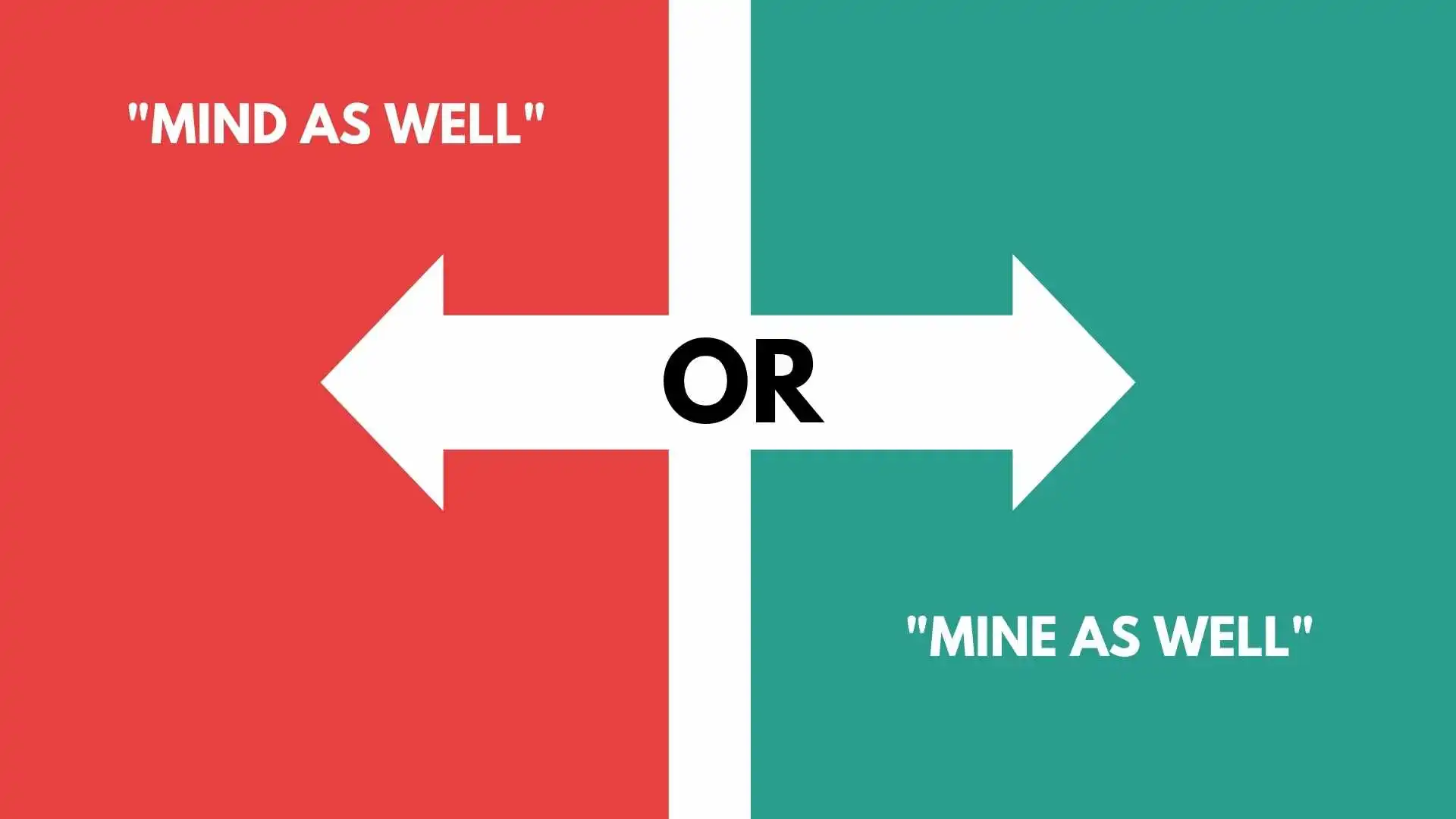
Have you ever typed out “I mind as well just stay home tonight” and then paused, wondering if that even looks right? 😅 You’re definitely not alone. This is one of the sneakiest common mistakes in English, and it trips up native speakers just as often as English learners.
The confusion happens because the correct phrase “might as well” sounds a lot like “mind as well” or “mine as well” when we say it quickly in casual speech. Say “might as well” fast enough, and your brain (and your keyboard) can easily mishear it as one of these look-alikes.
So which one is actually correct? Let’s clear this up right away. 👇
Quick Answer ⚡
The correct phrase is “might as well” not “mind as well” and not “mine as well.” Both of those are common misspellings or mishearings of the real expression, which means “it would be a good idea to” or “there’s no real reason not to.”
Now let’s dig into why this mix-up happens and how to never make this mistake again.
What Does “Might As Well” Actually Mean?
“Might as well” is an idiom used when there’s little reason not to do something, or when doing something is the most sensible option given the circumstances. It often carries a tone of mild resignation, practicality, or “why not?” energy.
Examples of “Might As Well” in a Sentence:
- It’s already raining, so we might as well cancel the picnic. 🌧️
- Since you’re going to the store anyway, you might as well grab some milk.
- We might as well try the new restaurant everywhere else is closed.
- I might as well finish this report tonight since I’m already awake.
- You might as well take the earlier flight; the later one costs more anyway.
Notice the pattern? In every example, there’s a reason or circumstance that makes the action logical or low-risk.
Why Do People Write “Mind As Well”? 🧠
This is almost always a simple mishearing. When people say “might as well” quickly in conversation, the “t” sound softens and disappears, making it sound like “mine as well” or even “mind as well.” Since “mind” is a real, common word, our brains sometimes autocorrect what we hear into a phrase that seems to make sense even though grammatically, “mind as well” doesn’t mean anything on its own.
There is no correct usage of “mind as well” as a standalone idiom. It’s simply an error.
Why Do People Write “Mine As Well”? ✍️
Same story here it’s a phonetic mix-up. “Mine as well” sounds almost identical to “might as well” when spoken casually, especially in fast or informal speech. But “mine” is a possessive pronoun (like in “this book is mine”), and it has zero grammatical connection to the idiom we’re trying to express.
So while it sounds plausible, “mine as well” is still incorrect in this context.
Comparison Table: “Might As Well” vs. “Mind As Well” vs. “Mine As Well” 📊
| Phrase | Correct? | Meaning | Example |
| Might as well | ✅ Correct | It’s a good idea / there’s no reason not to | “We might as well leave now.” |
| Mind as well | ❌ Incorrect | No real meaning a mishearing of “might as well” | ~~”We mind as well leave now.”~~ |
| Mine as well | ❌ Incorrect | No real meaning a mishearing of “might as well” | ~~”We mine as well leave now.”~~ |
Bottom line: Only one of these three is grammatically valid, and it’s “might as well.” 🎯
Common Mistakes People Make 🚫
Here are the most frequent slip-ups related to this phrase:
- Writing “mind as well” instead of “might as well”
- Writing “mine as well” instead of “might as well”
- Dropping the “as” entirely: “might well” (incomplete)
- Confusing it with “may as well,” which is actually a valid (though slightly more formal) variant
Is “May As Well” Also Correct?
Yes! “May as well” is a close cousin of “might as well,” and both are acceptable in modern English. They’re used interchangeably, though “might as well” is more common in everyday American speech, while “may as well” appears a touch more often in British English and formal writing.
| Variant | Correctness | Common Region |
| Might as well | ✅ Correct | Common in both US & UK |
| May as well | ✅ Correct | Slightly more common in UK/formal writing |
| Mind as well | ❌ Incorrect | N/A (mishearing) |
| Mine as well | ❌ Incorrect | N/A (mishearing) |
Memory Trick to Never Mix This Up Again 🧩
Here’s a simple mnemonic to lock this in:
“MIGHT as well” think of MIGHT as in possibility or strength (like ‘I might go’). If you can swap the word for “may” and the sentence still makes sense, you’ve got the right phrase!
Try it:
- “I might as well stay in.” → “I may as well stay in.” ✅ Makes sense!
- “I mind as well stay in.” → “I may as well stay in”? ❌ Doesn’t logically connect “mind” doesn’t swap with “may.”
If the substitution test works, you’re using the correct idiom. If it doesn’t, you’re likely writing the wrong phrase.
Real-Life Examples of the Mistake in Action 📱
This mix-up shows up everywhere, from texts to professional writing. Here’s what it typically looks like “in the wild”:
📩 In Emails
Incorrect: “Since the meeting is cancelled, we mind as well reschedule for next week.” Correct: “Since the meeting is cancelled, we might as well reschedule for next week.”
💬 On Social Media
Incorrect: “It’s Friday, I mine as well treat myself to takeout 🍕” Correct: “It’s Friday, I might as well treat myself to takeout 🍕”
📰 In Casual Writing or Comments
Incorrect: “If ticket prices are the same, fans mind as well go to the bigger show.” Correct: “If ticket prices are the same, fans might as well go to the bigger show.”
🎓 In Academic or Formal Writing
Formal writing almost always uses “might as well” or “may as well” never “mind” or “mine” as well. If you’re writing an essay, report, or professional email, stick to these two correct forms only.
British vs. American English: Any Differences? 🇬🇧🇺🇸
Good news this isn’t really a regional grammar difference. Both British and American English:
- Use “might as well” and “may as well” as the only correct forms
- Consider “mind as well” and “mine as well” incorrect in both dialects
The only subtle difference is frequency: American English leans slightly more toward “might as well,” while British English sometimes favors “may as well” in more formal contexts. But neither dialect accepts “mind” or “mine” as correct alternatives.
Quick-Reference Cheat Sheet 📝
| Situation | Use This |
| Casual conversation | Might as well |
| Formal writing | May as well |
| Texting/social media | Might as well (most common) |
| Academic essays | May as well / Might as well |
| Never use | Mind as well ❌ / Mine as well ❌ |
FAQs: People Also Ask ❓
1. Is “mind as well” ever correct?
No. “Mind as well” is not a recognized English idiom. It’s a common mishearing of “might as well” and should be avoided in writing.
2. Is “mine as well” ever correct?
No, “mine as well” is also incorrect. It’s another phonetic mix-up caused by the similar sound of “might” and “mine” when spoken quickly.
3. What’s the difference between “might as well” and “may as well”?
They mean the same thing both express that something is a reasonable or logical choice. “Might as well” is more casual and common in everyday speech, while “may as well” leans slightly more formal.
4. Why do people confuse these phrases so often?
It comes down to pronunciation. When “might as well” is said quickly, the “t” sound softens, making it sound like “mine” or “mind.” This is a classic example of an eggcorn a phrase that sounds like the original but doesn’t quite make grammatical sense.
5. How can I remember the correct spelling?
Use the substitution trick: swap the questionable word for “may.” If the sentence still makes sense (“may as well”), you’re using the right phrase.
6. Is this a spelling mistake or a grammar mistake?
It’s technically a mishearing that turns into a spelling and usage mistake. Since “mind” and “mine” are real words, spell-check won’t catch the error so it’s worth double-checking manually.
7. Does autocorrect fix “mind as well” automatically?
Not usually. Since “mind as well” is made up of real, correctly spelled words, most spell-checkers won’t flag it. This makes it an easy mistake to miss, even in professional writing.
Conclusion: The Key Takeaway 🎯
Let’s recap the golden rule: the only correct phrase is “might as well” (or its slightly more formal twin, “may as well”). Both “mind as well” and “mine as well” are incorrect they’re simply mishearings that snuck into common usage because they sound similar when spoken quickly.

Olivia Bennett is a passionate English grammar writer at GrammBoost.com who loves making grammar simple and easy to understand. She specializes in spelling, word differences, punctuation, and everyday English usage. Through clear explanations and practical examples, Olivia helps students, writers, and professionals write with greater confidence and accuracy.