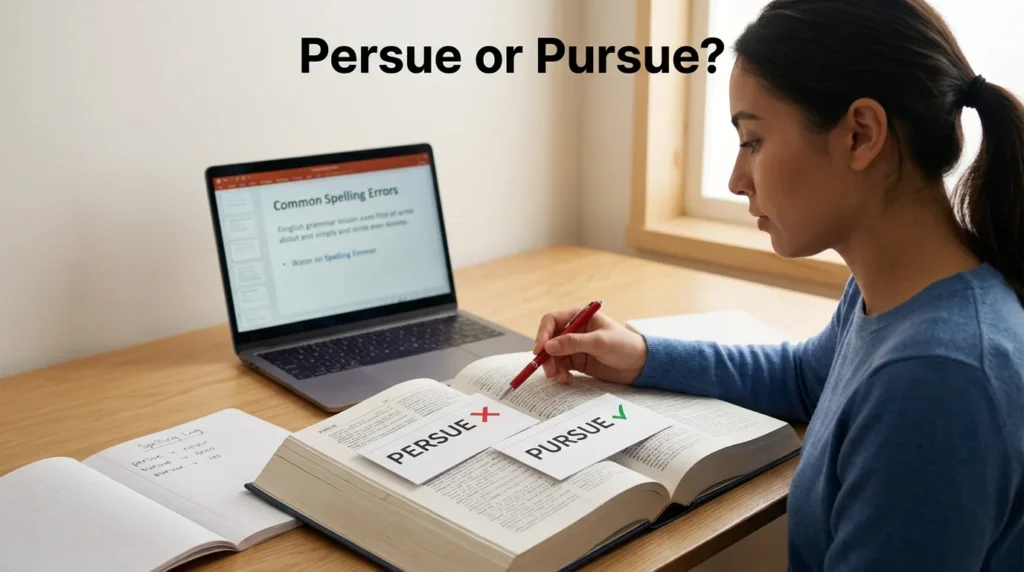
Some English words are easy to recognize when spoken but surprisingly difficult to spell correctly. “Persue” and “pursue” are a perfect example of this common spelling confusion. Because the two forms look very similar, it is easy to accidentally write persue when you actually mean pursue.
However, only “pursue” is the correct standard spelling in English. The word pursue means to follow, continue, or work toward achieving something, such as pursuing a career, goal, dream, or opportunity. You may see it frequently in school assignments, professional writing, applications, conversations, and motivational content.
“Persue”, on the other hand, is simply a misspelling and does not have a standard meaning in English. Understanding the correct spelling can help you write more confidently and avoid a mistake that is surprisingly common.
Quick Answer ⚡
“Persue” is always incorrect it’s simply a misspelling. The only correct spelling is “pursue”, which means to chase after, follow, or work toward something (like a goal, a career, or even a person). There’s no situation in standard English where “persue” is the right choice.
That’s it. That’s the whole answer. But let’s dig into why this mistake happens so often, and how to make sure you never fall into the trap again.
Why Do People Confuse “Persue” and “Pursue”? 🧠
This mix-up isn’t random there are real reasons it happens:
- The “per-” prefix trap: English has tons of words starting with “per-” (perform, persist, permit, persuade). Since “persuade” looks so similar to “pursue,” our brains sometimes blend the two.
- Phonetic spelling: When you say “pursue” quickly, the first syllable can sound like “per” instead of “pur,” especially in casual speech.
- Autocorrect isn’t perfect: Some people assume their phone or laptop will catch the error, but “persue” can sometimes slip through, especially in messaging apps with less strict spell-check.
- Visual memory confusion: If you’ve seen “persuade,” “person,” or “perceive” a thousand times, your brain might default to “per-” without thinking twice.
The good news? Once you understand the correct word and practice it a bit, this mistake becomes easy to avoid. 💪
What Does “Pursue” Actually Mean? 📖

Pursue (verb) means:
- To follow or chase someone or something, often with effort or determination.
- To continue or carry on with an activity, plan, or goal.
- To seek to attain or accomplish something over time.
Examples of “Pursue” in a Sentence
- She decided to pursue a career in medicine after volunteering at a hospital. 🏥
- The police officer began to pursue the suspect down the alley.
- He’s always wanted to pursue his passion for painting.
- Our company will pursue new business opportunities in Asia next year.
- They chose to pursue legal action against the contractor.
- I plan to pursue a master’s degree in psychology.
Related Word Forms
| Word Form | Part of Speech | Example |
| Pursue | Verb (base form) | I will pursue my goals. |
| Pursued | Verb (past tense) | She pursued a career in law. |
| Pursuing | Verb (present participle) | He is pursuing his dream job. |
| Pursuit | Noun | The pursuit of happiness is a common goal. |
| Pursuer | Noun (person doing it) | The pursuer finally caught up with him. |
What Does “Persue” Mean? ❌
Nothing! “Persue” is not a word in the English language. It has no dictionary entry, no accepted usage, and no grammatical function. It’s simply a spelling error for “pursue.”
If you see “persue” in an email, blog post, or text message, it’s a typo plain and simple. There is no context (formal, casual, British, American, academic, or otherwise) where “persue” is considered correct.
🚫 Remember: If you’re tempted to write “persue,” stop and swap in “pursue” instead.
Persue vs Pursue: Comparison Table 📊
Here’s a simple side-by-side breakdown so you can see the difference at a glance:
| Feature | Pursue ✅ | Persue ❌ |
| Correct spelling? | Yes | No |
| Dictionary word? | Yes | No |
| Meaning | To chase, follow, or work toward a goal | None (it’s a typo) |
| Part of speech | Verb | N/A |
| Example sentence | “I will pursue my career goals.” | “I will persue my career goals.” (incorrect) |
| Used in formal writing? | Yes | Never |
| Used in British English? | Yes | Never |
| Used in American English? | Yes | Never |
Common Mistakes to Watch For 🧐
Even careful writers slip up sometimes. Here are the most frequent errors related to “pursue”:
- Misspelling it as “persue” the most common error by far.
- Misspelling it as “persu” or “pursu” dropping letters when typing fast.
- Confusing it with “persuade” these words look alike but mean completely different things:
- Pursue = to chase or work toward something.
- Persuade = to convince someone to do something.
- Confusing it with “peruse” another lookalike word that means to read or examine something carefully.
- “I will peruse the document” (read it carefully) vs. “I will pursue the document” (this doesn’t quite make sense unless you’re literally chasing a piece of paper 😄).
Lookalike Words Table
| Word | Meaning | Example |
| Pursue | To chase or work toward a goal | She will pursue her dreams. |
| Persuade | To convince someone | He tried to persuade her to stay. |
| Peruse | To read or examine carefully | I’ll peruse the contract tonight. |
| Persue | ❌ Not a real word |
Memory Trick to Never Misspell “Pursue” Again 🧩
Here’s a simple mnemonic to lock in the correct spelling:
“PUR” like in “PURpose” because when you pursue something, you’re chasing a PURpose! 🎯
Both words start with “PUR-“, so if you remember that connection, you’ll never write “persue” again.
Another fun trick:
- P-U-R-S-U-E → Think: “Please, U Reach, Success Usually Emerges” (a silly sentence, but it helps some people remember the letter order).
Pick whichever trick sticks in your brain the goal is just to stop that “per-” habit before it starts typing itself. 😄
Real-Life Examples: Where You’ll See “Pursue” Used 🌍
📧 In Emails
“I wanted to follow up and let you know I plan to pursue the marketing position we discussed.”
📱 On Social Media
“Finally decided to pursue my passion for photography full-time! 📸✨ #dreambig #newchapter”
📰 In News Articles
“The senator announced she would pursue stricter regulations on data privacy.”
🎓 In Academic Writing
“This study aims to pursue a deeper understanding of climate change’s impact on coastal ecosystems.”
🗣️ In Everyday Speech
“I really want to pursue learning Spanish this year maybe I’ll finally get fluent!”
Notice a pattern? “Pursue” shows up everywhere from casual texts to formal reports because it’s such a useful, versatile word.
British vs American English: Any Differences? 🇬🇧🇺🇸
Good news there’s no difference in spelling or meaning between British and American English when it comes to “pursue.” Both dialects:
- Spell it exactly the same way: p-u-r-s-u-e
- Use it the same way grammatically
- Consider “persue” equally incorrect
This is one of those rare cases where you don’t need to worry about regional spelling variations (unlike, say, “color” vs “colour” or “organize” vs “organise”). 🎉
Why This Mistake Matters (Especially in Professional Writing) 💼
You might think, “It’s just one letter who cares?” But spelling mistakes like “persue” can:
- Make your resume or cover letter look unpolished to hiring managers.
- Reduce credibility in business emails or client communications.
- Hurt your grades in academic essays.
- Affect SEO and readability if you’re writing content for blogs or websites (search engines and readers both notice sloppy spelling).
Taking two seconds to double-check your spelling can make a real difference in how your writing is perceived. ✍️
FAQs: People Also Ask 🙋
1. Is “persue” a word?
No. “Persue” is not a recognized English word. It’s a common misspelling of “pursue.”
2. How do you spell pursue correctly?
The correct spelling is p-u-r-s-u-e. Remember: it starts with “PUR,” just like “purpose.”
3. What is the difference between pursue and persuade?
Pursue means to chase or work toward a goal, while persuade means to convince someone of something. They look similar but have completely different meanings.
4. What is the difference between pursue and peruse?
Pursue means to chase or follow, while peruse means to read or examine something carefully. Easy to mix up, but very different in meaning!
5. Is “pursue” formal or informal?
“Pursue” works in both formal and informal contexts you’ll see it in academic papers, business emails, and casual conversations alike.
6. What is the noun form of pursue?
The noun form is “pursuit” (e.g., “the pursuit of knowledge”).
7. Can “pursue” be used for people, not just goals?
Yes! You can “pursue” a person in the sense of chasing them (like in a police chase) or even romantically pursuing someone’s attention, though the goal-related meaning is more common in everyday use.
8. Why do so many people misspell “pursue” as “persue”?
Because it sounds similar when spoken quickly, and English has many “per-” words (like “persuade” and “perceive”) that can confuse the spelling pattern.
Final Takeaway:
In conclusion, pursue is the correct spelling, while persue is a common spelling mistake. The word pursue means to follow, chase, seek, or work toward something, such as a goal, career, education, or personal dream. Although persue may look correct at first, it is not a standard English word. A simple way to remember the correct spelling is to focus on the “pur” at the beginning: p-u-r-s-u-e.
Using the correct spelling helps make your writing clear, professional, and accurate. Whether you are writing an email, school assignment, or online content, always choose pursue instead of persue.

James Carter is an English language enthusiast and content writer who loves making grammar simple and easy to understand. He creates clear, beginner-friendly guides on spelling, grammar rules, confusing words, and everyday English usage. His goal is to help readers write with confidence through practical examples, easy explanations, and accurate language tips.