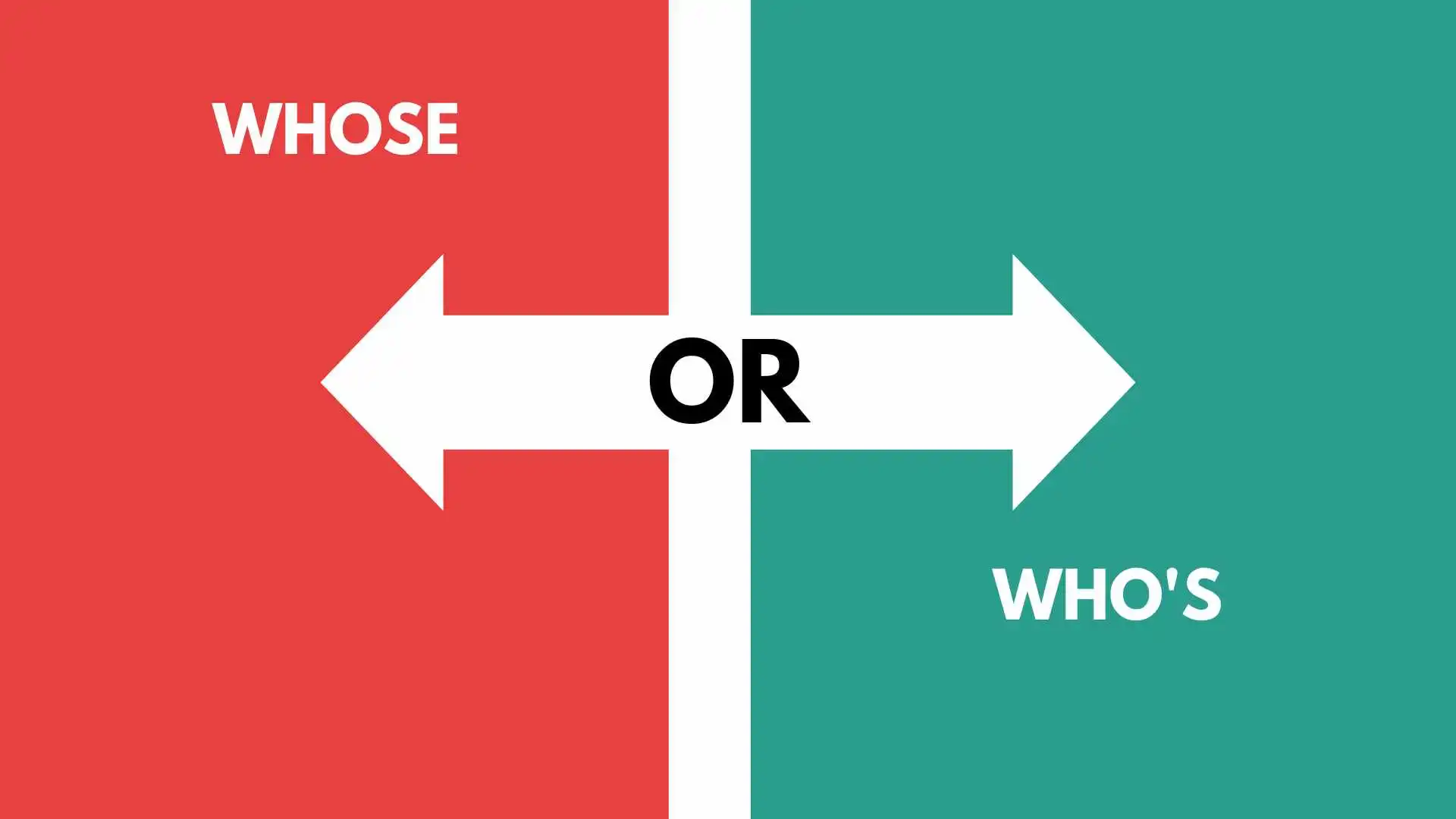
The words “whose” and “who’s” may look almost identical, but they have completely different meanings and uses in English.
Because of their similar spelling and pronunciation, many writers, students, and English learners often confuse them. Whose is a possessive word used to ask or talk about ownership, while who’s is a contraction of “who is” or “who has.”
Understanding this small difference can make your writing clearer and help you avoid a common grammar mistake. For example, you might ask, “Whose book is this?” when asking about ownership, but say, “Who’s coming to the party?”
⚡ Quick Answer
Who’s is a contraction meaning “who is” or “who has.” Whose is a possessive word used to show ownership. If you can replace the word with “who is” and the sentence still makes sense, use who’s. If not, use whose.
That’s it. That’s the whole secret. But let’s break it down properly so it truly sticks. 👇
📖 What Does “Who’s” Mean?
Who’s is a contraction a shortened combination of two words squeezed together with an apostrophe. It stands for:
- Who is → Who’s coming to the party tonight?
- Who has → Who’s taken my charger?
Think of the apostrophe as a placeholder for missing letters. In “who’s,” the apostrophe replaces the “i” in “is” or the “ha” in “has.”
Examples of “Who’s” in Action
- Who’s that knocking at the door? (Who is)
- Who’s going to finish the report by Friday? (Who is)
- Who’s been eating my lunch from the office fridge?! (Who has)
- Do you know who’s in charge of marketing this quarter? (who is)
- Who’s ready for pizza? 🍕 (who is)
Memory Trick: If you can swap the word for “who is” or “who has” and the sentence still reads naturally, it’s who’s.
📖 What Does “Whose” Mean?
Whose is a possessive pronoun. It shows that something belongs to someone. No apostrophe needed just like “his,” “her,” or “their,” it’s already possessive on its own.
Examples of “Whose” in Action
- Whose phone is this on the table?
- I don’t know whose jacket I picked up by mistake.
- Whose turn is it to walk the dog? 🐕
- The teacher asked whose homework was missing.
- That’s the author whose book just topped the bestseller list.
Memory Trick: Whose = Owns something. Both words start with “who” but whose is about ownership, not a shortened phrase.
🧠 The Simple Test to Never Get It Wrong Again
Here’s the golden rule beginners love:
Try replacing the word with “who is” or “who has.”
- If the sentence still makes sense ✅ → use who’s
- If the sentence sounds weird or wrong ❌ → use whose
Let’s test it:
- “___ bag is this?” → “Who is bag is this?” ❌ Doesn’t make sense → Use whose
- “___ coming tonight?” → “Who is coming tonight?” ✅ Makes sense → Use who’s
Try this trick for 3–4 sentences and it becomes second nature. 🎯
📊 Whose vs Who’s: Comparison Table
| Feature | Who’s | Whose |
| Type of word | Contraction | Possessive pronoun |
| Stands for | “Who is” / “Who has” | Ownership / belonging |
| Apostrophe? | Yes | No |
| Example sentence | Who’s calling me right now? | Whose phone keeps ringing? |
| Quick test | Replace with “who is/has” | Ask “who owns this?” |
| Common use | Questions, casual speech, informal writing | Formal and informal writing, questions about ownership |
❌ Common Mistakes People Make
Even confident writers slip up here. Let’s look at the most common errors:
Mistake 1: Using “who’s” instead of “whose”
- ❌ Who’s bag did you find?
- ✅ Whose bag did you find?
Mistake 2: Using “whose” instead of “who’s”
- ❌ Whose going to the meeting?
- ✅ Who’s going to the meeting?
3: Confusing it in formal writing
This mistake shows up a LOT in emails and reports where people rush and don’t proofread.
- ❌ “Please confirm whose attending the workshop.”
- ✅ “Please confirm who’s attending the workshop.”
Why This Happens 🧩
Both words:
- Sound exactly the same when spoken (they’re homophones)
- Start with “who”
- Relate to people
This overlap in sound is exactly why spelling and grammar tools (and human brains!) get tripped up.
💡 Easy Mnemonic to Remember Forever
Here’s a fun one that sticks:
🍎 “Whose” has no apostrophe because it already OWNS its letters just like it owns objects. 🍏 “Who’s” has an apostrophe because it’s MISSING letters just like a puzzle piece is missing.
Or the classic:
Apostrophe = A Piece is Missing (who is → who’s) No apostrophe = Nothing missing, just ownership (whose)
🌍 Real-Life Examples: Emails, Social Media & News
📧 In Emails
- “Hi team, who’s available for a quick call at 3 PM?”
- “Can you tell me whose laptop was left in the conference room?”
📱 In Social Media Captions
- “Who’s ready for the weekend?! 🎉 #FridayVibes”
- “Whose idea was it to make Mondays a thing? 😩”
📰 In News Headlines
- “Who’s Really Behind the New Policy Change?”
- “Whose Responsibility Is Climate Action?”
🎓 In Academic Writing
- “The study examines who’s most affected by remote work fatigue.”
- “Researchers identified whose data was used without consent.”
🗣️ In Everyday Speech
- “Who’s driving us to the airport tomorrow?”
- “Whose turn is it to pay for dinner?”
🇬🇧 British English vs 🇺🇸 American English: Any Difference?
Good news there’s no difference between British and American English when it comes to “whose” and “who’s.” The rules, spelling, and usage are identical on both sides of the Atlantic. 🎉
However, one usage note:
- In formal British writing (academic papers, legal documents), “whose” is sometimes used even when referring to objects, which some American style guides used to discourage (e.g., “the company whose profits declined”). Today, both British and American English accept this usage comfortably.
So no matter where you’re writing from, the rule stays the same. ✅
❓ Frequently Asked Questions (FAQs)
1. Is “whose” only used for people?
No! Whose can refer to people, animals, or even objects. Example: “The car whose engine broke down was towed away.”
2. Can “who’s” be used in formal writing?
Yes, but sparingly. Contractions like “who’s” are more common in casual or conversational writing. In formal essays or reports, it’s often better to write “who is” or “who has” in full.
3. Is “whose” ever used with an apostrophe?
No. “Whose” never takes an apostrophe. If you see an apostrophe, it should be “who’s.”
4. What’s an easy way to test which word to use?
Replace the word with “who is” or “who has.” If it fits, use “who’s.” If it sounds odd, use “whose.”
5. Are “whose” and “who’s” homophones?
Yes! They sound identical when spoken, which is exactly why they’re so easy to mix up in writing.
6. Does grammar-checking software always catch this mistake?
Not always. Because both words are spelled correctly (just used incorrectly), basic spell-checkers often miss this error. Advanced grammar tools usually catch it, but manual proofreading is still smart.
7. Is there a difference in meaning between “whose” and “who’s” in questions?
Yes. “Who’s calling?” asks about identity (who is calling), while “Whose phone is this?” asks about ownership (who owns the phone).
🎯 Final Recap: Whose vs Who’s
Whose and who’s may sound the same, but they have different meanings and uses. Whose is a possessive word used to ask or show who owns something, such as “Whose book is this?” On the other hand, who’s is a contraction of who is or who has, such as “Who’s coming today?” Remembering this simple difference can help you avoid common grammar mistakes. If you can replace who’s with who is or who has, the contraction is correct. Otherwise, use whose when referring to ownership or possession.

Sophia Collins is a passionate English grammar writer at GrammBoost.com who loves making the English language simple and easy to understand. She creates clear, beginner-friendly guides on grammar, spelling, word differences, and common language mistakes. Her goal is to help students, writers, and English learners build confidence and improve their writing through practical, easy-to-follow explanations.