You’re definitely not alone. This is one of the most common grammar mistakes in English, and honestly, it’s an easy one to make. Both versions look correct, both sound the same when you say them out loud, and spellcheck doesn’t always catch the difference because well both spellings are technically real words!
But here’s the thing: “anytime” and “any time” don’t always mean the same thing, and using the wrong one in the wrong context can make your writing look a little less polished especially in emails, essays, or professional messages.
In this article, we’ll break down the confusion once and for all, using simple explanations, real examples, a comparison table, and a fun memory trick to help it stick. Let’s dive in! 🚀
Quick Answer: Anytime vs Any Time
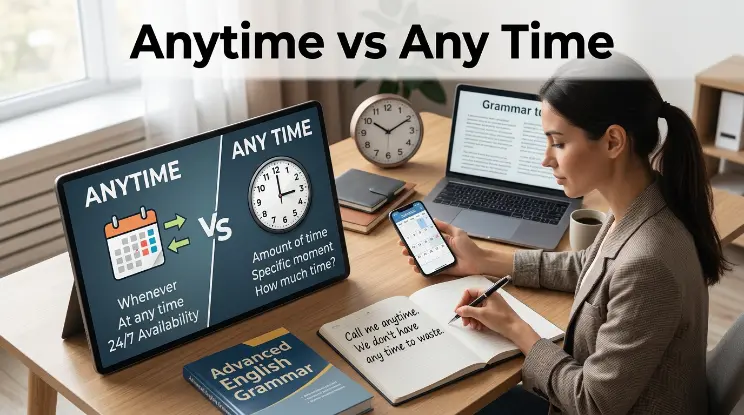
👉 “Anytime” (one word) is an adverb meaning “whenever” use it when you’re talking about time in general. 👉 “Any time” (two words) means “any amount of time” or “any specific time,” and it’s used when “time” acts like a noun, especially after prepositions like at, for, or in.
Quick example:
- ✅ Call me anytime. (whenever you like)
- ✅ Do you have any time to help me today? (any amount of time)
Understanding Each Word: Meaning and Usage
1. “Anytime” (One Word) ⏰
Anytime is an adverb. It means “at any time” or “whenever.” It’s casual, common in everyday speech, and works well in spoken and informal written English.
Examples:
- You can visit us anytime you want.
- Feel free to call anytime I’m usually free.
- The store is open anytime between 9 AM and 9 PM.
- She said she could meet anytime this week.
💡 Tip: If you can replace the word with “whenever” and the sentence still makes sense, you should use “anytime.”
“Call me anytime” = “Call me whenever.” ✅
2. “Any Time” (Two Words) 🕒
Any time is a noun phrase “time” is the noun, and “any” is simply describing it (just like “any money” or “any help”). It’s used:
- After prepositions (at, in, for, with, etc.)
- When referring to an amount of time
- In formal writing
Examples:
- I don’t have any time to finish this today.
- Do you have any time this afternoon for a quick call?
- We didn’t spend any time reviewing the report.
- If you need any time off, just let me know.
💡 Tip: If you can insert a word like “at all” or replace it with “some time,” it should be “any time.”
“I don’t have any time” = “I don’t have any time at all.” ✅
Anytime vs Any Time: Comparison Table 📊
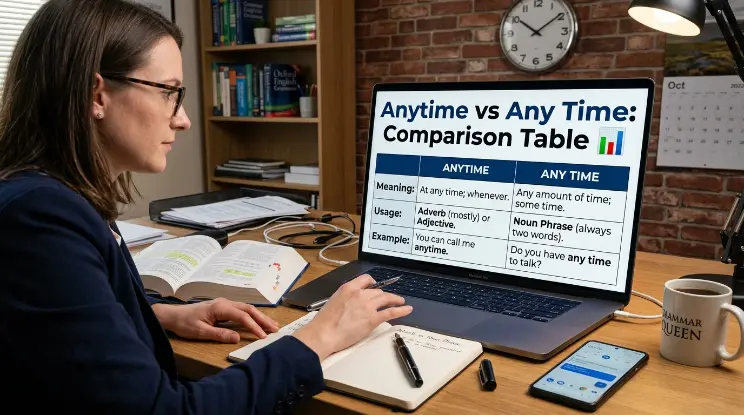
| Feature | Anytime (one word) | Any Time (two words) |
| Part of Speech | Adverb | Noun phrase (any + time) |
| Meaning | Whenever, at any moment | Any amount/period of time |
| Common Usage | Casual, spoken English | Formal, after prepositions |
| Test Word Swap | Replace with “whenever” | Replace with “any amount of time” |
| Example Sentence | “Text me anytime!” | “I don’t have any time today.” |
| Follows Preposition? | ❌ Rarely | ✅ Often (at, for, in) |
| Formality Level | Informal | Neutral to Formal |
Common Mistakes to Avoid 🚫
Even experienced writers slip up here! Here are the most frequent errors:
- ❌ “I don’t have anytime to talk right now.” ✅ “I don’t have any time to talk right now.” (Because “time” here is a noun following “don’t have any.”)
- ❌ “You can call me at anytime.” ✅ “You can call me anytime.” OR “You can call me at any time.” (Don’t use “at” with “anytime” pick one style.)
- ❌ “Do you have any time free lesson today?” (missing “a”) ✅ “Do you have any free time today?”
- ❌ “See you anytime soon.” ✅ “See you soon.” or “Come by anytime.” (Avoid mixing “anytime” with time-specific phrases like “soon.”)
Memory Trick to Remember the Difference 🧠✨
Here’s a simple mnemonic to lock this in:
“ANYTIME = ANY + TIME = WHENEVER” (one smooth word for one smooth idea) “ANY TIME = ANY + (a specific) TIME” (two separate words for a measurable amount)
Or try this fun trick: 🔑 If a preposition (at, for, in) comes before it → it’s two words. 🔑 If you can swap it for “whenever” → it’s one word.
Real-Life Examples 🌍
📧 In Emails
“Feel free to reach out anytime if you have questions.” “Let me know if you have any time available this week for a quick sync.”
📱 In Social Media Posts
“DM me anytime, I always reply! 💬” “Anyone got any time to help me move this weekend? 😅”
📰 In News Writing
“Officials warned residents that flooding could occur anytime during the storm season.” “The committee didn’t spend any time debating the new policy.”
🎓 In Academic Writing
“Participants could complete the survey anytime within the two-week window.” “The researchers did not allocate any time for follow-up interviews.”
🗣️ In Everyday Speech
“Come over anytime, we’re always home!” “Sorry, I don’t have any time this weekend.”
British English vs American English 🇬🇧 🇺🇸
Good news this one’s not a British vs American English issue! Both regions use “anytime” and “any time” the same way grammatically.
However, there are subtle style notes:
| Region | Common Preference |
| American English | “Anytime” is widely accepted in both casual and semi-formal writing. |
| British English | Style guides tend to be slightly more traditional, sometimes preferring “any time” in formal writing, even in cases where American English would use “anytime.” |
📌 SEO/Usage Insight: Google Trends and language usage data show that “anytime” is increasingly used online especially in marketing copy, apps, and customer service messages (e.g., “Cancel anytime,” “Available anytime”) because it feels friendly, modern, and concise. This is a great tip for content writers and copywriters focusing on conversational tone.
Bonus: Related Word Confusions (LSI Keywords) 🔍
While we’re on the topic of tricky word pairs, here are a few similar ones worth knowing (great for English usage and correct spelling practice):
- Everyday vs Every Day
- Anyway vs Any Way
- Awhile vs A While
- Someday vs Some Day
- Anymore vs Any More
These follow a similar “adverb vs noun phrase” logic, so mastering “anytime vs any time” will help you nail these too! 🎯
FAQs: People Also Ask ❓
1. Is “anytime” one word or two?
Both are correct, but they mean different things. “Anytime” (one word) is an adverb meaning “whenever.” “Any time” (two words) is a noun phrase meaning “any amount of time.”
2. Is “at anytime” correct grammar?
No. Avoid using “at” before “anytime.” Instead, say either “anytime” alone or “at any time.”
3. Can I use “anytime” in formal writing?
Yes, but “any time” is often considered slightly more formal. For business or academic writing, many style guides (especially in British English) prefer “any time.”
4. What’s the difference between “anytime” and “whenever”?
They’re very similar! “Anytime” can usually be replaced with “whenever” without changing the meaning of the sentence.
5. Is “anytime” a real word according to dictionaries?
Yes! Major dictionaries like Merriam-Webster and Oxford recognize “anytime” as a standard adverb.
6. How do I know which one to use in a sentence?
Ask yourself: Is “time” acting like a noun (referring to an amount)? Use “any time.” Is the word acting like “whenever”? Use “anytime.”
7. Does British English use “anytime” differently than American English?
Not grammatically but British writing style guides sometimes lean toward “any time” in formal contexts, while American English uses “anytime” more freely.
Conclusion: The Key Takeaway 🌟
In conclusion, “anytime” and “any time” are both correct, but they are used in different ways. “Anytime” is usually an adverb meaning “at any time” and is common in informal, everyday English. “Any time” is used when “any” describes the noun “time,” especially after words such as “at.”
Understanding this small difference can make your writing clearer and more natural. When you mean “whenever,” choose “anytime.” When you are talking about an unspecified amount or occasion of time, “any time” is often the better choice. With practice, choosing between these two forms becomes simple.

Olivia Bennett is a passionate English grammar writer at GrammBoost.com who loves making grammar simple and easy to understand. She specializes in spelling, word differences, punctuation, and everyday English usage. Through clear explanations and practical examples, Olivia helps students, writers, and professionals write with greater confidence and accuracy.