Have you ever written a sentence like “I need to move past this problem” and suddenly wondered, “Should it be past or passed?” 🤔 You are not alone! “Move past” and “move passed” can easily confuse English learners because the words sound similar, but they have very different grammatical roles.
Choosing the wrong one can make an otherwise clear sentence look incorrect. The good news is that the difference is actually simple once you understand how each word works.
In this guide, we’ll take a closer look at “move past” and “passed” so you can use them confidently in everyday English. We’ll explain what past means, how passed works as the past tense of “pass,” and why “move past” is the correct expression when you mean getting beyond a person, situation, problem, or difficult experience.
Quick Answer: Move Past or Passed?
Here’s the short version: “Move past” is correct when you mean to go beyond something (physically or emotionally). “Passed” is a verb (the past tense of “pass”), so it’s used differently like “she passed the test” or “time has passed.” You use past as a preposition/adverb after “move,” not “passed.”
Let’s break this down properly so it sticks. 📌
Why Do People Confuse “Past” and “Passed”?
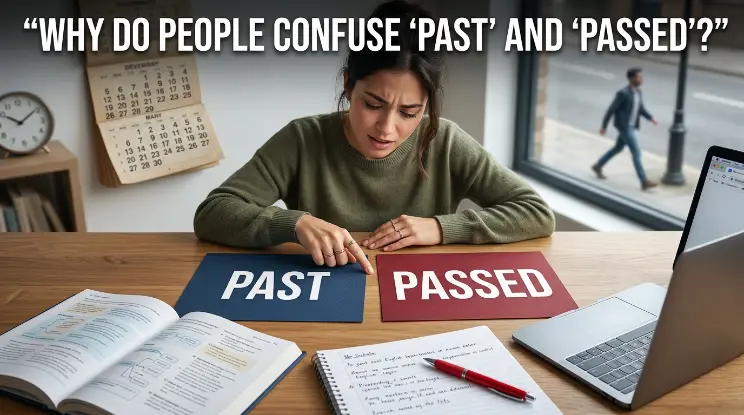
The confusion happens because:
- They’re homophones they sound identical when spoken 🎧
- Both relate to the idea of time or movement
- “Passed” is a real word, so spellcheck won’t always catch the error
- English grammar rules about prepositions vs. verbs aren’t always taught clearly in school
This is a classic case of English usage confusion, similar to “affect vs effect” or “their vs there.” Once you understand the role each word plays in a sentence, the confusion disappears. ✨
Understanding “Past” 📖

Past can function as a noun, adjective, preposition, or adverb but it is never a verb.
Meaning:
- Referring to time that has already happened
- Referring to a position beyond a point (physically)
Examples:
- “I finally decided to move past the breakup.” (preposition beyond)
- “He walked past the store without noticing it.” (preposition)
- “In the past, people wrote letters instead of texting.” (noun)
- “She lives in the past, always talking about old memories.” (noun)
- “It’s half past six.” (idiomatic time expression)
💡 Key point: After the verb “move,” you always use past, because you’re describing direction or a state not another action.
Understanding “Passed” ✅
Passed is the past tense and past participle of the verb “to pass.” It always shows an action that occurred.
Meaning:
- To go by, complete, or transfer something
- To succeed at something (like an exam)
- Time moving forward
Examples:
- “She passed the driving test on her first try.” 🚗
- “The bus passed my street two minutes ago.”
- “He passed the salt during dinner.” 🧂
- “A whole year has passed since we moved here.”
- “The bill was passed by the senate.”
💡 Key point: If you can replace the word with another verb form (like “passed away,” “passed by,” “passed through”), you need passed, not past.
“Move Past” vs. “Moved Passed” Which Is Correct?
Here’s the deal: “Move passed” is grammatically incorrect. You should never pair the verb “move” directly with “passed” in that construction.
✅ Correct: “I need to move past this argument.” ❌ Incorrect: “I need to move passed this argument.”
Why? Because in this sentence, “past” is acting as a preposition, describing what you’re moving beyond not describing an action of passing something.
However, “passed” can appear correctly in a similar-sounding sentence if paired with a different structure:
✅ Correct: “Two years have passed since I moved.”
See the difference? The subject and verb tense completely change the word you need. 🧠
Comparison Table: Past vs. Passed
| Feature | Past | Passed |
| Part of speech | Noun, adjective, preposition, adverb | Verb (past tense of “pass”) |
| Can follow “move”? | ✅ Yes “move past” | ❌ No “move passed” is incorrect |
| Refers to | Time or position | An action/event that occurred |
| Example sentence | “He drove past the school.” | “He passed the school on his bike.” |
| Common phrases | in the past, past experiences, half past | passed away, passed out, passed the exam |
| Tense | Not a verb (no tense) | Past tense/participle |
Common Mistakes to Avoid ⚠️
- “I want to move passed my fears.” ❌ ✅ Correct: “I want to move past my fears.”
- “That’s all in the passed now.” ❌ ✅ Correct: “That’s all in the past now.”
- “He past the ball to his teammate.” ❌ ✅ Correct: “He passed the ball to his teammate.”
- “Time has past so quickly.” ❌ ✅ Correct: “Time has passed so quickly.”
Memory Trick 🧠✨
Here’s a simple mnemonic to lock this in:
“Passed” has an extra “-ed” because it’s an action that’s already been DONE. Think: Pass + ED = Did something. Past has no “-ed” because it’s describing a place in time, not an action.
Another fun trick:
- If you can say “walked past” using another verb like drove, ran, or looked, it’s past.
- If you can replace it with “succeeded,” “went by,” or “handed over,” it’s passed.
Real-Life Examples 🌍
📧 In Emails:
“I understand there were delays, but let’s move past this and focus on the next steps.”
📱 On Social Media:
“Finally learning to move past toxic relationships. 💔➡️❤️ #GrowthMindset”
📰 In News Headlines:
“Senate has passed the new infrastructure bill.”
🎓 In Academic Writing:
“Researchers have moved past traditional methods to adopt AI-driven analysis.”
🗣️ In Everyday Speech:
“Can you believe how fast time has passed this year?”
British vs. American English 🇬🇧🇺🇸
Good news this rule stays consistent across both British and American English. There’s no regional variation here:
- 🇺🇸 American English: “I need to move past this mistake.”
- 🇬🇧 British English: “I need to move past this mistake.”
Both versions follow the same grammar logic, since “past” and “passed” function identically in both dialects. This is one of those universal English grammar tips that don’t change depending on where you’re from. 🌎
Frequently Asked Questions (FAQs) ❓
1. Is it “move past” or “move passed”?
It’s always “move past.” “Passed” cannot follow “move” grammatically.
2. Can “passed” ever be used with “move”?
Not directly. However, you can use “passed” in a separate clause, like: “Time passed as I tried to move on.”
3. Why do “past” and “passed” sound the same?
They are homophones, meaning they share pronunciation but differ in spelling and grammatical function.
4. What part of speech is “past”?
It can be a noun, adjective, adverb, or preposition but never a verb.
5. What part of speech is “passed”?
It is strictly a verb, specifically the past tense of “pass.”
6. Is “past” used only for time?
No, it can also describe physical movement, like “she walked past the house.”
7. What’s an easy way to remember the difference?
Use the mnemonic: “Passed” = an action that happened (has an -ed); “Past” = a point in time or space (no -ed).
Final Thoughts:
In conclusion, “move past” is the correct phrase when you mean going beyond something, leaving it behind, or continuing forward. “Passed” is usually the past tense of the verb “pass,” so it does not normally fit after “move” in this expression. Remember, past often works as a preposition or adverb to describe moving beyond a point, place, or situation. For example, “It’s time to move past your mistakes and focus on the future.” Understanding the difference between move past and move passed can help you write more naturally and avoid a common English grammar mistake.

Sophia Collins is a passionate English grammar writer at GrammBoost.com who loves making the English language simple and easy to understand. She creates clear, beginner-friendly guides on grammar, spelling, word differences, and common language mistakes. Her goal is to help students, writers, and English learners build confidence and improve their writing through practical, easy-to-follow explanations.