Ever typed out “I’m getting my masters degree” and then paused, finger hovering over the keyboard, wondering if you just made a grammar mistake? 🤔 You’re not alone.
This is one of the most googled grammar questions out there, and honestly, it makes sense why. The word looks almost the same whether you add an apostrophe or not, and both versions sound identical when spoken out loud. So how is anyone supposed to know which one is correct?
You’re updating your LinkedIn profile, writing a college application essay, or just texting a friend about grad school plans, getting this right matters more than you’d think. A misplaced (or missing) apostrophe can make even a polished resume look sloppy.
Quick Answer 🚀
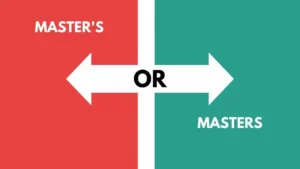
“Master’s” (with an apostrophe) is almost always correct when referring to the degree — as in “master’s degree” or “master’s in psychology.” The apostrophe shows possession, similar to “bachelor’s degree.” “Masters” (no apostrophe) is only correct in specific contexts, like referring to multiple people who hold mastery, or names like “The Masters” golf tournament.
Understanding “Master’s” vs “Masters”: The Basics
Let’s break this down word by word so it actually sticks.
What Does “Master’s” Mean?
“Master’s” is the possessive form of the word “master.” It’s short for “master’s degree,” which technically comes from the Latin idea of a degree granted by a master or of mastery in a subject.
Think of it like this: it’s the same grammatical pattern as:
- Bachelor’s degree ✅
- Doctor’s appointment ✅
- Master’s degree ✅
Examples:
- She earned her master’s in Business Administration last spring. 📚
- He’s currently working toward a master’s degree in Computer Science.
- Do you need a master’s to apply for this job?
- My sister just finished her master’s thesis!
What Does “Masters” Mean?
“Masters” (no apostrophe) is simply the plural form of “master.” It refers to more than one master — as in multiple skilled people, multiple degree holders, or a proper noun like a tournament.
Examples:
- The university has several masters programs, but this doesn’t refer to the degree name itself — it’s describing multiple “master” level programs (though in casual writing, many people still use “masters programs” loosely).
- Chess masters from around the world gathered for the tournament. ♟️
- The art exhibit features work from Renaissance masters like Da Vinci and Michelangelo. 🎨
- He watched The Masters golf tournament all weekend. ⛳
Master’s vs Masters: Comparison Table
| Term | Meaning | Grammar Type | Example Sentence |
| Master’s | Refers to the degree (possessive) | Singular possessive noun | “She has a master’s in Education.” |
| Masters | Plural of “master” (multiple people) | Plural noun | “The masters of the craft trained for decades.” |
| The Masters | Proper noun (golf tournament) | Proper noun | “He watches The Masters every April.” |
| Masters’ | Possessive plural (rare) | Plural possessive | “The masters’ techniques were passed down.” |
| Masters degree (no apostrophe) | Common but technically incorrect | — | ❌ “She has a masters degree.” |
| Master’s degree (correct) | Grammatically correct form | — | ✅ “She has a master’s degree.” |
Common Mistakes People Make 😬
Even native English speakers mix this up all the time. Here are the biggest culprits:
1. Dropping the Apostrophe Completely
❌ “I have a masters degree in finance.” ✅ “I have a master’s degree in finance.”
2. Adding an Apostrophe to the Plural
❌ “Many master’s compete in the tournament.” ✅ “Many masters compete in the tournament.”
3. Confusing It With “Masters'” (Plural Possessive)
This one’s rare, but it happens when you’re talking about something belonging to multiple masters. ✅ “The masters’ union voted on new rules.” (belonging to several masters)
4. Capitalizing When You Shouldn’t
❌ “I’m getting my Master’s in Nursing.” (unnecessary capital M unless it starts a sentence or is part of an official degree title like “Master of Science”) ✅ “I’m getting my master’s in nursing.”
Memory Trick: How to Never Mix This Up Again 🧠
Here’s a simple mnemonic to lock this in:
“It belongs to a master, so it needs an apostrophe.”
Just like:
- A bachelor’s degree belongs to a bachelor 🎓
- A cat’s toy belongs to a cat 🐱
- A master’s degree belongs to (the concept of) a master
If you can mentally replace it with “belonging to,” you need the apostrophe. If you’re talking about multiple people, drop the apostrophe and just add an “s.”
Quick Test: Ask yourself “Am I talking about ONE degree, or MULTIPLE people?”
- One degree → master’s (possessive)
- Multiple people → masters (plural)
Real-Life Examples: Where You’ll See This in Action
📧 In Emails
“Hi Professor Smith, I’m reaching out because I’m interested in applying to the master’s program in Data Science for the fall semester.”
📱 On Social Media
“Just got accepted into my dream master’s program!! 🎉😭 #gradschool #newchapter”
📰 In News Articles
“According to recent data, enrollment in online master’s degrees has surged by over 20% in the past three years.”
🎓 In Academic Writing
“This study examines the career outcomes of individuals holding a master’s degree in the social sciences.”
💬 In Everyday Speech
“Yeah, she’s got her masters… I mean, her master’s, in psych. Sorry, always mix that up!”
(See? Even in casual conversation, people stumble over this one.)
British English vs American English: Any Differences? 🇬🇧🇺🇸
Good news — this is one grammar rule that’s consistent across both British and American English. Whether you’re in London or Los Angeles, “master’s degree” keeps its apostrophe.
However, there are a few regional style notes worth knowing:
| Region | Common Style | Notes |
| 🇺🇸 American English | “master’s degree” | Apostrophe strongly preferred in formal writing (APA, MLA, Chicago style guides) |
| 🇬🇧 British English | “master’s degree” | Also uses apostrophe; style guides like Oxford follow the same rule |
| Informal/Casual Writing | “masters degree” (no apostrophe) | Increasingly common in casual speech and social media, but still considered incorrect formally |
SEO/Trend Insight: Interestingly, if you check search trends, “masters degree” (without the apostrophe) actually gets searched more often than “master’s degree” — showing just how common this mistake really is online. Google’s autocomplete and most search engines are smart enough to recognize both as the same intent, but for professional writing, resumes, and academic papers, always stick with the grammatically correct master’s.
Related Grammar Tips Worth Knowing 📝
While we’re on the topic, here are a few related possessive rules that often trip people up too:
- Bachelor’s degree ✅ (not “bachelors degree”)
- Associate’s degree ✅ (not “associates degree” — though this one varies more by institution)
- Doctorate — no apostrophe needed since it’s not possessive in the same way
- PhD — no apostrophe, it’s an abbreviation, not a possessive noun
Keeping these consistent will make your writing look polished across resumes, cover letters, and LinkedIn profiles.
FAQs: People Also Ask 🙋♀️
1. Is it “master’s degree” or “masters degree”?
It’s technically “master’s degree” with an apostrophe, since it shows possession. However, “masters degree” is a very common informal variation you’ll see online.
2. Do you capitalize “master’s” in a sentence?
No, you generally don’t capitalize it unless it starts a sentence or is part of an official title, like “Master of Arts” or “Master of Science.”
3. Is “masters” ever correct without an apostrophe?
Yes! When referring to multiple people (like chess masters or Renaissance masters) or proper nouns like “The Masters” golf tournament.
4. What’s the plural of “master’s degree”?
It would be “master’s degrees” — the apostrophe stays, and the “s” for plural goes at the end of “degree,” not “master’s.”
5. Is “masters” correct in British English?
The grammatically correct form in British English is still “master’s,” just like in American English. The apostrophe rule doesn’t change across dialects.
6. Why do so many people drop the apostrophe?
Because “master’s” and “masters” sound identical when spoken, many people simply don’t realize there’s a written difference — it’s a common and very understandable mistake.
7. Is “Masters” capitalized when talking about the golf tournament?
Yes! “The Masters” is a proper noun referring to the specific golf tournament, so it’s always capitalized.
Conclusion: The Key Takeaway 🔑
Understanding the difference between Master’s and Masters helps you use the correct form in academic and professional writing. Master’s is usually the correct choice when referring to a master’s degree, such as “I have a Master’s degree in English.” The apostrophe shows possession.
Masters, without an apostrophe, is generally the plural form of “master” and can refer to multiple masters or experts. In most cases, when discussing an academic qualification, use Master’s degree. Remembering this simple distinction can make your writing more accurate, polished, and professional. Choosing the right spelling also helps avoid common grammar mistakes.

Olivia Bennett is a passionate English grammar writer at GrammBoost.com who loves making grammar simple and easy to understand. She specializes in spelling, word differences, punctuation, and everyday English usage. Through clear explanations and practical examples, Olivia helps students, writers, and professionals write with greater confidence and accuracy.