Have you ever typed a sentence about the North Pole, polar bears, or freezing temperatures and paused halfway through, wondering: is it “artic” or “arctic”? 🤔
You’re definitely not alone. This is one of the most common spelling mistakes in the English language, and even native speakers mix it up all the time. The confusion mostly comes from how the word sounds when we say it out loud that sneaky first “c” tends to disappear in casual speech, which tricks our brains into writing it the wrong way too.
In this guide, we’ll clear up the confusion once and for all, with simple explanations, examples, a handy comparison table, and some fun memory tricks to help the correct spelling stick forever.
Quick Answer 🎯
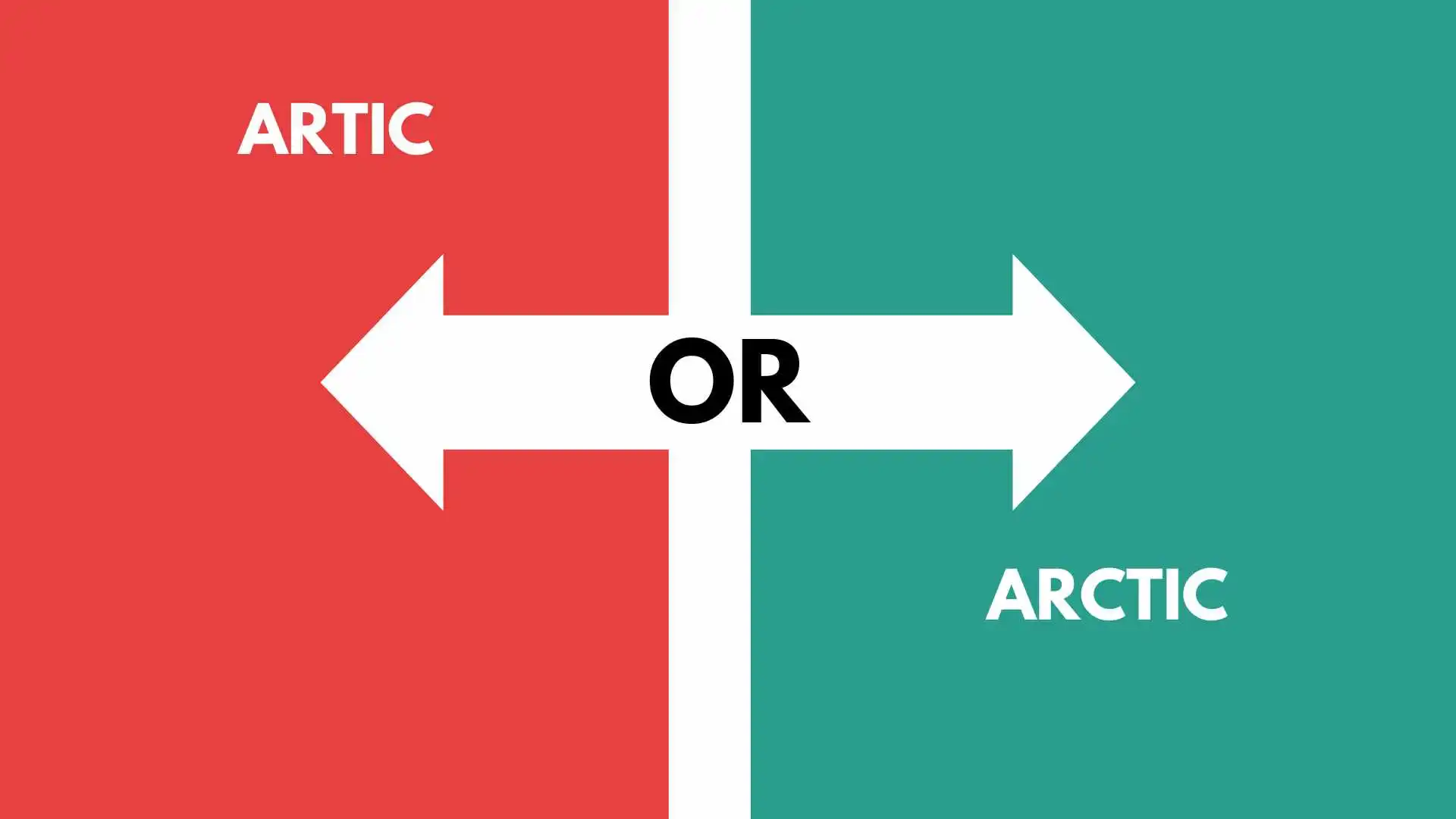
“Arctic” is the correct spelling. It refers to the region around the North Pole and is always spelled with two “c’s” A-R-C-T-I-C. “Artic” is simply a common misspelling with no accepted use in standard English.
What Does “Arctic” Actually Mean?
Arctic (pronounced ARK-tik) is an adjective and proper noun used to describe:
- The region surrounding the North Pole, including parts of Canada, Russia, Greenland, and Scandinavia
- Anything relating to extreme cold, ice, or polar conditions
- The Arctic Ocean, the smallest and shallowest of the world’s oceans
Examples of “Arctic” in a Sentence
- The Arctic is home to polar bears, seals, and Arctic foxes. 🐻❄️
- Scientists are studying how Arctic ice is melting due to climate change.
- Last night felt absolutely Arctic I couldn’t feel my fingers!
- The ship sailed through the icy waters of the Arctic Ocean.
- She’s fascinated by Arctic wildlife and hopes to visit Svalbard one day.
Notice how “Arctic” can describe a place (the Arctic Circle), a temperature (Arctic winds), or even an exaggeration in everyday speech (“it’s Arctic in here!”).
What About “Artic”? Is It Ever Correct?
Here’s the twist: “artic” isn’t a total myth but it doesn’t mean what people think it means.
In British English, “artic” is sometimes used as an informal, shortened slang term for an articulated lorry (a large truck with a trailer that bends in the middle). For example:
- The traffic was backed up for miles because an artic had jackknifed on the motorway.
However, when people write “artic” thinking they mean the icy polar region, that’s a spelling error, not an accepted alternative. So:
- ❌ “The artic is melting” (incorrect should be “Arctic”)
- ✅ “The artic overturned on the icy road” (correct, but only in casual British slang for a truck)
For 99% of everyday writing, if you’re talking about snow, ice, or the North Pole, “Arctic” is the only correct choice. ✅
Artic vs Arctic: Comparison Table
| Feature | Arctic ✅ | Artic ⚠️ |
| Correct spelling? | Yes, always | No (except as slang) |
| Meaning | The polar region near the North Pole; extreme cold | Informal British slang for “articulated lorry” (truck) |
| Part of speech | Noun / Adjective | Slang noun (regional) |
| Formal writing use | ✔️ Always acceptable | ❌ Never acceptable |
| Example sentence | “The Arctic tundra is freezing.” | “The artic blocked the road.” |
| Pronunciation | ARK-tik | AR-tik |
| Common in | Science, geography, news, everyday speech | UK trucking/transport slang only |
Why Do People Misspell “Arctic”?
Great question! The answer lies in pronunciation habits. 🗣️
Many English speakers naturally soften or drop the first “c” sound when speaking quickly, so “Arctic” comes out sounding like “AR-tik” instead of “ARK-tik.” Since we often spell words the way we hear them, the silent-feeling “c” gets left out on paper too.
This phenomenon is common with other tricky English words as well, where pronunciation doesn’t match spelling exactly think of words like “February” (many say “Feb-yoo-ary” instead of “Feb-roo-ary”).
Common Mistakes to Avoid
- ❌ Artic Circle → ✅ Arctic Circle
- ❌ Artic fox → ✅ Arctic fox
- ❌ Artic weather → ✅ Arctic weather
- ❌ Artic explorer → ✅ Arctic explorer
- ❌ Artic Ocean → ✅ Arctic Ocean
Memory Trick to Never Forget the Spelling Again 🧠
Here’s a simple mnemonic to lock in the correct spelling:
“Arctic has two C’s, just like it has two freezing poles: cold and colder!” ❄️❄️
Or try this one:
Think of the word “ARC” like an arc of ice stretching across the top of the globe plus “TIC”. ARC + TIC = ARCTIC.
Another trick many teachers use:
- A-R-C-T-I-C say it slowly, syllable by syllable: ARC-TIC. If you can hear both “c” sounds when you sound it out carefully, you’ll never drop one again.
Real-Life Examples of “Arctic” in Use
📧 In an Email
“Hi team, just a reminder that the client meeting about the Arctic research funding proposal is scheduled for Thursday.”
📱 On Social Media
“Woke up and it’s basically Arctic outside today ❄️🥶 #ColdSnap #WinterVibes”
📰 In the News
“New data reveals that Arctic sea ice has reached its lowest levels in recorded history.”
🎓 In Academic Writing
“The study examines the effects of rising temperatures on Arctic permafrost and biodiversity.”
💬 In Everyday Speech
“Turn the heater on, it’s absolutely Arctic in this house!”
As you can see, “Arctic” shows up everywhere from scientific journals to casual chats with friends. That’s exactly why getting the spelling right matters, whether you’re writing a school essay, a work email, or a quick tweet.
British English vs American English: Any Difference?
Good news this one’s simple! Unlike many British vs. American spelling differences (think “colour” vs. “color”), “Arctic” is spelled the same way in both British and American English. 🇬🇧🇺🇸
The only regional twist is that “artic” (as slang for a truck) is used only in British English, and it has nothing to do with the icy region. American English doesn’t use “artic” this way at all.
| Region | Word for Polar Region | Slang for Truck |
| 🇺🇸 American English | Arctic | “Semi” or “tractor-trailer” |
| 🇬🇧 British English | Arctic | “Artic” (short for articulated lorry) |
Related Words Worth Knowing
Building your grammar tips toolkit? Here are a few related words often confused alongside “Arctic”:
- Antarctic – refers to the region around the South Pole (note the “ant” prefix, meaning “opposite of Arctic”)
- Arctic Circle – the imaginary line marking the southern boundary of the Arctic region
- Sub-Arctic – areas just south of the Arctic Circle with cold but slightly milder climates
- Arctic tundra – the cold, treeless biome found in Arctic regions
💡 Fun fact: “Antarctic” literally comes from Greek, meaning “opposite the Arctic” so remembering one helps you remember the other!
Frequently Asked Questions (FAQs) ❓
1. Is “artic” a real word?
Sort of but only as British slang for an articulated lorry (a large truck). It is not a correct spelling of “Arctic,” the polar region.
2. Why does “Arctic” have two C’s?
The word comes from the Greek word arktikos, meaning “near the bear” (referring to the constellation Ursa Major, the Great Bear, visible in the northern sky). The spelling has kept both “c” sounds through Latin and into English.
3. How do you pronounce “Arctic” correctly?
It’s pronounced ARK-tik, with a clear “k” sound after “AR.” Many people mistakenly say “AR-tik,” dropping the first “c” sound.
4. Is “Arctic” always capitalized?
Yes, when referring to the Arctic as a specific region or the Arctic Ocean, it’s capitalized like a proper noun. When used as a general adjective for extreme cold (e.g., “arctic weather” in a loose, descriptive sense), it can sometimes appear lowercase, though many style guides still prefer capitalizing it.
5. What’s the opposite of “Arctic”?
The opposite region is the Antarctic, located around the South Pole.
6. Can “Arctic” be used to describe something other than weather or geography?
Yes! It’s often used figuratively to describe something extremely cold in tone or atmosphere, like “she gave him an Arctic stare” (meaning a cold, unfriendly look).
7. Is “artic” used in American English at all?
No, American English doesn’t typically use “artic” for trucks or anything else. It’s considered strictly informal British usage.
Final Takeaway: Artic or Arctic? 🏁
In conclusion, “Artic” and “Arctic” may look similar, but they have different meanings and uses. Arctic is the correct word when referring to the cold region around the North Pole or anything related to it. For example, Arctic animals and the Arctic Ocean.
On the other hand, Artic is usually a name, abbreviation, or part of a specific term rather than a common alternative spelling of Arctic. Remembering the extra “c” in Arctic can help you avoid spelling mistakes. Using the correct word will make your writing clearer and more accurate.

Olivia Bennett is a passionate English grammar writer at GrammBoost.com who loves making grammar simple and easy to understand. She specializes in spelling, word differences, punctuation, and everyday English usage. Through clear explanations and practical examples, Olivia helps students, writers, and professionals write with greater confidence and accuracy.