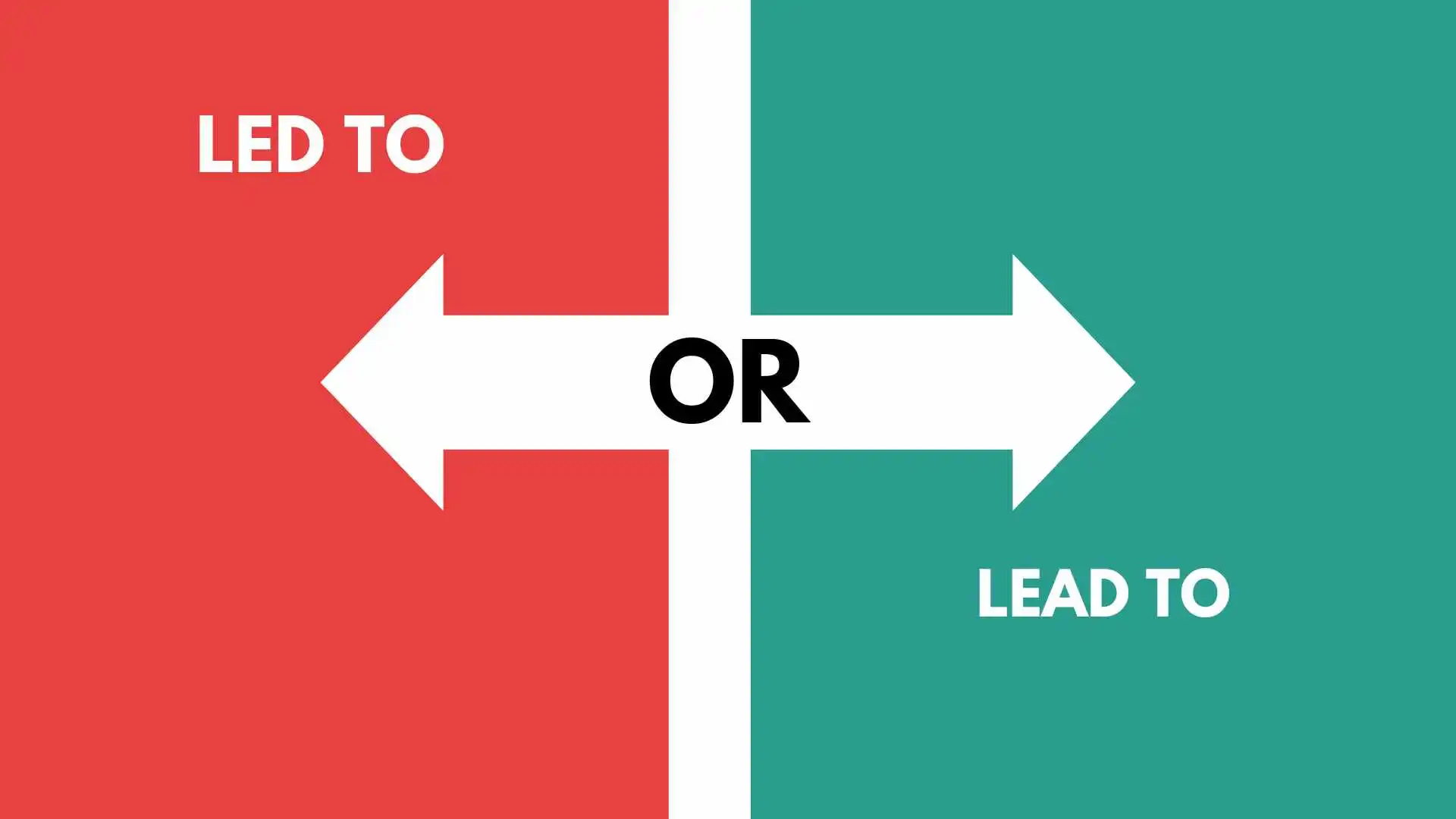
You’re writing an essay, a report, or even a simple text message, and you type: “This decision lead to a lot of problems.”
Something feels slightly off, but you’re not quite sure why. 🤔 Is it “led to” or “lead to”? And why does “lead” sound like the metal but look like it should rhyme with “read”?
This is honestly one of the most common English mistakes out there even confident writers slip up on this one. The confusion mostly comes down to tricky spelling and pronunciation overlaps. Let’s fix this for good! 💡
Quick Answer: Led To or Lead To?
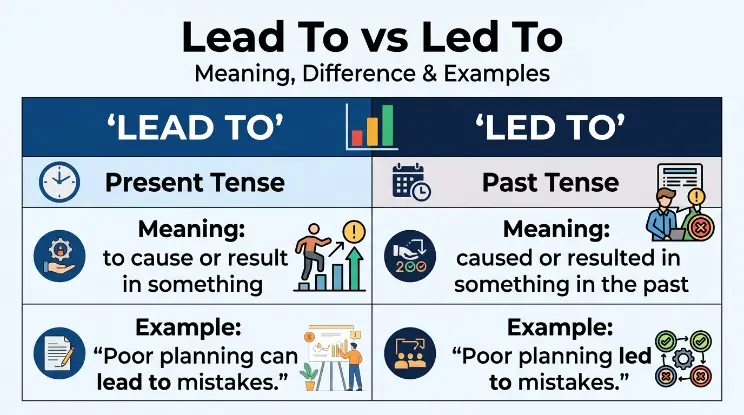
“Lead to” is present tense, while “led to” is past tense. Use “lead to” when talking about something happening now or generally, and “led to” when describing something that already happened.
What Does “Lead To” Mean? 📖
“Lead to” is the present tense form of the verb “lead,” meaning to cause, result in, or guide toward something. It’s used when talking about current, ongoing, or general situations.
Common Uses of “Lead To”
- Present tense action:
- “Skipping breakfast can lead to low energy throughout the day.”
- “This road will lead to the city center.”
- General truths or habitual outcomes:
- “Poor communication often leads to misunderstandings.” (note: “leads” for third-person singular)
- “Hard work usually leads to success.”
- Future/conditional statements:
- “If we don’t act now, this issue could lead to bigger problems.”
- “Ignoring the warning signs may lead to serious consequences.”
💡 Grammar note: With singular subjects (he/she/it), you add an “s” “leads to,” not “lead to.” Example: “Stress leads to health issues.”
What Does “Led To” Mean? 📖
“Led To” is the past tense form of “lead,” used to describe something that already happened and resulted in a specific outcome.
Common Uses of “Led To”
- Describing past events:
- “The investigation led to several important discoveries.”
- “Her hard work led to a well-deserved promotion.”
- Historical or narrative context:
- “The treaty led to decades of peace between the two nations.”
- “A small disagreement led to a major fallout between the friends.”
- Cause-and-effect storytelling:
- “His mistake led to the company losing a major client.”
- “The heavy rainfall led to widespread flooding in the region.”
⚠️ Common confusion alert: The word “lead” (rhymes with “bead”) is a present-tense verb, but “lead” is also a noun referring to the metal (rhymes with “bed”)! This is exactly why people get tripped up when typing “led” vs “lead.”
Which Is Correct, Led to or Lead to?
Both “led to” and “lead to” are correct, but they are used in different tenses. Lead to is used for the present or future, while led to is used for the past. The verb led is the past tense and past participle of lead.
For example: “Poor planning can lead to problems” refers to a general or future result. “Poor planning led to problems” means the problems happened in the past.
Which Is Correct: “It Led to” or “It Lead to”?
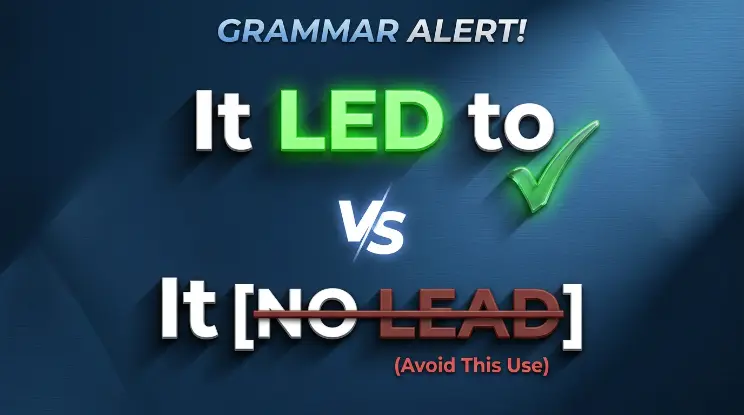
The correct choice depends on the tense. “It led to” is correct when talking about something that happened in the past. For example, “The mistake led to a serious problem.”
“It lead to” is usually incorrect because after it, we normally use leads to in the present tense. For example, “It leads to better results.” Therefore, use led to for the past and leads to for the present.
Which One Is Correct, Led or Lead?
Both led and lead are correct words, but they have different uses. Lead is usually the present form of the verb, meaning to guide or cause something to happen. Led is the past tense of lead.
For example: “She leads the team” is present tense, while “She led the team yesterday” is past tense. Remember that led is always used when describing a completed action in the past.
Comparison Table: Lead To vs Led To 📊
| Feature | Lead To | Led To |
| Tense | Present tense | Past tense |
| Pronunciation | Rhymes with “seed” | Rhymes with “bed” |
| Usage | Describes current or general outcomes | Describes past, completed outcomes |
| Example Sentence | “Exercise can lead to better health.” | “Regular exercise led to better health.” |
| Third-Person Singular | “Leads to” (he/she/it leads to) | Stays the same: “led to” |
| Common Mistake | Using “lead” when past tense is needed | Using “led” when present tense is needed |
Common Mistakes People Make ❌
- Using “lead to” instead of “led to” for past events
- ❌ “The meeting lead to a major decision.”
- ✅ “The meeting led to a major decision.”
- Using “led to” instead of “lead to” for present/future situations
- ❌ “This habit could led to bigger issues.”
- ✅ “This habit could lead to bigger issues.”
- Confusing “lead” (verb) with “lead” (the metal)
- “Lead” as a noun (the metal) is always pronounced like “bed,” which visually matches “led” this is the biggest source of confusion!
- Forgetting the “s” for third-person singular
- ❌ “She lead to great results every time.”
- ✅ “She leads to great results every time.” (or better: “Her efforts lead to great results”)
What Are Common Mistakes Using Lead and Led?
A common mistake is using lead when led is needed for a past action. For example, “The decision lead to problems” is incorrect; the correct sentence is “The decision led to problems.”
Another common mistake is forgetting to use leads with he, she, or it in the present tense. For example, “It lead to success” is incorrect. The correct form is “It leads to success.” Understanding the tense of the sentence helps you choose the correct word.
Memory Trick to Never Mix These Up Again 🧠
Here’s a foolproof way to remember the difference:
“Led” is short, quick, and already done just like the past. ⏳ Think: “led” and “already happened” both feel finished.
“Lead” (verb) is longer and ongoing, just like the present or future. 🚀 Think: “lead” sounds like “leed,” pointing forward.
Quick trick using the metal analogy:
- Lead (the metal) is heavy and pronounced like “bed” and so is “led” (past tense). Same sound, similar heaviness of “it already happened.”
- Lead (the verb, present tense) rhymes with “need” think of needing to do something now or in the future.
Real-Life Examples From Everyday Communication 🗣️
📧 In Emails
“This delay led to a shift in our project timeline, so please review the updated schedule.”
📱 On Social Media
“Consistency is everything small daily habits lead to big results over time. 💪”
📰 In News Writing
“The scandal led to the resignation of several top officials.”
🎓 In Academic Writing
“The study found that chronic stress can lead to long-term health complications.”
💬 In Everyday Speech
“Honestly, that one conversation led to us becoming best friends.”
British vs American English: Any Differences? 🇬🇧🇺🇸
Good news there’s no spelling or usage difference between British and American English here. Both dialects follow the same tense rules for “lead” and “led.”
| Region | Usage Notes |
| British English | Same present/past tense rule applies: “lead to” vs “led to” |
| American English | Identical usage and pronunciation patterns |
| Both | The noun “lead” (the metal) is spelled and pronounced the same way in both dialects |
Why This Mistake Is So Common (and Trending in Writing Circles) 📈
Because “lead” (present tense verb) and “lead” (the metal noun) are spelled identically but pronounced differently, this creates a ripple effect of confusion when writers try to form the past tense. Many people visually associate “led” with the metal’s pronunciation and mistakenly assume “lead” should also work as the past tense but it doesn’t.
This is a frequently searched grammar tips topic, especially among:
- Content writers and bloggers double-checking cause-and-effect sentences
- Students writing essays with historical or analytical narratives
- Non-native English speakers learning irregular verb conjugations
Mastering this distinction instantly improves the correct spelling and professionalism of your writing.
FAQs: People Also Ask ❓
1. Is it “led to” or “lead to” in past tense?
It’s “led to” for past tense. “Lead to” is only correct for present or future tense situations.
2. Why is “lead” pronounced differently in different contexts?
“Lead” (the verb, present tense) rhymes with “need,” while “lead” (the metal, a noun) rhymes with “bed” the same way “led” (past tense) is pronounced.
3. What is the past tense of “lead”?
The correct past tense of “lead” is “led,” not “lead” or “leaded.”
4. Is “leaded” ever correct?
No, “leaded” is not the correct past tense of the verb “lead.” However, “leaded” is used as an adjective referring to something containing lead (the metal), like “leaded gasoline.”
5. How do I know when to use “leads to” instead of “lead to”?
Use “leads to” with singular third-person subjects (he, she, it), such as “This app leads to better productivity.”
6. Is there a difference between British and American English for this rule?
No, both use identical present and past tense rules for “lead” and “led.”
7. What’s an easy way to remember the difference between lead and led?
Remember: “led” (past tense) sounds like the metal “lead,” while “lead” (present tense verb) rhymes with “need” and points toward the future.
8. Can “lead” be used as a noun as well as a verb?
Yes “lead” can mean a metal element, a leash for a pet (in British English), or the main role in a performance, in addition to being a verb meaning to guide or cause something.
Final Takeaway: Led To or Lead To? 🎯
Here’s your complete cheat sheet:
- ✅ Lead to = present/future tense (“This will lead to success.”)
- ✅ Led to = past tense (“That decision led to success.”)
- 🧠 Memory trick: “Led” sounds like the metal heavy and already done. “Lead” (verb) rhymes with “need” forward-looking.
- ⚠️ Watch out for the noun “lead” (the metal), which is spelled like the present tense verb but pronounced like the past tense!
With this rule locked in, you’ll never second-guess your sentences again whether you’re writing about something that already happened or something still unfolding. Onward to grammatically correct writing! 🚀
Read More About This
Girlies or Girlys? The Correct Spelling You Need to Know 💅✨2026
Master’s or Masters? The Apostrophe Confusion Everyone Gets Wrong 2026
Coliseum or Colosseum: Correct Spelling and Meaning for 2026
Artic or Arctic: Which Spelling Is Actually Correct? 2026

Sophia Collins is a passionate English grammar writer at GrammBoost.com who loves making the English language simple and easy to understand. She creates clear, beginner-friendly guides on grammar, spelling, word differences, and common language mistakes. Her goal is to help students, writers, and English learners build confidence and improve their writing through practical, easy-to-follow explanations.