Have you ever written a report, blog post, or LinkedIn caption and paused right before typing “in-depth” unsure whether that little hyphen actually belongs there? 🤔
Maybe you’ve even seen both versions floating around online and wondered which one search engines and grammar experts actually consider correct.
This is one of the most common spelling mistakes in professional and everyday English writing. The good news? Once you understand the simple rule behind it, you’ll never second-guess yourself again.
Quick Answer: In-Depth or Indepth?
“In-depth” (with a hyphen) is the only correct spelling. “Indepth” (written as one word) is a common misspelling and is not recognized as a valid word in standard English dictionaries.
What Does “In-Depth” Mean? 📖
In-depth is a compound adjective that describes something thorough, detailed, and comprehensive the opposite of shallow, brief, or surface-level.
Correct Examples of “In-Depth”
- “The reporter published an in-depth investigation into local corruption.”
- “We need an in-depth review of this year’s marketing performance.”
- “Her in-depth knowledge of tax law impressed the entire panel.”
- “This is an in-depth guide to mastering English grammar.”
When It’s Written Without a Hyphen
When the same idea appears after a verb (functioning as an adverbial phrase instead of a describing word before a noun), it’s written as two separate words, with no hyphen:
- “Let’s discuss this in depth during our next meeting.”
- “The article explains the topic in depth.”
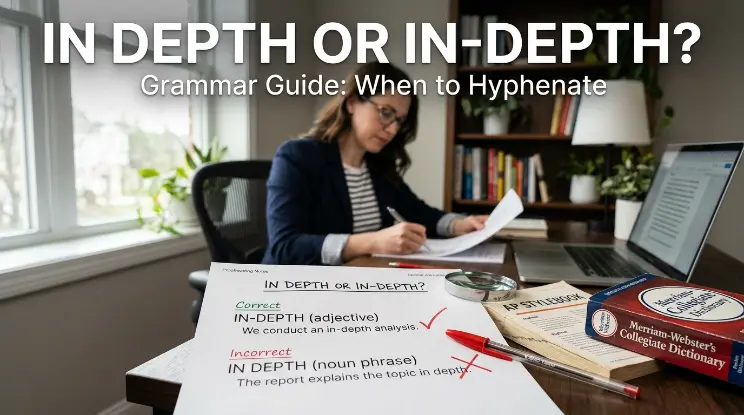
📌 Simple rule: Hyphen before a noun → “in-depth analysis.” No hyphen after a verb → “explained in depth.”
Why “Indepth” Is Incorrect ❌
“Indepth” spelled as a single word is not a recognized word in any major English dictionary, including Merriam-Webster, Oxford, or Cambridge. It’s simply a common mistake that happens for a few understandable reasons:
Why People Make This Mistake
- ⌨️ Fast typing habits hyphens are easy to skip when typing quickly
- 📱 Autocorrect gaps many keyboard apps don’t flag missing hyphens
- 🧠 Compound word confusion English has many words that merge into one (“nowadays,” “however”), so people assume “in-depth” follows the same pattern
- 🎓 Limited grammar exposure compound adjective rules aren’t always taught explicitly
🚫 Golden rule: Never use “indepth” in essays, resumes, professional emails, or published content. Always choose “in-depth” or “in depth” depending on sentence position.
Indepth or In Depth Meaning

In depth is the correct form when you mean something detailed, thorough, or carefully examined. Indepth is generally considered incorrect in standard English. When used before a noun, in-depth is usually hyphenated, such as “an in-depth analysis.” When used after a verb, write it as two words: “We discussed the topic in depth.”
In-Depth in a Sentence
In-depth is used as an adjective before a noun to describe something detailed or comprehensive. For example: “The teacher gave us an in-depth explanation of the subject.” Here, “in-depth” shows that the explanation was thorough and covered the topic carefully. Remember that in-depth usually comes before a noun.
In-Depth Knowledge Meaning
In-depth knowledge means having a deep, detailed, and thorough understanding of a particular subject. Someone with in-depth knowledge understands not only the basic facts but also the important details, reasons, and connections involved. For example, “She has in-depth knowledge of digital marketing” means she understands digital marketing very well.
In-Depth or In Depth Conversation

When describing a conversation as detailed or thorough, in-depth conversation is the correct form because it comes before the noun “conversation.” For example: “We had an in-depth conversation about our future plans.” If the phrase comes after the verb, use two words: “We talked in depth about our future plans.”
In-Depth or In Depth Synonym
Common synonyms for in-depth include thorough, detailed, comprehensive, extensive, deep, and exhaustive. The best synonym depends on the context and how detailed something is. For example, “an in-depth study” can also be called “a thorough study” or “a comprehensive study.” These words all suggest careful and detailed examination.
In Depth or In-Depth
| Form | Correct? | When to Use | Example |
|---|---|---|---|
| in depth | ✅ Correct | Usually used as an adverbial phrase, meaning thoroughly or in detail | We discussed the topic in depth. |
| in-depth | ✅ Correct | Usually used as an adjective before a noun | She gave an in-depth analysis. |
| indepth | ❌ Incorrect | Not the standard spelling | ❌ We had an indepth discussion. |
| in depth analysis | ❌ Usually incorrect | Use the hyphen when it directly modifies a noun | ❌ an in depth analysis |
| in-depth analysis | ✅ Correct | Compound adjective before a noun | We need an in-depth analysis. |
Quick rule:
in-depth → before a noun: We conducted an in-depth study.
in depth → after the verb: We studied the issue in depth.
indepth or in-depth
| Form | Correct Usage | Example |
|---|---|---|
| In-depth | Usually used as an adjective before a noun. The hyphenated form is the standard choice. | She gave an in-depth analysis of the topic. |
| In depth | Used as an adverbial phrase, usually after a verb. | We discussed the topic in depth. |
| Indepth | Generally considered incorrect in standard English. | ❌ We had an indepth discussion. |
Comparison Table: In-Depth vs In Depth vs Indepth 📊
| Form | Correct? | Grammar Role | Example |
| In-depth | ✅ Yes | Adjective (before noun) | “An in-depth report was released.” |
| In depth | ✅ Yes | Adverbial phrase (after verb) | “They studied the issue in depth.” |
| Indepth | ❌ No | Not a real word | “An indepth report was released.” ❌ |
Bookmark this table it’s the fastest way to double-check your sentence structure before hitting “publish” or “send.” 📌
Common Mistakes to Avoid 🚩
- Removing the hyphen before a noun
- ❌ “This is an indepth explanation.”
- ✅ “This is an in-depth explanation.”
- Adding an unnecessary hyphen after a verb
- ❌ “We reviewed it in-depth.”
- ✅ “We reviewed it in depth.”
- Assuming “indepth” is a shortcut spelling
- ❌ “Her indepth research impressed the board.”
- ✅ “Her in-depth research impressed the board.”
- Inconsistent hyphen use across one document
- Many writers unknowingly switch between “in-depth” and “in depth” without following the position-based rule consistently.
Memory Trick to Never Forget This Rule 🧠
Here’s a mnemonic that makes the rule stick permanently:
🌉 Before a noun = build a bridge (hyphen) “in-depth analysis”
🚶 After a verb = let the words walk separately (no hyphen) “explained in depth”
And always remember:
❌ “Indepth” (one word) is never correct no bridge, no separation, just a mistake.
Real-Life Examples From Everyday Communication 🗣️
📧 In a Professional Email
“Please find attached our in-depth proposal for the Q3 marketing campaign.”
📱 On Social Media
“New blog post is live! An in-depth guide to budget travel in 2026 ✈️ Link in bio.”
📰 In News Writing
“The network aired an in-depth special on renewable energy policies.”
🎓 In Academic Writing
“This paper offers an in-depth analysis of adolescent learning behaviors.”
💬 In Everyday Speech
“Can we go over this in depth tomorrow? I don’t think we have time right now.”
British vs American English: Any Differences? 🇬🇧🇺🇸
There is no spelling difference between British and American English here both use the same hyphenation rule.
| Region | Usage Note |
| British English | Follows the same before-noun hyphen rule |
| American English | Style guides like AP and Chicago also require the hyphen before a noun |
| Both | “Indepth” is considered incorrect everywhere |
No matter your audience, the rule remains identical worldwide. ✅
Why Getting This Right Matters for SEO & Credibility 📈
Search engines and readers both associate correct spelling and clean grammar with trustworthy, high-quality content. Using “indepth” instead of “in-depth” in blog titles, headings, or meta descriptions can:
- Hurt your content’s professionalism 🧐
- Confuse readers scanning for accurate information 📉
- Signal lower content quality to search algorithms 🔍
If you’re writing SEO content, resumes, or research papers, mastering small details like this along with related grammar tips and English usage rules helps your writing look polished and authoritative.
FAQs: People Also Ask ❓
1. Is “indepth” a real word?
No. “Indepth” is not found in any major English dictionary. The correct spellings are “in-depth” (before a noun) or “in depth” (after a verb).
2. When do I use a hyphen with “in-depth”?
Use the hyphen when “in-depth” comes directly before the noun it describes, such as “an in-depth study.”
3. Is “in depth” ever correct without a hyphen?
Yes when it functions as an adverbial phrase after a verb, like “explained in depth,” no hyphen is needed.
4. Why do people confuse indepth and in-depth?
Because English has many compound words that merge into one term, people mistakenly assume “in-depth” follows the same pattern but it doesn’t.
5. Is “in-depth” used differently in British vs American English?
No, both use identical hyphenation rules for this phrase.
6. Can “in-depth” be used in formal or academic writing?
Absolutely it’s commonly used in research papers, business reports, and journalism to describe thorough analysis.
7. Is “very in-depth” grammatically correct?
It’s used colloquially, but many style guides discourage it since “in-depth” already implies thoroughness on its own.
8. What’s the easiest way to remember the difference?
Use the mnemonic: hyphen before a noun (bridge 🌉), no hyphen after a verb (walking apart 🚶). And never use “indepth” as one word.
Final Takeaway: In-Depth or Indepth? 🎯
Quick recap before you go:
- ✅ In-depth (hyphenated) = correct before a noun
- ✅ In depth (two words) = correct after a verb
- ❌ Indepth (one word) = always incorrect
- 🧠 Memory trick: hyphen = bridge before a noun, no hyphen = separate words after a verb
With this simple rule locked in, you’ll confidently use “in-depth” correctly in every report, article, email, or academic paper you write from now on. No more hyphen hesitation! 🎉
Read More About This
Innie or Outie: Meaning, Differences, and Common Questions for 2026
Trys or Tries: Spelling Differences You Need to Know for 2026
Crain or Crane: Learn the Correct Word with Easy Examples for 2026
Realest or Realist: Meaning, Differences, and Correct Usage 2026

James Carter is an English language enthusiast and content writer who loves making grammar simple and easy to understand. He creates clear, beginner-friendly guides on spelling, grammar rules, confusing words, and everyday English usage. His goal is to help readers write with confidence through practical examples, easy explanations, and accurate language tips.