Ever caught yourself staring down at your stomach, poking your belly button, and thinking, “Wait… is this normal?” 😅 You’re definitely not alone.
“Innie or outie” is one of those phrases everyone has heard, giggled about, or Googled at 2 a.m. but very few people actually understand what causes the difference, whether one is “better,” or what it means for health.
This confusion is super common because belly buttons don’t come with an instruction manual. We just have them, and society loves to joke about them, but rarely explains them. So today, we’re clearing up the myths, the biology, and the language around innie vs outie belly buttons in a simple, friendly, no-awkwardness way.
Quick Answer 🎯
An innie is a belly button that curves inward, creating a small dent in the stomach this is the most common type. An outie is a belly button that pokes outward, forming a small bump this happens in a smaller percentage of people, usually due to how the umbilical cord healed after birth. Neither one is “better,” healthier, or more normal they’re just two natural variations of the same body part.
What Exactly Is an “Innie”? 🔽
An innie belly button is the type that sinks inward into the abdomen, forming a small hollow or dip.
Key facts about innies:
- Roughly 90% of people have an innie 🧍♀️🧍♂️
- It forms when the belly button skin folds inward after the umbilical cord stump falls off
- It’s considered the “typical” or statistically common shape
- It can still vary in depth some innies are shallow, some are deep
Examples in a sentence:
- “I’ve always had an innie, so wearing crop tops never feels weird.”
- “Her baby was born with a cute little innie belly button.”
- “Most swimsuit models in ads have innies, but that doesn’t mean it’s the ‘correct’ type.”
What Exactly Is an “Outie”? 🔼
An outie belly button pokes outward, forming a small raised bump instead of a dent.
Key facts about outies:
- Only about 10% of people have an outie
- It usually happens when scar tissue from the umbilical cord heals in a way that pushes outward
- In rare cases, an outie in adulthood can be linked to an umbilical hernia (a medical condition where tissue pushes through the abdominal wall) this is worth mentioning to a doctor if it’s new, painful, or growing
- Most outies are completely harmless and just a natural variation
Examples in a sentence:
- “My brother has an outie, and he used to get teased about it as a kid, which honestly wasn’t fair.”
- “The doctor checked the baby’s outie just to be safe, but everything was fine.”
- “She joked that her outie makes it hard to wear certain fitted shirts.”
What Is an Outie Down There?Outie Meaning
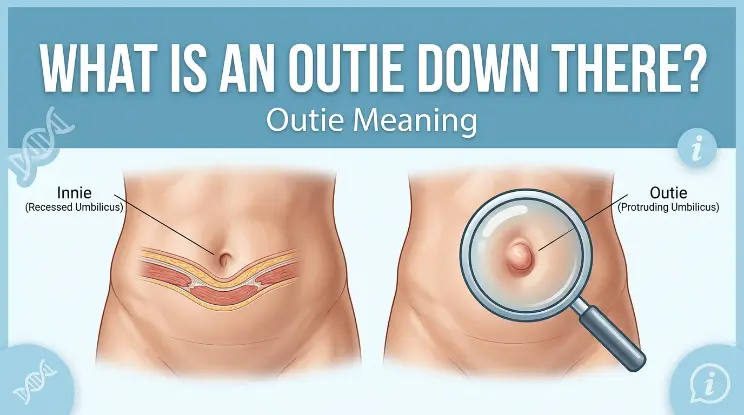
Outie is an informal word most commonly used to describe a belly button (navel) that sticks outward instead of going inward. The standard medical term is umbilical protrusion, but “outie” is the everyday term people commonly use. The opposite is an innie, which is a belly button that goes inward. For example, “I have an outie” simply means “My belly button sticks out.” An outie is a normal variation in belly-button shape and does not necessarily indicate a problem.
| Term | Meaning | Example |
|---|---|---|
| Outie | A belly button that sticks outward | “He has an outie.” |
| Innie | A belly button that goes inward | “She has an innie.” |
| Belly button | Common name for the navel | “My belly button is an outie.” |
| Navel | More formal/medical term for belly button | “The navel can be an innie or outie.” |
Outie in Simple Words
Outie = a belly button that sticks out.
Innie = a belly button that goes in.
An “outie down there” is a casual term used to describe a vulva where the inner labia (labia minora) extend beyond the outer labia (labia majora). The inner lips may be slightly visible or noticeably longer, and they can vary in shape, size, colour, and symmetry. This is a completely normal natural variation of female anatomy. Having an outie does not mean that anything is wrong or unhealthy.
Outie vs Innie V Diagram
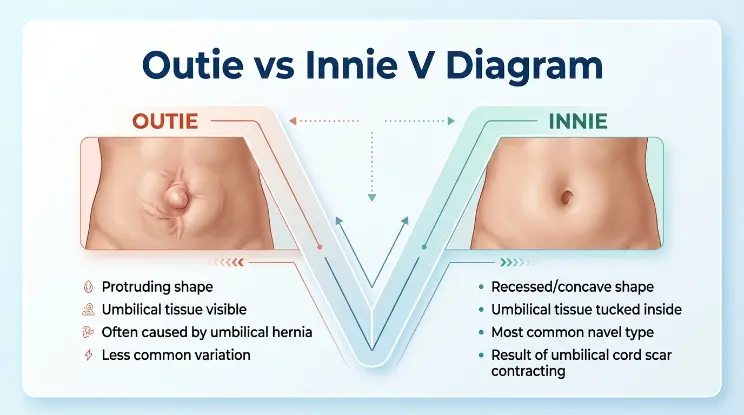
An innie and an outie describe the visible appearance of the vulva. In an innie, the inner labia are mostly covered or enclosed by the outer labia. In an outie, the inner labia extend beyond the outer lips and are more visible. A V diagram can help show this general difference, although every person’s anatomy looks unique. Both innies and outies are normal and common.
Outie vs Innie Lips
Outie and innie lips refer to the appearance and position of the labia, not to a medical condition. lips usually mean the inner labia extend past the outer labia, while innie lips remain mostly hidden inside the outer lips. The size and shape of the labia can naturally differ from person to person and may not be perfectly symmetrical. Neither type is better, more attractive, or healthier than the other.
Innie vs Outie: Comparison Table 📊
| Feature | Innie 🔽 | Outie 🔼 |
| Shape | Curves inward, forms a dent | Pokes outward, forms a bump |
| Population % | ~90% of people | ~10% of people |
| Cause | Umbilical scar folds inward | Umbilical scar heals outward |
| Health concern? | Rarely | Occasionally linked to umbilical hernia (if new/painful) |
| Common myth | “It’s the normal one” | “It’s abnormal or unhealthy” |
| Reality | Just one natural variation | Just another natural variation |
| Formed by | How umbilical cord stump detaches | Same process, different healing pattern |
Outie vs. Innie
| Term | Meaning | Explanation |
|---|---|---|
| Outie | A belly button that sticks outward | An outie is a navel that protrudes or points outward from the stomach. |
| Innie | A belly button that goes inward | An innie is a navel that forms a small hollow or dip inward. |
| Main Difference | Shape of the belly button | The main difference is that an outie sticks out, while an innie goes in. |
| Commonness | Innie is more common | Most people have an innie, while outies are less common. |
Is it more common to have an innie or an outie V
| Topic | Information |
|---|---|
| Is an innie or outie more common? | Innie belly buttons are much more common than outies. Most people have an innie, while only a small percentage have an outie. |
| Innie belly button | An innie curves inward and usually forms naturally as the umbilical cord area heals after birth. |
| Outie belly button | An outie sticks outward. It can result from the way the belly button heals and is a normal variation. |
| Which is normal? | Both innies and outies can be completely normal. The shape of a belly button does not determine a person’s health or beauty. |
Common Mistakes and Myths About Innie vs Outie ❌➡️✅
Just like grammar rules trip people up, belly button “rules” get misunderstood too! Here are the biggest myths:
Myth 1: “Outies are unhealthy”
Truth: Most outies are perfectly healthy. Only a small number are related to hernias, and that’s usually diagnosed by a doctor, not just by looking at it.
Myth 2: “You can predict a baby’s belly button type before birth”
Truth: Nope! It depends on how the umbilical cord heals after birth, not genetics predicting it in advance.
Myth 3: “Innies are more attractive or normal”
Truth: This is 100% a social myth, not a medical fact. Both types are completely natural.
Myth 4: Confusing “innie” and “outie” spelling
People often misspell these fun, informal words. Here’s a quick mnemonic to remember:
🧠 Memory Trick:
- Innie = “IN” + “nie” → think “IN-ward” (goes IN)
- Outie = “OUT” + “ie” → think “OUT-ward” (pokes OUT)
Also remember:
- ✅ Innie (correct)
- ❌ Inny (incorrect, though sometimes seen casually)
- ✅ Outie (correct)
- ❌ Outty / Owtie (incorrect)
Real-Life Examples: Where You’ll See “Innie or Outie” Used 💬
In Social Media Posts
“POV: you’re 8 months pregnant and your innie just became an outie 😩🍼 #pregnancylife”
In Casual Text Messages
“lol wait do you have an innie or outie? asking for science 🤣”
In Parenting Forums
“My newborn’s belly button looks like it’s turning into an outie is that normal after the cord falls off?”
In Health/Medical Articles
“While most belly button shapes are cosmetic, a new outie in adulthood accompanied by pain should be evaluated for a possible hernia.”
In Everyday Conversation
“Innie or outie?” is basically the belly-button version of “cats or dogs” a fun icebreaker question people ask at sleepovers, parties, or even job interviews (yes, really, some people use it as a quirky ice-breaker!).
Innie or Outie: Does Pregnancy Change It? 🤰
Fun fact: many people notice their innie temporarily turns into an outie during pregnancy. This happens because:
- The growing uterus pushes against the abdominal wall
- This pressure can pop the belly button outward temporarily
- It usually returns to its original shape a few months after birth
This is one of the most searched pregnancy-related questions, right alongside “why does my belly button hurt” and “is it normal for my belly button to pop out.”
British vs American English: Any Differences? 🇬🇧🇺🇸
Good news this is one case where there’s no real regional spelling difference! Both British and American English use:
- Innie
- Outie
These are informal, universally recognized terms in English-speaking countries. However, in more formal or medical writing, both regions tend to avoid slang and instead use:
- “Umbilicus” (medical term for belly button)
- “Inverted navel” (formal term for innie)
- “Protruding navel” (formal term for outie)
Usage Tip: Use “innie/outie” in casual writing, blogs, and conversations but switch to “inverted” or “protruding navel” in academic, clinical, or professional writing. ✍️
Innie or Outie: Quick Keyword Cheat Sheet 🔑
| Term | Best Used In |
| Innie / Outie | Casual conversation, blogs, social media |
| Belly button | Everyday, kid-friendly language |
| Navel | Slightly more formal, but still common |
| Umbilicus | Medical/clinical writing |
| Inverted navel | Formal term for innie |
| Protruding navel | Formal term for outie |
| Umbilical hernia | Medical condition (not the same as a normal outie) |
FAQs: People Also Ask About Innie or Outie 🙋
1. Is it normal to have an outie belly button?
Yes! About 10% of people naturally have an outie, and it’s completely normal in most cases.
2. Can an innie turn into an outie later in life?
Yes, this can happen due to pregnancy, significant weight gain, or in rare cases, an umbilical hernia. If it happens suddenly and painfully, see a doctor.
3. What causes someone to have an innie or outie?
It depends on how the umbilical cord scar heals after birth not on how the cord was cut, despite the popular myth.
4. Does the way the umbilical cord is cut determine innie or outie?
No, this is a common misconception. The healing process of the scar tissue, not the cutting technique, determines the shape.
5. Are outies more likely to have health problems?
Not usually. Most outies are cosmetic. However, a new outie with pain, swelling, or bulging in adulthood could indicate a hernia and should be checked by a doctor.
6. Is “innie or outie” used outside of talking about belly buttons?
Yes! It’s sometimes used playfully to describe other things that go inward or outward, but its most common and popular use is definitely about belly buttons.
7. How do I spell “innie” and “outie” correctly?
The correct spellings are innie and outie not “inny” or “outty.” Use the memory trick: IN goes IN, OUT goes OUT!
Conclusion:
At the end of the day, you have an innie or an outie, your belly button is just a natural scar left over from your very first physical connection to your mom. There’s no “correct” one just two common variations that are part of everyday human anatomy.
So next time someone asks, “Innie or outie?” you’ll not only have an answer, but you’ll also know the science, the spelling, and the fun facts behind it! 😄
Read More About This
Trys or Tries: Spelling Differences You Need to Know for 2026
Crain or Crane: Learn the Correct Word with Easy Examples for 2026
Realest or Realist: Meaning, Differences, and Correct Usage 2026
In-Depth or Indepth? The Correct Spelling Explained Simply 2026

Olivia Bennett is a passionate English grammar writer at GrammBoost.com who loves making grammar simple and easy to understand. She specializes in spelling, word differences, punctuation, and everyday English usage. Through clear explanations and practical examples, Olivia helps students, writers, and professionals write with greater confidence and accuracy.