Have you ever typed the word “vacuum” and paused halfway through, wondering, “Wait… is it one C or two? One U or two?” You’re definitely not alone!
This is one of the most commonly misspelled words in the English language, and honestly, it trips up even native speakers, editors, and English teachers.
If you’ve ever written “vaccum,” “vaccuum,” or “vacume” and then stared at it suspiciously this article is for you. Let’s clear up the confusion once and for all. 🧹
Quick Answer ⚡
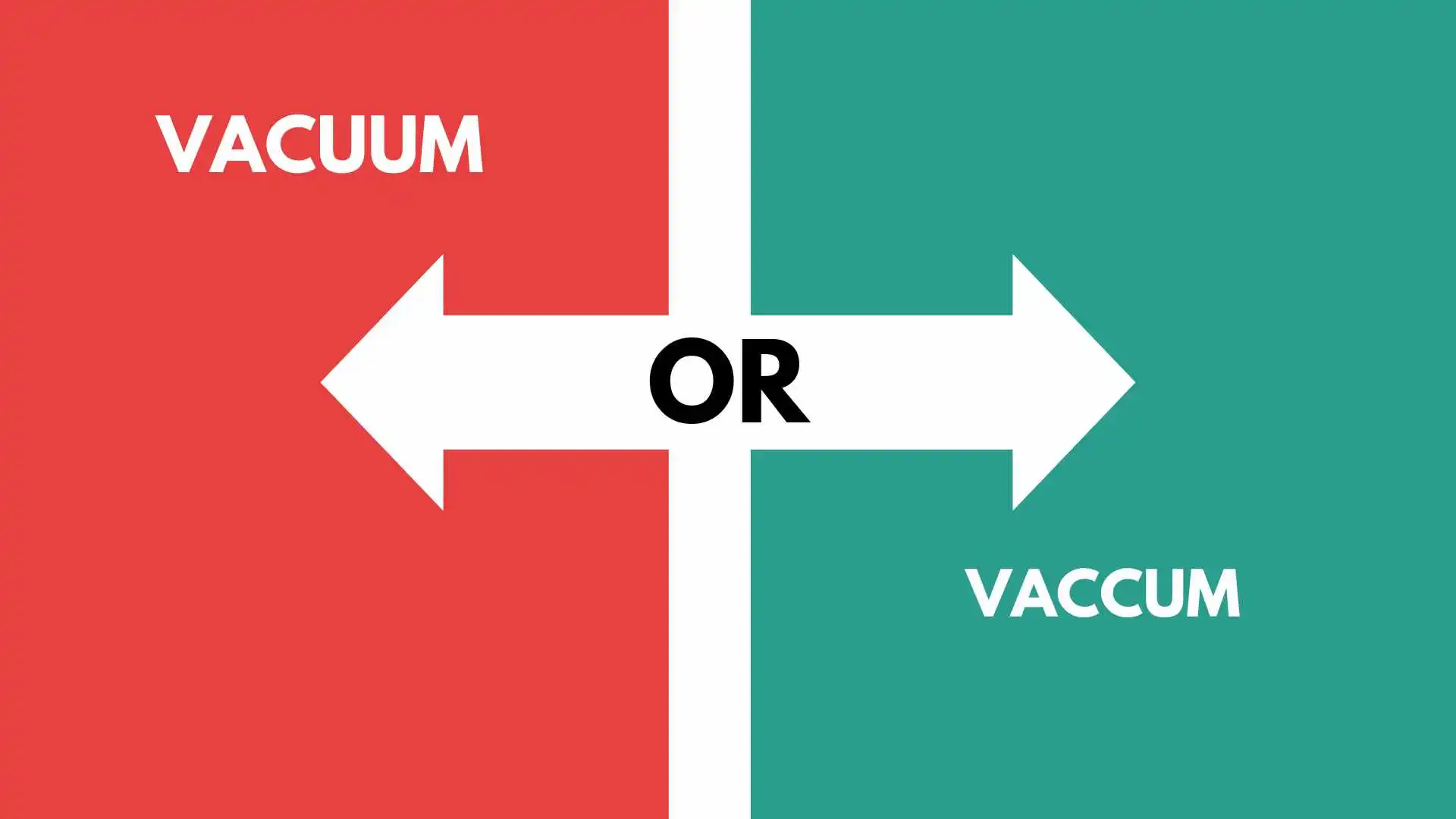
“Vacuum” is the only correct spelling. “Vaccum” is simply a common misspelling it doesn’t exist as a real word in standard English dictionaries. Just remember: two U’s, one C “vac-UU-m.”
What Does “Vacuum” Actually Mean?
Before we dig into spelling tricks, let’s understand the word itself. Vacuum is a noun (and sometimes a verb) with a few different meanings:
1. Vacuum as a Noun (Physics/Science)
A vacuum refers to a space completely empty of matter, including air.
- 🚀 “Astronauts must wear special suits because outer space is a vacuum.”
- 🔬 “The experiment was conducted inside a vacuum chamber.”
2. Vacuum as a Noun (Everyday Object)
It also refers to a vacuum cleaner the household appliance we use to clean floors and carpets.
- 🏠 “I need to buy a new vacuum; mine stopped working.”
- 🐾 “The vacuum is great for picking up pet hair.”
3. Vacuum as a Verb (Action)
When used as a verb, “vacuum” means to clean using a vacuum cleaner.
- 🧹 “Can you vacuum the living room before guests arrive?”
- 📅 “I vacuum my apartment every Sunday.”
4. Vacuum (Figurative Meaning)
It can also describe an emotional or situational “emptiness” or gap.
- 💔 “Her sudden departure left a vacuum in the team.”
- 🏛️ “The lack of leadership created a power vacuum.”
Why Is “Vacuum” So Hard to Spell? 🧠
Here’s the sneaky part: most English words follow predictable spelling patterns, but “vacuum” breaks the rules a little. It comes from the Latin word “vacuus,” meaning “empty.” That Latin root is why it has the unusual double-U pattern something rare in English!
Because our brains expect familiar patterns (like “vaccine,” which does have double C), we often accidentally borrow that double-C pattern and misspell “vacuum” as “vaccum.” It’s a classic case of spelling interference from a similar-looking word.
Which Is Correct, Vacuum or Vaccum?
Vacuum is the correct spelling, while vaccum is an incorrect spelling. The word vacuum is used as a noun for a space containing little or no matter, and it can also refer to a machine used for cleaning floors and carpets. As a verb, vacuum means to clean something with a vacuum cleaner. For example, you can say, “I need to vacuum the carpet” or “The vacuum is in the closet.” A simple way to remember the spelling is VACUUM — it has one C and two U’s.
Vacuum vs Vaccum: Comparison Table 📊
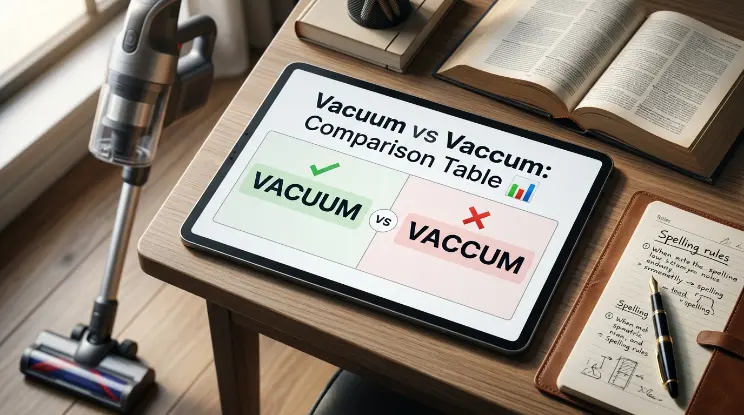
| Feature | ✅ Vacuum | ❌ Vaccum |
| Correct spelling? | Yes | No |
| Found in dictionaries? | Yes | No |
| Word origin | Latin “vacuus” (empty) | N/A (misspelling) |
| Common usage | Noun & verb | Not applicable |
| Example sentence | “I need to vacuum the carpet.” | ❌ Incorrect usage |
| Pronunciation | /ˈvæk.juːm/ | N/A |
As you can see, “vaccum” simply isn’t a real word it’s a spelling error that happens because of how our brains process similar-sounding or similar-looking words.
Vacuum or Vaccum
| Point | Vacuum | Vaccum |
|---|---|---|
| Spelling | ✅ Correct | ❌ Incorrect |
| Standard form | Vacuum | Vaccum |
| Letters | V-A-C-U-U-M | V-A-C-C-U-M |
| Meaning | A space containing little or no matter | No standard English meaning in this spelling |
| As a noun | A space with very little matter, or a cleaning machine | Incorrect spelling |
| As a verb | To clean something using a vacuum cleaner | Incorrect spelling |
| Pronunciation | Usually pronounced like “VAK-yoom” | Not a standard word |
| Plural | Vacuums | ❌ Vaccums |
| Verb form | Vacuumed | ❌ Vaccumed |
| Present participle | Vacuuming | ❌ Vaccuming |
| Common phrase | Vacuum cleaner | ❌ Vaccum cleaner |
| Example 1 | I need to vacuum the carpet. | ❌ I need to vaccum the carpet. |
| Example 2 | The vacuum is in the closet. | ❌ The vaccum is in the closet. |
| Why people confuse them | The spelling contains two u’s, which can be easy to miss. | Often written by mistake because people expect the word to contain two c’s. |
| Correct choice | ✅ Use vacuum | ❌ Do not use vaccum |
Easy way to remember: The correct spelling is VACUUM it has one C and two U’s: V-A-C-U-U-M
Common Misspellings of “Vacuum” 😅
You’d be surprised how many ways people accidentally spell this word! Here are the most frequent mistakes:
- ❌ Vaccum
- ❌ Vaccuum
- ❌ Vacume
- ❌ Vaccume
- ❌ Vacum
✅ The only correct version is: Vacuum
Memory Trick to Never Misspell “Vacuum” Again 🧠✨
Here’s a fun mnemonic to lock this spelling into your memory forever:
“U U love your Vacuum, so give it Two U’s and one C!”
Or try this visual trick:
- Think of the word as VAC + UUM
- Picture two vacuum tubes side by side (UU) sucking up dust 🧹💨
- Only one C, like there’s only “one Cleaner” doing the job!
Another popular trick among teachers:
- “Vacuum has UU, like two zeros (00) because a vacuum is empty!” Since a vacuum literally means “nothing” or “emptiness,” associating it with double zeros can help reinforce both the meaning and the spelling.
Real-Life Examples of “Vacuum” in Use 🌍
Let’s look at how this word pops up in different real-world contexts:
📧 In Emails
“Hi team, please remember to vacuum the meeting room before client visits this week.”
📱 On Social Media
“Just bought a robot vacuum and I’m obsessed 🤖🧹 #CleaningHacks”
📰 In News Headlines
“Political Vacuum Emerges After Sudden Resignation of Prime Minister”
🎓 In Academic Writing
“The study was conducted in a vacuum environment to eliminate air resistance.”
🗣️ In Everyday Speech
“Ugh, I still haven’t vacuumed the stairs remind me later!”
Notice how the word smoothly shifts between literal (cleaning) and abstract/scientific meanings depending on context.
British English vs American English: Any Difference? 🇬🇧 🇺🇸
Good news this is one of those rare words where spelling stays the same in both British and American English! Unlike “colour/color” or “organise/organize,” there’s no regional variation here.
| Region | Spelling | Example |
| British English 🇬🇧 | Vacuum | “I’ll hoover… I mean, vacuum, the flat later.” |
| American English 🇺🇸 | Vacuum | “I’ll vacuum the apartment later.” |
Fun fact: In the UK, people often say “hoover” instead of “vacuum” (thanks to the popular Hoover brand), even though “vacuum” is still grammatically correct and widely understood.
“Vacuumed” or “Vacuumd”? Verb Forms Explained 📝
Since “vacuum” is also used as a verb, let’s check its different forms:
| Tense | Form | Example |
| Base form | Vacuum | “I vacuum every weekend.” |
| Past tense | Vacuumed | “I vacuumed the whole house yesterday.” |
| Present participle | Vacuuming | “She is vacuuming the hallway right now.” |
| Third person singular | Vacuums | “He vacuums his car every Friday.” |
Notice: the double-U pattern stays consistent across all verb forms so once you learn the base spelling, you’re set for every tense!
Trending Searches & Keyword Insights 🔍
If you check search trends, you’ll notice people frequently search:
- “vacuum or vaccum correct spelling”
- “how do you spell vacuum”
- “vacuum cleaner spelling”
- “is vaccum a word”
- “vacuum grammar tips”
This tells us that spelling confusion is extremely common, which is exactly why understanding the correct usage (and sharing it!) is so valuable for writers, students, and content creators alike.
Common Mistakes to Avoid ❌
Here’s a checklist to keep your writing clean and professional:
- 🚫 Don’t write “vaccum” it’s not a real word.
- 🚫 Don’t confuse it with “vaccine” (medical term) just because they look similar.
- 🚫 Don’t drop a U remember, it needs two U’s.
- 🚫 Don’t add an extra C there’s only one C.
- ✅ Do double-check with spell-check tools if unsure.
- ✅ Do practice writing it a few times to build muscle memory.
FAQs: People Also Ask 🙋
Is “vaccum” ever correct in any context?
No. “Vaccum” is always a misspelling, regardless of context. The correct spelling is always vacuum.
How do you remember the correct spelling of “vacuum”?
Use the mnemonic: “Vacuum has UU, like two zeros because a vacuum means emptiness!” Visualizing double U’s as double zeros helps cement both the meaning and spelling.
Is “vacuum” a noun or a verb?
It’s both! As a noun, it refers to empty space or a cleaning appliance. As a verb, it means to clean using that appliance.
What is the plural form of “vacuum”?
The plural is vacuums (e.g., “The store sells different types of vacuums”).
Why does “vacuum” have two U’s?
It comes from the Latin word “vacuus,” meaning empty. The double-U spelling was preserved from its Latin origin, making it an unusual but historically rooted pattern in English.
Is there a British version of “vacuum” spelled differently?
No, the spelling remains the same in both British and American English. However, British speakers often use “hoover” as an informal synonym.
What’s the correct past tense of “vacuum”?
The correct past tense is vacuumed (e.g., “I vacuumed the car this morning”).
Final Thoughts:
Whether you’re talking about outer space, cleaning your living room, or describing a “power vacuum” in politics, always remember: two U’s, one C. Once that memory trick clicks, you’ll never second-guess this spelling again!
Mastering small details like this is part of what makes your writing look polished, professional, and credible whether you’re sending a work email, writing a blog post, or working on an academic paper. Keep practicing, keep learning, and your grammar confidence will keep growing. 🌱✨
Read More Articles
Hight or Height: Common Spelling Mistake Explained for 2026
Armour or Armor: Which Spelling Is Correct? Complete Grammar 2026
Or vs Nor: What’s the Difference? Complete Grammar 2026
Ms Mrs or Miss: What’s the Difference and When Should You Use Each? 2026

Sophia Collins is a passionate English grammar writer at GrammBoost.com who loves making the English language simple and easy to understand. She creates clear, beginner-friendly guides on grammar, spelling, word differences, and common language mistakes. Her goal is to help students, writers, and English learners build confidence and improve their writing through practical, easy-to-follow explanations.