Have you ever paused before writing Ms., Mrs., or Miss because you weren’t sure which title was correct? You’re definitely not alone. These three common English titles often confuse students, professionals, and even native speakers.
While they may look similar, each one has a different meaning and is used in different situations. Choosing the right title can show respect, improve communication, and help you make a positive impression in both personal and professional settings.
In this guide, you’ll learn the difference between Ms., Mrs., and Miss in the simplest way possible.
Quick Answer:
Miss is used for an unmarried woman, Mrs. is traditionally used for a married woman, and Ms. is a neutral title that does not indicate a woman’s marital status. Today, Ms. is the safest and most widely accepted choice when you’re unsure.
What Do Ms., Mrs., and Miss Mean?
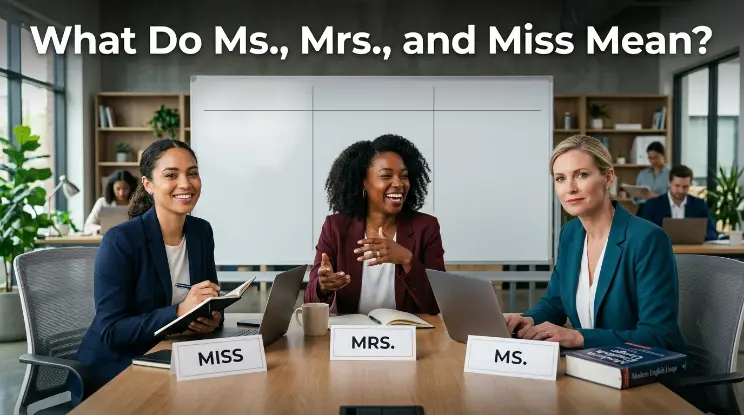
Titles like Ms., Mrs., and Miss are polite forms of address placed before a woman’s last name or full name. They help show respect and, in some cases, indicate marital status.
While all three are grammatically correct, each has a different meaning and usage.
What Does “Miss” Mean?
Miss is traditionally used for an unmarried woman or girl.
It is commonly used for:
- Young girls
- Teenage girls
- Unmarried adult women (if they prefer it)
- Teachers addressed by students in some schools
Examples of Miss
✅ Miss Taylor teaches English.
✅ I met Miss Johnson at the conference.
✅ Excuse me, Miss, you dropped your wallet.
✅ Miss Emma Brown won the competition.
✅ The letter was addressed to Miss Clark.
When Should You Use Miss?
Use Miss when:
- You know the woman is unmarried.
- She personally prefers the title.
- You’re speaking to or about a young girl.
What Does “Mrs.” Mean?
Mrs. is the traditional title for a married woman.
Historically, it was often followed by the husband’s surname.
Examples of Mrs.
✅ Mrs. Wilson will attend the meeting.
✅ Thank you, Mrs. Davis, for your help.
✅ Mrs. Smith teaches mathematics.
✅ The invitation was sent to Mrs. Thompson.
✅ We spoke with Mrs. Green yesterday.
When Should You Use Mrs.?
Use Mrs. when:
- The woman is married.
- She prefers using Mrs.
- You know her preferred title.
What Does “Ms.” Mean?
Ms. is a neutral title that does not reveal marital status.
Today, it is the most common professional title.
Examples of Ms.
✅ Ms. Anderson will join the meeting.
✅ Dear Ms. Roberts, thank you for your email.
✅ The article was written by Ms. Lewis.
✅ Please contact Ms. Parker tomorrow.
✅ Congratulations, Ms. Evans.
When Should You Use Ms.?
Use Ms. when:
- You don’t know whether someone is married.
- You’re writing professional emails.
- You’re communicating in business.
- You’re writing formal letters.
- The woman prefers Ms.
Today, many women choose Ms. because it focuses on the person rather than marital status.
Mr., Mrs., and Ms. Meaning
![ma google flow sa image bnvai ha muje is ki promt bna ka do ur esi promt ho k meri image attractive ur aggracive ho ma apna keyword deta hun [The Olive Tree in the Bible: Why It Matters So Much] ur image 100 kb sa km ho](http://grammboost.com/wp-content/uploads/2026/07/mr-mrs-and-ms-meaning.webp)
Mr., Mrs., and Ms. are common titles used before a person’s name, especially in formal writing, emails, letters, school, work, and professional communication. Although they look similar, they are used in slightly different situations.
Mr. is used for a man, regardless of whether he is married or unmarried. For example, Mr. Ahmed and Mr. John Smith are correct. Mrs. is traditionally used for a married woman, such as Mrs. Sarah Brown. Ms. is used for a woman without referring to her marital status. It is useful when you do not know whether a woman is married or when her marital status is not important.
Ms vs Mrs vs Miss Comparison Table
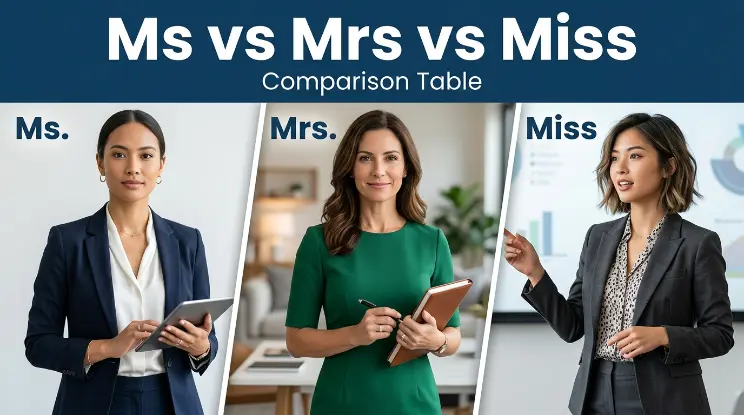
| Title | Meaning | Marital Status | Best Used For | Example |
| Miss | Unmarried woman or girl | Unmarried | Young girls or women who prefer it | Miss Taylor |
| Mrs. | Married woman | Married | Married women who use Mrs. | Mrs. Wilson |
| Ms. | Neutral title | Unknown or irrelevant | Professional communication | Ms. Parker |
Pronunciation Guide
| Title | Pronunciation |
| Miss | /mis/ |
| Mrs. | /MIS-iz/ |
| Ms. | /miz/ |
When Should You Use Each Title?
Use Miss When…
- Referring to an unmarried woman
- Speaking to a young girl
- She prefers the title
Examples:
- Miss Brown is our new teacher.
- Miss Kelly won first prize.
- Excuse me, Miss.
Use Mrs. When…
- Addressing a married woman
- She prefers being called Mrs.
Examples:
- Mrs. Johnson answered the phone.
- Mrs. Adams organized the event.
- Thank you, Mrs. White.
Use Ms. When…
- Marital status is unknown
- Writing business emails
- Formal communication
- Professional settings
Examples:
- Dear Ms. Carter,
- Thank you, Ms. Hall.
- Ms. Green will contact you tomorrow.
Examples in Everyday English
Emails 📧
Correct:
Dear Ms. Williams,
Thank you for your application.
Correct:
Dear Mrs. Harris,
We appreciate your support.
Correct:
Dear Miss Taylor,
Your interview is scheduled for Monday.
Office Communication
✅ Ms. Brown will lead today’s meeting.
✅ Mrs. Cooper approved the report.
School
Students often say:
- Miss Jones
- Mrs. Smith
Depending on the teacher’s preference.
Social Media
People often introduce themselves as:
- Ms. Emily Clark
- Mrs. Rachel Green
- Miss Sophie
Wedding Invitations
Traditional:
Mr. and Mrs. James Wilson
Modern:
Ms. Emma Wilson
Common Mistakes People Make
Mistake 1: Using Mrs. for Every Adult Woman
❌ Dear Mrs. Taylor (when you don’t know if she’s married)
✅ Dear Ms. Taylor
Mistake 2: Thinking Ms. Means Divorced
Wrong.
Ms. simply means marital status is not specified.
Mistake 3: Confusing Miss and Ms.
Miss = unmarried
Ms. = neutral
Mistake 4: Assuming Every Married Woman Uses Mrs.
Many married women prefer Ms.
Always respect personal preference.
Mistake 5: Forgetting the Period
American English usually writes:
- Ms.
- Mrs.
- Mr.
British English often writes:
- Ms
- Mrs
- Mr
Both are acceptable depending on the style guide.
Memory Trick 🧠
Remember this simple phrase:
Miss = Missing a husband (traditionally unmarried)
Mrs. = Married
Ms. = Mystery (You don’t knowor don’t need to knowher marital status.)
This easy trick helps many learners remember the difference.
British vs American English
Although the meanings are the same, punctuation differs.
| British English | American English |
| Ms | Ms. |
| Mrs | Mrs. |
| Mr | Mr. |
Usage is otherwise nearly identical.
Professional Writing Tips
Today, most companies recommend using Ms.
Reasons:
- Inclusive
- Professional
- Respectful
- Doesn’t assume marital status
Examples:
Dear Ms. Taylor,
Hello Ms. Brown,
Thank you, Ms. Wilson.
Academic Writing
Universities often recommend:
- Ms.
- Dr.
- Professor
Instead of assuming Mrs. or Miss.
Example:
Ms. Anderson submitted the research paper.
Business Communication
In business emails:
✅ Dear Ms. Clark,
is usually the safest choice.
Avoid guessing marital status.
News and Journalism
Modern newspapers frequently use Ms.
Example:
Ms. Lopez announced the new policy.
Many news organizations avoid mentioning marital status unless it’s relevant.
Social Etiquette Tips
Ask someone which title they prefer.
Respect personal choice.
If unsure, use Ms.
Never assume marital status.
Real-Life Examples
Example 1: Job Application
Dear Ms. Robinson,
Thank you for reviewing my application.
Example 2: School
Miss Carter teaches science.
Example 3: Medical Office
Mrs. Lewis has arrived for her appointment.
Example 4: Hotel
Welcome, Ms. Harris.
Example 5: Customer Service
Thank you, Ms. Patel, for contacting us.
Example 6: Social Media Profile
Ms. Jennifer Adams
Example 7: Wedding Invitation
Mr. and Mrs. Clark request your presence…
Why Is Ms. Becoming More Popular?
In recent years, Ms. has become the preferred title in many workplaces because:
- It avoids assumptions.
- It treats everyone equally.
- It keeps the focus on the person’s identity rather than marital status.
- It is recommended in many professional style guides.
Quick Decision Guide
| Situation | Best Choice |
| Unknown marital status | Ms. |
| Professional email | Ms. |
| Married woman who prefers Mrs. | Mrs. |
| Young unmarried girl | Miss |
| Formal business letter | Ms. |
| School teacher (if preferred) | Miss or Mrs. |
FAQs
Is Ms. the same as Mrs.?
No. Ms. does not indicate marital status, while Mrs. traditionally refers to a married woman.
Should I use Ms. if I don’t know whether someone is married?
Yes. Ms. is the safest and most respectful option when you’re unsure.
Can a married woman use Ms.?
Absolutely. Many married women prefer Ms. for personal or professional reasons.
Is Miss only for young girls?
Not always. It can also be used for unmarried adult women who prefer it.
Which title is best for business emails?
Ms. is generally the best choice unless you know the person’s preferred title.
Is it rude to use Ms. instead of Mrs.?
No. Most people consider Ms. respectful and professional. If someone prefers Mrs., it’s courteous to use that after you know their preference.
Do British and American English use these titles differently?
The meanings are the same, but American English usually includes periods (Ms., Mrs.), while British English often omits them (Ms, Mrs).
Conclusion
Understanding the difference between Ms., Mrs., and Miss helps you communicate politely and confidently in English. Miss is traditionally used for unmarried women or girls, Mrs. is used for married women who prefer that title, and Ms. is a neutral, modern option that works regardless of marital status.
When in doubt, Ms. is usually the safest and most professional choice, especially in emails, workplaces, and formal writing. By respecting individual preferences and using these titles correctly, you’ll make a positive impression in both personal and professional communication.
Read More Articles
Yay or Nay Spelling: Which One Is Correct? Complete Guide 2026
Whether or Not: Definition, Meaning, and Everyday Examples 2026
Is It “Here Here” or “Hear Hear”? Complete Grammar & Usage Guide 2026
Freshman or Freshmen: Correct Meaning, Usage, and Examples for 2026

Olivia Bennett is a passionate English grammar writer at GrammBoost.com who loves making grammar simple and easy to understand. She specializes in spelling, word differences, punctuation, and everyday English usage. Through clear explanations and practical examples, Olivia helps students, writers, and professionals write with greater confidence and accuracy.