
Have you ever wondered whether to write freshman or freshmen? 🎓 You’re not alone! These two words are commonly confused because they look almost identical, but they have different meanings. The difference is simple: one refers to one first-year student, while the other refers to more than one.
You’re talking about high school, college, or university, using the correct word will make your writing more accurate and professional.
In this guide, you’ll learn the meanings of freshman and freshmen, grammar rules, comparison tables, real-life examples, common mistakes, memory tricks, regional usage, and FAQs.
Quick Answer
Which Is Correct: Freshman or Freshmen?
Both freshman and freshmen are correct, but they are used differently.
- Freshman = One first-year student.
- Freshmen = Two or more first-year students.
Choose the word based on whether you’re referring to a single student or multiple students.
What Does “Freshman” Mean?

Definition of Freshman
Freshman is a singular noun that refers to one student in the first year of high school, college, or university.
Although traditionally used for both males and females, many institutions now also use the gender-neutral term first-year student.
Examples of “Freshman”
She is a freshman at Harvard University.
My brother is a freshman in high school.
Every freshman attended orientation.
As a freshman, I joined several student clubs.
The freshman quickly adapted to campus life.
What Does “Freshmen” Mean?

Definition of Freshmen
Freshmen is the plural form of freshman. It refers to two or more first-year students.
Examples of “Freshmen”
The freshmen attended the welcome ceremony.
Hundreds of freshmen enrolled this year.
The freshmen received campus maps.
Many freshmen live in residence halls.
The school organized activities for all freshmen.
Is It Freshman Year or Freshmen Year?
Freshman year is the correct phrase when talking about the first year of high school or college. Freshman is singular and is used as an adjective before a noun in this expression. For example, “I had a great experience during my freshman year.” Freshmen year is generally incorrect because freshmen is the plural form of freshman. You would use freshmen when referring to multiple first-year students, such as “The freshmen started classes in August.” Therefore, when describing the year itself, use freshman year.
Is It Freshman or Freshmen Orientation?
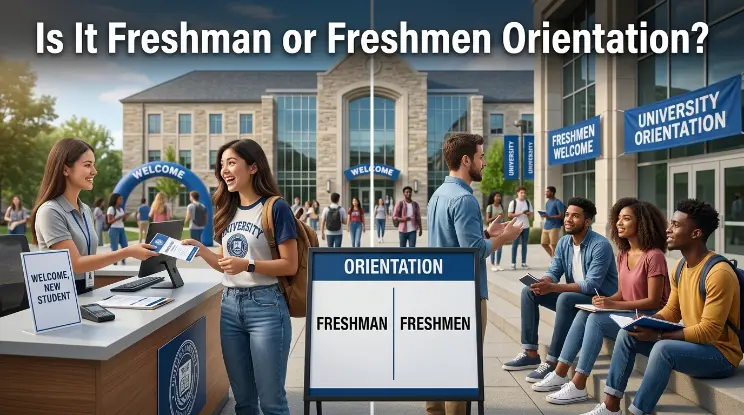
The correct phrase is usually freshman orientation when the event is described as an orientation program for first-year students. Here, freshman functions as an adjective modifying “orientation.” For example, “I attended freshman orientation before starting college.” Freshmen orientation can also appear in real-world usage, particularly when the phrase means orientation for freshmen, but freshman orientation is the conventional form in many American English contexts. If you are referring directly to the students, use freshmen, as in “The freshmen attended orientation.”
Is 9th Grade Freshman or Freshmen?
In the U.S. education system, a student in 9th grade is commonly called a freshman. This is the singular form for one student: “My brother is a freshman in high school.” When talking about several 9th-grade students, use freshmen: “The freshmen are attending their first school assembly.” The term is also used for first-year college students. Keep the distinction simple: one student = freshman; multiple students = freshmen.
Freshman vs Freshmen
Comparison Table
| Feature | Freshman | Freshmen |
| Number | Singular | Plural |
| Meaning | One first-year student | Two or more first-year students |
| Part of Speech | Noun | Noun |
| Example | She is a freshman. | They are freshmen. |
| Correct Usage | One student | Multiple students |
Key Differences
The difference depends on number.
- Freshman = One student.
- Freshmen = More than one student.
For example:
Sarah is a freshman.
Sarah and John are freshmen.
Why Do People Confuse Freshman and Freshmen?
Similar Spellings
The two words differ by only one letter:
- Freshman
- Freshmen
Irregular Plural Form
Unlike most nouns that simply add -s, freshman changes to freshmen.
This is similar to:
- Man → Men
- Woman → Women
- Freshman → Freshmen
When Should You Use “Freshman”?
Correct Situations
Use freshman when talking about:
- One college student
- One university student
- One high school student
- A single first-year learner
Correct Examples
The freshman won a scholarship.
My cousin is a freshman this year.
Every freshman must attend orientation.
She’s excited to be a freshman.
When Should You Use “Freshmen”?
Correct Situations
Use freshmen when referring to:
- Two or more first-year students
- Groups of new students
- Incoming classes
Correct Examples
The freshmen participated in orientation.
Many freshmen joined sports teams.
The university welcomed thousands of freshmen.
The freshmen met their academic advisors.
Common Mistakes
Mistake 1: Using Freshman for Multiple Students
❌ The freshman attended orientation.
(When referring to many students.)
The freshmen attended orientation.
Mistake 2: Using Freshmen for One Student
❌ She is a freshmen.
She is a freshman.
Mistake 3: Adding an “S”
❌ Freshmans
Freshmen
Easy Memory Trick
Freshman = One
Notice the ending:
Man = One person
So:
Freshman = One student
Freshmen = Many
Remember:
Men = More than one
So:
Freshmen = Multiple students
Another Trick
Think of these pairs:
- Man → Men
- Woman → Women
- Freshman → Freshmen
The pattern is exactly the same.
Real-Life Examples
College Orientation
“Every freshman received a welcome package.”
University Website
“The university welcomes over 3,000 freshmen each year.”
Social Media
“I’m officially a college freshman! 🎉”
School Announcement
“All freshmen should report to the auditorium.”
News Article
“The incoming freshmen class is the largest in school history.”
Everyday Conversation
“My sister is a freshman this semester.”
Student Handbook
“Each freshman is assigned an academic advisor.”
British vs American English
Is There a Difference?
Yes.
American English
The terms freshman and freshmen are widely used for first-year high school and college students.
British English
These terms are uncommon. Instead, people usually say:
- First-year student
- First-year undergraduate
- First-year pupil (for school, depending on the context)
If you’re writing for an international audience, first-year student is often the most inclusive and universally understood option.
Usage Trends
Freshman Is Common In
- College admissions
- University websites
- Student organizations
- School newspapers
- American education
Freshmen Is Common In
- Orientation materials
- Enrollment reports
- Campus news
- Student handbooks
Grammar Tips
Freshman Is Singular
Examples:
- One freshman
- Every freshman
- A freshman
Freshmen Is Plural
Examples:
- Several freshmen
- Many freshmen
- All freshmen
Related Words
Other academic classifications include:
- Sophomore
- Junior
- Senior
- First-year student
More Example Sentences
Examples Using Freshman
He is a freshman at Stanford University.
Every freshman must complete orientation.
The freshman joined the debate club.
She’s enjoying life as a freshman.
One freshman won the science competition.
My nephew became a freshman this fall.
The freshman quickly made new friends.
A freshman asked for directions to the library.
Examples Using Freshmen
The freshmen gathered in the auditorium.
All freshmen received student ID cards.
Several freshmen volunteered for community service.
The university welcomed over 2,000 freshmen.
Many freshmen live on campus.
The freshmen attended their first lecture.
Orientation helped the freshmen settle in.
The freshmen participated in welcome week activities.
Frequently Asked Questions (FAQs)
Is it freshman or freshmen?
Both are correct. Freshman refers to one first-year student, while freshmen refers to two or more.
What is the plural of freshman?
The plural of freshman is freshmen.
Can I say freshmans?
No. Freshmans is incorrect. The correct plural is freshmen.
Is freshman used for both kids?
Traditionally, yes. However, many schools now prefer the gender-neutral term first-year student.
Is freshman used in British English?
Not commonly. British English usually uses first-year student or similar terms instead.
How can I remember the difference?
Think:
Man = One
Men = Many
So:
- Freshman = One student
- Freshmen = Multiple students
What comes after freshman?
In American schools and colleges, the typical order is:
- Freshman
- Sophomore
- Junior
- Senior
Conclusion
The difference between freshman and freshmen is all about singular versus plural. Freshman refers to one first-year student, while freshmen refers to two or more first-year students. Although the words differ by just one letter, using the correct form makes your writing grammatically accurate and easier to understand.
If you’re ever unsure, remember the simple pattern: man = one, men = many. You’re writing about high school, college, or university, choosing the right word will help your English sound more natural and professional.
Read More Articles
Yay or Nay Spelling: Which One Is Correct? Complete Guide 2026
Ms Mrs or Miss: What’s the Difference and When Should You Use Each? 2026
Whether or Not: Definition, Meaning, and Everyday Examples 2026
Is It “Here Here” or “Hear Hear”? Complete Grammar & Usage Guide 2026

Olivia Bennett is a passionate English grammar writer at GrammBoost.com who loves making grammar simple and easy to understand. She specializes in spelling, word differences, punctuation, and everyday English usage. Through clear explanations and practical examples, Olivia helps students, writers, and professionals write with greater confidence and accuracy.