You’re wrapping up a work email and want to let someone know you looped in your manager.
You type “I cc’d Sarah on this,” then pause wait, is it “cc’d” or “cc’ed”? Should there even be an apostrophe? 🤔
This is one of those modern workplace grammar puzzles that didn’t even exist a few decades ago! Since “CC” started as an abbreviation (short for “carbon copy”), turning it into a verb creates a spelling dilemma that trips up even experienced professionals. Let’s clear it up once and for all. 💼
Quick Answer: CC’ed or CC’d?
Both “cc’d” and “cc’ed” are used and widely accepted, but “cc’d” is more common and preferred in modern business writing. There’s no single “official” dictionary rule, but consistency and clarity matter most.
What Does “CC” Mean? 📖
CC stands for “carbon copy” a term that originated from the days when people used carbon paper to create duplicate copies of typed documents. Today, it’s used in emails to mean sending a copy of a message to an additional recipient.
Common Uses of “CC” as a Noun
- “Please add John to the CC on this email.”
- “I noticed my boss was in the CC field.”
Common Uses of “CC” as a Verb
Over time, “CC” evolved into a verb meaning to send someone a copy of an email. This is where the “cc’d” vs “cc’ed” confusion comes in, since we need to turn an abbreviation into past tense.
- “I cc’d the whole team on that update.”
- “Don’t forget to cc the client on this thread.”
- “She cc’ed her supervisor for transparency.”
CC’d vs CC’ed: What’s the Difference? 🔍
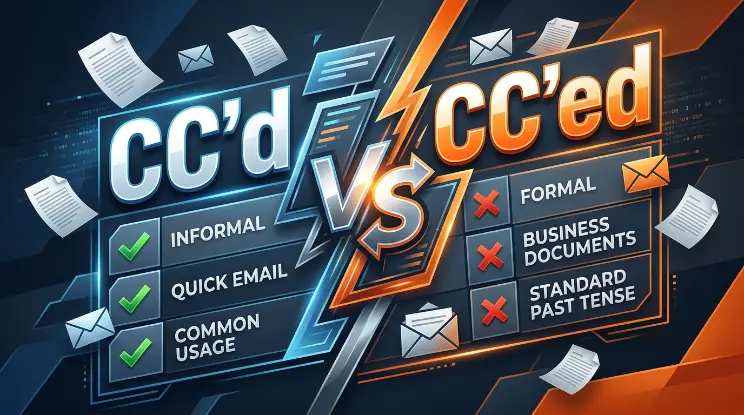
Here’s the honest truth: neither form is officially “wrong,” because “CC” as a verb is relatively new and informal, and dictionaries haven’t fully standardized its past-tense spelling. However, usage patterns show a clear preference.
H3: Why “CC’d” Is More Common
- It mirrors how we shorten other verb forms informally (like “OK’d” for “okayed”).
- It looks cleaner and takes up less space in fast-paced business writing.
- It’s the version most commonly seen in style guides, professional templates, and workplace communication.
H3: Why “CC’ed” Still Appears Often
- Some writers feel it looks more “complete” as a proper past-tense verb, similar to how regular verbs take “-ed.”
- It avoids ambiguity in pronunciation for readers unfamiliar with the shorthand.
- It’s more common in casual or conversational writing, especially in some regions.
💡 Bottom line: Either form is acceptable, but pick one and stay consistent throughout your writing especially in professional documents.
Comparison Table: CC’d vs CC’ed 📊
| Feature | CC’d | CC’ed |
| Popularity | More common in professional/business writing | Common but slightly less frequent |
| Style Preference | Preferred by most modern style guides | Acceptable, more casual |
| Formation Logic | Follows abbreviation + apostrophe + “d” pattern | Follows abbreviation + “ed” like a regular verb |
| Example Sentence | “I cc’d you on the invoice email.” | “I cc’ed you on the invoice email.” |
| Similar Examples | “OK’d,” “RSVP’d” | “OK’ed” (less common), “texted” |
| Best For | Business emails, professional communication | Informal writing, casual conversation |
CC’d or CC-ed
| Form | Correct? | Usage | Example |
|---|---|---|---|
| CC’d | ✅ Correct | Common and widely used in emails | I CC’d my manager on the email. |
| CC-ed | ⚠️ Less common | Understandable, but not the preferred form | I CC-ed my manager on the email. |
| CCed | ✅ Acceptable | Also used, especially in formal writing | I CCed my manager on the email. |
Best choice: Use CC’d in everyday email writing.
CC-ed Meaning in Email
CC-ed in an email means that someone was copied on the email so they can receive and see the message, even though they may not be the main person the email is addressed to. “CC” stands for Carbon Copy. For example, if your manager sends an email to you and CCs another team member, that team member can also read the email and usually see who else received it. CC is commonly used to keep people informed, share updates, or include someone in a conversation without making them the main recipient.
Common Mistakes People Make ❌
- Forgetting the apostrophe entirely
- ❌ “I ccd him on the email.”
- ✅ “I cc’d him on the email.”
- Capitalizing inconsistently
- ❌ “I CC’D him earlier.” (all caps looks like shouting in casual writing)
- ✅ “I cc’d him earlier.” (lowercase is standard in body text)
- Mixing both spellings in the same document
- ❌ “I cc’d Sarah, and later cc’ed the manager too.”
- ✅ “I cc’d Sarah, and later cc’d the manager too.” (pick one and stick with it)
- Using “CC” as a standalone verb without proper conjugation
- ❌ “I cc him yesterday.”
- ✅ “I cc’d him yesterday.”
Memory Trick to Remember This Rule 🧠
Here’s a simple way to lock this in:
Think of “cc’d” like “okay’d” shortened to “OK’d” short, snappy, and business-like. 💼
If you can imagine using an apostrophe + “d” for other abbreviations (like “RSVP’d” or “DM’d”), you can apply the same logic to “cc’d.”
Quick visual cheat sheet:
- CC + ‘d = ✅ Preferred, professional
- CC + ed = ✅ Acceptable, slightly casual
- CCd (no apostrophe) = ❌ Incorrect
Real-Life Examples From Everyday Communication 🗣️
📧 In Emails
“Just a heads-up I cc’d the finance team so they’re aware of the budget changes.”
📱 On Social Media / Messaging Apps
“Lol I accidentally cc’d my entire team on that meme thread 😅”
📰 In News/Business Writing
“Internal memos show the executive was cc’d on several confidential discussions.”
🎓 In Academic/Formal Writing
“Correspondence records indicate the department head was cc’d on all official communications.”
💬 In Everyday Speech
“Did you cc me on that email? I don’t see it in my inbox.”
British vs American English: Any Differences? 🇬🇧🇺🇸
There’s no major regional spelling difference here both British and American English speakers use “cc’d” and “cc’ed” interchangeably in workplace communication.
| Region | Usage Notes |
| British English | “Cc’d” is commonly used in professional/corporate emails |
| American English | “Cc’d” is the dominant form in style guides and business writing |
| Both | “CC’ed” appears occasionally but is less standardized |
Since “CC” as a verb is a relatively modern, informal addition to English (born out of email culture), it hasn’t been fully codified by any single English usage authority so consistency matters more than “correctness” here.
Why This Trend Matters in Digital Communication 📈
With remote work, digital collaboration, and email etiquette becoming essential professional skills, terms like “cc’d” appear constantly in:
- Workplace emails and internal memos
- Project management tools and Slack messages
- Customer service communication
- Legal and HR documentation (where cc’ing matters for record-keeping)
Getting this small correct spelling detail right helps your writing look more polished and shows strong attention to professional grammar tips something that quietly builds credibility with colleagues and clients.
FAQs: People Also Ask ❓
1. Is “cc’d” or “cc’ed” more correct?
Neither is officially “incorrect,” but “cc’d” is more widely used and preferred in professional and business writing.
2. Do I need an apostrophe when using “cc” as a verb?
Yes using an apostrophe (as in “cc’d”) is standard practice to clearly show it’s a shortened, conjugated verb form.
3. What does “cc’d” mean in an email?
It means someone was sent a copy of the email using the “CC” (carbon copy) field, in addition to the main recipient.
4. Can “CC” be used as a verb in formal writing?
Yes, “cc” is commonly used as an informal verb in workplace and business communication, though very formal documents may prefer full phrasing like “was copied on.”
5. Is “ccd” without an apostrophe acceptable?
No omitting the apostrophe (“ccd”) is considered incorrect and can look like a typo.
6. What’s the difference between “CC” and “BCC”?
“CC” (carbon copy) shows all recipients who received a copy, while “BCC” (blind carbon copy) hides those recipients from others on the email.
7. Should “CC’d” be capitalized in a sentence?
Typically, only the “CC” portion may appear capitalized as an abbreviation, while the rest stays lowercase: “cc’d” or “CC’d” just remain consistent throughout your writing.
8. Is there a British vs American English difference in usage?
No significant difference both regions use “cc’d” predominantly, with “cc’ed” appearing occasionally in casual writing.
Final Takeaway: CC’d or CC’ed? 🎯
Here’s your quick recap:
- ✅ CC’d = more common, preferred in professional and business writing
- ✅ CC’ed = acceptable, slightly more casual
- ❌ CCd (no apostrophe) = incorrect
- 🧠 Memory trick: think “OK’d” → same logic applies to “cc’d”
Whichever version you choose, the golden rule is consistency pick one spelling and stick with it throughout your emails, documents, and professional communication. Now you can hit “send” with total confidence! 📩
Read More Articles
To Long or Too Long: Meaning, Usage, and Correct Spelling for 2026
Niece or Neice: Which Spelling Is Correct? 2026
Payed Attention or Paid Attention? Correct Usage with Examples for 2026
Planning or Planing: Which Spelling Is Correct? Complete Grammar Guide 2026

James Carter is an English language enthusiast and content writer who loves making grammar simple and easy to understand. He creates clear, beginner-friendly guides on spelling, grammar rules, confusing words, and everyday English usage. His goal is to help readers write with confidence through practical examples, easy explanations, and accurate language tips.