If you have ever written a sentence and suddenly wondered whether it should be “To Long” or “Too Long,” you are not alone.
These two expressions may look almost identical, but only one is correct in standard English. The confusion usually happens because “to” and “too” sound alike when spoken, even though they have completely different meanings and uses.
Understanding this small difference can make your writing clearer and help you avoid a common grammar mistake.
⚡ Quick Answer
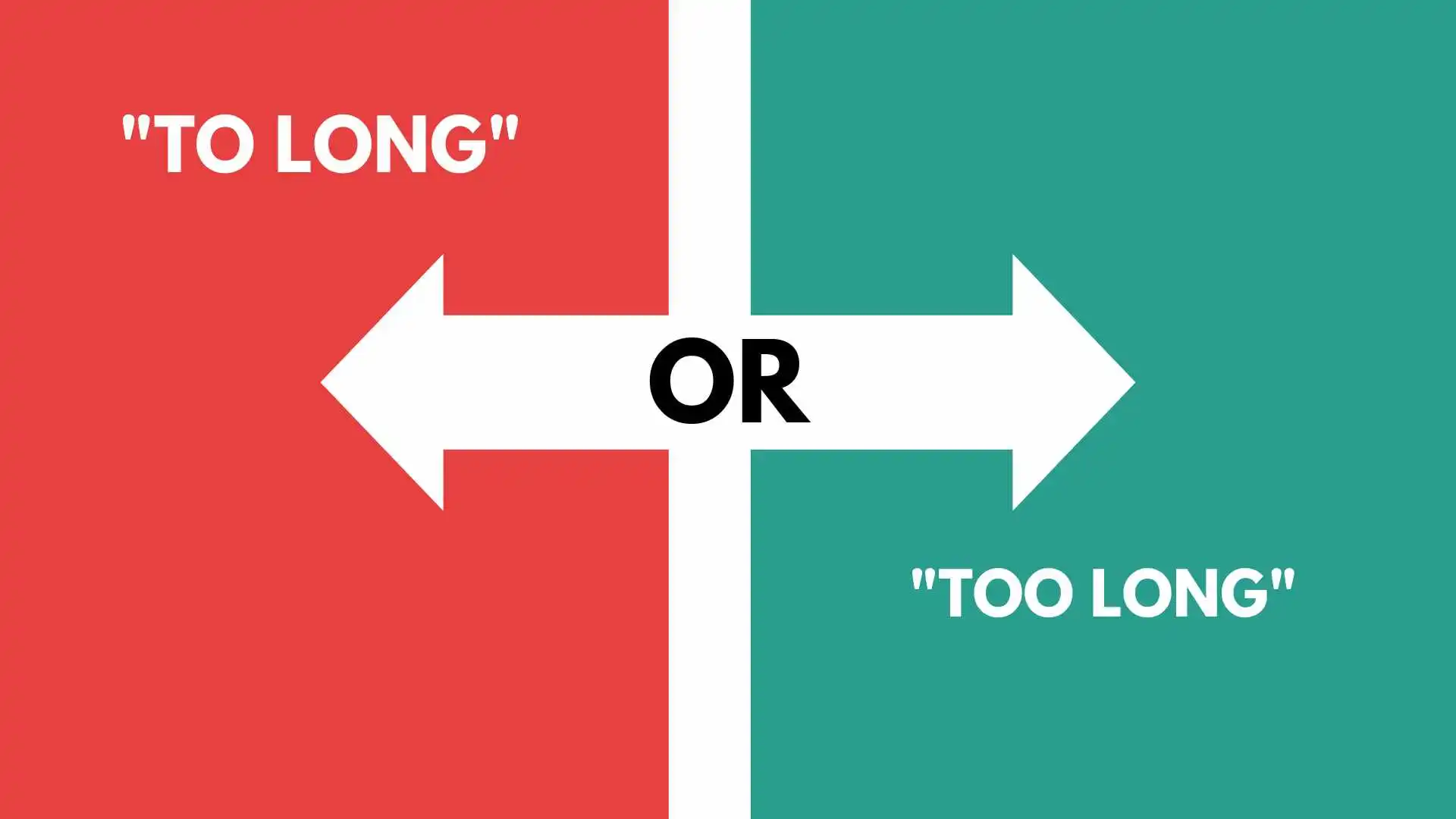
“Too long” is almost always correct when you’re describing something that exceeds a limit (like “this line is too long”). “To long” is only correct in the rare case where “long” is used as a verb meaning “to desire” (as in “to long for something”). If you’re not using “long” as a verb of desire, you want “too.”
📖 What Does “Too” Mean?
Too is an adverb with two main jobs:
- Meaning “excessively” or “more than needed”
- This coffee is too hot to drink. ☕🔥
- She arrived too late for the meeting.
- The essay is too long please cut it down.
- Meaning “also” or “as well”
- I want pizza too! 🍕
- He’s coming to the party too.
- Can I come too?
Memory Trick: Too has an extra O, just like it means “extra” or “excessive.” Two O’s = too much! 🔤
📖 What Does “To” Mean?
To is a preposition or part of an infinitive verb, and it’s one of the most-used words in English. It shows:
- Direction or destination
- I’m going to the store. 🏪
- She drove to Islamabad yesterday.
- Part of an infinitive verb (to + verb)
- I want to sleep. 😴
- He decided to quit his job.
- They plan to travel next month.
- Recipient or relationship
- Give this to your teacher.
- Talk to me.
Memory Trick: “To” is short and simple just like its job of pointing somewhere or connecting to a verb. One “O” = one direction! ➡️
It’s Been Too Long or To Long: Which Is Correct?
“It’s been too long” is the correct phrase when you want to say that a lot of time has passed or something has continued for longer than expected. Here, too means “more than necessary” or “more than expected.” For example, “It’s been too long since we last talked.” On the other hand, “to long” is incorrect in this expression because to is normally used before a verb, such as “to go” or “to learn.” Remember, use too long when describing an excessive amount of time or length. So, the correct expression is “It’s been too long,” not “It’s been to long.”
🆚 “To Long” vs “Too Long”: Comparison Table
| Word/Phrase | Part of Speech | Meaning | Example |
| Too long | Adverb + Adjective | Excessively lengthy | “This report is too long; shorten it.” |
| To long (for) | Preposition + Verb | To deeply wish/desire something | “I long to see you again.” |
| To (alone) | Preposition | Direction/connection | “I’m heading to the airport.” |
| Too (alone) | Adverb | Also/as well | “I’m coming too.” |
❌ Common Mistakes People Make
Here are the classic slip-ups see if you’ve made any of these! 👀
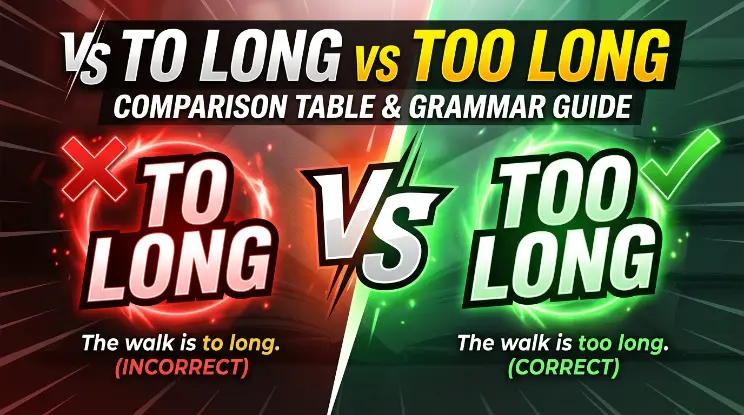
- ❌ “This meeting is to long.” → ✅ “This meeting is too long.”
- ❌ “Can I come to?” → ✅ “Can I come too?”
- ❌ “The line was to slow.” → ✅ “The line was too slow.”
- ❌ “I want too go home.” → ✅ “I want to go home.”
- ❌ “She’s coming too the party.” → ✅ “She’s coming to the party.”
Why Does This Happen?
- They sound identical when spoken aloud (homophones).
- Autocorrect doesn’t always catch it because both are real words.
- Fast typing on phones leads to skipped letters.
🧠 The Ultimate Memory Trick
“Too” has TOO MANY O’s just like it means TOO MUCH.
Whenever you’re unsure, ask yourself: “Am I talking about an excessive amount, or ‘also’?” If yes → use too (with two O’s). If you’re pointing somewhere or using an infinitive verb → use to.
Another quick trick:
- Try replacing the word with “also.” If the sentence still makes sense, use too.
- “I want pizza also” ✅ → so it’s “I want pizza too.”
- Try replacing the word with “toward.” If it fits, use to.
- “I’m going toward the store” ✅ → so it’s “I’m going to the store.”
💬 Real-Life Examples
📧 In Emails
“Sorry for the delayed reply this week has been too hectic to respond sooner.”
📱 On Social Media
“This queue is WAY too long 😩 #Mood” “Can’t wait to see everyone at the reunion!”
📰 In News Writing
“Officials say the bridge repair project took too long due to funding delays.”
🎓 In Academic Writing
“The methodology section was found to be too long relative to the paper’s overall structure, prompting the reviewers to recommend condensing it.”
🗣️ In Everyday Speech
“Ugh, it’s too hot to go outside today.”
🌍 British vs American English: Any Differences?
Good news this one’s universal! There’s no British vs American English difference here. Both dialects use:
- “too” for “excessively” or “also”
- “to” for direction, infinitives, and prepositional phrases
The confusion is purely a spelling/homophone issue, not a regional grammar difference. So whether you’re in London, New York, or Lahore, the rule stays exactly the same. 🌎
🔑 Related Keywords & Grammar Tips You Should Know
If you’re brushing up on English usage, here are a few related concepts worth exploring:
- To, Too, and Two the classic trio of homophones
- Common grammar mistakes in everyday writing
- Correct spelling tips for confusing word pairs
- Homophones in English (their/there/they’re, your/you’re)
- English usage rules for adverbs vs prepositions
- Proofreading tips to catch these errors before hitting “send”
Search interest in phrases like “too long or to long” and “to vs too grammar” has been steadily rising, especially among students, content writers, and non-native English learners looking for quick grammar tips they can apply immediately. ✅
🙋 FAQs (People Also Ask)
1. Is it “to long” or “too long” in a text message?
It’s almost always “too long” unless you’re saying you “long to” do something (like “I long to see you”). In casual texting about length, duration, or excess, use too.
2. What’s the difference between “to,” “too,” and “two”?
- To = direction/infinitive (“go to school,” “want to eat”)
- Too = excessive/also (“too hot,” “me too”)
- Two = the number 2 (“two apples”)
3. Why do people confuse “to” and “too” so often?
Because they’re homophones they sound identical but have different spellings and meanings. It’s an easy typo, especially when typing fast.
4. Is “to long for someone” grammatically correct?
Yes! When “long” is a verb meaning “to deeply wish for,” it’s correct to say “to long for someone” for example, “I long for the weekend.”
5. Does autocorrect fix “to” vs “too” mistakes?
Not always. Since both are real, correctly spelled words, autocorrect often can’t tell which one you meant so you still need to proofread manually. 🔍
6. Is this mistake considered unprofessional in writing?
Yes, especially in formal emails, resumes, or academic papers. It’s a small error, but it can make writing look rushed or careless to readers and employers.
7. What’s an easy trick to remember the difference?
Remember: “Too” has TOO MANY O’s, symbolizing “too much.” If you can substitute the word with “also” or “excessively,” it’s too. If you can substitute it with “toward,” it’s to.
✅ Final Takeaway
Understanding the difference between “to long” and “too long” can help you avoid a common English grammar mistake. The correct phrase is “too long” when you mean something lasts more time than expected, is excessively lengthy, or goes beyond a suitable limit. For example, “The meeting was too long” is correct.
“To long” is incorrect in this context because “to” is generally used to show direction, connection, or an infinitive. Remember that “too” means excessively or also, while “to” has other grammatical functions. Keeping this simple difference in mind will make your writing clearer, more accurate, and easier to understand.
Read More Articles
Niece or Neice: Which Spelling Is Correct? 2026
CC’ed or CC’d? A Simple Guide to Proper Usage for 2026
Payed Attention or Paid Attention? Correct Usage with Examples for 2026
Planning or Planing: Which Spelling Is Correct? Complete Grammar Guide 2026

Sophia Collins is a passionate English grammar writer at GrammBoost.com who loves making the English language simple and easy to understand. She creates clear, beginner-friendly guides on grammar, spelling, word differences, and common language mistakes. Her goal is to help students, writers, and English learners build confidence and improve their writing through practical, easy-to-follow explanations.