Have you ever wondered whether you should write “payed attention” or “paid attention”? 🤔 You’re not alone. Many English learners and even native speakers occasionally confuse these two phrases because paid and payed look very similar.
However, only one of them is correct in almost every situation.If you’re writing an email, school assignment, blog post, or social media caption, using the wrong spelling can make your writing look less professional.
In this guide, you’ll learn the correct grammar, meaning, examples, common mistakes, and an easy trick to remember the difference forever.
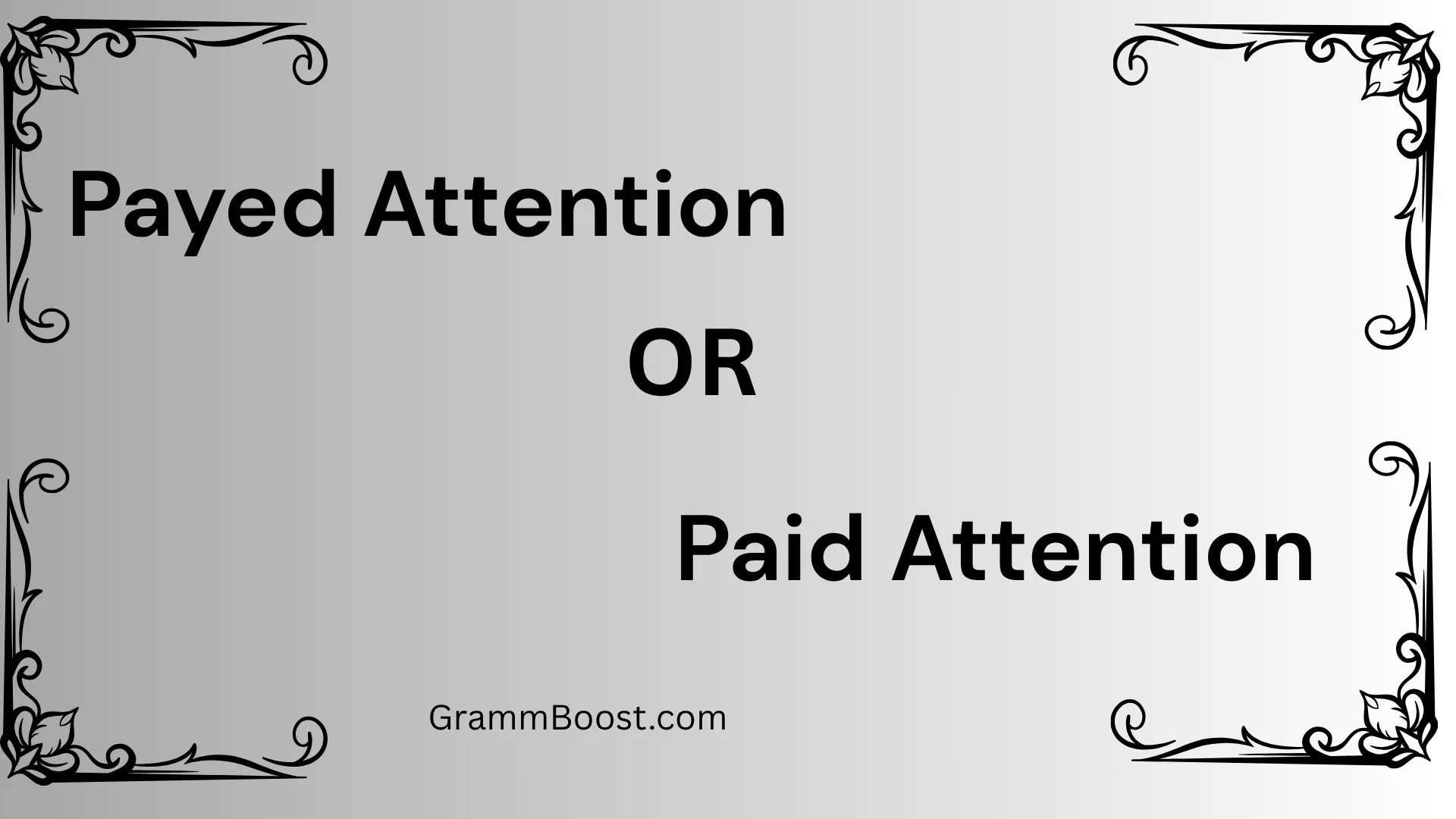
Quick Answer: Payed Attention or Paid Attention?
The correct phrase is paid attention. ✅
“Paid attention” is the correct past tense expression meaning to focus on or notice something.
“Payed attention” is almost always incorrect because payed is only used in specialized nautical (sailing) contexts.
What Does “Paid Attention” Mean?
Meaning of “Paid Attention”
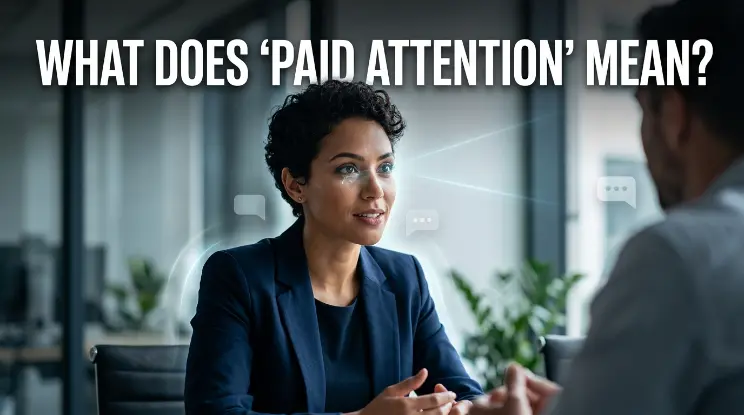
The phrase paid attention means:
- Focused on something
- Listened carefully
- Noticed something important
- Concentrated on what was happening
Here, paid is the past tense of the verb pay, but it is used idiomatically rather than referring to money.
Examples of “Paid Attention”
She paid attention during the lecture.
I wish I had paid attention in math class.
The children paid attention to their teacher.
We paid attention to every detail.
He never paid attention to the warning signs.
They paid attention when the manager explained the new policy.
Everyone paid attention because the announcement was important.
Why Is “Paid” Used Instead of “Payed”?
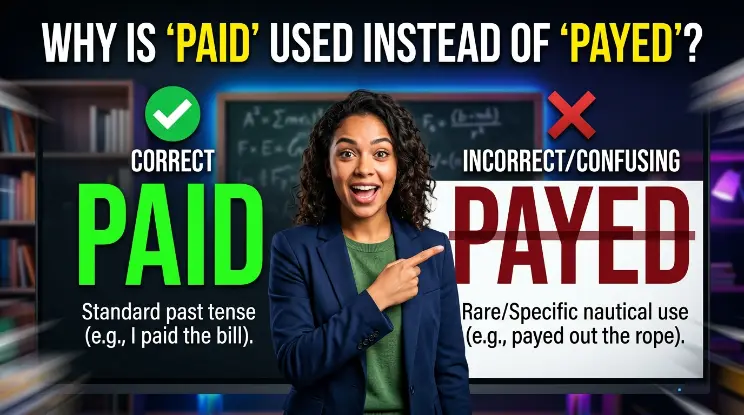
The verb pay has an irregular past tense.
| Base Form | Past Tense | Past Participle |
| Pay | Paid | Paid |
Examples:
- I pay my bills every month.
- Yesterday I paid my bills.
- I have paid my bills already.
Since the expression is pay attention, its past tense naturally becomes:
- Pay attention
- Paid attention
- Have paid attention
Not:
❌ Payed attention
What Does “Payed” Mean?
The Rare Meaning of “Payed”
Many people don’t realize that payed is actually a real English word.
However, it has nothing to do with attention.
It is mainly used in sailing and maritime English.
It means:
- To let out rope or cable
- To coat a wooden ship with tar or pitch to waterproof it
Examples of “Payed”
✅ The sailors payed out the rope.
✅ The crew payed the deck with tar.
These are highly specialized meanings that most English learners will never need.
Paid Attention vs Payed Attention
| Phrase | Correct? | Meaning | Example |
| Paid attention | ✅ Yes | Focused or listened carefully | She paid attention in class. |
| Payed attention | ❌ No | Incorrect in normal English | Incorrect |
| Payed out the rope | ✅ Yes | Sailing term | The sailors payed out the anchor line. |
Paid Attention or Payed Attention

| Word/Phrase | Correct? | Meaning | Example |
|---|---|---|---|
| Paid attention | ✅ Correct | Gave focus or listened carefully | I paid attention to the teacher. |
| Payed attention | ❌ Usually incorrect | Not the standard spelling for this meaning | ❌ I payed attention to the teacher. |
Paid attention is the correct phrase when you mean to listen carefully, focus, or notice something. The verb pay has the irregular past tense paid, so we say “I paid attention,” not “I payed attention.” Payed is a rare word used mainly in specific nautical contexts, not for ordinary attention.
Why Do People Write “Payed Attention”?
Many learners assume English verbs simply add -ed to form the past tense.
Examples:
- Walk → Walked
- Jump → Jumped
- Help → Helped
So they naturally write:
Pay → Payed
Unfortunately, pay is irregular.
Correct:
- Pay → Paid
Incorrect:
- Pay → Payed
This mistake is extremely common among beginners.
Grammar Rule Behind “Paid Attention”
The phrase pay attention is an idiomatic expression.
It means:
Give your focus or concentration.
The verb changes according to tense.
Present
- I pay attention in class.
Past
- I paid attention yesterday.
Present Perfect
- I have paid attention all semester.
Future
- I will pay attention next time.
Payed or Paid Money
Paid money is the correct phrase when you mean that someone gave money for something, such as a product, service, bill, or debt. For example, “I paid money for the new phone” and “She paid the money yesterday” are correct. Payed money is incorrect in normal English because paid is the past tense and past participle of pay. Although “payed” can appear in rare nautical contexts, it is not used when talking about ordinary money or payments.
Examples of “Paid Attention” in Different Situations
Classroom Examples
- The students paid attention during science class.
- Everyone paid attention to the teacher’s explanation.
- She finally paid attention after making several mistakes.
Workplace Examples
- Employees paid attention during the meeting.
- The manager appreciated those who paid attention to instructions.
- We paid attention to customer feedback.
Family Conversations
- My son paid attention while I explained the rules.
- Nobody paid attention when grandma told the story.
- They finally paid attention after hearing the news.
Social Media
- I should have paid attention before posting that photo.
- Everyone paid attention to the viral video.
- She paid attention to every comment.
News Reporting
- Investigators paid attention to the smallest details.
- The government paid attention to public concerns.
- Journalists paid attention to eyewitness reports.
Academic Writing
- Researchers paid attention to data accuracy.
- Students who paid attention scored better.
- Scientists paid attention to every observation.
Common Mistakes
Many writers accidentally use the wrong spelling.
| Incorrect | Correct |
| I payed attention. | ✅ I paid attention. |
| She payed attention. | ✅ She paid attention. |
| We payed attention carefully. | ✅ We paid attention carefully. |
| They have payed attention. | ✅ They have paid attention. |
Memory Trick to Remember the Correct Spelling 🧠
Here’s a simple trick:
👉 If you’re talking about money or attention, always think “PAID.”
Only remember PAYED when thinking about boats, ropes, or ships.
Easy reminder:
Attention = Paid
Rope = Payed
Real-Life Examples
✅ Thank you for paying attention during today’s meeting.
✅ Everyone paid attention to the presentation.
School
✅ The teacher noticed that every student paid attention.
Office
✅ We paid attention to every client request.
Friends
✅ You should have paid attention when I warned you.
News
✅ Officials paid attention to safety concerns before approving the project.
British vs American English
Good news!
There is no difference between British English and American English.
Both use:
✅ Paid attention
Neither uses:
❌ Payed attention
The only accepted use of payed in both varieties is the rare nautical meaning.
Common Grammar Tips
When using pay attention, remember these patterns.
| Tense | Example |
| Present | I pay attention. |
| Past | I paid attention. |
| Future | I will pay attention. |
| Present Perfect | I have paid attention. |
| Past Perfect | I had paid attention. |
| Continuous | I am paying attention. |
Similar Expressions
Here are some alternatives to paid attention.
| Expression | Meaning |
| Focused on | Concentrated |
| Took notice of | Observed |
| Listened carefully | Paid close attention |
| Concentrated on | Focused |
| Watched closely | Observed carefully |
| Was attentive | Stayed focused |
Tips to Avoid This Mistake
- ✅ Remember that pay is irregular.
- ✅ Always write paid attention.
- ✅ Avoid adding -ed automatically.
- ✅ Proofread your writing.
- ✅ Use grammar-checking tools if you’re unsure.
- ✅ Think about whether you’re discussing boats. If not, use paid.
Practice Sentences
Choose the correct option.
- She _____ attention during class.
✅ Paid
- We _____ attention to the instructions.
Paid
- The sailors _____ out the rope.
Payed
- I should have _____ attention.
Paid
- They _____ attention to every detail.
Paid
Frequently Asked Questions (FAQs)
Is “payed attention” ever correct?
No. Payed attention is incorrect in standard English. The correct phrase is paid attention.
Why is “paid attention” correct?
Because paid is the irregular past tense of pay, and the idiom is pay attention.
Is “payed” a real English word?
Yes. However, it is only used in specialized sailing and nautical contexts.
Do British and American English both use “paid attention”?
Yes. Both British and American English use paid attention.
Can I write “I have payed attention”?
No.
Correct:
I have paid attention.
What does “pay attention” mean?
It means to focus, notice, listen carefully, or concentrate on something.
How can I remember the difference?
Remember:
- Paid = Money + Attention
- Payed = Boats + Rope
If you’re not talking about ships, choose paid.
Final Thoughts
The confusion between payed attention and paid attention is understandable because the words look nearly identical. However, the grammar rule is actually simple. Whenever you’re talking about focusing, listening, or noticing something, the correct phrase is always paid attention. The spelling payed exists in English, but it belongs almost exclusively to nautical language and has nothing to do with attention.
By remembering that pay → paid is an irregular verb, you’ll avoid one of the most common English spelling mistakes. Whether you’re writing emails, academic papers, business documents, or social media posts, using paid attention will make your writing more accurate, natural, and professional.
Read More Articles
Send or Sent: Which Word Is Correct? Complete Grammar & Usage Guide 2026
Tyre or Tire: What’s the Difference Between Them? 2026
Planning or Planing: Which Spelling Is Correct? Complete Grammar Guide 2026
Niece or Neice: Which Spelling Is Correct? 2026

James Carter is an English language enthusiast and content writer who loves making grammar simple and easy to understand. He creates clear, beginner-friendly guides on spelling, grammar rules, confusing words, and everyday English usage. His goal is to help readers write with confidence through practical examples, easy explanations, and accurate language tips.