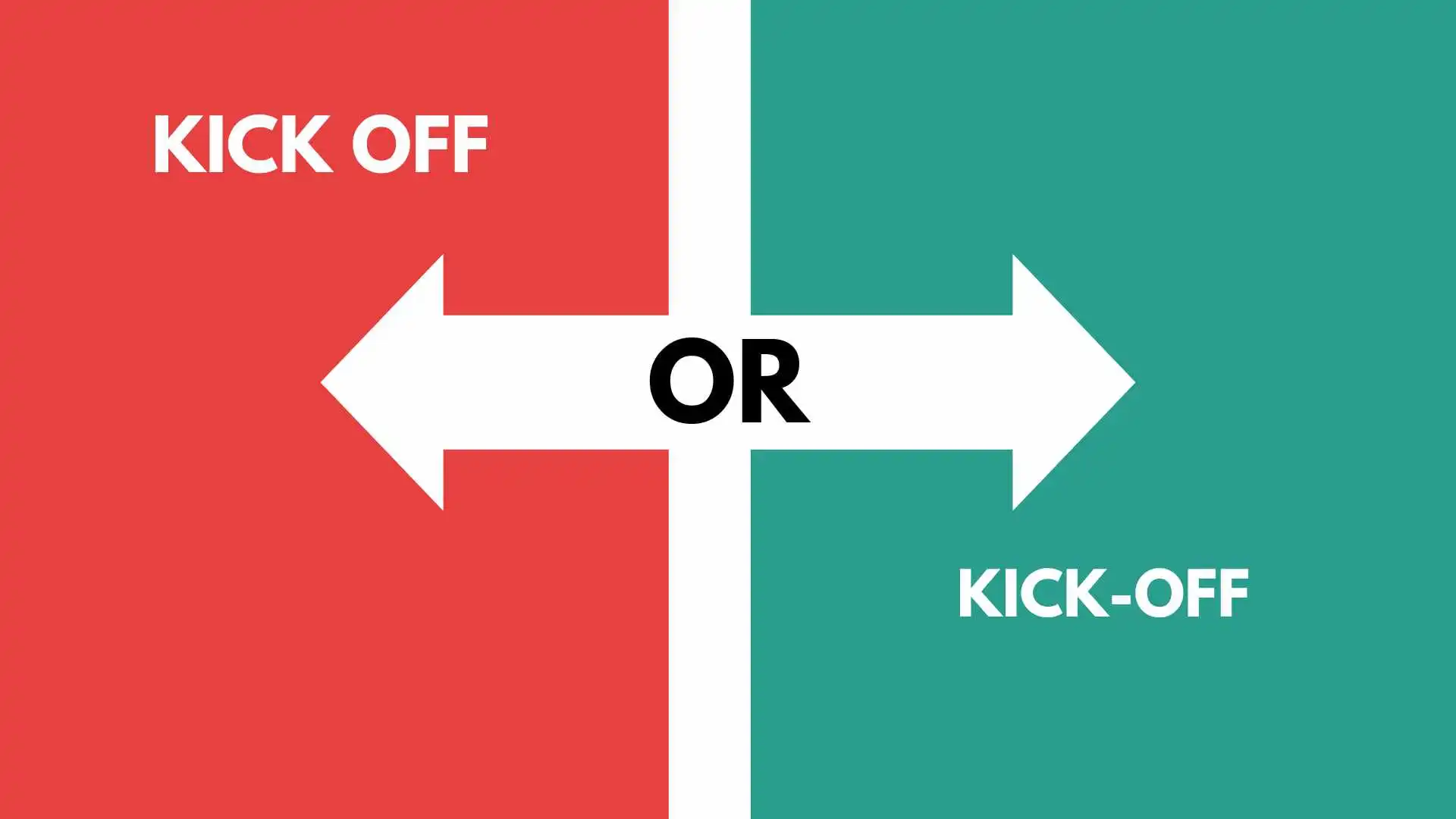
You’re writing an email announcing a new project: “We’re excited to kick-off the campaign next week.” Something feels a little off, but you can’t quite put your finger on why. 🤔 Should there be a hyphen? Should it be two separate words? Is “kickoff” even a thing too?
This is one of those sneaky English usage mix-ups that trips up writers all the time especially in business emails, sports commentary, and event announcements.
The confusion makes total sense because “kick off” and “kick-off” look almost identical, but they play completely different grammatical roles. Let’s break it down simply! 💡
Quick Answer: Kick Off or Kick-Off?
“Kick off” (two words, no hyphen) is a verb, meaning to begin or start something. “Kick-off” (hyphenated) is a noun or adjective, referring to the start of an event, especially in sports. Both are correct it just depends on how you’re using them in a sentence!
What Does “Kick Off” Mean? 📖
“Kick off” is a verb phrase meaning to begin, start, or launch something whether it’s a meeting, event, or campaign.
Common Uses of “Kick Off” (Verb)
- In business/professional contexts:
- “Let’s kick off the meeting with a quick round of introductions.”
- “The company plans to kick off its new marketing campaign next Monday.”
- In sports contexts:
- “The referee will kick off the match at exactly 3 PM.”
- “Players kick off the second half after halftime.”
- In everyday speech:
- “We’re going to kick off the party with some music and snacks.”
- “Let’s kick things off with a toast to the newlyweds!”
💡 Grammar tip: Since “kick off” is a verb phrase, it can be conjugated “kicks off,” “kicked off,” “kicking off” just like any other verb.
What Does “Kick-Off” Mean? 📖
“Kick-off” (hyphenated) is a noun or adjective referring to the start or beginning of an event, most commonly used in sports, but also in business and general contexts.
Common Uses of “Kick-Off” (Noun/Adjective)
- As a noun (sports):
- “The kick-off is scheduled for 7 PM sharp.”
- “Fans arrived early to watch the kick-off of the championship game.”
- As a noun (business/events):
- “The product launch kick-off went smoothly.”
- “We’re hosting a kick-off meeting to align on project goals.”
- As an adjective (before a noun):
- “The kick-off event attracted hundreds of attendees.”
- “She gave the kick-off speech to open the conference.”
⚠️ Regional note: In American English, you’ll also frequently see the closed, one-word form “kickoff” (no hyphen), especially in sports journalism more on that below!
Team to Kick Off Meaning
“Team to kick off” means that a team is going to start or begin something. It is often used for sports, projects, events, or activities. For example, “The team will kick off the campaign next week” means the team will officially begin the campaign. In sports, it can also refer to starting a game by kicking the ball.
Kick Off the Day Meaning
“Kick off the day” means to start the day with a particular activity, event, or action. It is commonly used in workplaces, schools, and everyday conversations. For example, “We kicked off the day with a team meeting” means the team started the day with a meeting.
Kick Off Synonyms
The best synonyms for kick off depend on the context. Common alternatives include start, begin, launch, commence, initiate, open, introduce, and get started. For example, “We will kick off the project” can also be written as “We will start the project” or “We will launch the project.”
Kick Off in a Sentence
Kick off can be used in many different sentences to describe the beginning of something. For example, “The company will kick off its new campaign on Monday.” Another example is “Let’s kick off the meeting with a quick introduction.” In sports, you might say, “The match will kick off at 7 p.m.”
Kick Off Meaning in Business
In business, kick off means to officially start a project, campaign, meeting, event, or business activity. It often suggests that the people involved are beginning the work after planning or preparation. For example, “The company will kick off the new project next month” means the project will officially begin next month.
Kick Off Meeting Meaning
A kick-off meeting is the first meeting held at the beginning of a project or initiative. It brings the team together to discuss the project’s goals, responsibilities, timeline, expectations, and next steps. For example, “We have a kick-off meeting on Monday to discuss the new website project.”
Kickoff or Kick-Off?
Both kickoff and kick-off can be correct, but their usage depends on how the word functions in a sentence. Kickoff is now very common, especially as a noun, while kick-off is also used, particularly in British English and in some compound constructions.
| Word | Correct? | Use | Example |
|---|---|---|---|
| Kickoff | ✅ Yes | Usually a noun meaning the start of an event, activity, or sports match. | The kickoff is at 7 p.m. |
| Kick-off | ✅ Yes | Hyphenated form, also used as a noun and in some compound phrases. | The kick-off is at 7 p.m. |
| Kick off | ✅ Yes | Verb meaning to start something or begin a game. | We will kick off the meeting at 9 a.m. |
Comparison Table: Kick Off vs Kick-Off vs Kickoff 📊
| Form | Correct? | Grammar Role | Example |
| Kick off | ✅ Yes | Verb (action) | “Let’s kick off the event with a speech.” |
| Kick-off | ✅ Yes | Noun/adjective (hyphenated) | “The kick-off is at 5 PM.” |
| Kickoff | ✅ Yes (mainly US) | Noun/adjective (one word) | “The kickoff is at 5 PM.” |
📌 Quick rule: If it’s an action (verb), keep it as two separate words: “kick off.” If it’s a thing or description (noun/adjective), use the hyphenated or closed form: “kick-off” or “kickoff.”
Common Mistakes People Make ❌
- Using the hyphen with the verb form
- ❌ “We will kick-off the event tomorrow.”
- ✅ “We will kick off the event tomorrow.”
- Leaving out the hyphen for the noun form
- ❌ “The kick off starts at noon.”
- ✅ “The kick-off starts at noon.” (or “kickoff” in American English)
- Inconsistent usage in the same document
- Mixing “kick off,” “kick-off,” and “kickoff” without a clear pattern can look unpolished in professional writing.
- Overusing hyphens unnecessarily
- ❌ “Let’s kick-off things properly this time.” (verb usage should never be hyphenated)
- ✅ “Let’s kick things off properly this time.”
Memory Trick to Never Mix These Up Again 🧠
Here’s a simple way to remember the difference:
Action = two words, no hyphen. Think of “kick off” like other action phrases such as “start up” or “log in” no hyphen needed when it’s a verb.
Thing = hyphen or one word. Think of “kick-off” like other event-related nouns such as “sign-in” or “warm-up” hyphenated when describing an event or thing.
Quick visual cheat sheet:
- 🏃 Verb (doing something) → “kick off” (two words)
- 🎉 Noun/Event (a thing) → “kick-off” or “kickoff” (hyphenated or closed)
Real-Life Examples From Everyday Communication 🗣️
📧 In Emails
“We’ll kick off the quarterly review meeting at 10 AM sharp see the kick-off agenda attached.”
📱 On Social Media
“So excited to kick off this new chapter! 🎉 Kickoff party details coming soon!”
📰 In Sports News
“The kickoff for tonight’s championship game has been delayed due to weather conditions.”
🎓 In Academic/Business Writing
“The research initiative will kick off in September, with a formal kick-off presentation to stakeholders.”
💬 In Everyday Speech
“Are you coming to the kickoff party this weekend? It’s supposed to kick off around 6.”
British vs American English: Any Differences? 🇬🇧🇺🇸
This is actually one of those rare cases where regional preferences do show up slightly:
| Region | Preferred Noun Form |
| British English | Tends to favor the hyphenated form: “kick-off” |
| American English | Frequently uses the closed, one-word form: “kickoff” |
| Both | The verb form is always written as two separate words: “kick off” |
So if you’re writing for a British audience, “kick-off” (hyphenated) is generally safer. If you’re writing for an American audience, “kickoff” (one word) is extremely common, especially in sports journalism and casual writing.
Why This Matters for Sports, Business & Event Writing 📈
“Kick-off” and “kick off” show up constantly in:
- Sports journalism ⚽🏈 match schedules, live commentary, event previews
- Corporate communication 💼 project kick-off meetings, campaign launches
- Event marketing 🎉 product launches, conference announcements
- Everyday social planning 🎊 parties, gatherings, celebrations
Because this term appears so frequently across industries, getting the correct spelling right verb vs. noun instantly makes your writing look more professional and detail-oriented. It’s a small but noticeable grammar tip that readers pick up on, even subconsciously.
FAQs: People Also Ask ❓
1. Is it “kick off” or “kick-off”?
Both are correct, depending on usage. “Kick off” (no hyphen) is a verb meaning to start something, while “kick-off” (hyphenated) is a noun or adjective referring to the start of an event.
2. Is “kickoff” one word ever correct?
Yes! “Kickoff” as one word is commonly used, especially in American English, as a noun or adjective like “kickoff time” or “the kickoff was delayed.”
3. What’s the difference between “kick off” and “kickoff”?
“Kick off” (two words) is always a verb. “Kickoff” (one word) or “kick-off” (hyphenated) are both acceptable noun/adjective forms, depending on regional preference.
4. Do British and American English spell this differently?
Yes, slightly British English tends to prefer “kick-off” (hyphenated), while American English often uses “kickoff” (one word) for the noun form.
5. Can “kick-off” be used outside of sports?
Absolutely! It’s widely used in business, marketing, and event planning to describe the beginning of a project, campaign, or meeting.
6. Is it ever correct to hyphenate the verb form?
No the verb form should always be written as two separate words: “kick off,” never “kick-off” or “kickoff.”
7. What’s an easy way to remember when to use a hyphen?
Remember: if it’s an action (verb), use two words (“kick off”). If it’s a thing or event (noun/adjective), use a hyphen or one word (“kick-off” or “kickoff”).
8. Is “kick-off meeting” hyphenated correctly?
Yes “kick-off meeting” is correct since “kick-off” functions as an adjective describing the type of meeting.
Final Takeaway: Kick Off or Kick-Off? 🎯
Understanding the difference between “kick off” and “kick-off” is simple once you know how each form works. “Kick off” is usually used as a verb, meaning to begin or start something, such as a meeting, event, or project. “Kick-off” is commonly used as a noun or adjective, especially when describing the beginning of an event, such as a “kick-off meeting.”
Choosing the correct form depends on its role in the sentence. Remember: use “kick off” for actions and “kick-off” for nouns and compound modifiers. Using these forms correctly can make your writing clearer, more polished, and grammatically accurate.
Read More About This
Sent or Send: What’s the Difference? Complete Grammar & Usage Guide 2026
Fulfilment or Fulfillment: Which Spelling Is Correct? 2026
Equal to or Greater Than Symbol: The Complete Beginner’s Guide (≥) 🔢 2026
Tyre or Tire: What’s the Difference Between Them? 2026

James Carter is an English language enthusiast and content writer who loves making grammar simple and easy to understand. He creates clear, beginner-friendly guides on spelling, grammar rules, confusing words, and everyday English usage. His goal is to help readers write with confidence through practical examples, easy explanations, and accurate language tips.