Ever been typing up a math assignment, a spreadsheet formula, or a report, and suddenly needed to write “70 or more” but in symbol form? You pause. Is it a sideways V? An equal sign with an arrow? A greater-than sign with a line under it? 🤔
You’re definitely not the only one. The equal to or greater than symbol trips up students, professionals, and even seasoned Excel users all the time. It looks simple once you know it, but if nobody’s ever shown you clearly, it’s easy to mix it up with similar-looking symbols.
This guide will walk you through exactly what the symbol looks like, how to type it on any device, when to use it, and how to avoid the most common mix-ups all explained in plain, simple English. 😊
Quick Answer 🎯
The equal to or greater than symbol is written as ≥. It means a value is either the same as another value or larger than it. For example, x ≥ 5 means x can be exactly 5, or any number bigger than 5.
What Does “Equal to or Greater Than” Actually Mean? 🧠
In plain English, “equal to or greater than” describes a value that meets a minimum requirement it can match the number exactly, or exceed it.
Think of it like a height requirement for a ride at an amusement park:
- If the sign says “Height ≥ 120 cm,” that means you can ride if you’re exactly 120 cm tall or taller.
- If you’re 119 cm, sorry no ride for you. 🎢🚫
The Symbol Itself: ≥
The symbol combines two ideas into one:
- > (greater than)
- = (equal to)
Put together, they form ≥, which is read aloud as “greater than or equal to” or “equal to or greater than” both phrasings mean the same thing, just in a different word order.
Examples in sentences:
- “You must be 18 or older (age ≥ 18) to vote.”
- “The temperature was ≥ 30°C, so we stayed indoors.”
- “A passing grade requires a score ≥ 60%.”
- “The company hires candidates with ≥ 3 years of experience.”
Greater Than or Equal To Sign
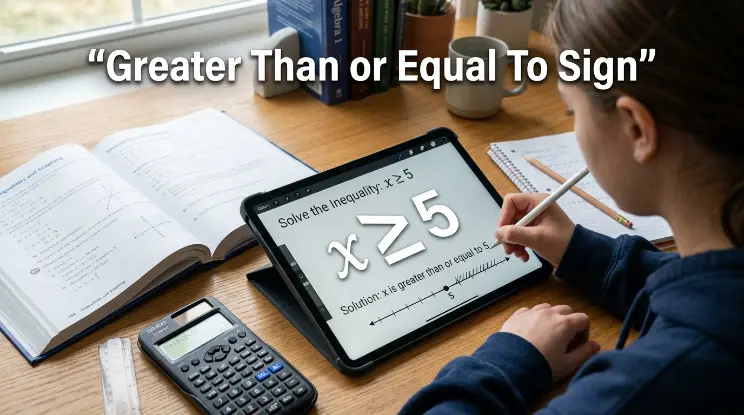
The greater than or equal to sign is ≥. It is used in mathematics to show that one number is either greater than or equal to another number.
For example, x ≥ 5 means that x can be 5 or any number greater than 5, such as 6, 10, or 100. The symbol combines the greater than sign (>) and the equal sign (=).
Example:
3 ≥ 5 → False
10 ≥ 5 → True
5 ≥ 5 → True
Greater Than and Less Than Symbols
The greater than symbol (>) shows that one number is larger than another, while the less than symbol (<) shows that one number is smaller than another. For example, 8 > 5 means 8 is greater than 5, while 3 < 7 means 3 is less than 7. These symbols are commonly used in mathematics, comparisons, and computer programming.
Less Than or Equal To Symbol
The less than or equal to symbol is ≤. It means that a number can be smaller than or exactly equal to another number. For example, x ≤ 10 means x can be 10 or any number below 10, such as 9, 5, or 0.
Greater Than or Equal To Symbol on Keyboard
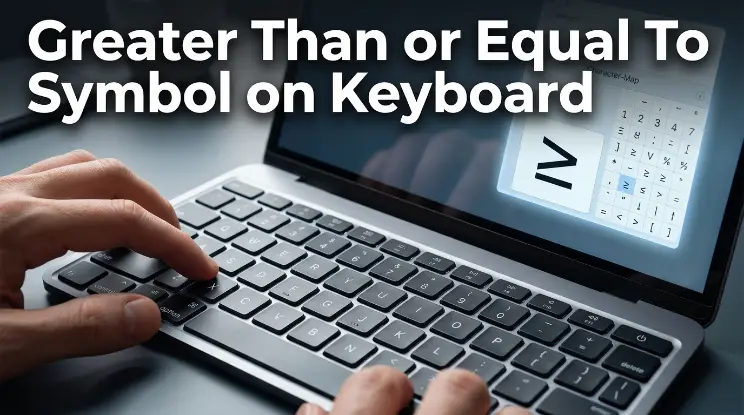
The greater than or equal to symbol (≥) usually does not have a dedicated key on a standard keyboard. You can type > by pressing Shift + . and = by pressing the = key, but ≥ generally needs to be inserted using a symbol tool, character map, or copied from another source. In Microsoft Word, you can also use Insert → Symbol to find it.
Greater Than or Equal To Symbol Copy and Paste
If you need the symbol quickly, you can simply copy and paste it:
≥
You can also copy the related symbols: > (greater than), < (less than), ≤ (less than or equal to), and ≥ (greater than or equal to).
More Than or Equal To Sign
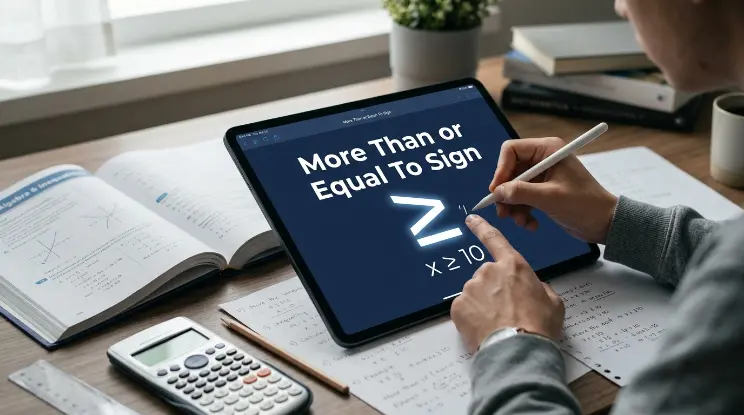
The “more than or equal to” sign is written as ≥. It is a mathematical symbol that means one number or value is greater than or equal to another. For example, 10 ≥ 7 means “10 is more than or equal to 7.” Since 10 is greater than 7, the statement is true. Similarly, 7 ≥ 7 is also true because the two numbers are equal. The symbol ≥ combines the greater-than sign (>) with the equals sign (=).
| Sign | Name | Meaning | Example |
|---|---|---|---|
| ≥ | Greater than or equal to | More than or equal to | 10 ≥ 7 |
| > | Greater than | More than | 10 > 7 |
| = | Equal to | Same value | 7 = 7 |
| ≤ | Less than or equal to | Less than or equal to | 5 ≤ 7 |
| < | Less than | Less than | 5 < 7 |
Examples of ≥
- x ≥ 10 → x is 10 or greater.
- Age ≥ 18 → Age is 18 or older.
- Score ≥ 80 → Score is 80 or higher.
- Price ≥ $50 → Price is $50 or more.
Easy way to remember:
≥ = greater than OR equal to
The open side faces the larger number, while the small horizontal line underneath means “or equal to.”
Equal To vs Greater Than vs Equal To or Greater Than 📊
It helps to see all three related symbols side-by-side so you never confuse them again.
| Symbol | Name | Meaning | Example | Explanation |
| = | Equal to | Exactly the same value | x = 5 | x is exactly 5, nothing else |
| > | Greater than | Strictly more than | x > 5 | x is more than 5 (6, 7, 8…) but NOT 5 itself |
| ≥ | Equal to or greater than | Same value OR more | x ≥ 5 | x can be 5, or anything bigger than 5 |
| < | Less than | Strictly less than | x < 5 | x is less than 5, but NOT 5 itself |
| ≤ | Equal to or less than | Same value OR less | x ≤ 5 | x can be 5, or anything smaller than 5 |
Memory tip: The little line underneath the “>” or “<” sign is like a “cushion” 🛋️ it softens the symbol so it “includes” the equal value too, instead of strictly excluding it.
How to Type the ≥ Symbol on Any Device ⌨️
This is where most people get stuck the symbol isn’t on a standard keyboard, so you need a shortcut or method depending on your device.
On Windows 💻
- Alt Code: Hold Alt and type 2265 on the numeric keypad, then release.
- Character Map: Search “Character Map” in the Start menu, find ≥, and copy it.
- Word: Type 2265 then press Alt + X to convert it into the ≥ symbol.
On Mac 🍎
- Open Character Viewer (Control + Command + Space) and search “greater than or equal to.”
- Some apps also support Option + > combinations, but this varies, so Character Viewer is the safest method.
On Google Docs / Google Sheets 📄
- Go to Insert → Special characters
- Search “greater than or equal to”
- Click to insert
In HTML (for websites) 🌐
≥
≥
In LaTeX (for academic writing) 📚
\geq
Quick Copy-Paste Option ✂️
If you just need it right now, here it is: ≥ feel free to copy and paste it anywhere you need!
Common Mistakes People Make 🙈
- Confusing ≥ with >. Remember: ≥ includes the equal value, while > strictly excludes it.
- Reading it backwards. “5 ≥ x” means 5 is equal to or greater than x, not the other way around pay attention to which side the symbol “opens” toward.
- Using the wrong symbol in spreadsheets. In Excel or Google Sheets, you type >= (greater-than sign followed by equal sign) instead of a special character, since spreadsheet formulas don’t accept the ≥ symbol directly.
- Mixing up ≥ and ≤. A simple trick: the symbol always “points” toward the smaller value, just like a greater-than or less-than sign normally does the little equal line underneath doesn’t change that direction.
- Forgetting the symbol in word problems. Many students translate “at least” incorrectly as “>” instead of “≥” but “at least” always means the value is included, so it should be ≥.
Memory Trick: “At Least” = ≥ 🐘
Here’s a fun mnemonic: think of an elephant 🐘 sitting on the “equal to” line, making the arrow heavier and rounder just like how “at least” makes the meaning heavier by including the number itself, not just anything above it.
Phrases that mean ≥ (equal to or greater than):
- “At least”
- “No less than”
- “Minimum of”
- “Or more”
Phrases that mean strictly > (greater than only):
- “More than”
- “Exceeds”
- “Over” (in strict mathematical contexts)
Real-Life Examples From Everyday Use 💬
From a school exam question:
“Solve for x: x + 3 ≥ 10”
From a job posting:
“Candidates must have ≥ 5 years of relevant experience in software development.”
From a spreadsheet formula (Excel/Google Sheets):
=IF(A1>=60, “Pass”, “Fail”)
From a social media post about weather:
“Temperatures today are expected to be ≥ 35°C, so please stay hydrated! ☀️💧”
From a news headline:
“New policy requires all applicants to be aged 21 or older (≥ 21) to qualify.”
From everyday speech:
“You need to score 70 or above to pass this test” which mathematically translates to score ≥ 70.
These examples show how the concept of “equal to or greater than” shows up far beyond the math classroom in job requirements, weather reports, grading systems, and even everyday conversations. 🌍
Usage Notes: Is There a British vs American Difference? 🌍
Good news there’s no difference between British and American English when it comes to the ≥ symbol itself. Both regions:
- Use the exact same symbol: ≥
- Read it the same way: “greater than or equal to” or “equal to or greater than”
- Use it identically in math, science, and computing
| Aspect | British English | American English |
| Symbol | ≥ | ≥ |
| Common phrase | “Greater than or equal to” | “Greater than or equal to” |
| Spreadsheet formula | >= | >= |
| Usage in exams | Same | Same |
The only minor regional difference is in teaching style some British math textbooks introduce inequality symbols slightly later in the curriculum compared to American textbooks, but the symbol and meaning remain universal.
FAQs: People Also Ask ❓
1. What is the symbol for “equal to or greater than”?
The symbol is ≥, formed by combining the greater-than sign (>) with an equal sign underneath it.
2. How do you type ≥ on a keyboard?
On Windows, use Alt + 2265. On Mac, use Character Viewer. In Word, type 2265 then press Alt + X. In spreadsheets, simply type >=.
3. What’s the difference between > and ≥?
> means strictly more than a value (excluding it), while ≥ means the value itself is included, along with anything greater.
4. How do you read the ≥ symbol out loud?
It can be read as “greater than or equal to” or “equal to or greater than” both are correct and mean the same thing.
5. Is ≥ the same as >=in Excel or programming?
Yes, in most spreadsheet software and programming languages, >= is simply the typed version of the ≥ symbol, since keyboards don’t have a dedicated key for it.
6. What does “at least” mean in math symbols?
“At least” translates to ≥, since it means the value can be equal to the number mentioned, or higher.
7. Is there a difference between ≥ in British and American English?
No, the symbol, meaning, and usage remain exactly the same in both British and American English.
8. What is the opposite of the ≥ symbol?
The opposite is ≤, which means “equal to or less than.”
Final Takeaway
Understanding the Equal to or Greater Than Symbol (≥) makes mathematical expressions easier to read, write, and understand. This symbol means that one value is either equal to or greater than another value. For example, x ≥ 10 means that x can be 10 or any number greater than 10.
It is commonly used in mathematics, statistics, inequalities, programming, and everyday calculations. Remember that the equal part allows the two values to be the same, while the greater-than part indicates a larger value. Once you understand how ≥ works, you can confidently use it in equations, comparisons, and problem-solving situations.
Read More About This
Sent or Send: What’s the Difference? Complete Grammar & Usage Guide 2026
Kick Off or Kick-Off: Meaning, Usage, and Grammar Guide for 2026
Fulfilment or Fulfillment: Which Spelling Is Correct? 2026
Tyre or Tire: What’s the Difference Between Them? 2026

James Carter is an English language enthusiast and content writer who loves making grammar simple and easy to understand. He creates clear, beginner-friendly guides on spelling, grammar rules, confusing words, and everyday English usage. His goal is to help readers write with confidence through practical examples, easy explanations, and accurate language tips.