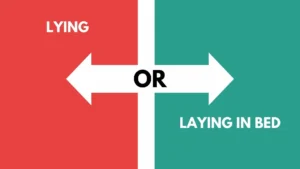
When it comes to everyday English, some word choices can be surprisingly confusing. “Lying or Laying in Bed” is a perfect example because both words are correct, but they are used in different situations.
Many people use “laying” when they actually mean “lying,” especially when talking about resting in bed. If you have ever wondered whether you should say “I am lying in bed” or “I am laying in bed,” you are not alone.
The difference becomes much easier once you understand what each verb means and how it works in a sentence. Lying usually means being in a resting or horizontal position, while laying generally means putting or placing something somewhere.
Quick Answer ⚡
“Lying” means to recline or rest yourself somewhere (no object needed) as in “I am lying in bed.” “Laying” means to place something else down as in “I am laying the blanket on the bed.” If you’re just resting your own body, it’s always lying in bed, not “laying in bed.”
Let’s break this down properly so it sticks for good. 👇
What Does “Lying” Actually Mean?
Lying comes from the verb “to lie”, which means to recline, rest, or be in a horizontal position. It’s an intransitive verb, which is just a fancy way of saying it doesn’t take a direct object you don’t “lie” something else, you just… lie.
Examples of “Lying” in a Sentence
- 🛌 I am lying in bed because I have a headache.
- 😴 The dog was lying on the porch all afternoon.
- 📚 She likes lying on the grass while reading a book.
- 🌙 He was lying awake, staring at the ceiling.
- 🏖️ We spent the whole day lying on the beach.
Notice something? In every one of these sentences, the subject is resting itself nobody is placing anything else down. That’s your first clue.
The Verb “To Lie” All Its Forms
| Tense | Form | Example |
| Present | lie / lying | I lie down every afternoon. |
| Past | lay | Yesterday, I lay in bed all day. |
| Past Participle | lain | I had lain there for hours before falling asleep. |
| Present Participle | lying | She is lying on the couch right now. |
😅 Yes the past tense of “lie” is “lay,” which is exactly why this gets so confusing. More on that below!
What Does “Laying” Actually Mean?
Laying comes from the verb “to lay”, which means to put or place something down. This is a transitive verb, meaning it needs a direct object you always lay something.
Examples of “Laying” in a Sentence
- 🧺 She is laying the towels on the bed.
- 🐔 The hen is laying an egg.
- 🃏 He is laying the cards on the table.
- 🧱 Workers are laying bricks for the new wall.
- 🎁 I’m laying the gifts under the tree.
See the pattern? Every sentence has an object towels, an egg, cards, bricks, gifts. Something is being placed down by someone or something else.
The Verb “To Lay” All Its Forms
| Tense | Form | Example |
| Present | lay / laying | I lay the book on the shelf every night. |
| Past | laid | Yesterday, I laid the book on the shelf. |
| Past Participle | laid | I had laid the towels out before guests arrived. |
| Present Participle | laying | He is laying the tiles in the kitchen. |
“Lying” vs “Laying”: Side-by-Side Comparison Table 📊
| Feature | Lying (from “to lie”) | Laying (from “to lay”) |
| Meaning | To recline or rest yourself | To place something down |
| Type of verb | Intransitive (no object) | Transitive (needs an object) |
| Present tense | lie | lay |
| Past tense | lay | laid |
| Past participle | lain | laid |
| Example | I am lying in bed. | I am laying the blanket on the bed. |
| Also means | To tell a falsehood (to lie) |
💡 Key takeaway: If there’s no object receiving the action, it’s lying. If something is being placed down, it’s laying.
So… Is It “Lying in Bed” or “Laying in Bed”? 🛏️
Here’s your answer, loud and clear:
✅ Correct: I am lying in bed. ❌ Incorrect: I am laying in bed.
Unless you’re placing something in the bed (like laundry, a baby, or a pet), you are simply lying there resting your own body. “Laying in bed” is only correct if you add an object, like:
- ✅ I am laying the baby in bed.
- ✅ She is laying her clothes on the bed.
Without an object, always go with lying in bed.
Common Mistakes People Make 🚫
This mix-up is so common that it even shows up in song lyrics, social media captions, and casual conversation. Here are the most frequent slip-ups:
- “I was laying in bed all day” ❌ → Should be “I was lying in bed all day.” ✅
- “The cat is laying on the sofa” ❌ → Should be “The cat is lying on the sofa.” ✅
- “He lay the book on the table” (present tense confusion) ❌ → Should be “He lays the book on the table.” ✅
- “I laid down for a nap” ❌ → Should be “I lay down for a nap” (past tense of lie) ✅
Why the Confusion Happens 🧩
The real trouble is that “lay” is both:
- the present tense of “to lay” (I lay the book down), and
- the past tense of “to lie” (Yesterday, I lay in bed).
Same spelling, two completely different jobs. No wonder people get tripped up!
Memory Trick to Remember Forever 🧠✨
Here’s a simple mnemonic that grammar teachers love:
“Lie” is for people, “Lay” needs a tray. 🍽️
Think of it this way:
- Lie = you, resting your own body (no object).
- Lay = you’re placing an object down, like setting a tray on a table.
Another fun trick: L-I-E = “I”, as in yourself. If you’re doing the action to yourself, use “lie/lying.” If you’re doing it to something else, use “lay/laying.”
Or try this rhyme:
“Chickens lay eggs, people lie in bed.” 🐣🛏️
Real-Life Examples of “Lying” vs “Laying” 🌍
📱 Social Media Caption
- ❌ “Just laying in bed all day, no regrets.”
- ✅ “Just lying in bed all day, no regrets.”
✉️ Casual Email
- ❌ “Sorry for the late reply, I was laying down with a migraine.”
- ✅ “Sorry for the late reply, I was lying down with a migraine.”
📰 News Headline
- ✅ “Rescue workers found the hiker lying injured near the trail.”
- ✅ “Construction crews are laying new pipelines across the city.”
🎓 Academic Writing
- ✅ “The patient was lying on the examination table when the doctor arrived.”
- ✅ “The foundation was laid in 1990, and construction continued for a decade.”
🗣️ Everyday Speech
- ❌ “I’ve just been laying around the house all weekend.”
- ✅ “I’ve just been lying around the house all weekend.”
Bonus Confusion: “Lie” as in Telling a Falsehood 🤥
Just to make things extra spicy, “lie” also means to tell a falsehood. But this version is regular in its conjugation:
| Tense | Form | Example |
| Present | lie | Don’t lie to me. |
| Past | lied | He lied about his age. |
| Past Participle | lied | She has lied before. |
Notice the past tense here is “lied,” not “lay” because this is a different verb entirely, even though it looks identical in the present tense. English keeps us on our toes! 😄
British English vs American English 🇬🇧🇺🇸
Good news this rule is the same in both British and American English. There’s no regional variation in the grammar itself. However:
- American English speakers tend to make the “lying vs laying” mistake more often in casual speech and social media.
- British English speakers are slightly more likely to use “lie/lay” correctly in formal writing, but the same everyday confusion still happens in spoken conversation.
So no matter which side of the pond you’re on, the rule holds: you lie down, but you lay something down.
Why This Grammar Rule Matters for SEO & Writing ✍️
If you’re a blogger, content writer, or student, getting lying vs laying right boosts your credibility. Search engines and readers both notice correct grammar and spelling, and phrases like “lying in bed” vs “laying in bed” are searched thousands of times a month by people trying to double-check themselves just like you’re doing now! Mastering these small English usage details makes your writing more polished, professional, and trustworthy.
Related keyword insights people often search for:
- grammar tips
- common English mistakes
- correct spelling
- lie vs lay
- present and past tense verbs
- English usage rules
- confusing word pairs
FAQs: People Also Ask ❓
1. Is it “lying in bed” or “laying in bed”?
It’s “lying in bed” when you’re simply resting. Use “laying” only when you’re placing something down, like “laying the baby in bed.”
2. What is the past tense of “lie” (to recline)?
The past tense is “lay.” Example: “Yesterday, I lay in bed all afternoon.”
3. What is the past tense of “lay” (to place something down)?
The past tense is “laid.” Example: “I laid the keys on the counter.”
4. Why is “lay” both a present and past tense word?
Because “lay” is the present tense of “to lay” (place something) and also the past tense of “to lie” (recline). They’re two separate verbs that happen to share a spelling in different tenses.
5. Is “laying down” ever correct?
Yes if there’s an object. Example: “She is laying down the rules” or “He is laying the mat down.” Without an object, use “lying down.”
6. Do chickens “lay” or “lie” eggs?
Chickens lay eggs because an egg is the object being placed. “The hen is laying an egg.”
7. Is this rule different in British and American English?
No, the grammar rule is identical in both. The confusion is just common everywhere in casual speech.
8. What’s an easy way to remember lie vs lay?
Remember: “Lie” is for people resting themselves; “lay” needs an object, like a tray. 🍽️
Final Takeaway 🎯
Understanding the difference between lying or laying in bed can make your English more accurate and natural. Use lying when you mean resting or being in a horizontal position, such as “I am lying in bed.” Use laying when you are placing something somewhere, such as “I am laying the book on the bed.”
Remember that “lie” does not take a direct object, while “lay” usually does. Once you understand this simple difference, choosing the correct word becomes much easier. Whether you are writing a message, an email, or formal content, using lying and laying correctly will help you communicate clearly and confidently.

Sophia Collins is a passionate English grammar writer at GrammBoost.com who loves making the English language simple and easy to understand. She creates clear, beginner-friendly guides on grammar, spelling, word differences, and common language mistakes. Her goal is to help students, writers, and English learners build confidence and improve their writing through practical, easy-to-follow explanations.