Ever typed “I live on New York” and then paused, feeling like something was off? Or written “See you in Monday” and wondered if that’s even correct? 🤔
You’re not alone. “In” or “on” is one of the most common grammar mix-ups for English learners and honestly, even native speakers sometimes second-guess themselves. These two tiny prepositions carry a LOT of weight, and picking the wrong one can make your sentence sound just a little off.
The good news? Once you understand the logic behind “in” and “on,” you’ll stop guessing and start knowing. Let’s break it down together. 👇
Quick Answer: In vs On (TL;DR) ⚡
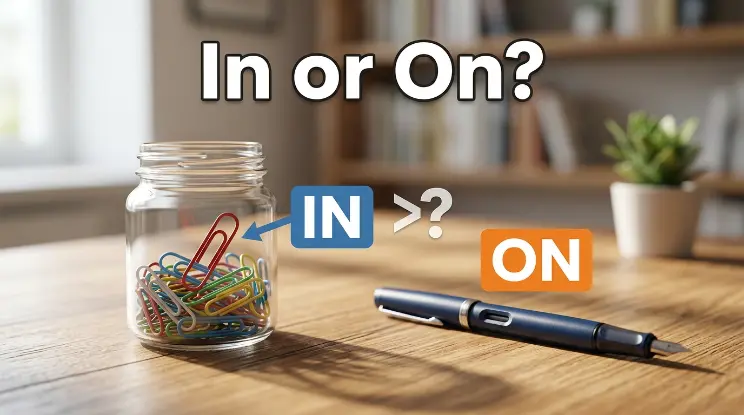
“In” is used for enclosed spaces, larger areas, months, years, and periods of time (think: inside something). “On” is used for surfaces, specific days and dates, and things that rest on top of something.
Example: You’re in your house, sitting on your couch, in July, on a Tuesday.
That’s the quick version now let’s dig into the details with plenty of examples. 🚀
What Does “In” Mean? Understanding the Basics
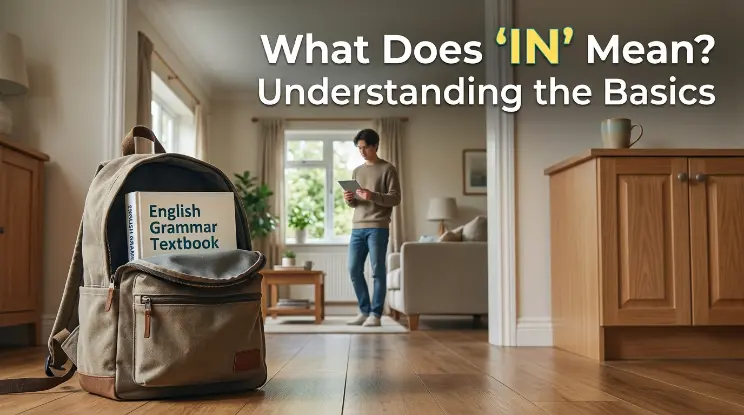
“In” generally suggests something is enclosed, surrounded, or contained within a space, time period, or situation. Picture a box if something is inside the box, you’d use “in.”
When to Use “In” 📦
1. Enclosed or larger spaces
- I left my keys in the car.
- She’s in the kitchen making dinner.
- They live in London.
- We met in a small café.
2. Months, years, seasons, and centuries
- My birthday is in March.
- She was born in 1998.
- Flowers bloom in spring.
- The internet became popular in the 20th century.
3. Parts of the day (except “at night”)
- I usually exercise in the morning.
- He calls his mom in the evening.
4. Countries, cities, and large geographic areas
- He grew up in Canada.
- The Eiffel Tower is in Paris.
- They travelled in Southeast Asia last year.
5. Abstract situations or conditions
- She’s in love.
- We’re in trouble.
- He’s in a good mood today.
What Does “On” Mean? Understanding the Basics
“On” typically refers to something being on top of a surface, or connected to a specific day, date, or platform. Think of it as contact one thing touching another.
When to Use “On” 🖥️
1. Surfaces
- The book is on the table.
- There’s a stain on your shirt.
- He put the plate on the counter.
2. Days and dates
- I have a meeting on Monday.
- Her wedding is on June 5th.
- We’re celebrating on New Year’s Eve.
3. Streets and specific locations (addresses)
- She lives on Baker Street.
- The store is on Fifth Avenue.
4. Technology, media, and platforms
- I saw it on Instagram.
- Let’s chat on Zoom.
- I watched the news on TV.
5. Modes of certain transport
- We travelled on a train.
- He was on a plane for six hours.
6. Fixed expressions
- I’m on vacation.
- She’s on a diet.
- We’re on the phone.
In vs On: Comparison Table 📊
| Feature | “In” ✅ | “On” ✅ |
| Meaning | Inside, enclosed, surrounded | On top of, in contact with a surface |
| Time | Months, years, seasons, centuries (in April, in 2020) | Days, dates (on Friday, on May 1st) |
| Place | Countries, cities, rooms (in Spain, in the office) | Streets, surfaces (on Elm Street, on the wall) |
| Transport | Cars, taxis (in the car) | Buses, trains, planes, bikes (on the bus) |
| Technology | Apps, platforms, screens (on YouTube, on the phone) | |
| Abstract use | States/conditions (in love, in danger) | Ongoing activities (on strike, on holiday) |
| Example Sentence | She was born in July. | The party is on Saturday. |
Common Mistakes with “In” and “On” ❌➡️✅
Here are some of the most frequent errors people make and how to fix them:
| ❌ Incorrect | ✅ Correct | Why |
| I live on New York. | I live in New York. | Cities take “in,” not “on.” |
| See you on July. | See you in July. | Months take “in.” |
| The meeting is in Monday. | The meeting is in on Monday. | Days take “on.” |
| She’s in the bus. | She’s on the bus. | Public transport (except cars) takes “on.” |
| He posted it in Instagram. | He posted it on Instagram. | Social media platforms take “on.” |
| I’m on danger. | I’m in danger. | Abstract states take “in.” |
Memory Trick to Remember “In” vs “On” 🧠
Here’s a simple mnemonic to lock this in:
“IN” = Inside a box. “ON” = On a table.
Picture a small box (in = enclosed things: rooms, cities, months, years) sitting on a table (on = flat surfaces: streets, days, screens).
Another handy trick:
- IN → think of “INside” (enclosed spaces, longer time periods)
- ON → think of “ONtop” (surfaces, specific days)
Real-Life Examples of “In” and “On” in Action 💬
📧 In Emails
- “Let’s schedule the call on Thursday in the afternoon.”
- “I’ll be in the office on Monday morning.”
📱 On Social Media
- “Just posted a new reel on Instagram! Check it out 🎥”
- “Can’t believe this happened in 2026 already!”
📰 In News Headlines
- “Wildfires reported in California on Tuesday.”
- “New policy to take effect in September.”
🎓 In Academic Writing
- “The study was conducted in 2021 and published on the university’s official journal website.”
🗣️ In Everyday Speech
- “I’ll meet you on the corner in ten minutes.”
- “She’s in a great mood on Fridays!”
British English vs American English: Any Differences? 🇬🇧🇺🇸
For the most part, “in” and “on” rules are consistent across British and American English. However, a few subtle differences exist:
| Context | British English 🇬🇧 | American English 🇺🇸 |
| Sports teams | She plays in the team. | She plays on the team. |
| Weekends | I’ll see you at the weekend. | I’ll see you on the weekend. |
| Street addresses | Both regions generally use in (small streets) or on (larger streets/avenues) usage can vary informally. | Same pattern, though “on” is more consistently used for named streets. |
💡 Tip: If you’re writing for a British audience, double-check sports and weekend-related phrases, since these are the biggest regional differences.
Quick Recap: In or On Cheat Sheet 📝
- In = enclosed spaces, months, years, seasons, countries, cities, abstract states
- On = surfaces, days, dates, streets, technology/platforms, most public transport
Use this rule of thumb: if you can picture something being surrounded by walls or time, use “in.” If you can picture something resting on top of a flat surface (physical or digital), use “on.”
FAQs: People Also Ask About “In or On” ❓
1. Is it “in a team” or “on a team”?
In American English, it’s typically “on a team.” In British English, “in a team” is more common.
2. Do we say “in the weekend” or “on the weekend”?
American English uses “on the weekend,” while British English prefers “at the weekend.”
3. Is it “in Monday” or “on Monday”?
It’s always “on Monday” days of the week always take “on.”
4. Do we say “in a car” or “on a car”?
You say “in a car” because you’re enclosed inside it. But for buses, trains, and planes, you say “on the bus/train/plane.”
5. Is it “in Facebook” or “on Facebook”?
It’s “on Facebook” all social media platforms take “on.”
6. Is it “in the morning” or “on the morning”?
It’s “in the morning.” Parts of the day (morning, afternoon, evening) use “in,” except for “at night.”
7. Do we say “in 2026” or “on 2026”?
It’s “in 2026″ years always take “in.”
8. Is it “in the internet” or “on the internet”?
It’s “on the internet” this is a fixed, commonly used expression.
Final Thoughts:
The difference between “in” and “on” really comes down to one simple idea: enclosure vs. surface. “In” wraps around something a room, a month, a mood. “On” sits on top a table, a date, a screen.
With a bit of practice (and maybe that box-and-table mnemonic 🧠), you’ll never have to pause mid-sentence again wondering which one to use. Keep practicing with real sentences, and soon it’ll become second nature!
Got any tricky “in or on” sentences you’re unsure about? Drop them in your notes and test yourself using this guide. Grammar mastery is just consistent practice away. ✨

James Carter is an English language enthusiast and content writer who loves making grammar simple and easy to understand. He creates clear, beginner-friendly guides on spelling, grammar rules, confusing words, and everyday English usage. His goal is to help readers write with confidence through practical examples, easy explanations, and accurate language tips.