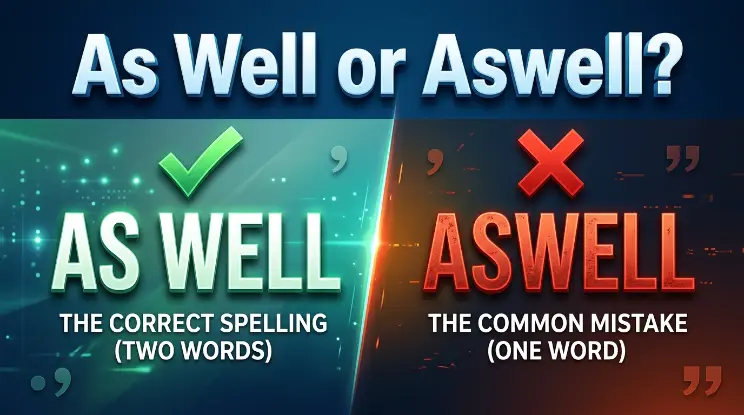
Have you ever written a sentence and suddenly wondered, “Is it ‘as well’ or ‘aswell’?” You are not alone. This is a common English spelling question, especially when you are writing quickly, chatting online, or trying to make your grammar more accurate.
At first glance, the two forms may look almost identical, but there is an important difference between them. One is the standard and correct form used in English, while the other is generally considered a spelling mistake.
In this guide, we will take a simple look at “as well” or “aswell” and explain which one you should use in your writing. You will learn what “as well” means, how it works in sentences, and why it is normally written as two separate words.
Quick Answer ⚡
“As well” is the only correct spelling. It’s always written as two separate words. “Aswell” is a common misspelling and is not recognized as standard English by any major dictionary.
What Does “As Well” Actually Mean?
“As well” is an adverbial phrase that means “also,” “too,” or “in addition.” It’s used to add extra information to a sentence.
Correct Usage Examples of “As Well” ✅
- I ordered a coffee, and I got a muffin as well.
- She’s a great singer, and she plays the guitar as well.
- Can you send me the invoice as well as the receipt?
- He’s coming to the party his sister is coming as well.
- Not only did they win the game, but they also broke the record as well.
Notice how “as well” usually sits at the end of a sentence or clause, doing the same job as “too” or “also.”
“As Well As” A Slightly Different Job
There’s also the phrase “as well as,” which works more like a conjunction meaning “in addition to” or “along with.”
- She speaks French as well as Spanish.
- The manager, as well as her team, attended the meeting.
- He enjoys hiking as well as cycling.
💡 Grammar tip: When “as well as” joins two subjects, the verb agrees with the first subject, not the one after “as well as.”
- ✅ The teacher, as well as her students, was excited. (singular “was” agrees with “teacher”)
Why Do People Write “Aswell”? 🧐
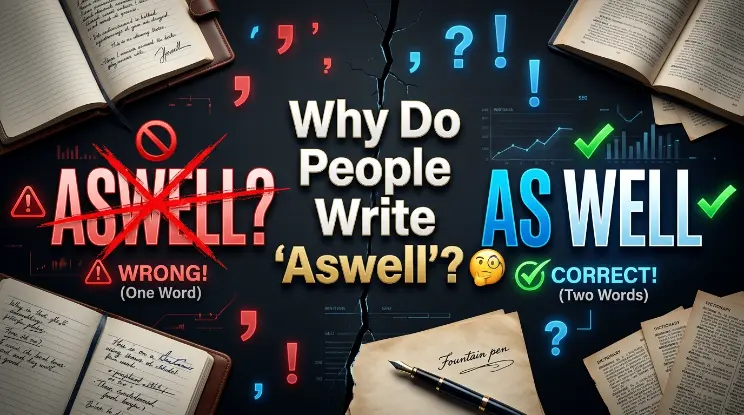
“Aswell” isn’t a made-up phrase from nowhere it’s a classic case of eye-mishearing. Since “as well” is often said quickly and smoothly in spoken English, it sounds like one fused word, similar to how “a lot” sometimes gets misspelled as “alot.”
Common reasons people slip up:
- Speech-to-text confusion spoken language blends the words together.
- Autocomplete habits some phones learn incorrect patterns if typed often enough.
- Visual pattern matching words like “always,” “already,” and “almost” are legitimately single words, so people assume “aswell” follows the same rule.
- Speed typing on social media or casual chats, where accuracy takes a back seat.
Comparison Table: “As Well” vs “Aswell”
| Feature | As Well ✅ | Aswell ❌ |
| Correct spelling? | Yes | No |
| Recognized by dictionaries? | Yes (Merriam-Webster, Oxford, Cambridge) | No |
| Meaning | Also, too, in addition | N/A (not a real word) |
| Grammatically valid? | Yes | No |
| Common in | Formal & informal writing | Typos, texting, social media |
| Example | “I like tea, and coffee as well.” | “I like tea, and coffee aswell.” (incorrect) |
Common Mistakes to Avoid 🚫
- Writing it as one word “aswell” is always wrong, no exceptions.
- Confusing “as well” with “aswel” or “aswhell” yes, these variations show up too, and they’re all incorrect.
- Overusing “as well” at the end of every sentence it can sound repetitive. Mix it up with “too” or “also.”
- Misplacing “as well” in a sentence, which can make it sound clunky:
- ❌ As well, I bought milk. (unnatural placement)
- ✅ I bought milk as well.
- ✅ I also bought milk. (better alternative if starting a sentence)
Memory Trick to Never Mix It Up Again 🧠
Here’s a simple mnemonic:
“As” and “Well” are BEST FRIENDS who never move in together.”
Just like “a lot” (not “alot”), “as well” always keeps its space literally! Picture the word “space” every time you write it, and you’ll never merge them again.
Another quick trick: if you can replace it with “too” or “also” and the sentence still makes sense, it should be written as two words “as well.”
- I’m coming as well. → I’m coming too. ✅ (two words confirmed)
Real-Life Examples From Everyday Communication 📱
In Emails
“Please find the attached report. I’ve included the summary sheet as well for your convenience.”
On Social Media
“Loved the concert last night! The opening act was amazing as well 🎶”
In News Writing
“The company announced new hires this week, along with a leadership restructuring as well.”
In Academic Writing
“The study examined income levels as well as education rates across regions.”
In Everyday Speech
“I’m grabbing lunch you want anything as well?”
See how naturally it fits into casual chats, professional emails, and even formal essays? That’s what makes “as well” such a versatile little phrase.
British English vs American English 🇬🇧🇺🇸
Good news there’s no regional difference here! “As well” is used identically in both British and American English. It’s considered:
- Neutral in tone (works in both casual and formal contexts)
- Common in spoken and written English across the globe
- A safe, universally accepted alternative to “too” and “also”
The only real “regional” issue is that the misspelling “aswell” pops up everywhere, regardless of country it’s a global typing habit, not a dialect thing. 🌍
“As Well” vs “Too” vs “Also” What’s the Difference?
Since these three words often get used interchangeably, here’s a handy breakdown:
| Word/Phrase | Position in Sentence | Formality Level | Example |
| As well | End of sentence | Neutral/slightly formal | “She’s joining us as well.” |
| Too | End of sentence | Casual | “She’s joining us too.” |
| Also | Beginning or middle of sentence | Neutral/formal | “She’s also joining us.” |
💡 Pro tip: In formal writing (reports, essays, business emails), “as well” or “also” tend to sound more polished than “too.”
FAQs About “As Well” and “Aswell” ❓
1. Is “aswell” a real word?
No. “Aswell” is not recognized in any standard English dictionary. The correct form is always “as well” two separate words.
2. Can I start a sentence with “as well”?
It’s uncommon and can sound awkward. It’s better to use “Also,” at the start of a sentence instead.
- ❌ As well, I need to buy milk.
- ✅ Also, I need to buy milk.
3. What’s the difference between “as well” and “as well as”?
“As well” means “also” or “too,” while “as well as” means “in addition to” or “along with,” and often connects two nouns or clauses.
4. Is “as well” formal or informal?
It works well in both formal and informal contexts, making it one of the most flexible phrases in English.
5. Why does autocorrect sometimes not fix “aswell”?
Not all keyboard autocorrect systems flag it as an error because it’s a common typo pattern, not a recognized “banned” word. Always double-check manually!
6. Is “as-well” (with a hyphen) correct?
No. There’s no hyphenated version of this phrase in standard English. Stick to “as well” with a space, no hyphen.
7. What are similar commonly misspelled phrases?
Other frequently merged phrases include:
- “a lot” (not “alot”)
- “all right” (not “alright” in formal writing)
- “in fact” (not “infact”)
- “no one” (not “noone”)
Final Takeaway 🎯
In conclusion, “as well” is the correct standard form, while “aswell” is generally considered incorrect in standard English. “As well” is written as two separate words and is commonly used to mean “also” or “too.” Understanding this small spelling difference can help you write more clearly and avoid common grammar mistakes.
You are writing an email, school assignment, blog post, or social media message, always choose “as well” when you want to use this expression. Remember: as well = correct, aswell = incorrect in standard English.

Olivia Bennett is a passionate English grammar writer at GrammBoost.com who loves making grammar simple and easy to understand. She specializes in spelling, word differences, punctuation, and everyday English usage. Through clear explanations and practical examples, Olivia helps students, writers, and professionals write with greater confidence and accuracy.