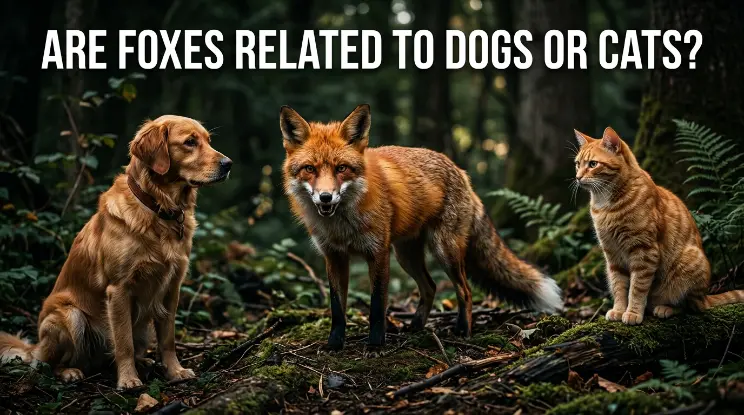
Ever watched a fox slink across your backyard at night and thought, “Wait… is that basically a wild cat with a bushy tail?” 🤔 You’re not alone. Foxes are one of nature’s biggest identity-crisis animals they look kind of cat-like with their pointy ears, slit-like pupils, and sneaky, solo hunting style.
But they also bark like dogs, dig burrows like dogs, and belong to the same big animal family as wolves.
This mix of dog-like and cat-like traits confuses tons of people, and it’s a genuinely popular question people search for online. So let’s clear up the confusion once and for all, in plain, simple English. 🐾
Quick Answer 🎯
Foxes are biologically related to dogs, not cats. They belong to the Canidae family (the same family as dogs, wolves, and coyotes), even though many of their behaviors and physical features look more feline.
That’s the short version now let’s dig into why this is true, and why the confusion happens in the first place.
What Does “Related” Actually Mean Here?

Before we go further, let’s get our terms straight, because this matters for correct usage and understanding:
- Related (biologically) means sharing a common ancestor and belonging to the same scientific classification group (family, genus, species).
- Similar (in appearance or behavior) just means “looks or acts alike” it does NOT mean two animals are related.
This distinction is the whole key to answering “are foxes related to dogs or cats” correctly. 🧬
Example Sentences:
- “Foxes are related to dogs because both belong to the Canidae family.” ✅
- “Foxes are similar to cats in the way they stalk prey silently.” ✅
- ❌ “Foxes are related to cats” this is incorrect, even though it feels true because of shared behaviors.
The Science: Where Foxes Actually Belong 🔬
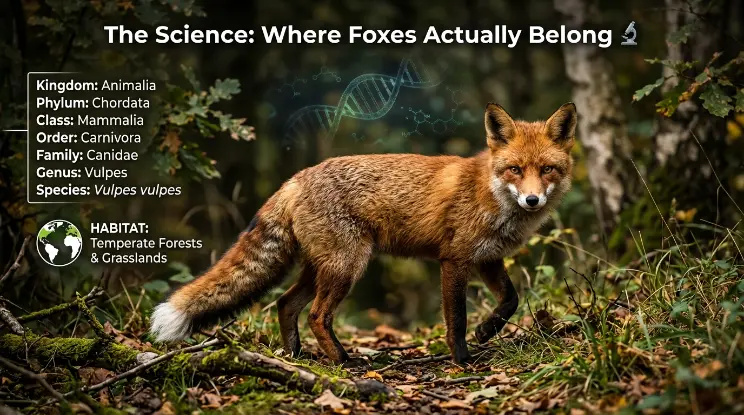
Here’s the simple breakdown of fox classification:
- Kingdom: Animalia
- Class: Mammalia
- Order: Carnivora
- Family: Canidae (the dog family)
- Genus: Varies by fox type (e.g., Vulpes for red foxes)
Dogs, wolves, coyotes, jackals, and foxes are all members of Canidae. Cats, on the other hand, belong to a completely different family called Felidae. Foxes and cats only share the same order (Carnivora), which is a much broader, more distant grouping kind of like how you and a fourth cousin twice removed both belong to the same extended family reunion, but you’re not siblings.
Comparison Table: Foxes vs Dogs vs Cats 🐺🐱🦊
| Feature | Foxes 🦊 | Dogs 🐶 | Cats 🐱 |
| Scientific Family | Canidae | Canidae | Felidae |
| Closest Relative | Wolves, dogs, coyotes | Wolves, foxes | Lions, tigers, house cats |
| Pupil Shape | Vertical (slit-like, cat-like) | Round | Vertical (slit-like) |
| Hunting Style | Solo, stalking | Pack or solo | Solo, stalking |
| Social Behavior | Mostly solitary | Pack animals | Mostly solitary |
| Vocal Sounds | Barks, screams, yips | Barks, howls | Meows, purrs |
| Claws | Non-retractable | Non-retractable | Retractable |
| Diet | Omnivore | Omnivore/Carnivore | Obligate carnivore |
| Domesticated? | No (mostly wild) | Yes | Yes |
As you can see, foxes actually behave a bit like cats but are biologically dogs’ cousins. That’s the twist that trips everyone up!
Why Do People Think Foxes Are Related to Cats? 🐈
This is a genuinely reasonable mix-up, and here’s why it happens:
- Vertical pupils just like cats, giving them that sneaky, nighttime stare 👀
- Solitary hunting foxes don’t hunt in packs the way wolves and dogs often do
- Retractable-ish claws fox claws are semi-retractable, unlike a dog’s fully exposed claws
- Pouncing behavior foxes literally do a cat-style pounce when hunting mice in snow (it’s adorable, look it up!)
- Whisker use foxes rely on whiskers for night navigation, much like cats
These are called convergent evolution traits when two unrelated (or distantly related) animals evolve similar features because they live similar lifestyles (in this case, nighttime, solitary hunting). It doesn’t mean they’re related; it just means nature found a similar solution twice. 🌙
Common Mistakes People Make 📝
Since this is also a great English usage and vocabulary lesson, here are common mistakes people make when talking or writing about this topic:
- ❌ Mistake: “Foxes are part cat, part dog.” ✅ Correct: “Foxes are canines that display some cat-like behaviors.”
- ❌ Mistake: “Foxes and cats are cousins.” ✅ Correct: “Foxes and dogs are cousins; foxes and cats are only distantly related through a shared order.”
- ❌ Mistake: Using “breed” for foxes (foxes are a species, not a dog breed). ✅ Correct: “Foxes are a separate species within the dog family, not a breed of dog.”
Memory Trick / Mnemonic 🧠
Here’s a simple mnemonic to remember this forever:
“Foxes Follow Fido’s Family.”
Since Foxes and Fido (a classic dog name) both start with F and both belong to the same Family (Canidae), it’s an easy way to lock in that foxes = dog family, no matter how cat-like they act.
Or try this rhyme:
🦊 “Though I pounce and stare like a cat in the night, I’m really a canine that’s just how I bite!” 🐾
Real-Life Examples of This Topic in Use 💬
In Everyday Speech
- “My neighbor swore the fox in her yard was ‘basically a wild cat,’ but nope it’s actually in the dog family!”
On Social Media
- A viral tweet caption once read: “Foxes: proof that nature loves a plot twist. Dog family, cat vibes.” 🦊✨
In News Articles
- Wildlife articles often clarify: “Despite popular belief, foxes are not related to domestic cats; they are canids, closely tied to wolves and dogs.”
In Academic Writing
- A biology textbook might state: “Vulpes vulpes, the red fox, is a member of the Canidae family and shares a most recent common ancestor with wolf-like canids rather than felids.”
An Email or School Assignment
- “As part of my biology homework, I learned that foxes are technically dogs’ relatives, even though their hunting style looks a lot like a cat’s.”
British vs American English Notes 🇬🇧🇺🇸
Good news there’s no major regional difference in how this topic is discussed! Both British and American English:
- Use the word “fox” the same way
- Refer to the fox family as Canidae in both regions
- Commonly use the phrase “related to” rather than “relative of,” though both are grammatically correct
One small difference:
- British English sometimes uses “vixen” more commonly in casual conversation (for a female fox), while American English uses “female fox” more often in everyday speech, even though “vixen” is understood in both.
FAQs: People Also Ask 🙋♀️
1. Are foxes more like cats or dogs?
Foxes are biologically dogs (Canidae family), but they behave more like cats in hunting style and body language.
2. Can foxes and dogs mate?
No. Even though they’re in the same family, foxes and dogs have different chromosome numbers and cannot successfully interbreed.
3. Why do foxes have cat-like eyes?
Foxes have vertical pupils because they’re active at night and need better light control for nocturnal hunting a trait shared with cats through convergent evolution, not shared ancestry.
4. Is a fox a wild dog?
Not exactly a “wild dog” in the technical sense, but foxes are wild members of the dog family (Canidae), distinct from domestic dogs.
5. Do foxes act like cats?
Yes! Foxes stalk prey, pounce, and often hunt alone all cat-like behaviors despite being genetically closer to dogs.
6. What family do foxes belong to?
Foxes belong to the Canidae family, the same family as dogs, wolves, coyotes, and jackals.
7. Are foxes closely related to wolves?
Foxes and wolves are in the same family (Canidae) but are more like distant cousins than close relatives wolves are actually closer to domestic dogs than to foxes.
Conclusion: The Final Verdict 🏁
So, are foxes related to dogs or cats? They’re related to dogs. Foxes belong to the Canidae family, the same scientific family as wolves, coyotes, and domestic dogs. Their cat-like eyes, solo hunting habits, and stealthy pounces are just a case of convergent evolution nature reusing a good design, not proof of shared ancestry.
Next time someone tells you a fox is “basically a cat,” you’ll know exactly how to set the record straight with facts, examples, and maybe even that handy mnemonic: “Foxes Follow Fido’s Family.” 🦊🐶

James Carter is an English language enthusiast and content writer who loves making grammar simple and easy to understand. He creates clear, beginner-friendly guides on spelling, grammar rules, confusing words, and everyday English usage. His goal is to help readers write with confidence through practical examples, easy explanations, and accurate language tips.