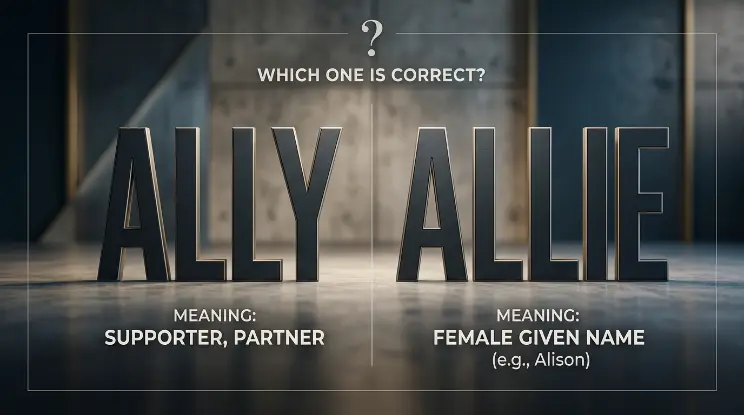
Have you ever typed a sentence, paused, and thought “Wait, is it ‘ally’ or ‘allie’? Which one is even a real word?” 🤔
You’re not alone! This is one of those sneaky little English mix-ups that trips up students, professionals, and even native speakers. The words look similar, sound almost identical when spoken quickly, and yet they mean completely different things.
In this guide, we’re going to clear up the confusion once and for all with simple explanations, real-life examples, a handy comparison table, and even a memory trick so you never second-guess yourself again. Let’s dive in! 🚀
⚡ Quick Answer
“Ally” is a real English word meaning a person, group, or country that supports or helps another. “Allie” is simply a nickname or given name (usually short for Alison, Allison, or Alexandra) it is not a standard dictionary word. So if you’re writing about friendship, support, or partnership, you want ally, not “allie.”
📖 What Does “Ally” Mean?
Ally (noun/verb) refers to:
- A person who cooperates with or supports someone else
- A country that has a formal agreement to support another country, especially during war
- Someone who advocates for a marginalized group they may not personally belong to (e.g., “a straight ally to the LGBTQ+ community”)
It can also be used as a verb, meaning to join forces with or to unite for a common purpose.
✅ Examples of “Ally” in Sentences
- She has always been a loyal ally to her coworkers during tough projects.
- The United States and the United Kingdom have been allies since World War II.
- He decided to ally himself with the opposing team to win the debate.
- As a manager, being an ally to your team means listening to their concerns.
- Being an ally for social causes means showing up, not just posting about it. 📢
🔤 Pronunciation Tip
“Ally” is pronounced AL-eye (rhymes with “rally” or “tally”) when used as a noun, though stress can shift slightly when used as a verb.
👩 What Does “Allie” Mean?
Allie is not a standard English word it’s a proper noun, specifically a common nickname or given name. You’ll usually see it:
- As a short form of Alison, Allison, or Alexandra
- As a character name in movies, books, or TV shows (like Allie from The Notebook)
- As a username, brand name, or pet name
✅ Examples of “Allie” in Sentences
- Allie is coming over for dinner tonight.
- My best friend’s name is Allie, short for Allison.
- Have you watched the movie where Allie and Noah fall in love?
- Allie‘s Bakery just opened downtown the cupcakes are amazing! 🧁
- I met Allie at the conference last week; she’s a graphic designer.
⚠️ Important: Since “Allie” is a name, it should always be capitalized, no matter where it appears in a sentence.
📊 Ally vs Allie: Comparison Table
| Feature | Ally | Allie |
| Part of speech | Noun / Verb | Proper noun (name) |
| Meaning | Supporter, partner, or friend in a cause | Nickname for Alison, Allison, or Alexandra |
| Capitalization | Lowercase (unless starting a sentence) | Always capitalized |
| Common usage | Formal writing, politics, business, relationships | Casual conversation, names, fiction |
| Plural form | Allies | Allies (rare, only if referring to multiple people named Allie) |
| Example | “They became close allies.” | “Allie loves painting.” |
❌ Common Mistakes People Make
Here are the most frequent slip-ups with ally vs allie:
- ❌ “She is my allie at work.” → ✅ “She is my ally at work.”
- ❌ “The two nations became allie during the war.” → ✅ “The two nations became allies during the war.”
- ❌ Using “ally” when referring to a person’s actual name (e.g., writing “ally” instead of “Allie” for someone named that).
- ❌ Forgetting to capitalize “Allie” when it’s used as a name.
🧠 Memory Trick (Mnemonic)
Here’s an easy way to remember the difference:
“Ally” ends in -LY, like FRIEND-LY because an ally is a friendly supporter. 🤝
“Allie” ends in -IE, like a NAME, just like Katie, Jamie, or Sophie. 👧
Whenever you’re unsure, ask yourself: “Am I talking about support/friendship (ally) or a person’s name (Allie)?”
🌍 British vs American English
Good news there’s no difference between British and American English when it comes to spelling “ally.” Both varieties use the same spelling and meaning.
However, “Allie” as a name may have slightly different popularity trends:
- In the US, “Allie” is a popular casual nickname, especially among Gen Z and Millennials.
- In the UK, “Allie” is also used, though “Ally” (without the -ie) is sometimes seen as a nickname for Alistair or Alison too which can add to the confusion!
🔎 Regional Note: In Scotland, “Ally” is a fairly common nickname for men named Alistair or Alasdair, which is a fun regional twist worth knowing.
💬 Real-Life Examples
📧 In an Email
“Thank you for being such a strong ally throughout this negotiation process. Your support made all the difference.”
📱 On Social Media
“Shoutout to every ally who shows up for marginalized communities, not just during awareness months but every single day. 💜 #Allyship”
📰 In the News
“The two countries signed a defense pact, formally becoming military allies.”
🎓 In Academic Writing
“The study explores how corporate allyship influences workplace diversity outcomes.”
🗣️ In Everyday Speech
“My neighbor has always been an ally she watches my kids whenever I need help.”
👩 Referring to a Name
“I’m meeting Allie for coffee this afternoon.”
❓ FAQs About Ally vs Allie
1. Is “Allie” a real word in English?
No, “Allie” is not a standard dictionary word. It is a proper noun used as a nickname or given name.
2. What is the difference between an ally and an allyship?
An ally is a person who supports another person or group, while allyship refers to the ongoing action and practice of supporting that person or group.
3. Can “ally” be used as a verb?
Yes! For example: “The two companies decided to ally with each other to expand into new markets.”
4. Is “Allie” short for anything specific?
It’s most commonly short for Alison, Allison, or Alexandra, though it can also stand on its own as a given name.
5. How do you pronounce “ally”?
It’s pronounced AL-eye, similar to “rally” or “tally.”
6. Is “Ally” always spelled the same in British and American English?
Yes, the spelling of “ally” (meaning supporter or partner) remains identical in both British and American English.
7. What’s a good way to remember the difference between ally and Allie?
Remember: “Ally” = friendLY support, while “Allie” = a name, just like Katie or Sophie. 🧠
🎯 Final Thoughts
In conclusion, both Ally and Allie are correct names, but they can have different origins, meanings, and personal preferences. Ally is often used as a short form of names such as Alison or Alexandra, while Allie is a more informal and friendly spelling commonly used as a nickname. Neither spelling is universally more correct, so the best choice depends on the person and the name they prefer.
If you are writing about someone specific, always use their preferred spelling. Whether you choose Ally or Allie, both versions are familiar, attractive, and widely understood in English-speaking communities.

Olivia Bennett is a passionate English grammar writer at GrammBoost.com who loves making grammar simple and easy to understand. She specializes in spelling, word differences, punctuation, and everyday English usage. Through clear explanations and practical examples, Olivia helps students, writers, and professionals write with greater confidence and accuracy.