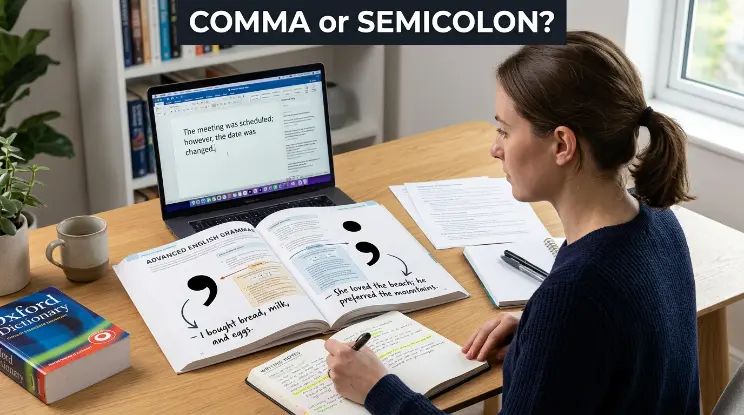
Have you ever been halfway through writing a sentence, paused, and thought: “Wait… should I use a comma here, or does this need a semicolon?” 🤔
You’re not alone. The comma vs semicolon debate is one of the most common grammar mix-ups in the English language. Even experienced writers second-guess themselves here, because these two punctuation marks look like they do similar jobs but they absolutely don’t.
The good news? Once you understand the simple rule behind each one, you’ll never confuse them again.
Quick Answer ⚡
Use a comma to separate short items, add pauses, or connect a main clause to a simpler word or phrase. Use a semicolon to join two complete, closely related sentences without a conjunction like “and” or “but.”
That’s the one-sentence version. Now let’s break it down properly, with examples, tables, and a few memory tricks to lock it in for good. 🧠
What Is a Comma, Exactly? 🖊️
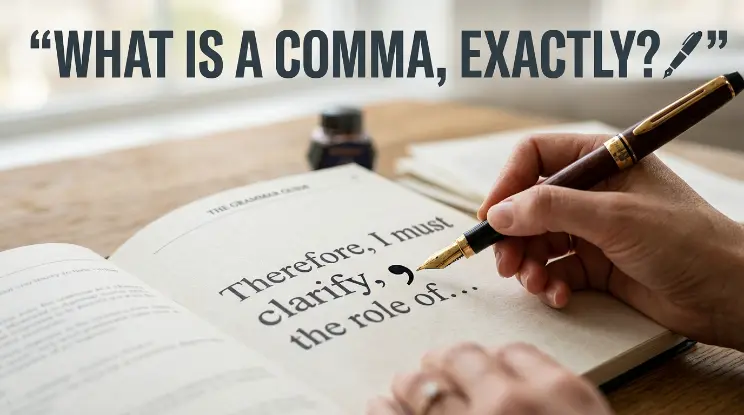
A comma (,) is a punctuation mark used to show a brief pause in a sentence. It separates ideas, items, or clauses that aren’t quite strong enough to stand alone as full sentences.
When to Use a Comma
- Separating items in a list
- I bought apples, bananas, oranges, and grapes.
- Joining an independent clause with a dependent clause
- Even though it was raining, we went for a walk.
- Before a coordinating conjunction (and, but, or, so, yet) connecting two full sentences
- I wanted to go to the beach, but it started raining.
- Setting off introductory words or phrases
- Honestly, I didn’t expect that to happen.
- Separating extra (non-essential) information
- My brother, who lives in London, is visiting next week.
Common Comma Mistakes 🚫
- ❌ Comma splice: I love pizza, I eat it every week. (Two full sentences joined by just a comma this is incorrect!)
- ✅ Fixed: I love pizza, and I eat it every week. (or use a semicolon more on that below!)
What Is a Semicolon, Exactly? 🔗
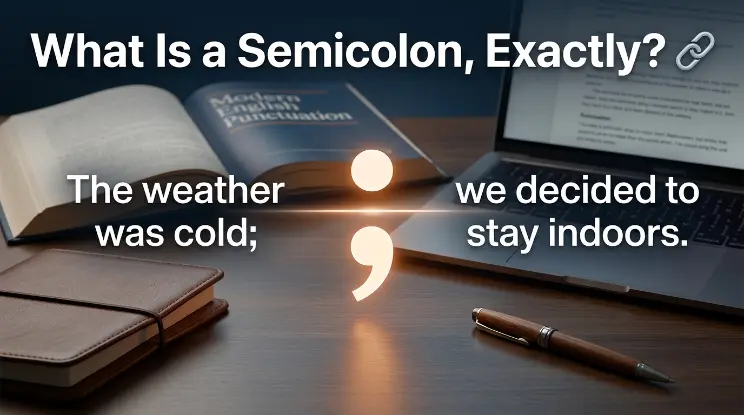
A semicolon (;) is a punctuation mark that connects two independent clauses meaning two groups of words that could each stand alone as a complete sentence when the ideas are closely related.
Think of a semicolon as a “soft period.” It’s stronger than a comma but not as final as a full stop.
When to Use a Semicolon
- Joining two closely related complete sentences (without “and,” “but,” etc.)
- I love pizza; I eat it every week.
- Before transitional words like “however,” “therefore,” “moreover,” “meanwhile”
- She studied all night; however, she still felt unprepared.
- Separating complex list items that already contain commas
- I’ve lived in Paris, France; Rome, Italy; and Tokyo, Japan.
Common Semicolon Mistakes 🚫
- ❌ Using a semicolon with an incomplete sentence: Because I was tired; I went to bed early. (Wrong “Because I was tired” isn’t a complete sentence.)
- ✅ Fixed: Because I was tired, I went to bed early.
Comma vs Semicolon: Side-by-Side Comparison Table 📊
| Feature | Comma (,) | Semicolon (;) |
| Main job | Pause, separate items or clauses | Join two complete related sentences |
| Can join two full sentences alone? | ❌ No (creates a comma splice) | ✅ Yes |
| Used in lists? | ✅ Simple lists | ✅ Complex lists (with internal commas) |
| Used with conjunctions (and, but)? | ✅ Yes | ❌ No (not needed) |
| Used with transition words (however, therefore)? | ❌ Rarely alone | ✅ Yes, commonly |
| Strength of pause | Short pause | Medium pause (stronger than comma, softer than period) |
| Example | I like tea, and she likes coffee. | I like tea; she likes coffee. |
Memory Trick to Never Mix Them Up Again 🧠💡
Here’s a simple mnemonic:
🟢 Comma = Continue the same sentence with extra info or items. 🔵 Semicolon = Separate but Similar two full sentences that are closely connected.
Another fun trick: picture the semicolon as two sentences holding hands 🤝 each one is a complete little sentence, but they’re linked because they belong together in meaning.
Real-Life Examples 🌍
Let’s see how these punctuation marks show up in everyday writing.
📧 In Emails
- Comma: “Please find attached the report, and let me know if you have questions.”
- Semicolon: “The meeting has been rescheduled; please update your calendars accordingly.”
📱 On Social Media
- Comma: “Woke up late, missed the bus, still made it to work on time 😅”
- Semicolon: “Some days you win; some days you learn.”
📰 In News Writing
- Comma: “The mayor announced the new policy, which will take effect next month.”
- Semicolon: “The storm caused widespread damage; recovery efforts are already underway.”
🎓 In Academic Writing
- Comma: “The study included 200 participants, all of whom completed the survey.”
- Semicolon: “The results were statistically significant; however, further research is needed.”
Comma vs Semicolon: Usage Insights 🔍
Here’s something interesting the semicolon is actually used less often in casual writing today, especially in American English, where writers tend to prefer breaking ideas into two shorter sentences instead.
| Region | Tendency |
| American English | Prefers shorter sentences; semicolon use is more common in formal/academic writing |
| British English | Semicolons appear a bit more often in journalism and literary writing |
Either way, both punctuation marks follow the same core grammar rules in both American and British English the difference is mostly in style preference, not rules.
Related Grammar & SEO Keywords 🔑
To help you master this topic (and for search visibility), keep these related terms in mind:
- Punctuation rules
- Comma splice
- Independent clause
- Sentence structure
- Grammar tips
- Common mistakes
- English usage
- Correct spelling and punctuation
- Writing clarity
Comma or Semicolon: Quick Decision Table 🧩
| Situation | Use This |
| Listing 3+ simple items | Comma |
| Listing complex items with internal commas | Semicolon |
| Joining two full sentences with “and/but/or” | Comma |
| Joining two full sentences with NO conjunction | Semicolon |
| Before “however,” “therefore,” “meanwhile” (joining sentences) | Semicolon |
| Adding a pause after an introductory phrase | Comma |
| Setting off extra descriptive information | Comma |
Frequently Asked Questions (FAQs) ❓
1. Can I use a comma instead of a semicolon?
Not when joining two complete sentences without a conjunction that creates a comma splice, which is a common grammar mistake. Use a semicolon or add a conjunction instead.
2. Is it wrong to use a semicolon before “and”?
Generally, yes. A semicolon replaces the need for “and.” If you’re using “and,” a comma is usually correct instead.
3. Can a semicolon be used in a list?
Yes! Use semicolons in a list when the items themselves contain commas, to avoid confusion.
4. Do British and American English treat semicolons differently?
Not in terms of grammar rules both follow the same structure. The difference is mostly stylistic, with semicolons appearing slightly more in British formal and journalistic writing.
5. What happens if I use a comma to join two independent clauses?
You create a comma splice, which is considered incorrect in standard English. Fix it with a semicolon, a conjunction, or by splitting it into two sentences.
6. Is the semicolon becoming outdated?
Not outdated just less common in casual writing. It’s still widely used in formal, academic, and journalistic contexts.
7. What’s an easy way to remember the difference?
Think: comma = pause and continue, semicolon = two related full sentences joined together.
Final Thoughts:
In conclusion, knowing when to use a comma or semicolon can make your writing clearer, smoother, and easier to understand. A comma is commonly used to separate items, phrases, or parts of a sentence, while a semicolon connects closely related independent clauses or separates complex items in a list.
The key is to understand how the parts of your sentence are connected. If you are simply separating information, a comma may be enough. If two complete thoughts are closely related, a semicolon can often work better. With regular practice, choosing between a comma and semicolon will become much easier and more natural.

James Carter is an English language enthusiast and content writer who loves making grammar simple and easy to understand. He creates clear, beginner-friendly guides on spelling, grammar rules, confusing words, and everyday English usage. His goal is to help readers write with confidence through practical examples, easy explanations, and accurate language tips.