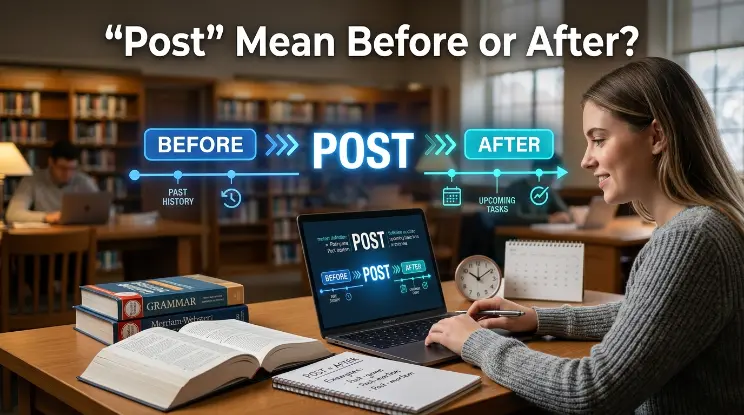
Ever seen a word like post-game, post-war, or postpone and paused for a second, wondering, “Wait… does post mean before this happened, or after it?” 🤔
You’re definitely not alone. The prefix post- trips up a lot of English learners (and even native speakers!) because it looks like it could go either way. Some people mix it up with “pre-,” others just guess based on the sentence and hope for the best.
Good news: this one has a clean, simple answer and once it clicks, it clicks for good.
Quick Answer ⚡
“Post” means AFTER, not before. It comes from Latin post, meaning “after” or “following.” So post-game means “after the game,” and postwar means “after the war.” The opposite prefix, pre-, means “before.”
That’s it. That’s the core rule. Now let’s dig into why it confuses people, how to use it correctly, and how to never mix it up again.
What Does “Post-” Actually Mean? 📖
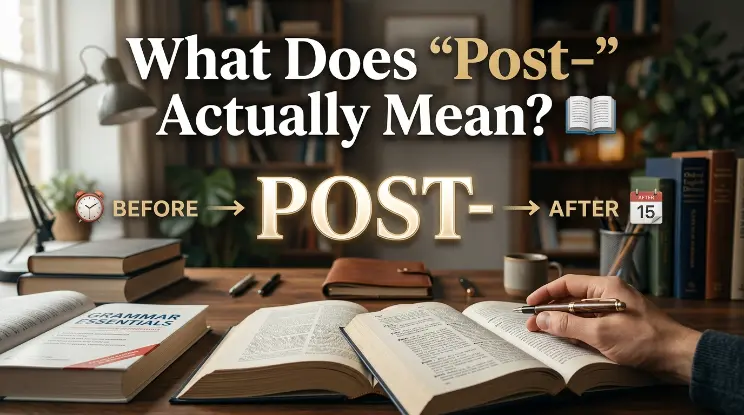
Post- is a prefix a small chunk of letters you attach to the front of a word to change its meaning. It comes straight from Latin, where post literally translates to “after” or “behind.”
When you stick “post-” onto a word, you’re saying: this happens after [that thing].
Examples of “Post-” in Action
- Postpone 🗓️ → to put something off until after the planned time
- Post-game interview 🎤 → the interview that happens after the game ends
- Postwar era 🕊️ → the period of time after a war has ended
- Postgraduate studies 🎓 → education you pursue after graduating
- Post-mortem 🔍 → an examination done after death (or, in business, a review done after a project ends)
- Postnatal care 👶 → medical care given after a baby is born
Notice the pattern? Every single one of these describes something happening after a specific event or point in time.
What About “Pre-“? (The Opposite Word) 🔄
Since so much of the confusion comes from mixing up “post-” with “pre-,” let’s clear that up too.
Pre- also comes from Latin, and it means “before.”
Examples of “Pre-” in Action
- Preview 👀 → a look before the main event
- Pre-game warm-up 🏈 → the warm-up before the game starts
- Prehistoric 🦕 → the time period before recorded history
- Prenatal care 🤰 → medical care given before a baby is born
- Preheat the oven 🔥 → heating the oven before you put the food in
So when you line them up side by side, the difference becomes crystal clear.
Comparison Table: “Post-” vs “Pre-” 📊
| Prefix | Meaning | Origin | Example Word | Meaning of Example |
| Post- | After | Latin post | Post-game | After the game |
| Pre- | Before | Latin prae | Pre-game | Before the game |
| Post- | After | Latin post | Postwar | After the war |
| Pre- | Before | Latin prae | Prewar | Before the war |
| Post- | After | Latin post | Postgraduate | After graduation |
| Pre- | Before | Latin prae | Pregraduate (rare) | Before graduation |
| Post- | After | Latin post | Postpone | Push to a later (after) time |
| Pre- | Before | Latin prae | Prepare | Get ready before something |
💡 Notice: “Post-” and “pre-” are true opposites. If you remember one, you automatically know the other!
Why Do People Get Confused? 🤯
Here are the most common reasons this mix-up happens:
- They look similar. Both are short prefixes that get glued onto other words, so it’s easy to blur them together, especially when reading fast.
- “Post” also means “mail.” 📬 In everyday English, “post” can mean sending a letter (British English especially “I’ll post the card tomorrow”). This unrelated meaning sometimes makes people overthink the prefix meaning.
- Social media “posting.” When you “post” something online, you’re publishing it now which has nothing to do with the “after” meaning of the prefix. This double duty can create confusion.
- Non-native speakers often translate literally, and in some languages, similar-sounding prefixes work differently.
Memory Trick to Never Mix It Up Again 🧠
Here’s a simple mnemonic:
“POST” starts with a P, just like “PAST.” And “past” already happened meaning it comes after something else has occurred.
Or try this one:
Post = Past the event (it already happened) Pre = Prior to the event (it hasn’t happened yet)
Another fun trick: think of a postman 📮. A postman delivers mail after it’s been written and sent never before. That image can help “post” stick as “after” in your brain.
“Post” as a Standalone Word (Not Just a Prefix) 📝
It’s worth noting that “post” isn’t only a prefix it’s also a full word on its own, and it has a few different meanings:
- To post (verb) → to publish something online, e.g., “She posted a photo on Instagram.”
- The post (noun) → mail or the postal service, e.g., “Did the post arrive yet?” (common in British English)
- A post (noun) → a job or position, e.g., “He took up his post as manager.”
- A post (noun) → a vertical pole, e.g., “The fence post needs fixing.”
None of these standalone meanings directly involve “before” or “after” but when “post” is attached as a prefix to another word (like post-game, post-war, post-op), it always signals “after.”
Real-Life Examples of “Post-” in Everyday Use 🌍
📧 In Emails
“Please submit your feedback in the post-training survey by Friday.”
📱 On Social Media
“That post-workout glow is unmatched. 💪✨”
📰 In News Headlines
“Markets react cautiously in the post-election period.”
🎓 In Academic Writing
“The study measured cognitive performance in the post-treatment phase.”
🗣️ In Everyday Speech
“Let’s grab coffee for a quick post-mortem on how the meeting went.”
Each one follows the same rule: something happening after the main event.
British vs American English: Any Differences? 🇬🇧🇺🇸
Good news the prefix meaning of “post-” (as in “after”) is identical in both British and American English. There’s no regional confusion on the “before or after” question itself.
However, there are small regional quirks worth knowing:
| Aspect | British English | American English |
| “Post” as mail | Common: “I’ll post the letter.” | Less common; Americans usually say “mail the letter.” |
| Hyphenation | Often hyphenated: post-war | Sometimes closed up: postwar |
| Formality | “Post” (mail) used casually and formally | “Post” (mail) mostly formal/technical (e.g., “postal service”) |
So while the core meaning of “post-” as “after” doesn’t change across dialects, Americans are more likely to say “mail” instead of “post” when talking about letters. 📬
Common Mistakes to Avoid ❌
- Mistake: Using “post” to mean “before.” Fix: Remember post = after, always.
- Mistake: Confusing “post” the prefix with “post” the social media verb. Fix: Context matters. “I’ll post it later” (publish) is different from “post-event summary” (after the event).
- Mistake: Forgetting the hyphen in newer or less common combinations. Fix: Common words like postpone and postgraduate don’t need hyphens, but less common ones (like post-interview) often do. When unsure, a hyphen is usually safer and clearer.
- Mistake: Mixing up “post-” with “para-” or “peri-,” which have different meanings (beside, around). Fix: Stick to the “past = after” trick specifically for post-.
Quick Reference Table: Popular “Post-” Words 📋
| Word | Meaning |
| Postpone | Delay to a later time |
| Post-game | After the game |
| Postwar | After a war |
| Postgraduate | After graduating |
| Post-mortem | After death / after-action review |
| Postnatal | After childbirth |
| Post-op (postoperative) | After surgery |
| Postscript (P.S.) | Added after the main letter/text |
FAQs About “Post” (People Also Ask) ❓
1. Does “post” mean before or after?
“Post” means after. It’s a prefix from Latin meaning “following” or “behind” in time.
2. What is the opposite of “post-“?
The opposite prefix is “pre-,” which means “before.”
3. Is “postpone” related to the meaning of “post-“?
Yes! Postpone literally means to place something after its originally planned time.
4. Does “post” always mean “after” in every context?
Not exactly. As a prefix, yes, it always means “after.” But as a standalone word, “post” can also mean mail, a job position, or to publish something online.
5. Is “post” British or American English?
Both dialects use “post” as a prefix meaning “after” the same way. The difference shows up mainly with “post” meaning mail, which is more common in British English.
6. What does “postgraduate” mean?
It refers to studies or a degree pursued after completing an undergraduate degree.
7. Why do people confuse “post” with “before”?
Usually because of its similarity to “pre-,” or because “posting” on social media happens instantly, which can make “post” feel present-tense rather than “after.”
Final Takeaway
In conclusion, “post” usually means after or later, especially when it is used as a prefix. For example, “postwar” means after a war, and “postgraduate” refers to education after graduation. However, the meaning can change depending on how the word is used. “Post” can also mean a job, position, message, or something placed or attached somewhere.
If you are wondering whether “post” means before or after, remember the simple rule: post = after. Understanding the context will help you identify its exact meaning. With these examples, using and understanding “post” should become much easier in everyday English.

Olivia Bennett is a passionate English grammar writer at GrammBoost.com who loves making grammar simple and easy to understand. She specializes in spelling, word differences, punctuation, and everyday English usage. Through clear explanations and practical examples, Olivia helps students, writers, and professionals write with greater confidence and accuracy.