Ever been halfway through writing an essay, email, or Instagram caption and paused, pen hovering, wondering: “Wait… am I supposed to underline this book title or put it in italics?” 🤔
You’re definitely not alone. This is one of those sneaky little grammar questions that trips up students, bloggers, professionals, and even seasoned writers.
It seems simple, but the rules have shifted over time and depending on where you’re writing (a typed document vs. a handwritten note), the “correct” answer actually changes!
Quick Answer 🎯
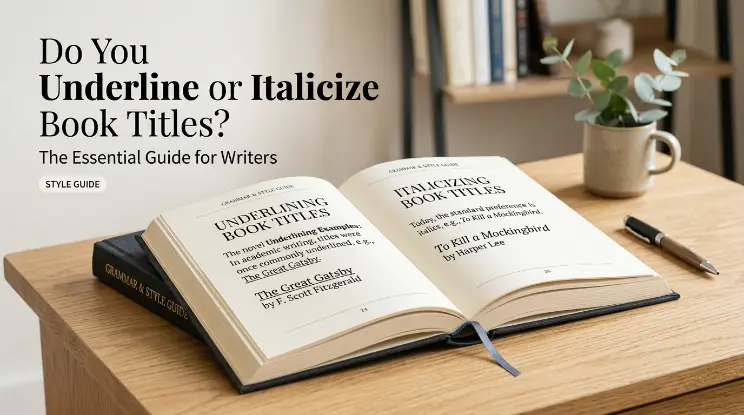
In typed or digital writing, you should italicize book titles. Underlining book titles is only considered correct in handwritten work, or in situations where italics aren’t available (like old typewriters). That’s it that’s the short version! Now let’s dig into why, with plenty of examples.
Why Does This Confusion Even Exist?
Great question! Back before computers were common, most people wrote by hand or used typewriters and typewriters couldn’t produce italic text. So writers used underlining as a stand-in for italics. It was a workaround, not the “real” rule.
Once word processors and computers made italics easy to type, the style guides (like APA, MLA, and Chicago) updated their rules. Today:
- ✍️ Handwriting → underline
- 💻 Typing (digital or printed) → italicize
Simple, right? But let’s break down each option properly so you never second-guess yourself again.
What Does It Mean to Italicize a Title? 📝
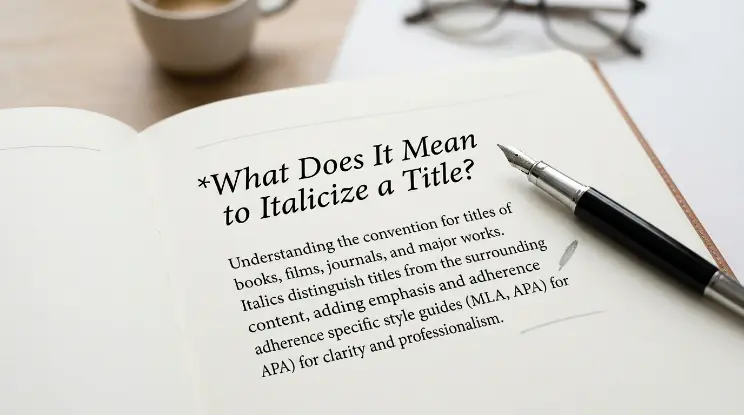
Italicizing means slanting the text slightly to the right, like this. It’s the modern, standard way to format titles of longer, standalone works when typing.
When to Use Italics:
- Book titles → The Great Gatsby
- Movie titles → Inception
- Newspaper names → The New York Times
- Magazine titles → National Geographic
- Names of ships, planes, or spacecraft → Titanic
- Full-length plays → Hamlet
- Albums → Thriller
- TV series (as a whole) → Stranger Things
Examples in Sentences:
- I just finished reading Harry Potter and the Sorcerer’s Stone over the weekend.
- Have you seen The Shawshank Redemption? It’s a classic!
- She subscribes to The Wall Street Journal every morning.
- My favorite album of all time is Abbey Road by The Beatles.
What Does It Mean to Underline a Title? 🖊️
Underlining means drawing a straight line beneath the text, like this. It was the go-to method before italics became widely accessible, and it still has its place today.
When to Use Underlining:
- Handwritten essays, notes, or letters since you can’t easily “italicize” pen-on-paper writing.
- Older typewritten documents where italics weren’t an option.
- Some teachers still request underlining for younger students who are just learning formatting rules.
Examples:
- In a handwritten book report: “My favorite book is <u>Charlotte’s Web</u>.”
- On an old-school typed resume from the 1980s: “Published in <u>Time Magazine</u>.”
💡 Key takeaway: Underlining and italics serve the exact same grammatical purpose they just look different depending on the medium (hand vs. digital).
Comparison Table: Underline vs. Italicize 📊
| Feature | Italicize ✅ (Modern Standard) | Underline (Old-School / Handwritten) |
| Used in | Typed documents, computers, printed books | Handwritten work, old typewriters |
| Recommended by | MLA, APA, Chicago Style (current editions) | Older style guides, pre-computer era |
| Best for | Book titles, movies, newspapers, albums | Same categories, but only when italics aren’t possible |
| Formality | Professional, publishing-standard | Informal or educational settings (e.g., grade school) |
| Digital writing (emails, blogs, Word docs) | ✔️ Yes | ❌ No |
| Example | Pride and Prejudice | <u>Pride and Prejudice</u> |
What About Quotation Marks? A Quick Bonus Rule 🔍
Since we’re talking about formatting titles, it’s worth mentioning: not everything gets italicized or underlined. Shorter works usually go in quotation marks instead.
| Type of Work | Formatting | Example |
| Book (full-length) | Italics | To Kill a Mockingbird |
| Chapter within a book | “Quotation marks” | “Chapter One: A New Beginning” |
| Poem (short) | “Quotation marks” | “The Road Not Taken” |
| Epic poem (book-length) | Italics | The Odyssey |
| Song title | “Quotation marks” | “Bohemian Rhapsody” |
| Album title | Italics | A Night at the Opera |
| Article title | “Quotation marks” | “10 Tips for Better Sleep” |
| Website/publication name | Italics | The Atlantic |
Easy rule of thumb: 📌 Big, standalone works get italics. Smaller works that are “part of” something bigger get quotation marks.
Common Mistakes People Make ❌
Let’s talk about the slip-ups that even confident writers sometimes make:
- Mixing both styles in one document e.g., underlining one book title and italicizing another. Pick one method and stay consistent!
- Underlining in digital writing This was correct in the typewriter era but looks outdated (and is marked wrong in most modern style guides) in essays, blogs, or emails.
- Italicizing short works like song titles or article titles instead of using quotation marks.
- Forgetting to italicize/underline at all simply writing “I read Dracula” without any formatting makes it unclear if you’re talking about the book or just chatting casually.
- Bolding titles instead bold is not a standard replacement for italics or underlining in formal writing.
Memory Trick / Mnemonic 🧠
Here’s a fun way to remember it:
“Type it? Tilt it. Write it? Underline it.”
- Type it → Tilt it (italics slant/tilt the text) 💻➡️slant
- Write it → Underline it (pen and paper = underline) ✍️➡️_line_
Another popular mnemonic teachers use:
“BIG works get italics, SMALL works get quotes.” (Books = big, poems/songs/articles = small)
Real-Life Examples: Where You’ll See This in Action 🌍
📧 In Emails
“Hi team, I just finished reading Atomic Habits and think we should discuss it at our next meeting.”
📱 On Social Media
Most social platforms (Instagram, X/Twitter, Facebook) don’t support italics easily, so people often use asterisks or just leave titles unformatted:
“Currently obsessed with Fourth Wing 🔥 #bookstagram” (Some apps do support italics through formatting shortcuts worth checking your platform!)
📰 In News Writing
“Critics have praised Oppenheimer for its stunning visuals and gripping narrative.” This follows AP Style, which also uses italics for major titles in most modern digital publishing.
🎓 In Academic Writing
“In Beloved, Toni Morrison explores themes of trauma and memory.” (MLA and APA both require italics here.)
💬 In Everyday Speech
Obviously, when we speak, we can’t underline or italicize anything! But native speakers often add slight vocal emphasis on title words which is the spoken equivalent of these formatting rules.
British vs. American English: Any Differences? 🇬🇧 🇺🇸
Good news this is one grammar rule where British and American English agree! Both:
- Use italics for full-length works (books, films, newspapers) in typed/printed text.
- Reserve underlining mainly for handwriting or specific stylistic/legal contexts.
The only regional differences show up in punctuation with quotation marks (single vs. double quotes) but that’s a topic for another article! 😉
FAQs: People Also Ask 🙋
1. Do you underline or italicize book titles in MLA format?
You italicize book titles in MLA format. Underlining was used in older MLA editions before word processors were standard, but current MLA guidelines call for italics.
2. Do you underline or italicize book titles in APA format?
Same answer italicize. APA style (7th edition) requires italics for titles of books, reports, and other standalone works.
3. Is it ever correct to underline a book title today?
Yes only in handwritten work, such as a handwritten essay, letter, or exam answer where italics aren’t possible.
4. What about short story titles italics or quotation marks?
Short stories get quotation marks, not italics, since they’re typically part of a larger collection (unless published as a standalone book).
5. Do you italicize the Bible or religious texts?
Generally, no major religious texts like the Bible, Quran, and Torah are usually not italicized according to most style guides, since they’re treated as sacred/reference texts rather than standard published works.
6. Should I italicize a book title in a text message or social media post?
It’s optional! Many apps don’t easily support italics, so it’s acceptable to leave titles unformatted or use asterisks (like this) as a workaround.
7. Do you italicize TV show titles or just episode titles?
Italicize the show’s name (e.g., Friends), but use quotation marks for individual episode titles (e.g., “The One Where Ross Got High”).
Final Thoughts: The Key Takeaway 🎉
In conclusion, book titles should generally be italicized in modern writing. Italics make titles clear and help readers distinguish them from the rest of the text. Underlining book titles was common in the past, especially when typewriters could not produce italics. Today, underlining is usually unnecessary unless a specific style guide or teacher requires it. You are writing an essay, article, blog post, or academic paper, italics are the preferred choice for book titles. Following this simple rule will make your writing look more professional, accurate, and easier to read.

Olivia Bennett is a passionate English grammar writer at GrammBoost.com who loves making grammar simple and easy to understand. She specializes in spelling, word differences, punctuation, and everyday English usage. Through clear explanations and practical examples, Olivia helps students, writers, and professionals write with greater confidence and accuracy.