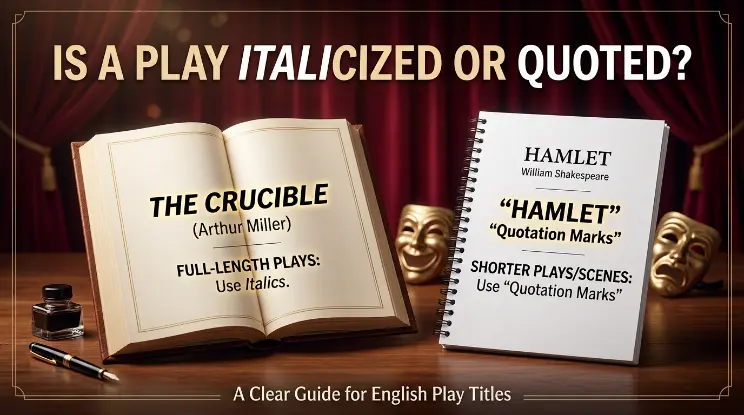
You’re writing an essay, an email, or maybe a social media post about a play you just watched, and suddenly you freeze: Do I put Hamlet in italics? Or “Hamlet” in quotes? Is there even a difference?
You’re not imagining things this is one of the most common grammar tips questions out there. Titles are sneaky. Some get italicized, some get quotation marks, and the rules aren’t always obvious unless someone actually sits down and explains them (which is exactly what we’re about to do!). 🙌
By the end of this article, you’ll never have to Google this again.
Quick Answer ⚡
A play’s title should always be italicized, not put in quotation marks. This follows standard English usage rules for titles of long, standalone works the same rule that applies to books, movies, and TV series.
Example: Romeo and Juliet ✅ (not “Romeo and Juliet” ❌)
Why Does This Rule Exist? 📚
Punctuation for titles isn’t random it follows a simple logic based on length and format of the work:
- Italics are used for big, standalone works things that are published or performed as a complete piece on their own.
- Quotation marks are used for smaller works that are usually part of something bigger.
Once you understand this logic, you’ll be able to punctuate almost any title correctly not just plays!
The Rule for Plays, Specifically 🎬
A play is considered a complete, standalone creative work just like a novel or a movie. That’s why it gets italicized.
✅ Correct Examples:
- I finally saw Hamilton live on Broadway!
- Our class is reading A Streetcar Named Desire this semester.
- The Crucible is one of Arthur Miller’s most famous plays.
- Have you seen Wicked? The music is incredible.
- Shakespeare wrote Macbeth around 1606.
❌ Incorrect Examples:
- I finally saw “Hamilton” live on Broadway.
- Our class is reading “A Streetcar Named Desire” this semester.
- “The Crucible” is one of Arthur Miller’s most famous plays.
Notice how the incorrect examples aren’t wrong in meaning they’re wrong in formatting. This is a common mistake that even experienced writers make, especially when typing quickly or writing on devices where italics aren’t always easy to apply (like texting).
What About Scenes, Acts, or Short Skits? 🤔
Here’s where it gets interesting not everything related to a play follows the same rule!
- Full-length plays → Italicized (e.g., Hamlet)
- Individual scenes or acts within a play → Usually just described in plain text, no italics or quotes needed (e.g., Act 2, Scene 3 of Hamlet)
- One-act plays or short skits that are part of a collection → Often put in quotation marks, because they’re a smaller piece within a bigger published work
Example:
The short play “Trifles” appears in the anthology Literature: An Introduction.
See the difference? The anthology (the bigger, standalone book) is italicized, while the short play inside it gets quotation marks because it’s a smaller piece within that larger work.
📊 Comparison Table: Italics vs. Quotation Marks
| Type of Work | Formatting | Example |
| Full-length play | Italics | Death of a Salesman |
| Novel | Italics | To Kill a Mockingbird |
| Movie | Italics | Inception |
| TV series (whole show) | Italics | Stranger Things |
| Magazine or newspaper | Italics | The New York Times |
| Short story | “Quotation marks” | “The Lottery” |
| Poem (short) | “Quotation marks” | “The Road Not Taken” |
| Single episode of a TV show | “Quotation marks” | “The One with the Prom Video” (Friends) |
| Song title | “Quotation marks” | “Bohemian Rhapsody” |
| One-act play in an anthology | “Quotation marks” | “Trifles” |
💡 Pattern to notice: Big, standalone works = italics. Small works that are usually part of a bigger collection = quotation marks.
Common Mistakes People Make 🚫
Let’s go over the slip-ups that happen most often, especially in casual writing.
| Common Mistake | Why It Happens | The Fix |
| Using quotes for full play titles | People confuse plays with short stories or songs | Always italicize full play titles |
| Using both italics AND quotes together | Overcorrecting out of uncertainty | Pick just one italics for plays |
| Underlining instead of italicizing | Leftover habit from handwriting/typewriters | Use italics in digital and typed writing |
| Not formatting titles at all | Typing fast on phones or social media | Use italics when the platform allows it |
| Capitalizing incorrectly | Mixing up title case rules | Capitalize main words only (not “a,” “the,” “of,” unless they start the title) |
🧠 Memory Trick (Mnemonic)
Here’s a fun way to remember it:
“Plays get the STAGE treatment the whole spotlight (italics).” Think of italics as the big stage lighting shining on an entire show, while quotation marks are more like a small spotlight on just one part of a bigger performance.
Or simply:
“Big work = italics. Bite-sized work = quotes.”
Real-Life Examples From Everyday Writing 📱
In an email:
“Hi team, quick reminder that tickets for Les Misérables go on sale Friday!”
On social media (Instagram caption):
“Cried through the entire second act of Fences tonight 😭🎭 #BroadwayNight”
In a text message:
“Did you finish reading Hamlet for class lol” (In casual texting, italics often get dropped but in formal writing, it should still be Hamlet.)
In academic writing:
“In A Doll’s House, Henrik Ibsen explores themes of independence and societal expectations.”
A news article:
“The revival of August: Wilson’s Fences drew critical acclaim on Broadway this season.”
In everyday speech:
“We’re going to see Wicked this weekend I’ve heard the sets are amazing!”
British vs. American English: Any Differences? 🇬🇧🇺🇸
Good news this is one grammar rule where British and American English mostly agree! Both styles use:
- Italics for play titles
- Quotation marks for shorter works within a larger piece
The only regional difference tends to be in quotation mark style:
| Style | Preferred Quotation Marks | Example |
| American English | Double quotes (“…”) | “Trifles” |
| British English | Single quotes (‘…’) | ‘Trifles’ |
So while the italics-for-plays rule stays the same worldwide, the type of quotation mark used for shorter works may shift slightly depending on region and publishing house style guide (like AP, MLA, or Oxford style).
Quick Style Guide Cheat Sheet 📝
If you want a fast reference, here’s how the major style guides treat play titles:
| Style Guide | Rule for Play Titles |
| MLA | Italicize full-length plays |
| APA | Italicize full-length plays |
| Chicago Manual of Style | Italicize full-length plays |
| AP Style (journalism) | Uses quotation marks instead of italics for most titles, including plays, due to print formatting traditions |
⚠️ Good to know: AP Style is the exception here! Because journalism traditionally avoided italics in print, AP style puts quotation marks around play titles instead. So if you’re writing for a newspaper following AP guidelines, you might see “Hamlet” in quotes but for academic, creative, or general writing (MLA, APA, Chicago), Hamlet in italics is correct.
FAQs: People Also Ask ❓
1. Is a play italicized or quoted in MLA format?
In MLA format, full-length plays are italicized, not quoted.
2. Do you italicize the title of a musical?
Yes! Musicals follow the same rule as plays italicize the full title, like Hamilton or Wicked.
3. How do you write a play title in an essay?
Italicize it, and use title-case capitalization (capitalize main words), such as The Glass Menagerie.
4. Are Shakespeare’s plays italicized?
Yes titles like Macbeth, Othello, and A Midsummer Night’s Dream should all be italicized.
5. Do you italicize a one-act play?
It depends on context. If it stands alone, italicize it. If it’s part of a collection or anthology, use quotation marks instead.
6. Why do some websites use quotation marks for plays?
Some publications follow AP Style, which traditionally uses quotation marks instead of italics for most titles, including plays.
7. Is it correct to underline a play title instead of italicizing it?
Underlining was common in handwritten or typewritten work, but in modern typed and digital writing, italics are preferred.
Conclusion: The Simple Rule to Remember 🎯
So, is a play italicized or quoted? The answer is simple: italicize full-length play titles, just like you would with books, movies, and TV series. Quotation marks are reserved for smaller works, like short stories, poems, songs, or one-act plays within a larger collection.
Once you remember the “big work = italics, small work = quotes” rule, you’ll never second-guess your punctuation again. Whether you’re writing an essay, a social media caption, or a professional email, correct English usage makes your writing look polished and confident. 🌟

Sophia Collins is a passionate English grammar writer at GrammBoost.com who loves making the English language simple and easy to understand. She creates clear, beginner-friendly guides on grammar, spelling, word differences, and common language mistakes. Her goal is to help students, writers, and English learners build confidence and improve their writing through practical, easy-to-follow explanations.