Have you ever typed a sentence, stared at the word “today,” and suddenly panicked because you weren’t sure if it needed an apostrophe? You’re definitely not alone. 🙋♀️
This tiny apostrophe causes big confusion in emails, on social media, even in published articles. People constantly ask: is it “todays weather” or “today’s weather”? The good news is that once you learn one simple rule, you’ll never second-guess yourself again.
In this guide, we’ll break down the difference between “todays” and “today’s” in plain English, with tons of examples, a handy comparison table, common mistakes to avoid, and a memory trick you’ll actually remember. Let’s clear up this grammar mix-up once and for all! ✅
Quick Answer 🎯
“Today’s” (with an apostrophe) is almost always correct. It shows possession (something belonging to today) or is a contraction of “today is.” “Todays” (no apostrophe) is only correct in the rare case of using “today” as a plural noun and even then, it’s uncommon. If you’re unsure, use “today’s.”
What Does “Today’s” Mean? 🧐
“Today’s” is the possessive form of the noun “today.” It shows that something belongs to, or is associated with, today.
Think of it like “Sarah’s book” or “the dog’s bone” you’re showing ownership or connection.
“Today’s” as Possessive
Use “today’s” when you want to say something belongs to or relates to today.
Examples:
- Today’s weather looks sunny. ☀️
- Did you read today’s newspaper?
- Today’s meeting has been rescheduled to 3 PM.
- I can’t believe today’s traffic was so bad. 🚗
- Today’s youth are more tech-savvy than ever.
“Today’s” as a Contraction
“Today’s” can also be a shortened form of “today is.” This works the same way “it’s” means “it is.”
Examples:
- Today’s a great day to start something new. (= Today is)
- Today’s my birthday! 🎉 (= Today is)
- Today’s the deadline for the project. (= Today is)
What Does “Todays” Mean? 🤔
“Todays” (no apostrophe) treats “today” as a plural noun as if there could be more than one “today.” This is grammatically unusual because “today” almost always refers to a single point in time, not a countable object.
You’ll rarely see “todays” used correctly in everyday writing. It mostly shows up in:
- Song lyrics or poetic writing, where “todays” might represent multiple days that are each “a today” (e.g., “all our yesterdays and todays”).
- Typos most commonly, people write “todays” when they actually mean “today’s.”
Example of correct (though rare) usage:
- Our todays are shaped by the choices we made yesterday.
⚠️ Important: In 99% of real-world writing (emails, texts, articles, social posts), if you’re tempted to write “todays,” you almost certainly mean “today’s.”
Which Is Correct: “Todays” or “Today’s”?
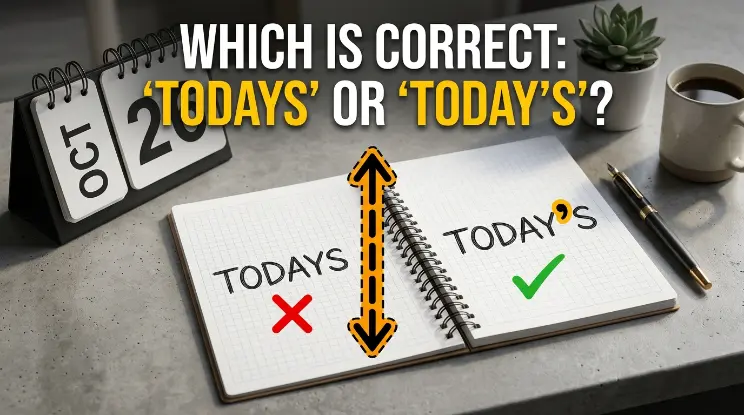
“Today’s” is correct when you mean “of today” or “belonging to today.” The apostrophe shows possession. For example, “today’s news” means the news of today, and “today’s weather” means the weather for today. “Todays” without an apostrophe is generally incorrect in standard English when you mean something connected with today.
| Form | Correct? | Meaning | Example |
|---|---|---|---|
| today’s | ✅ Correct | Of or belonging to today | Today’s news is interesting. |
| todays | ❌ Usually incorrect | Not the standard possessive form | ❌ Todays news |
| today | ✅ Correct | This day | I will do it today. |
Which Is Correct: “Todays” or “Today’s Meeting”?
The correct phrase is “today’s meeting.” Here, today’s means “the meeting of today” or “the meeting happening today.” The apostrophe is necessary because today’s is being used to show a relationship between today and the meeting. For example, “I will attend today’s meeting” means that you will attend the meeting scheduled for today.
| Phrase | Correct? | Explanation |
|---|---|---|
| today’s meeting | ✅ Correct | The meeting happening today |
| todays meeting | ❌ Incorrect | Missing the apostrophe |
| today meeting | ❌ Usually incorrect | Not the standard expression |
| the meeting today | ✅ Correct | Another natural way to say it |
Examples:
- I have to prepare for today’s meeting. ✅
- Today’s meeting starts at 10 a.m. ✅
- ❌ Todays meeting starts at 10 a.m.
Which Is Correct: “Today’s Date” or “Today’s Date”?
Both phrases you wrote are exactly the same: “today’s date.” So there is no spelling difference to compare. “Today’s date” is the correct phrase when you mean the date of the current day. The apostrophe in today’s shows that the date belongs to or is associated with today.
| Phrase | Correct? | Meaning |
|---|---|---|
| today’s date | ✅ Correct | The date of today |
| todays date | ❌ Incorrect | Missing apostrophe |
| today date | ❌ Usually incorrect | Not standard English |
| the date today | ✅ Correct | Another possible wording |
Examples:
- What is today’s date? ✅
- Please write today’s date at the top. ✅
- I forgot to check today’s date. ✅
Easy Rule
Today + ’s = today’s when it means “of today.”
👉 today’s news ✅
👉 today’s meeting ✅
👉 today’s date ✅
👉 todays news ❌
👉 todays meeting ❌
Comparison Table: “Todays” vs “Today’s” 📊
| Word | Meaning | Usage | Example |
| Today’s | Possessive form of “today” | Shows something belongs to today | Today’s forecast predicts rain. |
| Today’s | Contraction of “today is” | Replaces “today is” in casual speech | Today’s the last day to register. |
| Todays | Plural noun (rare/poetic) | Refers to multiple “today” moments | Our todays build our future. |
| Todays | Common typo | Mistakenly used instead of “today’s” | ❌ Todays weather is nice. |
Common Mistakes to Avoid 🚫
Let’s look at the most frequent slip-ups people make with these two words.
Mistake #1: Dropping the Apostrophe
❌ Todays special includes a free drink. ✅ Today’s special includes a free drink.
Mistake #2: Adding an Apostrophe for a True Plural
This is rare, but if you genuinely mean multiple “today” moments in a poetic sense, don’t force an apostrophe. ❌ Our today’s are numbered. ✅ Our todays are numbered. (poetic/rare usage)
Mistake #3: Confusing “Today’s” with “Todays'”
Some people mistakenly add an apostrophe after the “s,” as if “today” were plural and possessive (like “the dogs’ bones”). This is incorrect because “today” doesn’t have a standard plural possessive form. ❌ Todays’ news is shocking. ✅ Today’s news is shocking.
Memory Trick to Remember the Difference 🧠
Here’s a simple mnemonic to lock this in:
“If it belongs to today, give it an apostrophe.”
Or try this test: Replace the word with “today is.” If the sentence still makes sense, use “today’s.”
- Today’s weather is nice → “Today is weather is nice”? No, but it shows possession, so ✅ today’s is right.
- Today’s my birthday → “Today is my birthday”? Yes! ✅ today’s is correct.
Another quick trick: 🍎 Apostrophe = Ownership. Just like “apple’s core” shows the core belongs to the apple, “today’s weather” shows the weather belongs to today.
Real-Life Examples 🌍
Here’s how “today’s” (and occasionally “todays”) shows up in everyday communication:
📧 In Emails
“Please find attached today’s agenda for the 2 PM meeting.”
📱 On Social Media
“Today’s mood: coffee first, questions later. ☕😴 #MondayMotivation”
📰 In News Headlines
“Today’s Top Stories: Markets Rally After Fed Announcement”
🎓 In Academic Writing
“Today’s students face different challenges than previous generations, particularly around digital literacy.”
💬 In Everyday Speech
“Did you catch today’s episode? It was wild!”
As you can see, “today’s” dominates real-world usage across nearly every context.
British vs American English: Any Differences? 🇬🇧🇺🇸
Good news this one’s universal! Both British English and American English treat “today’s” the same way:
- Both use “today’s” for possession and contraction.
- Both consider “todays” ungrammatical outside of poetic or stylistic exceptions.
- There’s no regional spelling variation here, unlike words such as “colour/color” or “organise/organize.”
So no matter where your audience is, stick with “today’s” for standard writing.
Understanding this pattern helps with grammar tips across many similar words, not just “today’s.”
FAQs: People Also Ask ❓
1. Is “todays” ever correct?
Yes, but rarely. It’s only correct as a plural noun in poetic or stylistic writing (e.g., “our todays and tomorrows”). In everyday writing, “today’s” is almost always what you need.
2. What does “today’s” mean grammatically?
“Today’s” is either the possessive form of “today” (showing ownership, like “today’s weather”) or a contraction of “today is” (like “today’s my birthday”).
3. How do I know when to use an apostrophe with “today”?
Ask yourself: does the word show possession or replace “today is”? If yes, use “today’s.” If you’re referring to multiple days in a rare plural sense, use “todays” without an apostrophe.
4. Is “todays'” (apostrophe after the s) correct?
No. “Today” doesn’t have a standard plural possessive form, so “todays'” is considered incorrect in standard English.
5. Why does spellcheck sometimes flag “today’s”?
Spellcheck tools usually flag “today’s” only if it’s used incorrectly in context for example, if the sentence needs a plural noun instead of a possessive or contraction.
6. Is this the same rule as “its” vs “it’s”?
Yes! The pattern is similar: the apostrophe version (“it’s,” “today’s”) often indicates possession or a contraction, while the non-apostrophe version is either plural or a different grammatical form.
7. Do British and American English spell “today’s” differently?
No. Both dialects use “today’s” identically for possessive and contraction purposes. There’s no regional variation for this particular word.
Final Thoughts:
Understanding the difference between “Todays” and “Today’s” helps you write more accurately. “Today’s” is the correct form when talking about something that belongs to or relates to today, such as today’s news or today’s weather. The apostrophe shows possession. “Todays” without an apostrophe is generally incorrect in standard English.
Remembering this simple rule can improve your grammar and make your writing clearer. Whether you are writing an email, article, social media post, or school assignment, using “Today’s” correctly ensures your sentence looks professional and natural.
Read More About This
Crain or Crane: Learn the Correct Word with Easy Examples for 2026
Anyday or Any Day: Understanding the Correct Spelling for 2026
Innie or Outie: Meaning, Differences, and Common Questions for 2026
Realest or Realist: Meaning, Differences, and Correct Usage 2026

Sophia Collins is a passionate English grammar writer at GrammBoost.com who loves making the English language simple and easy to understand. She creates clear, beginner-friendly guides on grammar, spelling, word differences, and common language mistakes. Her goal is to help students, writers, and English learners build confidence and improve their writing through practical, easy-to-follow explanations.