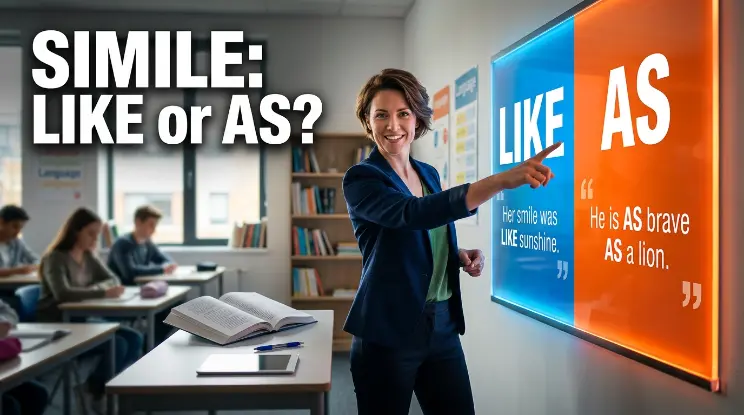
Have you ever written “brave as a lion” and then wondered if you should’ve written “brave like a lion” instead? Or maybe you’ve stared at a sentence, pen hovering, unsure which little word makes your comparison sound right.
You’re not alone. This is one of the most common grammar tips questions students, writers, and even seasoned bloggers ask. The confusion usually comes from the fact that both “like” and “as” are used to compare two things but they don’t work the exact same way, and native speakers often mix them up in casual speech too.
Good news: by the end of this article, you’ll never second-guess yourself again. 🎉
Quick Answer 💡
A simile can use both “like” and “as” it just depends on the sentence structure. Use “like” before a noun or pronoun (e.g., “brave like a lion”), and use “as” when comparing with a full clause or a fixed phrase (e.g., “as brave as a lion”).
Let’s break this down properly so it sticks. 👇
What Exactly Is a Simile? 📖
Before we compare “like” vs “as,” let’s quickly define the star of the show.
A simile is a figure of speech that compares two different things to highlight a shared quality. Similes almost always use a comparison word usually “like” or “as” to make that connection clear.
Examples:
- Her smile was like sunshine. ☀️
- He runs as fast as a cheetah. 🐆
- The classroom was as quiet as a library. 📚
- Life is like a box of chocolates. 🍫
Notice something? Both words are doing the same job connecting two things being compared but they’re used in slightly different grammatical patterns.
Using “Like” in a Simile
“Like” is a preposition when used in similes. That means it’s followed by a noun, pronoun, or noun phrase never a full clause with a subject and verb.
Structure:
[Noun/Adjective] + like + [Noun]
Examples:
- She sings like an angel. 🎤
- The city looked like a painting at sunset.
- My brother eats like a horse. 🐴
- This coffee tastes like heaven. ☕
- He fought like a lion in the ring.
✅ Tip: If what follows the comparison word is just a thing (a noun), “like” is your safe bet.
Using “As” in a Simile
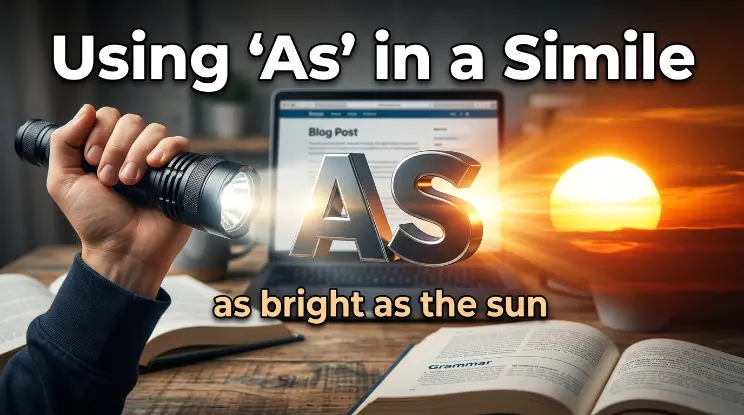
“As” is typically used in similes as part of a fixed expression (“as ___ as ___”) or before a clause (a group of words with a subject and a verb).
Structure 1: The classic “as ___ as ___” pattern
[Subject] + is/was + as + [adjective] + as + [Noun]
Examples:
- She is as brave as a lion. 🦁
- The water was as cold as ice. 🧊
- His hands were as rough as sandpaper.
- The test was as easy as pie. 🥧
Structure 2: Before a clause (subject + verb)
- He danced as if he owned the floor. 💃
- She looked at me as a mother looks at her child.
✅ Tip: If a full sentence (with its own subject and verb) follows the comparison, “as” is usually correct.
Like vs As: Comparison Table 📊
| Feature | Like | As |
| Part of speech | Preposition | Conjunction (or part of a fixed phrase) |
| Followed by | Noun / pronoun / noun phrase | Clause (subject + verb) or another “as” |
| Common pattern | [X] like [Y] | as [adjective] as [Y] |
| Example | Brave like a lion | As brave as a lion |
| Formality | Slightly more casual | Slightly more formal/traditional |
| Typical use | Everyday speech, casual writing | Classic similes, literature, formal writing |
Common Mistakes People Make ❌
Even confident writers slip up here. Let’s look at the usual suspects.
Mistake #1: Using “like” before a full clause
- ❌ He acted like he owned the place.
- ✅ He acted as if he owned the place. (more formally correct)
- 🟡 Note: In casual American English, “like” before a clause (“he acted like he owned the place”) is extremely common and widely accepted in speech just avoid it in formal writing.
Mistake #2: Mixing up “as” and “like” in the same sentence
- ❌ She swims as a fish.
- ✅ She swims like a fish. (a fish is a noun, so “like” is correct)
#3: Forgetting the second “as”
- ❌ He is as tall like his father.
- ✅ He is as tall as his father.
#4: Overusing “like” in writing
Using “like” too many times in one paragraph can make writing sound repetitive or overly casual. Mix in “as” comparisons for variety and polish. ✨
Memory Trick to Remember the Rule 🧠
Here’s a simple mnemonic to lock this in:
“Like a THING, As a THOUGHT.”
- Like + a thing (noun) → “quiet like a mouse” 🐭
- As + a full thought (clause) → “quiet as a mouse is at night”
Or try this classic trick teachers use:
🔤 “L” is for “Little words” (like + noun) 🔤 “A” is for “A whole clause” (as + subject + verb)
Whichever trick clicks for you use it! Repetition is what makes grammar rules stick. 💪
Real-Life Examples in Action 🌍
Let’s see how “like” and “as” show up in everyday contexts.
📧 In Emails
“The new dashboard is easy to use, like a well-organized filing cabinet.”
📱 On Social Media
“This traffic is moving as slow as a snail today 🐌 #MondayMood”
📰 In News Writing
“The stock market reacted like a rollercoaster after the announcement.”
🎓 In Academic Writing
“The results were as consistent as predicted by the original hypothesis.”
🗣️ In Everyday Speech
“You look like you saw a ghost!” 👻 “She’s as stubborn as a mule.” 🐴
British vs American English: Any Differences? 🇬🇧🇺🇸
Here’s a fun nugget for language nerds:
- In both British and American English, the grammar rule (like + noun, as + clause) is technically the same.
- However, American English is far more relaxed about using “like” before a clause in casual speech (“It’s like he doesn’t even care”).
- British English, especially in formal or written contexts, tends to stick more strictly to “as if” or “as though” instead of “like” before a clause.
- Both varieties agree that “as ___ as ___” is the standard formal simile structure.
| Region | Casual Speech | Formal Writing |
| 🇺🇸 American English | “like” before clauses is common | “as if / as though” preferred |
| 🇬🇧 British English | “like” before clauses used, but less accepted | “as if / as though” strongly preferred |
Why This Confusion Happens (Keyword Insight) 🔍
Search trends show that people often Google phrases like:
- “like vs as grammar”
- “simile examples with like and as”
- “as as vs like difference”
- “correct spelling and usage of similes”
This tells us the confusion isn’t just about spelling it’s about sentence structure and English usage rules that aren’t always taught clearly in school. That’s exactly why breaking it down with examples (like we just did!) makes such a big difference.
Similes vs Metaphors: A Quick Bonus 🎁
Since we’re on the topic, here’s a fast distinction:
- Simile: Uses “like” or “as” to compare → “He is as strong as an ox.”
- Metaphor: States one thing is another, no comparison word → “He is an ox.”
Knowing this helps you spot similes faster in reading and writing. 📝
FAQs: People Also Ask ❓
1. Does a simile always need “like” or “as”?
Yes. By definition, a simile uses a comparison word almost always “like” or “as” (sometimes “as if” or “as though”). Without one of these, it becomes a metaphor instead.
2. Can you use “like” and “as” interchangeably in similes?
Not always. “Like” works before nouns, while “as” typically pairs with clauses or forms the “as ___ as ___” structure. Swapping them incorrectly can sound grammatically off.
3. Is “as” more formal than “like” in similes?
Generally, yes. “As” (especially in “as if” or “as though”) is considered more formal and is preferred in academic or professional writing.
4. What’s an easy example of a simile with “as”?
“She is as graceful as a swan.” 🦢 This follows the classic “as + adjective + as + noun” pattern.
5. What’s an easy example of a simile with “like”?
“He runs like the wind.” 💨 Here, “like” is followed directly by a noun (“the wind”).
6. Why do people say “like” so much in casual conversation?
In spoken English, especially American English, “like” has become a flexible, informal connector used for comparisons, hesitation, and even quoting speech (“she was like, ‘no way!'”). It’s common in speech but best avoided in formal writing.
7. Is it wrong to say “as if” instead of “like” before a clause?
No it’s actually the more grammatically correct and formal choice. “As if” and “as though” are the traditional options before clauses, while “like” is the more relaxed, modern alternative.
Final Thoughts: Like or As Which Should You Use?
In conclusion, a simile can use both “like” and “as” to make comparisons more vivid and easier to understand. “Like” is commonly used before a noun or pronoun, such as “She runs like the wind.” “As” is often used in structures such as “as brave as a lion.” Both forms help readers create a clear picture in their minds.
The important thing is to use the correct sentence structure so the comparison sounds natural. Whether you choose “like” or “as,” a well-written simile can make your writing more creative, expressive, and memorable in everyday speech, stories, poems, and essays.

Olivia Bennett is a passionate English grammar writer at GrammBoost.com who loves making grammar simple and easy to understand. She specializes in spelling, word differences, punctuation, and everyday English usage. Through clear explanations and practical examples, Olivia helps students, writers, and professionals write with greater confidence and accuracy.