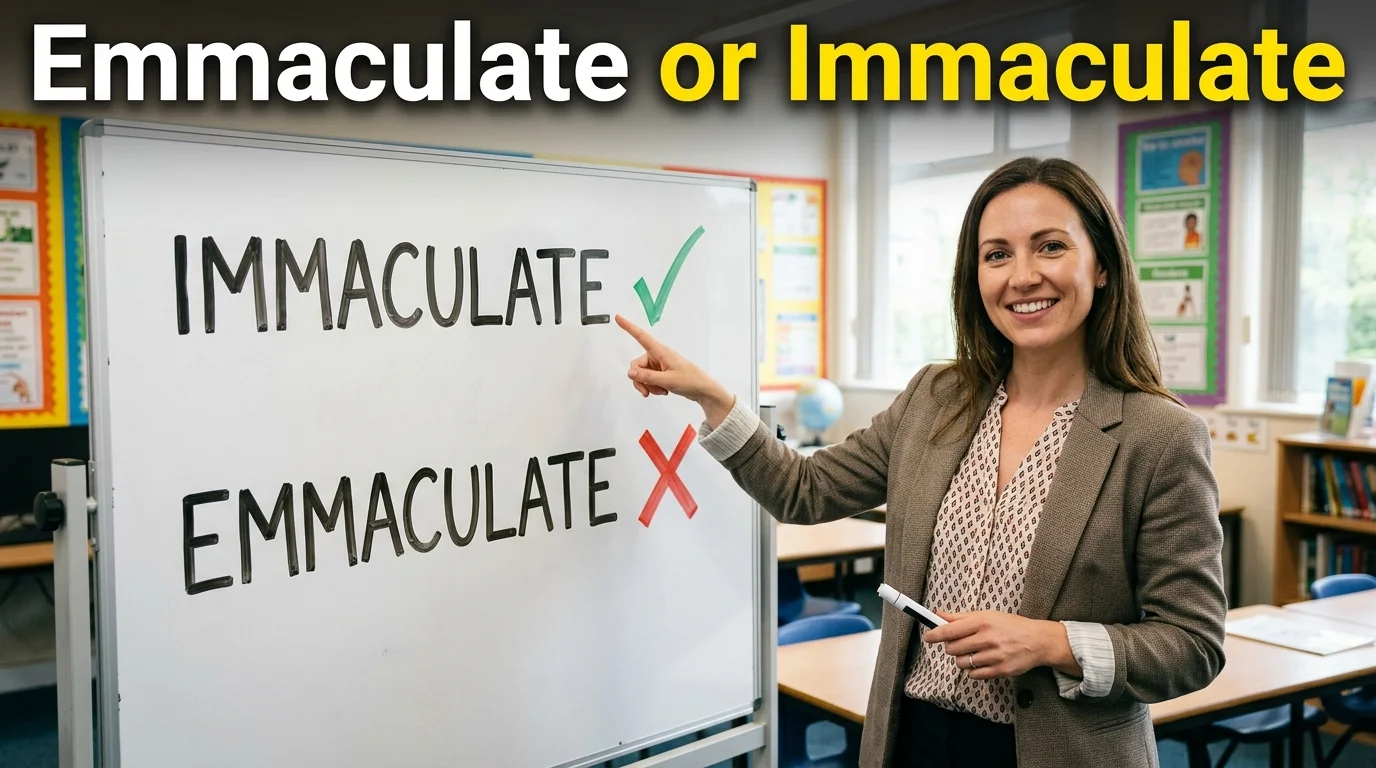
Ever typed out a text bragging about your “emmaculate” kitchen, hit send, and then had that nagging feeling something looked… off? 😅 You’re definitely not alone. This is one of the most common spelling slip-ups in English, and honestly, it makes total sense why people get confused.
The word sounds like it could start with “em,” it feels like it should have a double “m,” and autocorrect doesn’t always save you in time. But here’s the thing only one of these spellings actually exists in the English language, and the other is a straight-up spelling mistake.
Let’s clear up this confusion once and for all, with easy examples, a handy comparison table, and a mnemonic trick you’ll never forget. 🧠
Quick Answer ⚡
“Immaculate” is the correct spelling. “Emmaculate” is not a real word it’s simply a common misspelling of “immaculate,” which means perfectly clean, flawless, or without any mistakes.
What Does “Immaculate” Actually Mean?
Immaculate (adjective) means:
- Perfectly clean, neat, or tidy 🧹
- Free from flaws, errors, or blemishes ✅
- Morally pure or spotless (in a more formal or religious sense) ⛪
It comes from the Latin word immaculatus, meaning “unstained” or “spotless” in- (not) + maculatus (stained, spotted). So literally, immaculate means “not stained.” That little bit of word history actually helps explain the spelling too (more on that below!).
Examples of “Immaculate” in a Sentence
- Her wedding dress was absolutely immaculate, without a single wrinkle.
- He kept his car in immaculate condition, like it just rolled off the lot.
- The chef’s immaculate attention to detail made every dish look like art. 🍽️
- Their new apartment was immaculate not a speck of dust anywhere.
- The lawyer presented an immaculate argument with zero logical gaps.
- She has an immaculate reputation in the finance industry.
- The hotel room was immaculate, exactly as advertised in the photos.
As you can see, “immaculate” works for physical cleanliness, flawless performance, or even spotless reputations. It’s a versatile word that instantly upgrades your writing. ✨
What About “Emmaculate”?
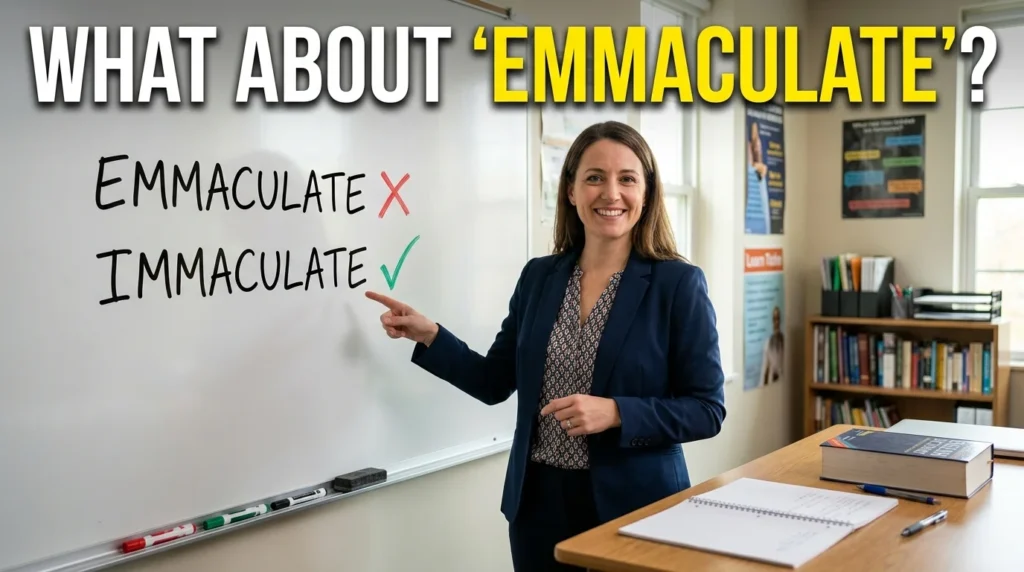
Let’s be direct: “emmaculate” is not a word. 🚫
It doesn’t appear in any standard English dictionary not Merriam-Webster, not Oxford, not Cambridge. It’s simply a misspelling that happens because:
- People mishear the word when spoken aloud
- The “im-” prefix gets confused with “em-” (which is common in other words like embrace, emphasis, or emmy)
- Social media and texting have normalized it through repeated typos that eventually “look right” to some people
So if you’ve been writing “emmaculate,” don’t worry you’re in good company. It’s one of the internet’s favorite typos. But now that you know, you can fix it for good! 💪
Comparison Table: Immaculate vs Emmaculate
| Feature | Immaculate ✅ | Emmaculate ❌ |
| Correct spelling? | Yes | No |
| Found in dictionaries? | Yes (Merriam-Webster, Oxford, Cambridge) | No |
| Origin | Latin immaculatus (“unstained”) | N/A common misspelling |
| Meaning | Perfectly clean, flawless, spotless | None (invalid word) |
| Example sentence | “The house was immaculate.” | “The house was emmaculate.” ❌ |
| Use in professional writing? | Yes, always appropriate | Never will be flagged as an error |
| Common in casual texting/social media? | Sometimes misspelled anyway | Frequently seen (incorrectly) |
Why Do People Confuse Immaculate and Emmaculate?
Great question! Here’s the psychology and linguistics behind it:
- Prefix confusion: English has both “im-” and “em-” prefixes, and they sound nearly identical when spoken quickly. Words like embarrass, empower, and employ all start with “em-,” so our brains sometimes autocorrect “immaculate” to match that more familiar pattern.
- Auditory processing: When people hear “immaculate” spoken casually, the first syllable can sound like “em” rather than “im,” especially in fast speech.
- Repetition of the error: Once a misspelling appears often enough online, it starts to look normal to some readers, even though it’s still wrong.
Memory Trick to Never Misspell It Again 🧠✨
Here’s a simple mnemonic to lock in the correct spelling:
“I’m immaculate!”
Notice how the word starts with “I’m” (I + am)? Just remember that being immaculate starts with “I” not “E.” If you can remember “I’m immaculate,” you’ll never write “emmaculate” again.
Another trick:
- IMmaculate = I Make it perfect
Pick whichever trick sticks best in your brain, and you’re set for life. 🎯
Real-Life Examples: Where You’ll See This Word
📧 In Emails
“Thank you for maintaining an immaculate record throughout your employment with us.”
📱 On Social Media
“Bestie your skin is looking absolutely immaculate today 😍✨ #skincare”
📰 In News Articles
“The gymnast delivered an immaculate routine, scoring a perfect 10 from every judge.”
🎓 In Academic Writing
“The researcher’s immaculate methodology left no room for bias or error.”
🗣️ In Everyday Speech
“Dude, your new sneakers are immaculate where’d you cop those?”
Notice a pattern? “Immaculate” pops up everywhere from casual slang (especially in fashion and beauty contexts) to formal academic papers. It’s a word that flexes across every register of English.
British vs American English: Any Differences?
Good news there’s no regional spelling difference here. Unlike words such as colour/color or organise/organize, “immaculate” is spelled the exact same way in:
- 🇬🇧 British English
- 🇺🇸 American English
- 🇦🇺 Australian English
- 🇨🇦 Canadian English
So no matter where your audience is, “immaculate” stays consistent. One less thing to worry about! 🙌
Trending Usage: Why “Immaculate” Is Everywhere Right Now
If you’ve been on TikTok or Instagram lately, you’ve probably noticed “immaculate” trending in phrases like:
- “Immaculate vibes only” 🌟
- “Her fit today was immaculate” (referring to an outfit)
- “Immaculate taste in music”
This shows how a classic, slightly formal-sounding word has found new life in Gen Z slang, often used to praise style, aesthetics, or overall vibe not just cleanliness. Language evolves, and “immaculate” is a great example of an old word getting a cool new context. 🔥
Common Mistakes to Avoid
Here’s a quick list of related errors people make alongside the “emmaculate” typo:
- ❌ Emaculate (missing the second “m”)
- ❌ Imaculate (missing one “m”)
- ❌ Immaculet (wrong ending)
- ✅ Immaculate (the only correct version)
Grammar tip: Always double-check words with double letters (like the “mm” in immaculate) since these are among the most commonly misspelled patterns in English.
FAQs: People Also Ask 🙋
1. Is “emmaculate” a real word?
No. “Emmaculate” is not recognized in any standard English dictionary. The correct spelling is always immaculate.
2. How do you spell immaculate correctly?
It’s spelled I-M-M-A-C-U-L-A-T-E. Remember: it starts with “im,” not “em.”
3. What does immaculate mean in simple terms?
It means something is perfectly clean, neat, or without any flaws or mistakes.
4. Is immaculate a formal word?
It can be used in both formal writing (academic, professional) and casual conversation, especially in modern slang about style and appearance.
5. Where does the word “immaculate” come from?
It comes from the Latin word immaculatus, meaning “unstained” or “spotless.”
6. Can “immaculate” describe a person’s behavior or character?
Yes! You can say someone has an “immaculate reputation” or “immaculate manners,” meaning they’re flawless in conduct or character.
7. Why do so many people misspell immaculate as emmaculate?
It usually happens due to the similar-sounding “im-” and “em-” prefixes in English, plus the influence of repeated typos on social media.
8. Is there a British spelling difference for immaculate?
No, the spelling is identical across British, American, Australian, and Canadian English.
Conclusion:
In conclusion, immaculate is the correct spelling, while emmaculate is a common spelling mistake. The word immaculate means perfectly clean, neat, or free from errors and imperfections. For example, you might describe a spotless room as immaculate or praise someone for maintaining an immaculate appearance.
Remember that immaculate begins with the letter “I,” not “E.” Although the incorrect spelling may look or sound similar, using the right form makes your writing more accurate and professional. Whether you are writing an article, an email, or a school assignment, always choose immaculate to express perfection, cleanliness, or exceptional attention to detail.

Sophia Collins is a passionate English grammar writer at GrammBoost.com who loves making the English language simple and easy to understand. She creates clear, beginner-friendly guides on grammar, spelling, word differences, and common language mistakes. Her goal is to help students, writers, and English learners build confidence and improve their writing through practical, easy-to-follow explanations.