
Spelling mistakes can happen easily when a word contains letters that seem like they should be repeated. “Comming or Coming” is a common spelling question because people sometimes assume that the final consonant in a word should be doubled before adding “-ing.”
However, the correct spelling is “coming,” with only one “m.” It is the present participle of “come” and can describe someone moving toward a place, an event approaching, or something that will happen soon. For example, “She is coming to visit us tomorrow” describes a person who will arrive the next day.
You might also say, “The coming weeks will be exciting,” when talking about the near future. On the other hand, “comming” is an incorrect spelling of “coming” in standard English. The confusion often occurs because English spelling rules can be tricky, and some verbs do double their final consonant before adding “-ing.”
Quick Answer ⚡
“Coming” is the only correct spelling. “Comming” (with two M’s) is a common misspelling and is never correct in any form of English, British or American.
Let’s break down exactly why this mistake happens so often and how to fix it for good.
Why Do People Confuse “Comming” and “Coming”? 🤷♀️
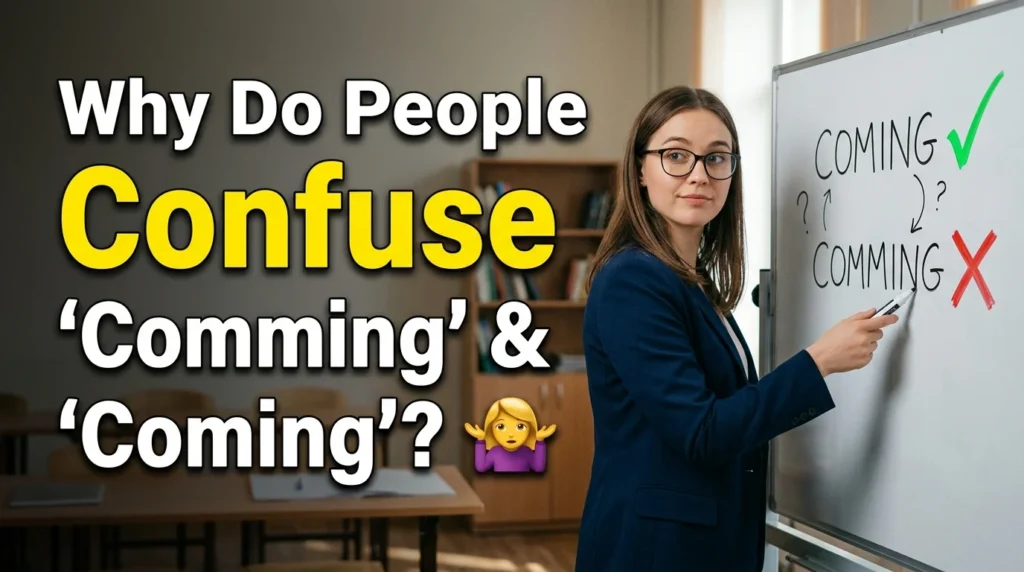
This mistake comes from the same spelling rule that causes so many English errors: doubling the final consonant before adding -ing or -ed.
You’ve probably learned rules like:
- run → running (double the “n”)
- swim → swimming (double the “m”)
- stop → stopping (double the “p”)
Since doubling is so common, people naturally assume “come” should follow the same pattern and become “comming.” But it doesn’t! Here’s the twist that changes everything. 👇
The Correct Word: “Coming” ✅

Meaning of “Coming”
“Coming” is the present participle (the -ing form) of the verb “come.” It describes an action that is happening now, will happen soon, or is approaching.
Examples of “Coming” in a Sentence
- She is coming to the party tonight. 🎉
- Winter is coming, so grab your coats!
- I saw him coming down the street.
- Are you coming with us to the movies?
- The train is coming in five minutes. 🚆
- Big changes are coming to the company next year.
Notice how naturally “coming” fits into everyday conversation, texting, work emails, and storytelling.
Why “Comming” Is Incorrect ❌
The word “comming” simply doesn’t exist in any English dictionary not in British English, American English, Canadian English, or Australian English. It’s purely a spelling mistake based on a misunderstanding of the consonant-doubling rule.
So Why Doesn’t “Come” Double Its Final Consonant?
Here’s the real grammar rule behind it 👇
The consonant-doubling rule normally applies when:
- The word ends in a single vowel + single consonant
- That final syllable is stressed
But “come” is a special case because of its spelling pattern, not just its sound. Let’s look closer:
- The word “come” ends in a silent E (co-m-e)
- When you add -ing, English spelling rules say: drop the silent E before adding a vowel suffix
- come + ing → dro p the E → com + ing → coming
There’s no need to double the “m” because the silent E already signals that the word doesn’t need a doubled consonant. This is different from words like “run” or “stop,” which have no silent E and end in a true single vowel + single consonant, so those words double up.
Compare It With Similar Words
| Word | Ends With Silent E? | Rule Applied | Correct -ing Form |
| Come | ✅ Yes | Drop the E | Coming |
| Make | ✅ Yes | Drop the E | Making |
| Write | ✅ Yes | Drop the E | Writing |
| Run | ❌ No | Double the consonant | Running |
| Stop | ❌ No | Double the consonant | Stopping |
| Swim | ❌ No | Double the consonant | Swimming |
See the pattern? 🔍 Words that end in a silent E simply drop the E and add -ing no doubling needed. Words that end in a single vowel + consonant with no silent E double the consonant instead.
This is a super useful English spelling rule to remember for tons of other words too!
Comparison Table: Comming vs Coming
| Aspect | Comming | Coming |
| Correct Spelling? | ❌ No (misspelling) | ✅ Yes |
| Part of Speech | N/A | Verb (present participle) |
| Dictionary Entry | Not found | Found in all major English dictionaries |
| British English | Incorrect | Correct ✅ |
| American English | Incorrect | Correct ✅ |
| Example Sentence | “He’s comming home.” ❌ | “He’s coming home.” ✅ |
Memory Trick to Never Misspell “Coming” Again 🧠
Here’s a fun mnemonic to help it stick:
“COME drops its silent E before COMING one M is all you need to see!”
Or try this simple rhyme:
“Silent E says goodbye, one M stands by!”
Another easy trick:
- Think of the word “HOME.” You wouldn’t spell it “hommed” or double the M when you add endings, right? Apply that same logic to “come” the silent E rule keeps things simple, and the M stays single. 🏠
Real-Life Examples: Where You’ll See “Coming” 📬
In Emails
“Just confirming I’ll be coming to the 2 PM meeting today.”
In Social Media Posts
“Big announcement coming soon! Stay tuned 👀🔥 #excited”
In News Headlines
“Storm Season Coming Early This Year, Experts Warn”
In Academic Writing
“The data suggests a shift is coming in consumer behavior over the next decade.”
In Everyday Speech
“Hey, are you coming to dinner tonight? We’re coming too!”
“Coming” shows up everywhere from casual chats to formal reports which is exactly why spelling it correctly matters for your credibility and clarity in writing. ✍️
British English vs American English 🇬🇧🇺🇸
Good news again: there’s no difference between British and American English for this word!
Unlike spelling differences such as:
- color (American) vs colour (British)
- traveling (American) vs travelling (British)
…“coming” is spelled exactly the same everywhere English is spoken. Whether you’re writing for a UK, US, Australian, or Canadian audience, “coming” never changes. One less rule to memorize! 🎉
Other Common Misspellings of “Come” ✍️
While we’re at it, let’s clear up a few related mistakes:
| Incorrect | Correct |
| Comming | Coming |
| Comeing | Coming |
| Cimming | Coming |
| Comed | Came (irregular past tense) |
| Commed | Came |
Quick tip: The base word is “come” drop the silent E before adding -ing:
- come + ing = coming (not “comeing” or “comming”)
And remember, the past tense of “come” is irregular: it’s “came,” not “comed” or “commed.”
- ❌ “Yesterday, she comed to my house.”
- ✅ “Yesterday, she came to my house.”
Common Mistakes People Make With “Coming” 🚩
- Doubling the M writing “comming” instead of “coming” (the most frequent error).
- Keeping the silent E writing “comeing” instead of dropping the E.
- Confusing tense using “come” or “coming” when the sentence actually needs “came.”
- ❌ “She come to the party last night.”
- ✅ “She came to the party last night.”
- Autocorrect slip-ups fast typing on phones often introduces errors like “comming” without you noticing.
Pro tip: Always proofread quick texts and social media posts before sending autocorrect doesn’t always catch spelling errors like this one! A quick read-through can save you from common mistakes in professional and casual writing alike.
Why This Grammar Tip Matters for SEO & Content Writing ✨
For bloggers, students, and professionals, correct spelling isn’t just a “nice to have” it directly impacts:
- Credibility clean, error-free writing builds trust with readers.
- SEO rankings search engines reward high-quality, accurately written content.
- Professionalism even one typo in a resume or client email can leave a poor impression.
People searching for “correct spelling,” “grammar tips,” and “English usage” every month are often trying to avoid exactly this kind of mistake. Mastering small details like “coming” vs “comming” instantly makes your writing look sharper and more polished. 🌟
FAQs: People Also Ask 🙋
1. Is “comming” ever correct in any dialect of English?
No. “Comming” isn’t a recognized word in British, American, Canadian, or Australian English. It’s always a spelling mistake.
2. Why does “come” drop the E instead of doubling the consonant?
Because “come” ends in a silent E. English spelling rules say to drop the silent E before adding a suffix that starts with a vowel (like -ing), rather than doubling the final consonant.
3. What is the correct past tense of “come”?
The correct past tense is “came” it’s an irregular verb, so it doesn’t follow the standard -ed pattern.
4. What is the correct spelling of the -ing form of “come”?
It’s “coming” no doubled M, and the silent E is dropped.
5. Is “coming” a verb or an adjective?
It’s mainly used as a verb (present participle of “come”), but it can also work as an adjective, like in “the coming weeks” or “the coming storm.”
6. Are there other English words that follow the same silent-E rule as “come”?
Yes! Words like “make” → making, “write” → writing, and “hope” → hoping all follow the same pattern drop the silent E, then add -ing.
7. How can I avoid typos like “comming” when typing fast?
Turn on spell-check, proofread before posting, and remember the simple rule: silent E words drop the E and never double the final consonant.
Final Thoughts:
In conclusion, coming is the correct spelling, while comming is a common spelling mistake. Coming is the present participle of the verb “come” and can describe someone moving toward a place, an upcoming event, or something that will happen soon. For example, you can say, “She is coming to visit us” or “The coming week will be busy.” Remember that coming has only one “m” in the middle.
Although the incorrect spelling may look reasonable, it is not accepted in standard English. Learning this simple spelling rule will help you write more accurately and confidently in everyday conversations, emails, and professional content.

James Carter is an English language enthusiast and content writer who loves making grammar simple and easy to understand. He creates clear, beginner-friendly guides on spelling, grammar rules, confusing words, and everyday English usage. His goal is to help readers write with confidence through practical examples, easy explanations, and accurate language tips.