Have you ever typed a sentence, stared at it, and thought “Wait, is it everyone’s or everyones?” You’re definitely not alone. This is one of the most common English grammar mistakes, and it trips up students, professionals, and even native speakers all the time.
The confusion usually comes from one tiny punctuation mark: the apostrophe (‘). It looks small, but it completely changes the meaning of the word. Add it in the wrong place (or leave it out completely), and your sentence can look unprofessional especially in emails, essays, or social media posts.
The good news? Once you understand the simple rule behind it, you’ll never make this mistake again. Let’s clear up the confusion once and for all. 🚀
Quick Answer ⚡
“Everyone’s” (with an apostrophe) is the correct spelling. It’s used to show possession (“everyone’s phone”) or as a contraction of “everyone is” (“everyone’s here”). “Everyones” (without an apostrophe) is not a correct English word and should never be used.
What Does “Everyone’s” Actually Mean? 📖
“Everyone’s” is a contraction or possessive form of the pronoun everyone. It can mean two different things depending on context:
1. Possession (Something Belongs to Everyone)
When “everyone’s” shows ownership, it means “belonging to everyone.”
Examples:
- Everyone’s opinion matters in this meeting. 🗣️
- Did you see everyone’s costumes at the party? 🎭
- Everyone’s homework is due on Friday. 📚
- The teacher praised everyone’s effort.
2. Contraction of “Everyone Is”
When “everyone’s” is short for everyone is, it’s used in casual or spoken English.
Examples:
- Everyone’s excited about the concert tonight! 🎶
- Everyone’s waiting for you outside.
- I think everyone’s ready to start.
- Everyone’s coming to the party, right?
💡 Tip: If you can replace “everyone’s” with “everyone is” and the sentence still makes sense, it’s a contraction. If it shows ownership, it’s possessive.
Is “Everyones” Ever Correct? ❌
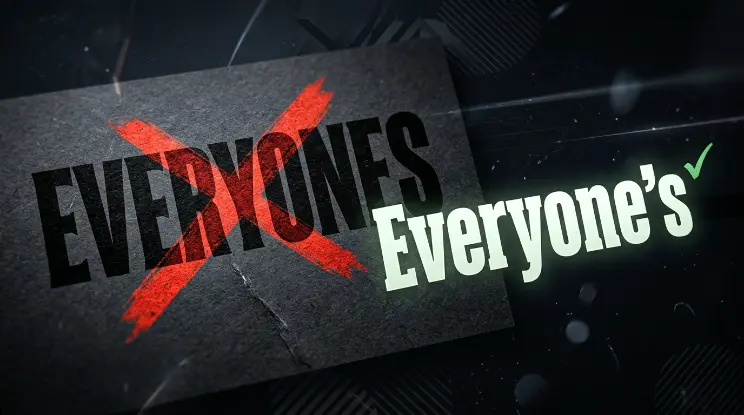
Nope never. “Everyones” is not a real word in standard English. There’s no grammatical rule that allows you to make “everyone” plural or possessive by simply adding an “s” without an apostrophe.
Since everyone is already a singular indefinite pronoun (referring to all people as a group, but grammatically singular), it doesn’t need and can’t take a plain “s” ending.
Incorrect:
- ❌ Everyones bags are on the table.
- ❌ Everyones welcome to join.
Correct:
- ✅ Everyone’s bags are on the table.
- ✅ Everyone’s welcome to join.
Comparison Table: Everyone’s vs Everyones 📊
| Word | Correct? | Meaning | Example |
| Everyone’s | ✅ Yes | Possession (“belonging to everyone”) | Everyone’s coat is on the rack. |
| Everyone’s | ✅ Yes | Contraction of “everyone is” | Everyone’s ready to leave. |
| Everyones | ❌ No | Not a real word | ~~Everyones coat is on the rack.~~ |
Common Mistakes People Make 🚫
Here are the most frequent errors related to this word, so you can spot (and avoid) them:
- Dropping the apostrophe entirely: “Everyones going to the game” ❌ → “Everyone’s going to the game” ✅
- Confusing it with “everyones'”: There’s no such word as everyones’ either plural possessive doesn’t apply here since “everyone” is always singular.
- Mixing it up with “everyone else’s”: When referring to other people’s things, the correct form is everyone else’s, not everyone’s else or everyones else.
- Using it interchangeably with “everybody’s”: This one’s actually fine! “Everyone’s” and “everybody’s” mean the same thing and follow the same apostrophe rule.
Memory Trick to Never Forget the Rule 🧠
Here’s a simple mnemonic to lock this in:
🔑 “One apostrophe for ONE-derful EVERYONE.”
Since everyone is singular (think: “every ONE person”), it needs an apostrophe + “s” just like any other singular noun showing possession similar to “the dog’s bone” or “Sarah’s book.”
Another easy trick:
- Everyone = every + one (singular) → treat it like any singular noun.
- Singular nouns + apostrophe + s = possession. (dog → dog’s, cat → cat’s, everyone → everyone’s)
Real-Life Examples: Where You’ll See This Word 💬
📧 In Emails
“Hi team, please make sure everyone’s timesheet is submitted by Friday.”
📱 On Social Media
“Everyone’s talking about the new iPhone release! 😍 #TechNews”
📰 In News Headlines
“Everyone’s Guide to Saving Money in 2026″
🎓 In Academic Writing
“Everyone’s perspective should be considered before drawing a conclusion in qualitative research.”
🗣️ In Everyday Speech
“Come on, everyone’s waiting for us at the restaurant!”
Notice how in every single example, the apostrophe is doing one of two jobs: showing ownership or standing in for “is.”
British English vs American English: Any Differences? 🇬🇧🇺🇸
Good news there’s no difference between British and American English when it comes to this rule. Both dialects:
- Use everyone’s the same way (possession or contraction)
- Reject everyones as incorrect
- Follow identical apostrophe rules for singular indefinite pronouns
The only minor stylistic difference is that British English tends to favor “everyone” in formal writing, while American English sometimes uses “everybody” more casually but the apostrophe rule stays exactly the same for both.
Related Grammar Tips You Should Know ✍️
Since this topic touches on apostrophe usage and indefinite pronouns, here are a few related rules worth bookmarking:
- Someone’s vs someones → Same rule applies (someone’s book ✅, someones book ❌)
- Anyone’s vs anyones → Same rule (anyone’s choice ✅, anyones choice ❌)
- Its vs it’s → “Its” shows possession (no apostrophe), while “it’s” is short for “it is” a common exception worth knowing
- Whose vs who’s → “Whose” shows possession, “who’s” means “who is”
Understanding these patterns will seriously boost your English usage and correct spelling skills across the board. 🎯
Frequently Asked Questions (FAQs) ❓
1. Is “everyones” ever grammatically correct?
No. “Everyones” is not a recognized English word in any context. Always use everyone’s.
2. What’s the difference between “everyone’s” and “everyone is”?
There’s no difference in meaning “everyone’s” is simply the contracted, shortened form of “everyone is,” commonly used in casual speech and writing.
3. Can “everyone’s” be used in formal writing?
Yes, but only in the possessive sense (e.g., “everyone’s responsibility”). For formal or academic writing, it’s often better to avoid the contraction form (“everyone’s here”) and write “everyone is here” instead.
4. Is there a plural form of “everyone’s”?
No. Since “everyone” is always singular, there’s no plural form like “everyones'” that would be incorrect.
5. How do I know if I should use an apostrophe with “everyone”?
Ask yourself: does the sentence show ownership, or can you replace it with “everyone is”? If yes to either, use everyone’s. If you’re not showing possession or meaning “is,” you might just need “everyone” (no apostrophe at all).
6. Is “everybody’s” the same as “everyone’s”?
Yes! They’re interchangeable and follow the exact same grammar rules.
7. Why do people mistakenly write “everyones”?
It’s usually a simple typo or a misunderstanding of apostrophe rules many people forget that singular indefinite pronouns like “everyone,” “someone,” and “anyone” still need an apostrophe to show possession.
Conclusion: The Key Takeaway 🌟
In conclusion, the correct form is “everyone’s” when you want to show possession or use a contraction of “everyone is” or “everyone has.” The form “everyones” is generally incorrect because it is missing the apostrophe. For example, “Everyone’s opinion matters” shows possession, while “Everyone’s ready” means “Everyone is ready.”
Remember that the apostrophe is important because it changes the meaning and grammar of the word. If you are writing an email, school assignment, social media post, or professional message, using “everyone’s” correctly will make your writing clearer and more accurate. Always check the context before choosing the right form.

Olivia Bennett is a passionate English grammar writer at GrammBoost.com who loves making grammar simple and easy to understand. She specializes in spelling, word differences, punctuation, and everyday English usage. Through clear explanations and practical examples, Olivia helps students, writers, and professionals write with greater confidence and accuracy.