Ever paused mid-sentence, fingers hovering over the keyboard, wondering: “Is it tomato or tomatoe?” You’re definitely not alone. This is one of the most Googled spelling questions in English, and honestly, it makes sense why people get confused.
Part of the blame goes to a famous political moment (more on that later 👇), part of it comes from English’s messy plural rules, and part of it is just… vibes. The word sounds like it might need that extra “e,” similar to words like “toe” or “shoe.”
But don’t worry by the end of this article, you’ll never second-guess yourself again. We’re breaking down the correct spelling, common mistakes, memory tricks, and everything in between.
Quick Answer 🎯
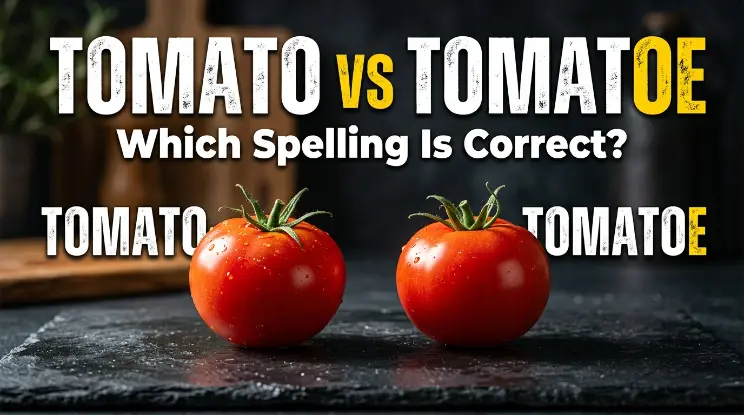
The correct spelling is “tomato” (no E at the end). The only time you’ll ever see an “e” added is in the plural form: tomatoes. “Tomatoe” as a singular word is always incorrect.
That’s it. That’s the whole rule. But let’s dig into the why, because understanding it will help it stick forever.
Tomato vs. Tomatoe: Breaking It Down
✅ “Tomato” The Correct Singular Form
Tomato is a noun referring to the red (or sometimes yellow, green, or purple) fruit that we treat as a vegetable in cooking. It comes from the Nahuatl word tomatl, via Spanish tomate.
Examples:
- I bought a fresh tomato at the farmers market.
- Can you slice this tomato for the salad?
- This sauce needs one more tomato.
- The tomato plant in my garden is finally fruiting! 🌱
❌ “Tomatoe” Always Incorrect (as a Singular)
Tomatoe is simply a misspelling. There is no context in standard English where “tomatoe” is the correct way to write the singular noun. It doesn’t exist in dictionaries as an accepted form.
Incorrect:
- ~~I ate a tomatoe for lunch.~~
- ~~Pass me that tomatoe.~~
Correct:
- I ate a tomato for lunch.
- Pass me that tomato.
✅ “Tomatoes” The Correct Plural Form
Here’s where the “e” does belong but only when you’re talking about more than one. English has a rule where nouns ending in a consonant + “o” often take “-es” in the plural (think: potatoes, heroes, echoes).
Examples:
- I bought three tomatoes for the pasta sauce.
- These tomatoes are perfectly ripe. 🍅🍅🍅
- She grows tomatoes every summer.
- The recipe calls for two cups of chopped tomatoes.
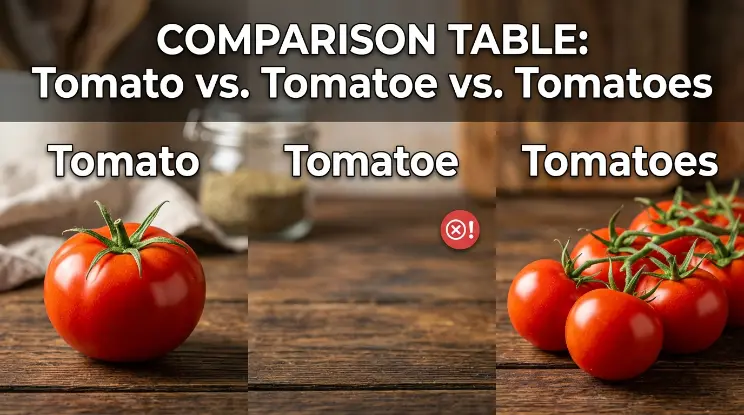
Comparison Table: Tomato vs. Tomatoe vs. Tomatoes
| Word | Correct? | Form | Meaning | Example Sentence |
| Tomato | ✅ Yes | Singular | One tomato fruit | “She sliced a tomato for the sandwich.” |
| Tomatoe | ❌ No | N/A (misspelling) | Not a real word | ~~”He ate a tomatoe.”~~ (incorrect) |
| Tomatoes | ✅ Yes | Plural | More than one tomato | “The garden is full of tomatoes.” |
Why Do People Confuse Tomato and Tomatoe? 🤔
1. The Famous “Potatoe” Moment
In 1992, a well-known political figure corrected a student’s spelling of “potato” to “potatoe” during a public spelling bee event and got it wrong. This moment became a huge pop culture reference and cemented a myth that words like potato and tomato might need that extra “e.” Spoiler: they don’t, unless you’re using the plural form.
2. Plural Rule Confusion
Because the plural forms (tomatoes, potatoes, heroes) do have an “e,” people sometimes assume the singular form should too. This is a classic case of overcorrection in English grammar.
3. Phonetic Instinct
English speakers often spell words the way they sound. Since “tomato” ends in a vowel sound that feels like it “should” have more letters, people instinctively add an “e” similar to how “toe,” “doe,” and “hoe” are spelled.
Common Mistakes to Avoid 🚫
- ❌ Writing “tomatoe” instead of “tomato” (singular)
- ❌ Writing “tomatos” instead of “tomatoes” (plural missing the “e”)
- ❌ Using “tomatoe’s” to mean plural (that’s a possessive apostrophe, not a plural!)
- ❌ Mixing up singular and plural in the same sentence (e.g., “I need two tomato for the salad”)
Memory Trick / Mnemonic 🧠
Here’s an easy way to lock this in:
“No E alone, but E when there’s more than one!”
Or try this mini rhyme:
🍅 One tomato, no extra letter. 🍅🍅 Two tomatoes with an E, it’s better!
Another trick: think of the word “potato.” These two words behave identically:
- Potato → Potatoes
- Tomato → Tomatoes
If you remember one, you automatically know the other. Two birds, one mnemonic! 🐦🐦
Real-Life Examples: Where You’ll See This Word Used
📧 In Emails
“Hi team, please pick up two crates of tomatoes for tomorrow’s catering event.”
📱 On Social Media
“Just harvested my first tomato of the season! 🍅 So proud of this little garden. #homegrown”
📰 In News Articles
“Local farmers report a bumper crop of tomatoes this year due to favorable weather conditions.”
🎓 In Academic or Scientific Writing
“The tomato (Solanum lycopersicum) is botanically classified as a fruit, though it is commonly prepared as a vegetable.”
🗣️ In Everyday Speech
“Can you grab a tomato from the fridge? I need it for the sandwich.”
British English vs. American English 🇬🇧 🇺🇸
Good news this one’s actually simple! Unlike many British vs. American spelling differences (like “colour” vs. “color”), tomato and tomatoes are spelled the same way in both dialects.
The only real difference is pronunciation:
| Region | Pronunciation | Sounds Like |
| American English | /təˈmeɪtoʊ/ | “tuh-MAY-toh” |
| British English | /təˈmɑːtoʊ/ | “tuh-MAH-toh” |
This is actually where the old song lyric “You say tomato, I say tomahto” comes from a playful nod to this exact pronunciation difference, not a spelling one. 🎵
Related Words That Follow the Same Pattern
If you understand tomato/tomatoes, you’ll automatically understand these too:
| Singular | Plural |
| Potato | Potatoes |
| Hero | Heroes |
| Echo | Echoes |
| Volcano | Volcanoes |
| Torpedo | Torpedoes |
Exception alert ⚠️: Not all “o” words follow this rule! Some just add “s”:
- Photo → Photos
- Piano → Pianos
- Halo → Halos
English grammar tips like these are worth bookmarking since there’s no single universal rule it’s often a case of memorizing common exceptions.
FAQs: People Also Ask 🙋
1. Is “tomatoe” ever correct?
No. “Tomatoe” is not a recognized word in any standard English dictionary. The correct singular spelling is always “tomato.”
2. What is the plural of tomato?
The plural is tomatoes, with an “e” before the “s.”
3. Why do people spell it “tomatoe”?
This is usually due to confusion with the plural form, phonetic spelling instincts, or the influence of a famous 1992 spelling mishap involving “potatoe.”
4. Is tomato a fruit or a vegetable?
Botanically, a tomato is a fruit (specifically a berry), but it’s commonly used as a vegetable in cooking and is legally classified as one in some contexts, like U.S. trade law.
5. Do British and American English spell “tomato” differently?
No, the spelling is identical. Only the pronunciation differs between the two dialects.
6. What’s the difference between “tomatoes” and “tomatoe’s”?
“Tomatoes” is the plural form (more than one tomato). “Tomatoe’s” would incorrectly use an apostrophe, which is only for possession (e.g., “the tomatoe’s skin was thin”) and even then, the base word should be spelled “tomato’s,” not “tomatoe’s.”
7. Are there other words that follow the same spelling pattern as tomato?
Yes! Words like potato/potatoes, hero/heroes, and echo/echoes follow the same singular-to-plural pattern.
Conclusion: Key Takeaway 🍅
In conclusion, tomato is the correct spelling in English, while tomatoe is a common spelling mistake. You are writing a recipe, school assignment, blog post, or everyday message, always use tomato when referring to the fruit. The plural form is tomatoes, which can sometimes make the spelling confusing.
Remembering the difference is simple: singular is tomato, and plural is tomatoes. Using the correct spelling helps make your writing clear, professional, and easy to understand. So, whenever you wonder whether to write tomato or tomatoe, choose tomato as the correct English spelling.

James Carter is an English language enthusiast and content writer who loves making grammar simple and easy to understand. He creates clear, beginner-friendly guides on spelling, grammar rules, confusing words, and everyday English usage. His goal is to help readers write with confidence through practical examples, easy explanations, and accurate language tips.