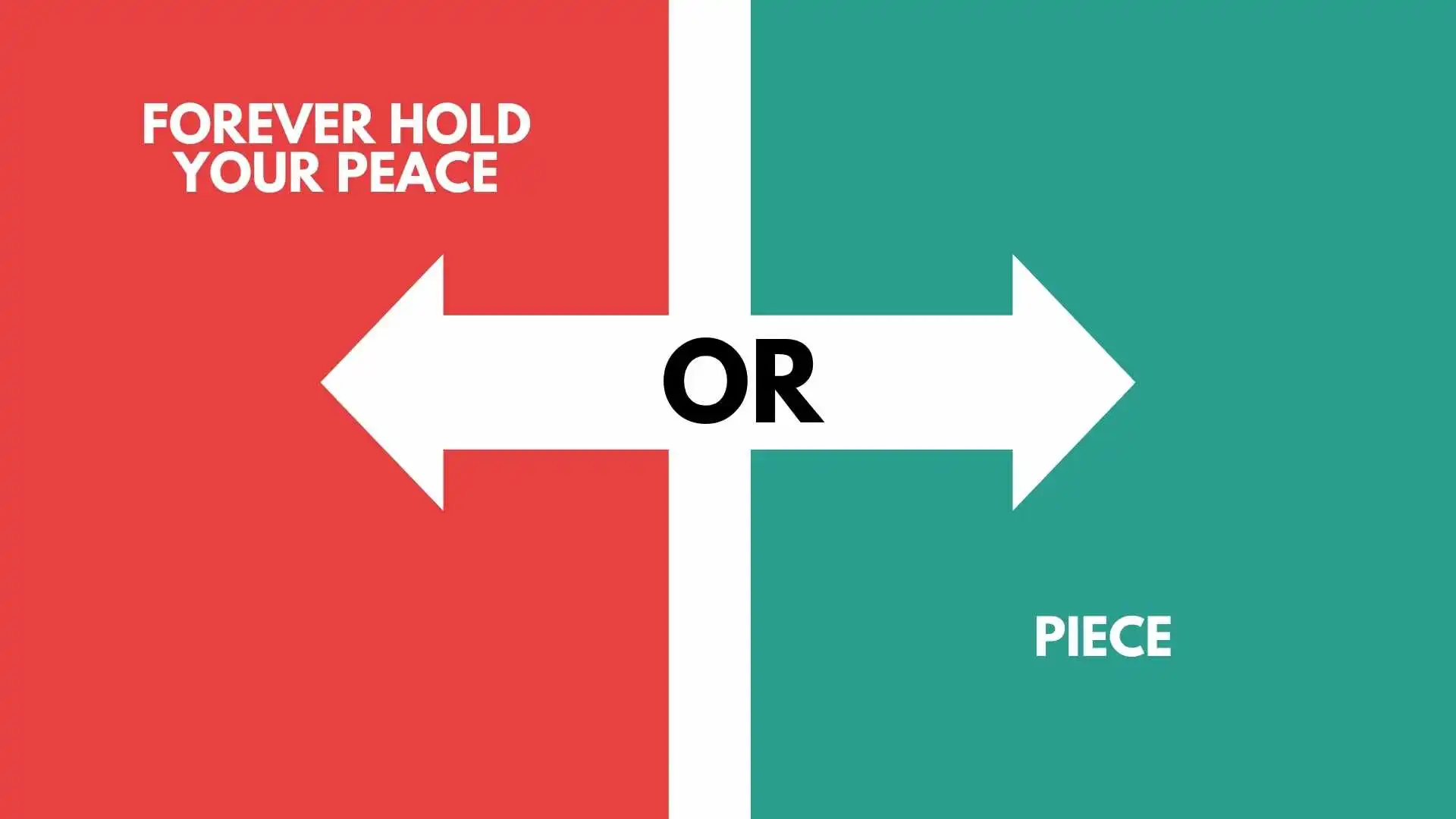
Picture this: you’re watching a wedding scene in a movie, the officiant turns to the crowd and says the famous line and you suddenly wonder, is it “forever hold your peace” or “forever hold your piece“? 🤔
You’re not alone. This is one of those phrases that sounds the same but trips up even native English speakers because “peace” and “piece” are homophones words that sound identical but have completely different meanings and spellings.
If you’ve ever typed this phrase into a text message, wedding invitation, or essay and paused to double-check yourself, this article is for you. Let’s clear up the confusion once and for all. ✅
Quick Answer 🎯
The correct phrase is “forever hold your peace.” It means to stay silent and never voice an objection again. “Piece” (meaning a portion or part of something) is never correct in this expression.
Now let’s dig into why and make sure you never mix them up again.
Understanding the Words: Peace vs. Piece
Before we tackle the full phrase, let’s break down each word individually. Knowing the core meaning of “peace” and “piece” will make the correct usage stick in your brain forever. 🧠
What Does “Peace” Mean?
Peace (noun) refers to:
- A state of calm, quiet, or freedom from conflict 🕊️
- Silence or stillness
- Harmony between people or nations
Examples:
- The countryside was full of peace and quiet.
- After years of war, the two nations finally signed a peace treaty.
- She closed her eyes and felt a deep sense of inner peace.
- Please hold your peace and let him finish speaking.
- The negotiators worked hard to bring peace to the region.
What Does “Piece” Mean?
Piece (noun) refers to:
- A part or portion of something 🍕
- An individual item in a set or collection
- A single component of a larger whole
Examples:
- Can I have another piece of cake, please?
- She lost an important piece of the puzzle.
- He wrote a beautiful piece of music for the film.
- I need a piece of paper to write this down.
- The museum displayed a rare piece of ancient pottery.
The Phrase: “Forever Hold Your Peace” Where It Comes From
The full traditional phrase is:
“Speak now, or forever hold your peace.”
This line comes from traditional wedding ceremonies, where the officiant asks if anyone in the audience objects to the marriage. If no one speaks up, they must stay silent about it forever hence “hold your peace,” meaning to keep quiet and not raise the issue again.
Why “Peace” and Not “Piece”?
Because the phrase is about silence and staying calm, not about owning a “part” of something. “Hold your peace” is an old English idiom meaning:
- To remain silent 🤐
- To refrain from speaking your opinion or objection
- To keep your thoughts to yourself, especially in a formal or tense moment
Since “piece” refers to a physical or metaphorical part of something, it simply doesn’t fit the meaning of staying quiet.
Comparison Table: Peace vs. Piece
| Feature | Peace 🕊️ | Piece 🧩 |
| Part of Speech | Noun | Noun |
| Core Meaning | Calm, silence, absence of conflict | A part or portion of something |
| Used in the Idiom? | ✅ Yes “hold your peace” | ❌ No |
| Example Sentence | She finally found peace of mind. | He ate the last piece of pizza. |
| Common Phrases | peace of mind, peace treaty, world peace | piece of cake, piece of advice, piece by piece |
| Pronunciation | /piːs/ | /piːs/ (identical!) |
As you can see, both words sound exactly the same, which is exactly why people mix them up in writing. 📝
Common Mistakes People Make
Here are the most frequent errors related to this phrase:
- ❌ “Forever hold your piece” Incorrect. This literally makes no sense (hold your… part of something?).
- ❌ “Speak now or forever hold your piece” Same mistake, very common on social media and memes.
- ❌ Using “piece” in other peace-related idioms, like “piece and quiet” instead of peace and quiet.
- ❌ Writing “piece of mind” instead of peace of mind (this is one of the most Googled grammar mix-ups!).
Memory Trick to Remember the Difference 🧠✨
Here’s a simple mnemonic to lock this in permanently:
“PEACE has an ‘A’ for CALM. PIECE has an ‘I’ for a bIt (a small part).”
Or try this one:
- Peace = P-E-A-C-E → think of “EAse” (calm, easy feeling)
- Piece = P-I-E-C-E → think of a pie (a piece of pie 🥧 = a slice/part)
Whenever you’re unsure, ask yourself: “Am I talking about calm and silence, or a part of something?” If it’s about silence → peace. If it’s about a portion → piece.
Real-Life Examples of the Phrase in Use
In Weddings 💍
“If anyone objects to this union, speak now or forever hold your peace.”
In Everyday Speech 🗣️
“I already told him what I think now I’ll just hold my peace and move on.”
In Social Media Posts 📱
“Watching my sister’s wedding today… waiting for that ‘forever hold your peace’ moment lol #wedding #nervous”
In News and Journalism 📰
“Critics of the new policy were asked to ‘hold their peace’ during the public forum, but tensions remained high.”
In Academic or Formal Writing 🎓
“The board members were reminded that objections raised after the vote would be irrelevant, urging them to hold their peace during future sessions.”
Common Misuse Example (What NOT to Do) 🚫
“Speak now or forever hold your piece.” ← Incorrect, though surprisingly common in casual writing, memes, and even some wedding invitation templates!
Related Idioms That Use “Peace” Correctly
To reinforce your understanding, here are other common idioms and phrases using peace:
- Peace of mind a feeling of being mentally calm and free from worry
- Peace and quiet a calm, undisturbed environment
- Make peace to resolve a conflict
- Rest in peace a phrase used for someone who has passed away
- Peacekeeping actions taken to maintain peace, especially by military or diplomatic forces
And here are common (correct) idioms using piece:
- Piece of cake something very easy to do
- Piece of advice a suggestion or recommendation
- Piece by piece gradually, one part at a time
- A piece of the pie a share of something, like profits
- In one piece safe and unharmed
British vs. American English: Any Differences? 🇬🇧🇺🇸
Good news this is one grammar rule that doesn’t change across regions! Both British and American English:
- Spell “peace” and “piece” the same way
- Use “forever hold your peace” identically in wedding ceremonies and idiomatic speech
- Pronounce both words identically as homophones
The only regional variation is in usage frequency the “speak now or forever hold your peace” line is more commonly associated with Western/Christian wedding traditions, but the idiom itself (“hold your peace,” meaning to stay silent) is understood across all English-speaking countries.
Other related search terms people often look up include:
- “hold your peace meaning”
- “peace vs piece grammar”
- “speak now or forever hold your peace origin”
- “common homophones in English”
- “English idioms list”
Frequently Asked Questions (FAQs) ❓
1. Is it “hold your peace” or “hold your piece”?
It’s “hold your peace.” This idiom means to stay silent, not to hold a physical or metaphorical part of something.
2. Where does the phrase “forever hold your peace” come from?
It originates from traditional wedding ceremony scripts, where the officiant invites objections before pronouncing the couple married. If no one objects, they must remain silent forever.
3. Is “hold your piece” ever correct in any context?
No. “Piece” cannot correctly be substituted in this idiom under any circumstance. It’s a common spelling mistake, not an alternate valid version.
4. What’s the difference between “peace of mind” and “piece of mind”?
“Peace of mind” is correct and means feeling calm and untroubled. “Piece of mind” is a common misspelling and doesn’t make grammatical sense in that context.
5. Are “peace” and “piece” pronounced the same?
Yes! They’re homophones, meaning they sound exactly alike (/piːs/) but have completely different spellings and meanings.
6. How can I remember the difference between peace and piece?
Use the mnemonic: Piece has “pie” in it (a piece of pie = a part). Peace relates to calm and “ease.” Associating each word with a related concept helps you recall the correct spelling.
7. Is this phrase still used in modern weddings?
Yes, though it’s becoming less common as more couples opt for simpler, more personalized ceremonies. However, it’s still frequently referenced in movies, TV shows, and pop culture. 🎬
8. Does British English spell “peace” or “piece” differently?
No, spelling for both words is identical in British and American English. There’s no regional variation for this particular grammar point.
Final Thoughts: Key Takeaway 🔑
In conclusion, the correct phrase is “Forever Hold Your Peace,” not “Forever Hold Your Piece.” The word “peace” refers to silence, calm, or choosing not to speak, while “piece” means a part of something. This phrase is commonly used in formal situations, especially during wedding ceremonies, to give people a final opportunity to share objections or concerns.
Understanding the difference between “peace” and “piece” helps you use the expression correctly. Remembering the meaning behind the phrase makes it easier to avoid spelling mistakes and communicate clearly in both writing and conversation.

James Carter is an English language enthusiast and content writer who loves making grammar simple and easy to understand. He creates clear, beginner-friendly guides on spelling, grammar rules, confusing words, and everyday English usage. His goal is to help readers write with confidence through practical examples, easy explanations, and accurate language tips.