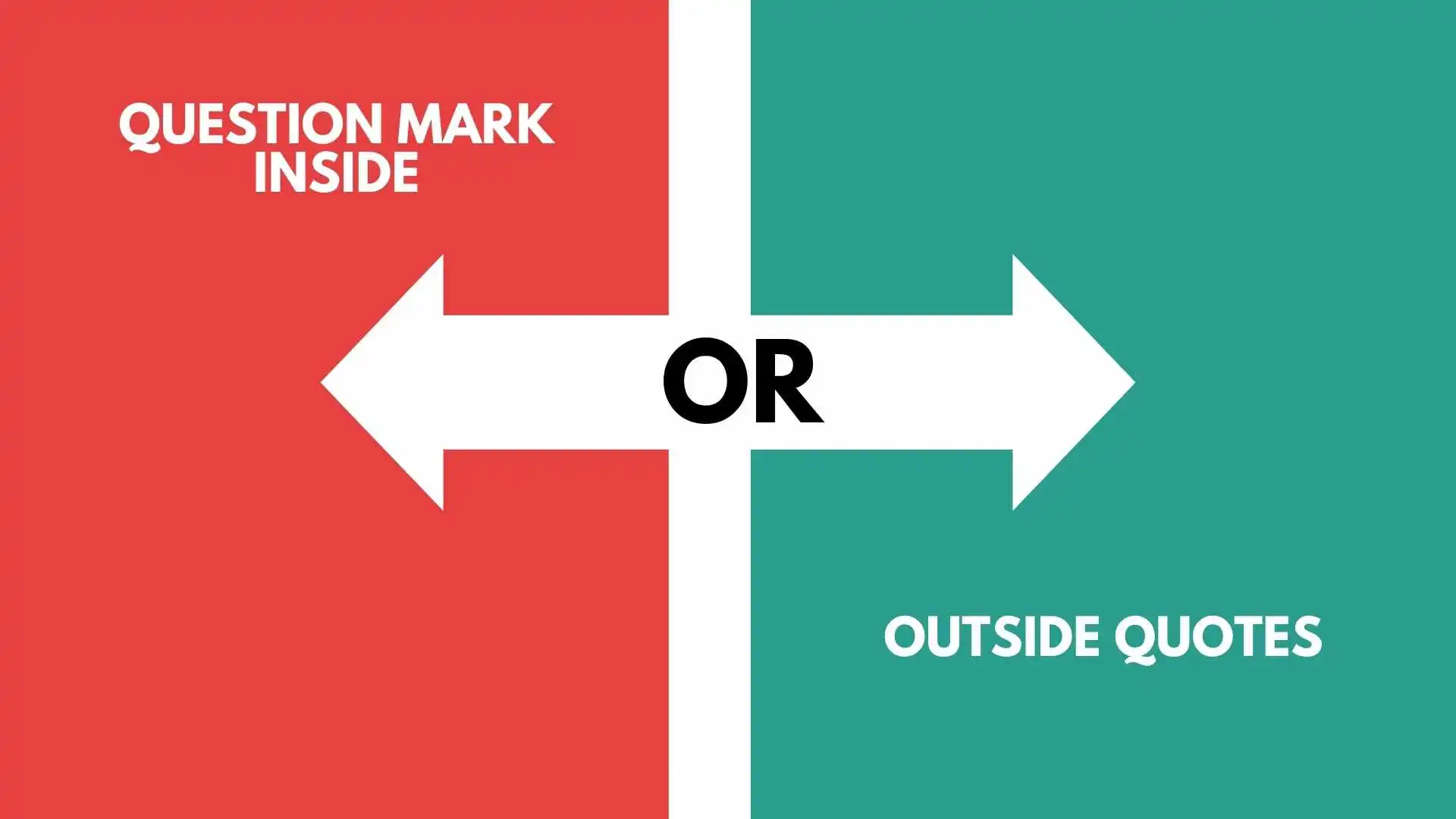
You’re typing a message. You’ve got a quote in there. And suddenly you freeze: does the question mark go inside the quotation marks or outside them? 😅
You’re not alone. This is one of the most common grammar mistakes in English even confident writers pause over it. The tricky part? The answer isn’t always the same. It actually depends on what’s being asked.
Good news: once you understand the logic behind it, you’ll never second-guess yourself again. This guide breaks it all down with simple rules, examples, comparison tables, and a memory trick you’ll actually remember. Let’s fix this punctuation puzzle for good! ✅
Quick Answer 🎯
Put the question mark inside the quotation marks if the quoted material itself is a question. Put it outside if your whole sentence is the question, but the quote isn’t. That’s it the rest of this article just helps you apply that rule with confidence.
Understanding the Core Rule
English punctuation around quotes isn’t random it follows one simple test:
Ask yourself: “Who is asking the question the quote, or the sentence?”
- If the quoted words are the question → question mark goes inside the quotes.
- If your sentence is the question, and the quote is just a statement, name, or phrase → question mark goes outside the quotes.
Let’s look at both cases in detail. 👇
1. Question Mark Inside the Quotes
Use this when the quoted text is itself a direct question.
Examples:
- She asked, “Are you coming to the party?”
- He turned to me and said, “Why did you do that?”
- The sign read, “Do you know where the nearest exit is?”
- My teacher always asks, “Did you finish your homework?”
📌 Key clue: If you removed the quotation marks, the sentence inside them would still make sense as a question on its own.
2. Question Mark Outside the Quotes
Use this when your entire sentence is a question, but what’s inside the quotes is not a question it’s just a statement, title, or phrase.
Examples:
- Did she really say, “I’m quitting my job”?
- Have you read the article titled “Life After Graduation”?
- Isn’t it strange that he called it “the best decision ever”?
- Do you agree with the saying “honesty is the best policy”?
📌 Key clue: If you removed the quotation marks, what’s left inside them would be a plain statement not a question.
3. When Both the Sentence and the Quote Are Questions
This one’s rare but worth knowing. If both parts are genuinely questions, most style guides say: only one question mark is needed, and it goes inside the quotes.
Example:
- Did he really ask, “Why did you leave?”
You don’t write two question marks (one inside, one outside) that looks cluttered and incorrect. ❌ Did he really ask, “Why did you leave?”?
Comparison Table: Inside vs Outside 📊
| Situation | Where the “?” Goes | Example |
| The quoted words are a question | Inside the quotes | She asked, “Where are you going?” |
| Your sentence is a question, quote is not | Outside the quotes | Did she say, “I’m leaving early”? |
| Both sentence and quote are questions | Inside only (one mark) | Did he ask, “Are you sure?” |
| Quoting a title (not a question) | Outside, if sentence asks | Have you read “The Great Gatsby”? |
| Quoting a title that is a question | Inside, if title is the question | Did you watch “What Is Love?” |
Common Mistakes to Avoid ⚠️
- Adding two question marks one inside, one outside. Only one is needed.
- ❌ Did she ask, “Are you okay?”?
- ✅ Did she ask, “Are you okay?”
- Putting the mark outside when the quote itself is the question.
- ❌ She asked, “Can you help me”?
- ✅ She asked, “Can you help me?”
- Putting the mark inside when the quote is just a statement.
- ❌ Did you hear him say, “I quit?”
- ✅ Did you hear him say, “I quit”?
- Confusing this rule with periods and commas those almost always go inside quotes in American English, but question marks follow the logic rule above, not that pattern.
Memory Trick 🧠
Here’s a simple mnemonic to lock this in:
“Whose question is it?” If the quote asks, the mark stays close inside. If you ask about the quote, it stands apart outside.
Or picture it this way: the question mark belongs to whoever is speaking the question. If the speaker inside the quotes is asking, the mark stays with their words. If you, the writer, are asking, the mark stays with your sentence.
British vs American English: Any Difference? 🇬🇧 🇺🇸
Good news this particular rule is the same in both British and American English. The logic-based placement of question marks (inside for quoted questions, outside for questions about a quote) applies universally.
Where British and American English do differ is:
| Feature | American English | British English |
| Quotation mark style | Double quotes ” ” preferred | Single quotes ‘ ‘ often preferred |
| Periods/commas with quotes | Almost always inside | Often outside unless part of the quote |
| Question marks with quotes | Logic-based rule (same as above) | Logic-based rule (same as above) |
So if you’re writing for a British audience, you might use single quotes, but the question mark placement logic stays identical.
Real-Life Examples 📱💬
In Emails
Subject: Quick Question Hi Sarah, did you get a chance to review the file I sent titled “Q3 Budget Report”?
(The title isn’t a question, so the mark goes outside.)
In Social Media Posts
Someone commented: “Can you believe this weather?” 😂
(The comment itself is a question, so the mark stays inside.)
In News Headlines
The reporter asked, “Will the new policy affect small businesses?”
(Direct quote is a question mark goes inside.)
In Academic Writing
Does the author’s claim that “climate change is irreversible” hold up to scrutiny?
(The quoted phrase is a statement, not a question mark goes outside.)
In Everyday Speech (Texting)
Friend 1: Did you just text me “running late”? Friend 2: Yeah, sorry! 🙈
Why This Matters for Clear Writing ✍️
Getting this right isn’t just about correct spelling or being a grammar perfectionist it affects clarity. A misplaced question mark can confuse readers about who is actually asking the question: you, or the person you’re quoting.
This is especially important in:
- Journalism (accurately representing quotes)
- Academic papers (citing sources precisely)
- Business emails (avoiding ambiguity)
- Creative writing (dialogue punctuation)
Mastering this small detail instantly makes your writing look more polished and professional. 🌟
FAQs: People Also Ask 🙋
1. Does the question mark always go inside quotation marks?
No. It only goes inside when the quoted material itself is a question. If your sentence is the question and the quote is just a statement, it goes outside.
2. What if I’m quoting a book or movie title that isn’t a question?
The question mark goes outside the quotes if your sentence is asking the question, since the title itself isn’t a question. Example: Have you seen “Inception”?
3. Is this rule different in British English?
No, the logic is the same in both British and American English. The only difference is quotation mark style (single vs double).
4. What happens if both the quote and the sentence are questions?
You only use one question mark, placed inside the quotes, right after the quoted question.
5. Do periods follow the same rule as question marks?
No. In American English, periods and commas almost always go inside quotation marks regardless of logic. Question marks (and exclamation points) follow the meaning-based rule instead.
6. Is there an easy way to remember this rule?
Yes ask yourself “whose question is it?” If the quoted speaker is asking, keep the mark inside. If you’re asking about the quote, keep it outside.
7. Can I use double question marks for emphasis in quotes?
No, that’s considered informal and grammatically incorrect in standard writing. Stick to one question mark, correctly placed based on the rule.
Conclusion: The Key Takeaway
Understanding whether a question mark goes inside or outside quotation marks depends on the meaning of the sentence. If the quoted words themselves are a question, place the question mark inside the quotation marks. However, if the entire sentence is a question and the quoted words are not, place it outside. Following this simple rule helps improve punctuation accuracy and makes your writing clearer. Remember to consider what part of the sentence is actually asking the question before deciding where to place the question mark.

Olivia Bennett is a passionate English grammar writer at GrammBoost.com who loves making grammar simple and easy to understand. She specializes in spelling, word differences, punctuation, and everyday English usage. Through clear explanations and practical examples, Olivia helps students, writers, and professionals write with greater confidence and accuracy.