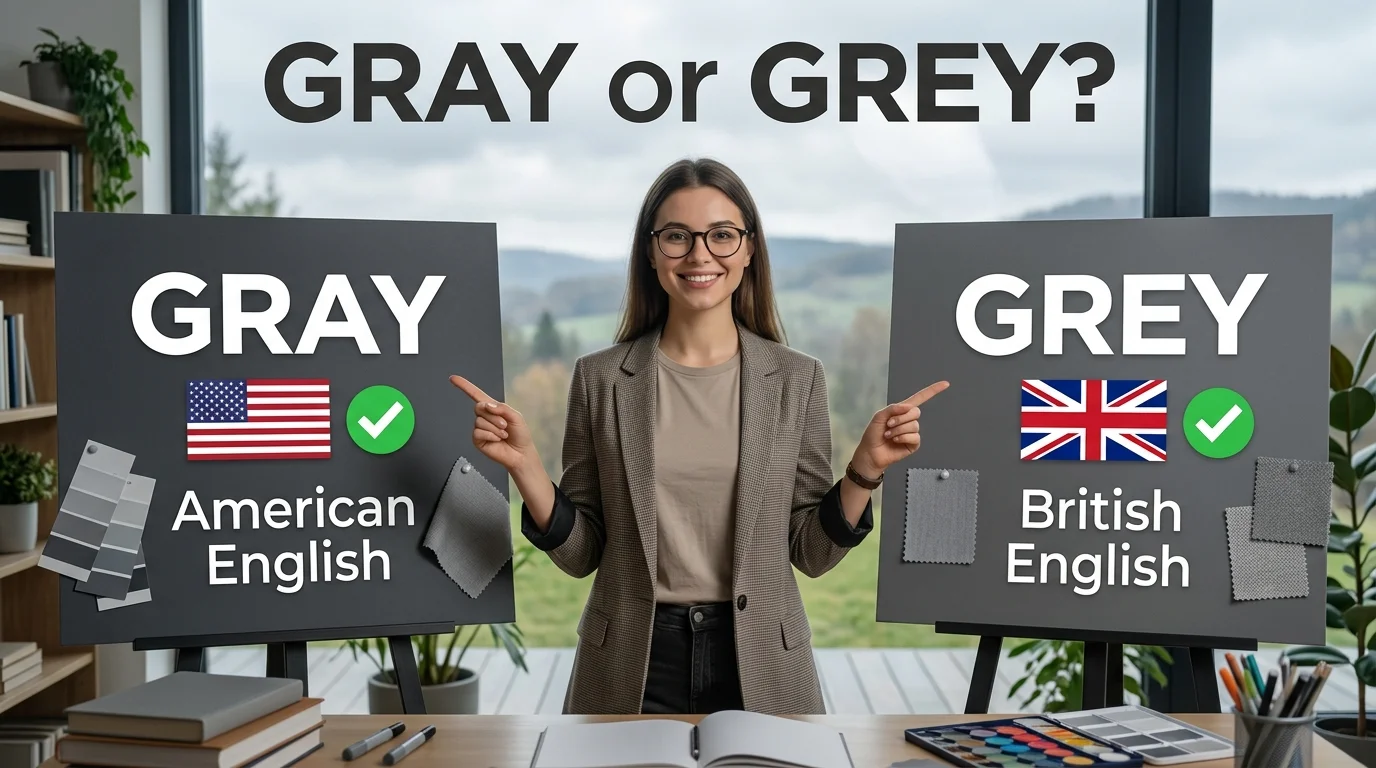
Have you ever noticed that some people write “gray” while others prefer “grey” and wondered which spelling is actually correct? This small difference often confuses English learners, writers, and even people who use English every day.
The good news is that both gray and grey are correct spellings of the same color. The main difference is regional preference: gray is more commonly used in American English, while grey is generally preferred in British English.
You might see either spelling in books, websites, clothing descriptions, school assignments, and everyday conversations. For example, an American writer may describe a cloudy sky as gray, while a British writer may describe the same sky as grey. .
Quick Answer 🎯
Both spellings are correct “gray” is the preferred spelling in American English, while “grey” is preferred in British English. It’s not a mistake either way; it’s just a regional difference, similar to “color” vs. “colour.”
That’s really the whole secret. But let’s dig into the details, because there’s more nuance (and some fun trivia) worth knowing.
Why Does This Confusion Even Exist? 🤔
English is a beautiful mess of borrowed words, historical spelling shifts, and regional divergence. Over the centuries, American English and British English drifted apart in small but noticeable ways think “color/colour,” “center/centre,” and yes, “gray/grey.”
Both spellings actually trace back to the same Old English root word, grǣg, meaning the color between black and white. Over time, American and British spelling conventions settled on different versions, and both stuck around.
So no, you haven’t been misspelling it. You’ve just been using one valid version of a word that has two valid versions. 😌
Gray: The American Spelling 🇺🇸

Gray is the standard spelling used in the United States and, generally, in Canada (though Canada sometimes leans British in other areas).
Examples of “gray” in a sentence:
- The sky turned a dull gray before the storm hit.
- She wore a gray sweater to the interview.
- His hair had gone completely gray by age 40.
- The report showed a gray area in the company’s policy.
- We painted the walls a soft gray to match the furniture.
You’ll see “gray” everywhere in American newspapers, US-based websites, American textbooks, and everyday American conversation.
Grey: The British Spelling 🇬🇧
Grey is the preferred spelling in the United Kingdom, Australia, New Zealand, Ireland, and most other English-speaking countries outside the US.
Examples of “grey” in a sentence:
- London skies are famously grey most of the year.
- The cat had beautiful grey fur.
- He felt a grey, gloomy mood settle over him.
- The committee discussed the grey areas in the new legislation.
- Her uniform included a grey blazer and tie.
If you’re reading a British novel, a BBC article, or an Australian news site, “grey” is what you’ll typically encounter.
Gray vs Grey: Comparison Table 📊
| Feature | Gray | Grey |
| Region | American English 🇺🇸 | British English 🇬🇧 |
| Common in | US, sometimes Canada | UK, Australia, NZ, Ireland, India |
| Meaning | Color between black and white | Same color between black and white |
| Example Sentence | “The car is gray.” | “The car is grey.” |
| Proper Noun Usage | “Earl Grey” tea (always “grey”!) | “Grey’s Anatomy” (US show, uses “Grey” as a surname) |
| Search Popularity | Slightly higher globally | Slightly higher in UK-based searches |
| Used in | US media, American English learners | UK media, Commonwealth countries |
💡 Fun fact: Notice that “Earl Grey” tea is always spelled with an “e,” even in American English, because it’s a proper noun (named after Earl Grey, a British Prime Minister). And “Grey’s Anatomy,” the American TV show, uses “Grey” because it’s a character’s last name not because of British spelling rules!
Common Mistakes People Make ❌
Let’s talk about where people usually slip up:
- Mixing spellings within the same document. If you start with “gray,” stay consistent throughout your writing. Switching between “gray” and “grey” in the same piece looks unprofessional and confuses your reader.
- Assuming one spelling is “wrong.” Neither is incorrect it’s about audience and regional convention, not grammar rules.
- Forgetting proper nouns. Names like “Earl Grey” or “Grey’s Anatomy” don’t follow the regional spelling rule they’re fixed because they’re names.
- Ignoring your audience. If you’re writing for a British audience, using “gray” repeatedly might feel slightly “off” to them (and vice versa).
- Autocorrect confusion. Many spellcheckers default to American English, which can quietly change your “grey” to “gray” without you noticing.
Memory Trick to Never Forget Again 🧠✨
Here’s a simple mnemonic that grammar teachers love:
A for America → grAy E for England → grEy
Just remember: America likes A, England likes E. Once this clicks, you’ll never mix them up again!
Another fun trick some people use:
- G-R-A-Y = “Gray Rhymes with Away” (both American-style words)
- G-R-E-Y = “Grey Rhymes with They” (a very British-sounding word, “they”)
Pick whichever sticks better in your brain. 🧩
Real-Life Examples Across Different Contexts 📱📰🎓
In Emails (Professional Writing)
“Please find attached the gray-colored design mockup for your review.” (American business email) “Kindly review the grey swatch options before Friday’s meeting.” (British business email)
On Social Media
“Loving this gray hoodie from my fall wardrobe drop 🧥🍂 #ootd” (US influencer) “Obsessed with this grey jumper, so cosy for autumn 🍁” (UK influencer)
In News Headlines
“Gray Skies Expected Across the Midwest This Weekend” US news outlet “Grey Clouds Loom Over London Ahead of Bank Holiday” UK news outlet
In Academic Writing
American university paper: “The gray matter in the brain is responsible for processing information.” British university paper: “The grey matter in the brain is responsible for processing information.”
In Everyday Speech
Whether someone says “my hair is turning gray” or “my hair is turning grey,” listeners on both sides of the Atlantic will understand perfectly. Context always makes it clear!
Gray/Grey in Compound Words and Derivatives 🔤
The spelling rule extends to related words too:
| American English | British English |
| grayscale | greyscale |
| grayish | greyish |
| graying (hair) | greying (hair) |
| gray area | grey area |
| gray matter | grey matter |
| grayhound (rare/incorrect) | greyhound (correct always with “e”!) |
⚠️ Special note: “Greyhound” (the dog breed and the US bus company) is always spelled with an “e,” regardless of American or British English. It’s a fixed brand name and breed name, not subject to regional spelling variation.
Google Trends & Usage Insights 🔍
If you’re curious about search behavior, here’s what tends to happen:
- “Gray” dominates search volume in the US, Philippines, and parts of Asia where American English is taught.
- “Grey” dominates in the UK, Australia, South Africa, and India, where British English conventions are more common.
- Globally, “gray” often has slightly higher overall search volume, largely due to the size of the US population and internet usage.
- For SEO purposes, if you’re writing for a global audience, using “gray” first and mentioning “grey” as an alternative (like this article does!) helps capture searches from both spelling camps.
This matters if you’re a blogger, marketer, or content writer using both spellings strategically (without mixing them awkwardly) can improve your correct spelling search visibility.
Gray vs Grey: Which Should You Use? 🤷♀️
Ask yourself these quick questions:
- Who is my audience? American readers → use “gray.” British/Commonwealth readers → use “grey.”
- What style guide am I following? AP Style (American journalism) uses “gray.” Most UK publishers use “grey.”
- Is this a brand name or proper noun? Stick with the official spelling (e.g., “Earl Grey,” “Greyhound”).
- Am I writing for a global audience? Pick one and stay consistent throughout the piece.
FAQs: People Also Ask ❓
1. Is “gray” or “grey” more correct?
Neither is more correct they’re both valid spellings. “Gray” is American English, and “grey” is British English.
2. Which spelling should I use in the US?
Use “gray” if you’re writing for an American audience or following AP Style / US style guides.
3. Which spelling should I use in the UK?
Use “grey” if you’re writing for a British, Australian, or Commonwealth audience.
4. Why is “Earl Grey” tea spelled with an “e” even in American English?
Because it’s a proper noun named after a real historical figure (Earl Grey, a British Prime Minister). Proper nouns keep their original spelling regardless of regional rules.
5. Is “greyhound” spelled with an “a” or an “e”?
Always with an “e” “greyhound,” in both American and British English. This applies to the dog breed and the bus company.
6. Can I use both spellings in the same document?
It’s best not to. Pick one spelling based on your audience or style guide and stay consistent throughout your writing.
7. Does spellcheck automatically fix gray/grey?
Yes, many spellcheckers (especially Microsoft Word and Google Docs set to “English (US)”) may auto-correct “grey” to “gray.” Check your language settings if you want to keep the British spelling.
8. Is there a difference in meaning between gray and grey?
No difference in meaning at all both refer to the same color between black and white. The only difference is regional spelling preference.
Conclusion:
In conclusion, gray and grey are both correct spellings of the same color. The main difference is regional usage. Gray is more common in American English, while grey is preferred in British English and other regions. Neither spelling is wrong, so your choice depends on your audience and writing style. If you are writing for an American audience, use gray. For British readers, grey is generally the better choice.
Most importantly, stay consistent and avoid switching between the two spellings in the same piece of writing. Understanding this simple difference will help you write clearly and confidently.

James Carter is an English language enthusiast and content writer who loves making grammar simple and easy to understand. He creates clear, beginner-friendly guides on spelling, grammar rules, confusing words, and everyday English usage. His goal is to help readers write with confidence through practical examples, easy explanations, and accurate language tips.