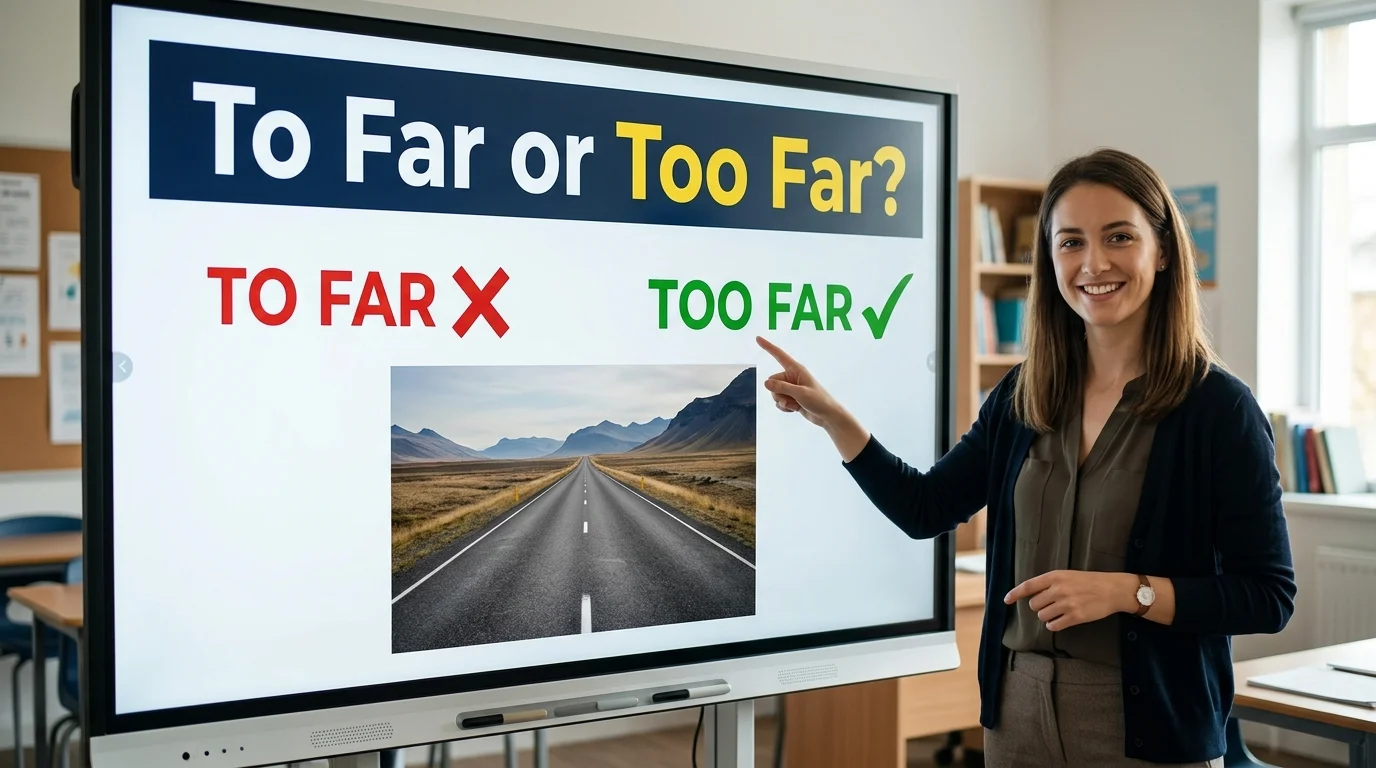
Have you ever written a sentence and wondered whether to use “to far” or “too far”? You are not alone! These expressions can be confusing because the words to and too sound exactly alike, but they have different meanings and grammatical uses.
Choosing the wrong one can make an otherwise good sentence look incorrect. In standard English, “too far” is the correct expression when you want to say that something is at an excessive distance or has gone beyond an acceptable limit. For example, you might say, “The store is too far from my house,” or “He took the joke too far.”
The word too can mean “more than necessary” or “excessively,” while to is commonly used to indicate direction, movement, or a destination. Therefore, “to far” is incorrect when you mean that something is excessively distant or has exceeded a limit.
Quick Answer ⚡
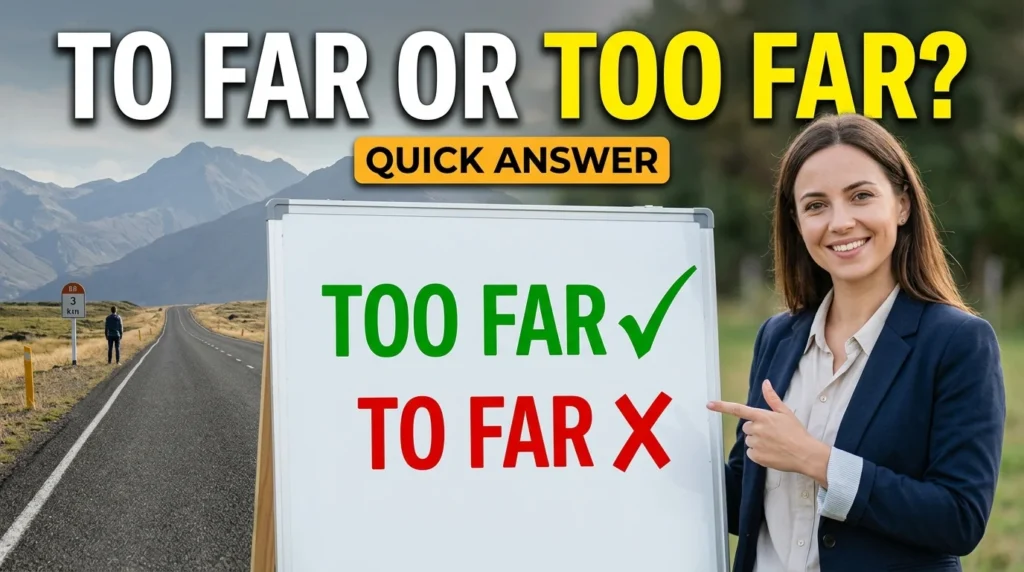
“Too far” is almost always correct it means “too much distance” or “excessive.” “To far” is grammatically incorrect in standard English because “to” is a preposition that needs an object (like “to the store”), not an adjective like “far.” So when in doubt, go with “too far.”
Understanding the Words: “To” vs “Too” vs “Far”
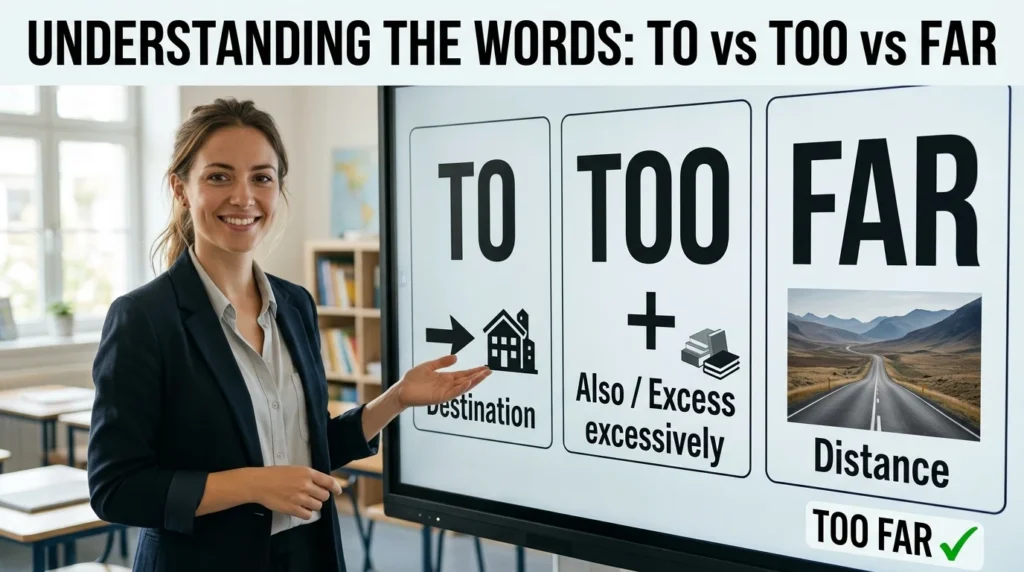
Before we dive into the phrase itself, let’s break down each word. This is the foundation of good English usage, and once you get it, you’ll never second-guess yourself again.
What Does “To” Mean? 📍
“To” is a preposition. It shows direction, movement, or connection between things. It’s almost always followed by a noun, place, or verb.
Examples:
- I’m walking to the park.
- She gave the book to her friend.
- We’re going to learn something new today.
Notice how “to” always connects to something else a place, person, or action. It never stands alone describing “how much” of something.
What Does “Too” Mean? ➕
“Too” has two main meanings:
- “Also” or “as well”
- I want pizza too! 🍕
- She’s coming too.
- “Excessively” or “more than needed”
- This coffee is too hot. ☕
- He’s driving too fast.
The second meaning is the one we care about here because “too far” falls into this “excessive” category.
What Does “Far” Mean? 🚶♂️
“Far” is an adjective or adverb describing distance either physical or figurative.
Examples:
- The store is far from here.
- Don’t take the joke far.
- How far did you run today?
So… Is It “To Far” or “Too Far”? ✅
Here’s the golden rule:
“Too far” is the correct phrase. It means something has gone beyond an acceptable or reasonable limit whether that’s physical distance or a figurative boundary (like a joke, an argument, or a decision).
“To far” is not grammatically valid because “to” always needs to connect to a noun or verb phrase you can’t say “to far,” just like you can’t say “to hot” or “to fast.”
Correct Examples of “Too Far” 👇
- You’ve taken this too far let’s calm down.
- The airport is too far to walk to.
- I think that comment went too far.
- We drove too far and missed the exit.
- Don’t push him too far, he’s already stressed.
Why “To Far” Is Wrong ❌
You’ll only ever see “to far” as a typo or a genuine grammar mistake. There’s no correct sentence in standard English where “to far” works. If you’re tempted to write it, you almost certainly mean “too far.”
Comparison Table: “To” vs “Too” vs “Far” 📊
| Word | Part of Speech | Meaning | Example Sentence |
| To | Preposition | Direction, connection, or part of an infinitive verb | I’m going to the gym. |
| Too | Adverb | “Also” OR “excessively” | It’s too cold outside. |
| Far | Adjective/Adverb | Distance (physical or figurative) | That’s far from the truth. |
| Too far | Phrase | Beyond an acceptable limit | You’ve gone too far this time. |
| To far | ❌ Incorrect | Not a valid English phrase | (Always a mistake) |
Common Mistakes People Make 🧐
Let’s look at where this confusion usually pops up:
- ❌ “That joke was to far.” → ✅ “That joke was too far.”
- ❌ “Don’t go to far from the house.” → ✅ “Don’t go too far from the house.”
- ❌ “It’s to cold to go outside.” → ✅ “It’s too cold to go outside.” (Notice both words appear here one is “too,” the other is “to”!)
That last example is important. Many sentences use both words together, which is exactly why people get confused. Let’s decode it:
- “It’s too cold” → excessive coldness → needs too
- “to go outside” → connects to the verb “go” → needs to
Memory Trick to Never Mix Them Up Again 🧠
Here’s a simple mnemonic that works every time:
“Too” has TWO O’s because it means TOO MUCH.
Think of the extra “o” as extra extra distance, extra heat, extra anything. If the sentence is about something being excessive, add that extra “o” and use “too.”
Another trick:
- To = Toward (both start with “to” and involve direction)
- Too = extra (both have double letters, representing “more”)
Try replacing the word with “also” or “excessively” in your sentence. If it still makes sense, you need “too.”
Test it:
- “Don’t go too far” → “Don’t go excessively far” ✅ Makes sense → use too
- “I’m going to the store” → “I’m going excessively the store” ❌ Doesn’t make sense → use to
Real-Life Examples 🌍
In Emails 📧
“I understand your frustration, but I think this request has gone too far outside our agreed scope.”
On Social Media 📱
“Bro took the prank too far 💀😂 #fail”
In News Headlines 📰
“Officials say the proposed budget cuts have gone too far, risking public services.”
In Academic Writing 🎓
“The researchers argue that extrapolating the data too far beyond the sample range weakens the study’s validity.”
In Everyday Speech 🗣️
“Hey, slow down you’re driving too far over the speed limit!”
Notice how in every context casual, professional, academic “too far” is the only correct choice.
British vs American English: Any Difference? 🇬🇧🇺🇸
Good news there’s no regional difference here! Both British and American English use “too far” identically. This isn’t like “colour” vs “color” or “favourite” vs “favorite.” The rule is universal across all English-speaking countries.
However, one usage note:
- In British English, you might hear “a bit too far” used more often for softer emphasis.
- In American English, “way too far” is a common casual intensifier.
Both are grammatically correct it’s just a matter of style and tone. 🌐
Related Confusions Worth Knowing 💡
Since we’re on the topic of grammar tips, here are a few similar mix-ups that follow the same logic:
| Confusing Pair | Correct Usage Example |
| To much / Too much | I ate too much cake. |
| To many / Too many | There are too many cars on this road. |
| To late / Too late | We arrived too late for the show. |
| To good / Too good | This deal is too good to be true. |
| To bad / Too bad | It’s too bad you missed the party. |
See the pattern? Whenever the meaning is “excessive” or “also,” it’s always “too” with two O’s.
FAQs: People Also Ask 🙋
1. Is “to far” ever correct?
No. “To far” is not grammatically correct in any standard context. If you’re describing distance being excessive, always use “too far.”
2. What’s the difference between “to” and “too”?
“To” is a preposition showing direction or connection (e.g., “go to school”). “Too” means “also” or “excessively” (e.g., “too tired,” “me too”).
3. How do I remember when to use “too” instead of “to”?
Remember: “too” has an extra O for “extra” or “excessive.” If your sentence means “more than enough,” use “too.”
4. Is “too far” formal or informal?
“Too far” works in both formal and informal writing it’s a completely standard, neutral phrase suitable for emails, essays, and casual conversation alike.
5. Can “too far” be used figuratively?
Yes! “Too far” is often used figuratively, such as “That comment went too far” (meaning it was offensive or inappropriate), not just for physical distance.
6. Why do people confuse “to” and “too” so often?
Because they’re homophones they sound identical when spoken. The confusion is purely a spelling issue, not a pronunciation one.
7. Is there a British English version of “too far”?
No “too far” is used identically in British, American, Australian, and Canadian English. There’s no regional spelling variation for this phrase.
Final Thoughts:
Conclusion
In conclusion, “to far” and “too far” may sound similar, but only “too far” is correct when describing excessive distance or going beyond an acceptable limit. The word “too” means more than necessary, while “to” is commonly used to show direction or movement. For example, you can say, “The store is too far from my house.”
Using the correct phrase helps you avoid common grammar mistakes in everyday conversations, emails, and writing. Remember this simple rule: whenever you mean excessive distance or something going beyond a limit, use “too far,” not “to far.”

Olivia Bennett is a passionate English grammar writer at GrammBoost.com who loves making grammar simple and easy to understand. She specializes in spelling, word differences, punctuation, and everyday English usage. Through clear explanations and practical examples, Olivia helps students, writers, and professionals write with greater confidence and accuracy.