
Have you ever tried to write about beautiful landscapes, green hills, or peaceful areas between mountains but stopped to wonder whether “vallies” or “valleys” is the correct spelling? You are not alone! English spelling can be tricky, especially when a word changes from singular to plural.
Both forms may look reasonable at first glance, but only one is correct in standard English. “Valleys” is the correct plural form of “valley,” which describes a low area of land between hills or mountains, often with a river running through it.
On the other hand, “vallies” is a common spelling mistake and should generally be avoided in modern English writing. This confusion often happens because people assume that words ending in -y always follow the same spelling pattern when becoming plural.
Quick Answer ⚡
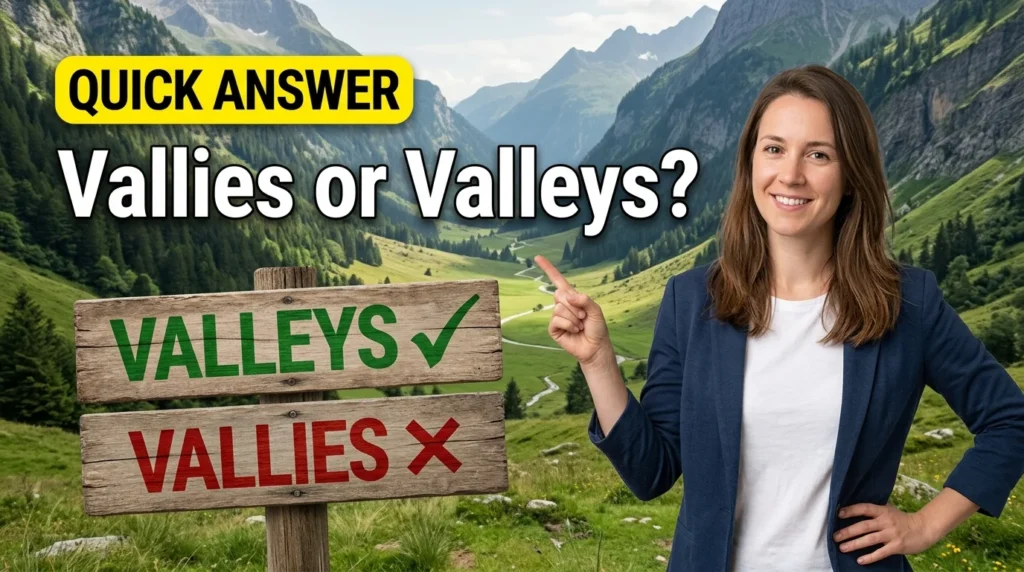
“Valleys” is the correct spelling. “Vallies” is a common misspelling. When a word ends in a vowel + y (like “valley”), you simply add an -s. You only change the “y” to “ies” when the word ends in a consonant + y.
That’s it that’s the whole rule in one sentence. But let’s dig into why, because understanding the logic means you’ll never mix it up again.
Meet the Word: “Valley” 🏔️

A valley is a low area of land between hills or mountains, often with a river or stream running through it. Think rolling green landscapes, dramatic mountain gaps, or the cozy little dip where a town sits.
Singular examples:
- We hiked down into the valley just as the sun was setting.
- The valley was covered in a soft morning mist.
- Silicon Valley is famous for tech startups, not actual silicon mining. 😄
Plural the correct form is “valleys”:
- The Alps are full of breathtaking valleys.
- We drove through three different valleys on our road trip.
- Farmers have cultivated these valleys for centuries.
Why “Vallies” Is Wrong ❌
Here’s where the confusion sneaks in. Most English speakers learn early on that words ending in “y” become “ies” in the plural like:
- baby → babies
- city → cities
- puppy → puppies
So it feels natural to assume valley → vallies. But there’s a catch most people forget.
The Real Rule (and Why It Matters)
| Ending Before the “Y” | Rule | Example |
| Consonant + y | Change “y” to “i,” add “es” | baby → babies |
| Vowel + y | Just add “s” | valley → valleys |
Look closely at “valley.” The letter right before the “y” is e a vowel, not a consonant. That single detail changes everything.
Other words that follow the same “vowel + y” rule:
| Singular | Plural | Vowel Before “Y” |
| monkey | monkeys | e |
| donkey | donkeys | e |
| journey | journeys | e |
| toy | toys | o |
| day | days | a |
| boy | boys | o |
See the pattern? Whenever a vowel (a, e, i, o, u) sits right before the “y,” you just tack on an “s.” No drama, no rule-breaking, no “ies.”
Comparison Table: Vallies vs Valleys 📊
| Word | Correct? | Meaning | Example |
| Valleys | ✅ Correct | Plural of “valley” low land between hills | “The valleys were lush and green.” |
| Vallies | ❌ Incorrect | Common misspelling; not a real word | ~~”The vallies were lush and green.”~~ |
There’s no gray area here unlike some grammar debates, this one has a clear, simple winner. “Valleys” is the only correct spelling in standard English, in both American and British usage.
Memory Trick to Never Forget It Again 🧠
Here’s a fun mnemonic to lock this in:
“If a vowel comes before, just add an S nothing more!”
Or try this visual trick: picture the word valley notice the “e” sitting right before the “y,” like a little guard standing watch. That guard’s job is to block the “y” from ever changing to “ie.” As long as that vowel guard is there, the plural stays simple just add “s.”
Another quick trick: think of “monkey” and “valley” together. Monkeys live in valleys! 🐒🏞️ If you remember that both end the same way (vowel + y), you’ll remember both get an easy “-s” plural.
Common Mistakes People Make 🚫
- Spelling it “vallies” the most frequent error, usually from over-applying the “y to ies” rule.
- Confusing it with “valleys'” (possessive) remember, “valleys'” (with an apostrophe after the s) shows possession by multiple valleys, like “the valleys’ rivers were flooded.”
- Autocorrect confusion some people trust spell-check blindly, but weirdly, “vallies” sometimes slips through because it resembles other accepted words like “allies.”
- Mixing up with similar-sounding words like “valise” (a small suitcase) or “Vallejo” (a city name). These are unrelated but sound similar enough to cause hesitation.
Real-Life Examples 📝
Here’s how “valleys” shows up in everyday writing across different contexts:
📧 In an Email
“Our team retreat will take place in one of the most scenic valleys in Colorado. Please pack layers, as mountain valleys can get chilly at night.”
📱 On Social Media
“Just hiked through TWO stunning valleys today and I’m never leaving the mountains again 🏔️😍 #naturelover #hikinglife”
📰 In the News
“Heavy rainfall this week has caused flooding in several low-lying valleys across the region, prompting evacuation warnings.”
🎓 In Academic Writing
“The study examined sediment deposition patterns across river valleys formed during the last glacial period.”
🗣️ In Everyday Speech
“We’re planning a trip through the wine valleys next month I heard the views are incredible.”
Notice something? In every single context casual, professional, academic the spelling stays the same: valleys. No exceptions.
British vs American English 🇬🇧🇺🇸
Good news here: this one’s not a regional battle. Unlike words such as “colour/color” or “organise/organize,” “valleys” is spelled the same in both British and American English. There’s no British alternative like “vallies” hiding out there it’s simply wrong on both sides of the Atlantic.
The word “valley” itself, and its plural, has stayed consistent across English-speaking countries because it follows a standard, universal spelling pattern that isn’t tied to regional conventions.
Keyword & Usage Insights 🔍
If you’re a writer, blogger, or student trying to nail down correct spelling and English usage, here are some related terms worth knowing:
- Grammar tips for pluralizing words ending in “y”
- Common mistakes in English spelling
- Vowel and consonant rules in plural formation
- Spelling rules for everyday English words
- English usage guides for writers and students
- Homophone and near-homophone confusion (valise vs valley)
These search terms often come up together because people usually aren’t just confused about “valley” they’re trying to understand the broader rule so they can apply it to other tricky words too.
Quick Rule Recap Table 📋
| Rule | Applies When | Example |
| Add -s only | Vowel comes before “y” | valley → valleys, toy → toys |
| Change “y” to -ies | Consonant comes before “y” | city → cities, baby → babies |
Bookmark this table it works for almost every English noun ending in “y,” not just “valley”!
FAQs: People Also Ask ❓
1. Is “vallies” ever correct in any dialect of English?
No. “Vallies” is not a recognized word in American, British, Australian, or any other standard form of English. It’s simply a spelling mistake.
2. What is the plural of “valley”?
The plural of “valley” is “valleys.” Just add an “s” since the word ends in a vowel + y.
3. Why do so many people spell it “vallies”?
Because English has a well-known rule that words ending in “consonant + y” change to “ies” in the plural (like baby → babies). People often over-apply this rule to all “y” words, forgetting the vowel exception.
4. Are there other words similar to “valley” that follow this same pattern?
Yes! Words like monkey, donkey, journey, chimney, toy, and day all end in vowel + y, so they simply add “-s” for their plurals.
5. Is “valley’s” the same as “valleys”?
No. “Valley’s” (with an apostrophe before the s) is the possessive form, meaning something belonging to one valley like “the valley’s river.” “Valleys” (no apostrophe) is simply the plural form.
6. How can I remember the difference between “vallies” and “valleys” quickly?
Use the mnemonic: “If a vowel comes before, just add an S nothing more!” Or just remember that “valley” has an “e” right before the “y,” so it never changes.
7. Does spell-check always catch “vallies” as wrong?
Most modern spell-checkers will flag it, but not all especially in fast typing or messaging apps. It’s best to know the rule yourself rather than relying entirely on autocorrect.
Conclusion
In conclusion, valleys is the correct spelling, while vallies is a common spelling mistake. A valley is a low area of land between hills or mountains, often with a river running through it. The plural form of “valley” is created by changing the ending -y to -eys, giving us “valleys.” Understanding this simple spelling rule can help you avoid mistakes in school assignments, essays, and everyday writing.
Whenever you need to describe more than one valley, remember to use “valleys.” Choosing the correct spelling makes your writing clearer, more professional, and easier for readers to understand.

Sophia Collins is a passionate English grammar writer at GrammBoost.com who loves making the English language simple and easy to understand. She creates clear, beginner-friendly guides on grammar, spelling, word differences, and common language mistakes. Her goal is to help students, writers, and English learners build confidence and improve their writing through practical, easy-to-follow explanations.