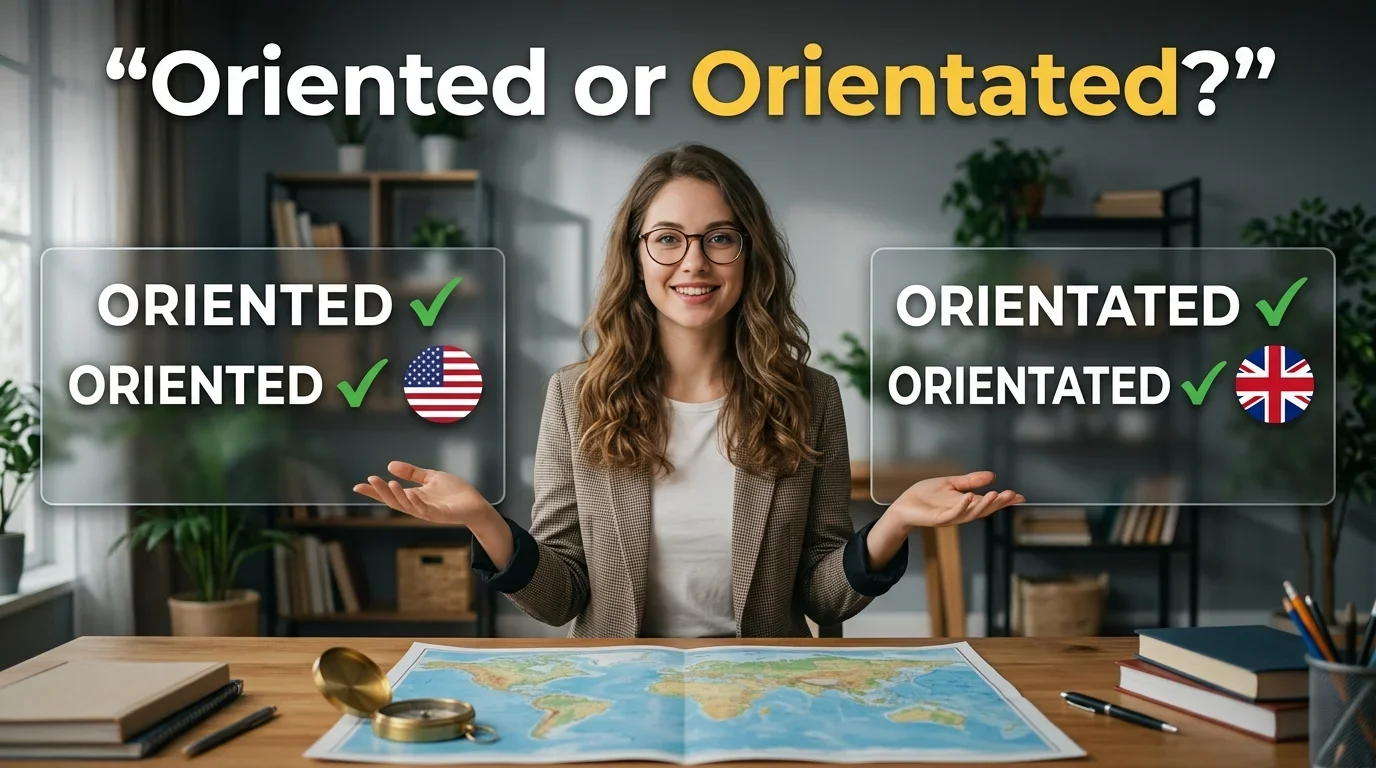
Have you ever wondered whether to write “oriented” or “orientated” in an email, school assignment, or professional document? Both words look correct, and you may have seen them used in different types of English writing.
The good news is that both “oriented” and “orientated” are accepted English words with essentially the same meaning in most contexts. They describe directing someone or something toward a particular goal, purpose, or position.
However, there is a slight difference in regional preference and everyday usage. “Oriented” is generally more common in American English and is widely used in professional phrases such as “goal-oriented,” “customer-oriented,” and “career-oriented.”
Quick Answer ⚡
“Oriented” is the preferred spelling in American English, while “orientated” is commonly used in British English. Both words mean the same thing — to align, adjust, or familiarize oneself with a situation — so neither is “wrong,” but your choice should match your audience.
That’s it. That’s the short version. Now let’s dig into the why, the how, and the when so you never second-guess yourself again.
What Does “Oriented” Mean? 🎯
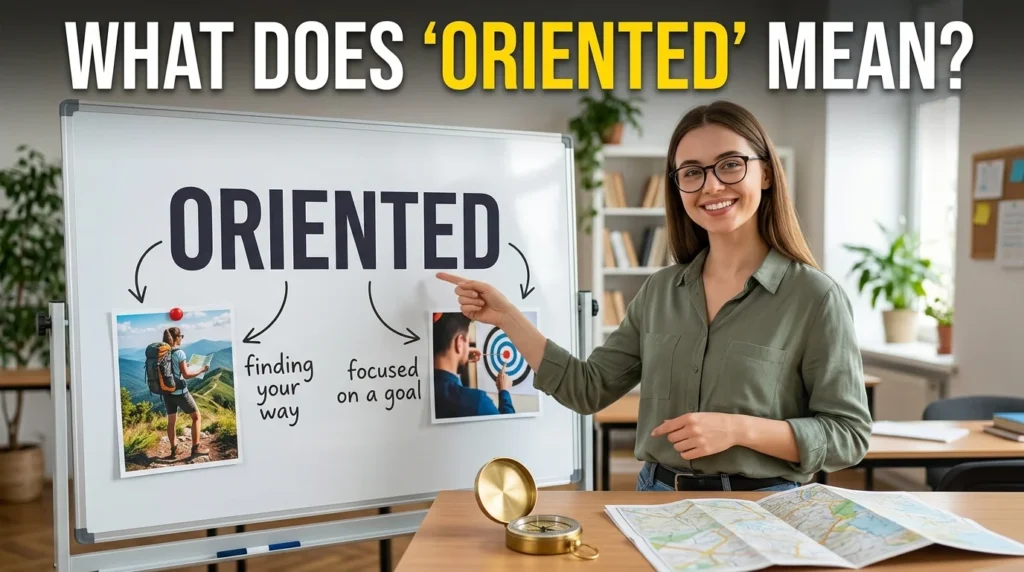
Oriented is the past tense and past participle of the verb “orient,” which means to:
- Align or position something in relation to a direction or reference point
- Familiarize someone with a new situation, place, or system
- Focus or direct attention toward a particular goal
Examples of “Oriented” in a Sentence
- The new employees were oriented to the office procedures on their first day.
- She is a very goal-oriented person who always has a five-year plan.
- The map is oriented so that north points upward.
- Our marketing strategy is customer-oriented, meaning we prioritize client needs.
- He quickly oriented himself after landing in the unfamiliar city.
Notice how “oriented” often pairs with words like goal-oriented, detail-oriented, or customer-oriented. These compound adjectives are extremely common in business and academic writing. 💼
What Does “Orientated” Mean? 🧭
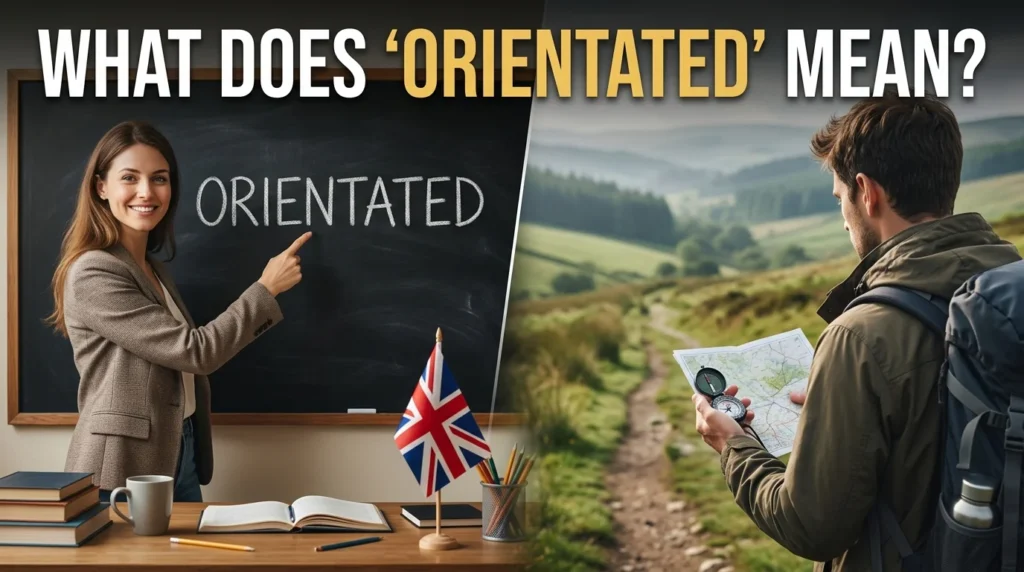
Orientated is simply the British English variant of “oriented.” It comes from the verb “orientate,” which carries the exact same meaning as “orient.”
Yes English speakers in the UK, Australia, and parts of the Commonwealth basically added an extra syllable, and it stuck around!
Examples of “Orientated” in a Sentence
- The students were orientated to the university campus during induction week.
- She’s very career-orientated and works long hours to reach her goals.
- The building is orientated towards the east to catch the morning sun.
- He felt disoriented at first but soon became orientated to his new surroundings.
- Our approach is results-orientated, focusing on measurable outcomes.
If you’re reading a British newspaper, an Australian company report, or a UK university’s website, you’ll spot “orientated” fairly often. 🇬🇧
Oriented vs Orientated: Comparison Table 📊
| Feature | Oriented | Orientated |
| Root Word | Orient (verb) | Orientate (verb) |
| Region | American English 🇺🇸 | British English 🇬🇧 |
| Formality | Preferred in formal & academic writing | Common in everyday British speech/writing |
| Popularity | More widely used globally | Regionally common, less used internationally |
| Example | “He is well-oriented in his new job.” | “He is well-orientated in his new job.” |
| Grammar Correctness | 100% correct | 100% correct (regionally) |
| Style Guide Preference | AP Style, Chicago Manual of Style favor “oriented” | Oxford style accepts both, but “orientated” is common |
Is “Orientated” a Real Word? 🤔
Yes! Despite what some grammar purists claim online, “orientated” is a legitimate word. It’s not slang, and it’s not a typo. It’s listed in major dictionaries, including the Oxford English Dictionary and Merriam-Webster (as a chiefly British variant).
However, some language experts consider “orientated” to be a slightly redundant or “back-formed” version of “oriented,” since “orient” already functions perfectly well as a verb on its own. This is similar to debates around words like:
- Preventive vs Preventative
- Burglarize vs Burgle
- Administrate vs Administer
So while “orientated” isn’t incorrect, many editors and style guides — even in the UK — now lean toward the shorter, simpler “oriented” for clarity. ✍️
Common Mistakes to Avoid ❌
Here are the slip-ups people make most often with these two words:
- ❌ Mixing spellings within the same document (e.g., using “oriented” in paragraph one and “orientated” in paragraph three)
- ❌ Assuming “orientated” is always a mistake (it’s not — it’s regional!)
- ❌ Using “orientated” in American business or academic writing, where “oriented” is the expected standard
- ❌ Forgetting the compound adjective hyphen (e.g., writing “goal oriented” instead of “goal-oriented”)
- ❌ Overusing “orientated” when a simpler word like “familiar” or “adjusted” might read more naturally
Memory Trick 🧠
Here’s a simple mnemonic to lock this in:
“Americans like it shorter ‘Oriented’ has fewer letters, just like American English often trims extra syllables.”
Or try this fun one:
O-R-I-E-N-T-E-D = “Everyone Enjoys Direct English” (short and to the point, just like Americans prefer their spelling) 🇺🇸
O-R-I-E-N-T-A-T-E-D = “Add The Extra Details” (the British love their extra letters — think “colour” vs “color”) 🇬🇧
If you remember that British English tends to keep extra letters (colour, favourite, orientated), this pairing will make total sense.
Real-Life Examples 🌍
📧 In Emails
“Hi team, please join us for the new-hire orientation session on Monday. You’ll be oriented to our internal systems and tools.”
📱 On Social Media
“Just moved to a new city and I’m still getting oriented! Any tips for finding good coffee shops? ☕ #NewCity #Adulting”
📰 In News Articles (British Publication)
“The government’s policy remains firmly orientated towards renewable energy investment over the next decade.”
🎓 In Academic Writing (American Journal)
“This study is oriented around understanding consumer behavior in digital marketplaces.”
💬 In Everyday Speech
“I’m such a visually-oriented learner — I need charts and diagrams to understand anything!”
British vs American English: Why the Difference Exists 🌎
This isn’t a random quirk — it’s part of a bigger pattern in English spelling differences. American English (thanks in large part to Noah Webster’s 19th-century spelling reforms) tends to favor shorter, simplified spellings, while British English often retains older or more elaborate forms.
Compare these familiar examples:
| American English 🇺🇸 | British English 🇬🇧 |
| Color | Colour |
| Organize | Organise |
| Analyze | Analyse |
| Oriented | Orientated |
| Preventive | Preventative |
See the pattern? It’s the same story with “oriented” vs “orientated.” Neither version is “lazy” or “fancy” — they’re just products of different spelling traditions. 🕰️
SEO & Usage Trends 📈
If you’re a content writer, blogger, or student wondering which word performs better online, here’s a useful insight:
- “Oriented” has significantly higher global search volume and usage, largely because American English dominates international business, tech, and digital content.
- “Orientated” still ranks well in UK, Australian, and Irish search markets and content.
- For global SEO content, “oriented” is generally the safer, more universally understood choice.
- For UK-targeted content (law, government, education), “orientated” may feel more natural to your audience.
Related keywords and phrases you’ll often see alongside this topic include:
- grammar tips
- common English mistakes
- correct spelling
- British vs American English
- commonly confused words
- English usage guide
- writing tips for beginners
Oriented or Orientated: Which Should YOU Use? ✅
Here’s a simple decision guide:
- ✅ Writing for a US-based audience, company, or publication? → Use oriented
- ✅ Writing for a UK, Australian, or Commonwealth audience? → Either works, but orientated is common
- ✅ Writing academic, technical, or global content? → Use oriented (it’s more universally recognized)
- ✅ Not sure of your audience? → Default to oriented — it’s understood everywhere and preferred by most modern style guides
FAQs: People Also Ask 🙋
1. Is “orientated” grammatically correct?
Yes. It’s a fully valid word in British English, derived from the verb “orientate.” It’s just less common in American English.
2. Which is more commonly used, “oriented” or “orientated”?
“Oriented” is used far more often worldwide, mainly because American English has a larger global content footprint online.
3. Can I use “oriented” and “orientated” interchangeably?
Yes, they mean the same thing. However, for consistency, stick to one spelling throughout your document, especially in formal writing.
4. Is “orientate” even a real verb?
Yes, “orientate” is a real (though sometimes debated) verb meaning to align or adjust to a situation, used mainly in British English.
5. Why do Americans say “oriented” instead of “orientated”?
American English generally favors shorter, simplified spellings due to 19th-century spelling reforms, which is why “oriented” became the standard.
6. Does Microsoft Word or Grammarly flag “orientated” as wrong?
Some American-English-based grammar tools may flag “orientated” as nonstandard, but it’s not actually incorrect it’s just a regional preference.
7. What’s the noun form of both words?
Both “orient” and “orientate” share the same noun form: orientation (e.g., “new employee orientation”).
Final Thoughts
In conclusion, oriented and orientated are both correct words with similar meanings. They describe being directed toward something, familiar with a subject, or focused on a particular goal. Oriented is more common in American English, while orientated is more frequently used in British English. However, both forms are acceptable in many English-speaking regions.
The best choice depends on your audience, writing style, and regional preference. To keep your writing clear and professional, choose one form and use it consistently. Understanding this simple difference will help you avoid confusion and communicate more confidently in everyday conversations, academic work, and professional writing.

Olivia Bennett is a passionate English grammar writer at GrammBoost.com who loves making grammar simple and easy to understand. She specializes in spelling, word differences, punctuation, and everyday English usage. Through clear explanations and practical examples, Olivia helps students, writers, and professionals write with greater confidence and accuracy.