
Have you ever looked at a shirt, jacket, or dress and wondered whether the correct word is “sleeve” or “sleave”? English spelling can be confusing when two words look similar, but only one is commonly used for a particular meaning. “Sleeve” is the correct standard English word for the part of a garment that covers all or part of your arm.
You will often see it used when describing clothing, fashion styles, and different types of outfits. For example, a shirt may have long sleeves, short sleeves, or no sleeves at all. “Sleave,” on the other hand, is a rare and archaic English word associated with fine or tangled silk thread.
It is not the correct spelling when you are talking about the part of a shirt or jacket that covers your arm. Understanding this distinction can help you avoid spelling mistakes in everyday conversations, fashion articles, school assignments, and professional writing.
Quick Answer ⚡
Sleeve is the everyday word it’s the part of a shirt or jacket that covers your arm. Sleave, on the other hand, is a rare, old-fashioned term referring to a strand of silk thread used in weaving. In 99% of real-world writing, you want sleeve.
What Does “Sleeve” Mean? 👕
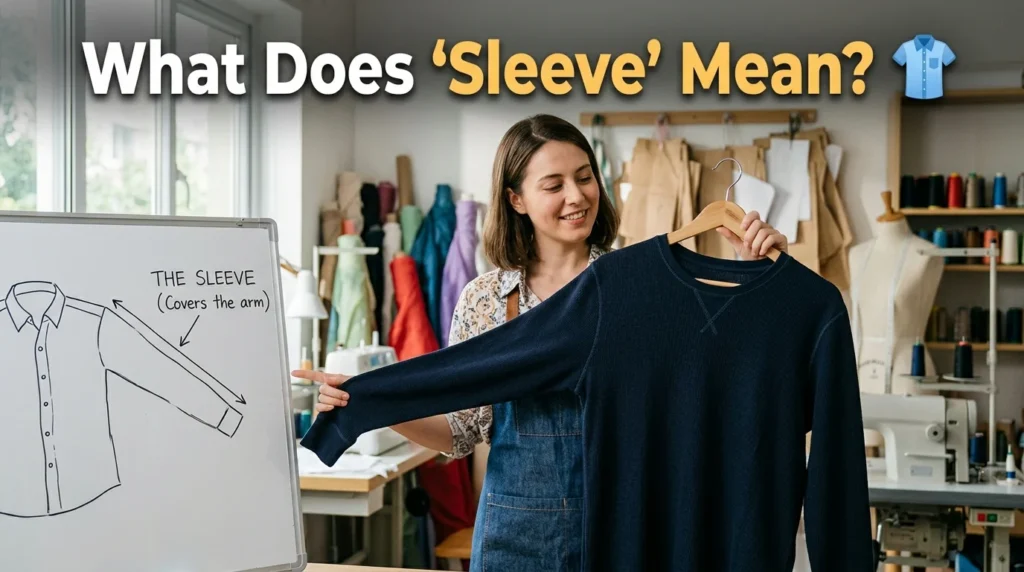
Sleeve is a noun (and sometimes informally used in other ways) that refers to:
- The part of a garment that covers the arm.
- She rolled up her sleeve before washing the dishes.
- This shirt has short sleeves, perfect for summer.
- A protective cover or casing for an object (like a record, a phone, or a tool).
- He slid the vinyl record back into its sleeve.
- Buy a laptop sleeve to protect your device while traveling.
- An idiomatic expression “up your sleeve” means having a hidden plan or trick ready.
- Don’t worry, I’ve got a few tricks up my sleeve.
More Examples of “Sleeve” in Action
| Sentence | Meaning |
| The tailor shortened the sleeves of my blazer. | Clothing arm covering |
| The magician had a card up his sleeve. | Idiom for a hidden plan |
| I bought a cute sleeve for my Kindle. | Protective case |
| Her wedding dress had long lace sleeves. | Clothing detail |
What Does “Sleave” Mean? 🧶

Sleave is a much rarer word, mostly found in historical, poetic, or textile-related writing. It refers to:
- A strand of silk that separates into filaments often used in embroidery or weaving.
- The weaver carefully untangled the sleave before spinning it.
- As a verb (archaic) meaning “to separate or divide threads.”
- She sleaved the silk into finer strands for delicate stitching.
You’ll rarely encounter “sleave” outside of:
- Historical literature (Shakespeare famously used “sleave silk” in Macbeth)
- Textile and weaving industry documents
- Poetry or period dramas
Examples of “Sleave” in Context
| Sentence | Context |
| The sleave silk shimmered under the candlelight. | Poetic/historical writing |
| Weavers used sleave to create fine embroidery patterns. | Textile terminology |
| “Sleep that knits up the ravell’d sleave of care” | Famous Shakespeare quote (Macbeth) |
Sleeve vs Sleave: Comparison Table 📊
| Feature | Sleeve 👕 | Sleave 🧵 |
| Meaning | Arm part of clothing / protective cover | Strand of silk thread |
| Common usage | Extremely common, everyday word | Rare, mostly historical/literary |
| Part of speech | Noun (sometimes verb informally) | Noun / archaic verb |
| Pronunciation | /sliːv/ (rhymes with “leave”) | /sliːv/ or /ˈsleɪv/ (varies) |
| Example | “Roll up your sleeve.” | “The sleave silk was fine and delicate.” |
| Modern relevance | Used daily in speech, fashion, tech | Almost obsolete outside literature |
Common Mistakes and Spelling Tips ✍️
Here’s where people usually trip up:
- ❌ He wore a jacket with long sleaves. (Should be sleeves)
- ❌ I keep my vinyl records in a protective sleave. (Should be sleeve)
- ✅ He wore a jacket with long sleeves.
- ✅ I keep my vinyl records in a protective sleeve.
Why the Confusion Happens
- Both words are pronounced almost the same.
- “Sleave” looks like it could be a valid spelling variant because English has plenty of odd spellings.
- Spellcheck sometimes doesn’t flag “sleave” because it’s a real (if obscure) word not a typo.
🧠 Memory Trick (Mnemonic)
Think of it this way:
“SleEVE” has EVE in it, and Eve wore clothes (after the Garden of Eden)! 👗 Clothes → arms → sleeve.
Or simply remember: Sleeve = everyday clothing. Sleave = ancient, rare, and almost extinct just like it barely appears in modern writing.
Real-Life Examples 🌍
In Emails:
“Could you confirm if the sample jacket comes in a size with adjustable sleeves?”
In Social Media Captions:
“New drop 🔥 Oversized hoodie, drop shoulder sleeves, comfy fit. Shop now!”
In News Writing:
“Fashion week showcased dramatic puff sleeves as the season’s biggest trend.”
In Academic/Literary Writing:
“Shakespeare’s metaphor of the ‘ravell’d sleave of care’ beautifully compares sleep to untangling silk threads.”
In Everyday Speech:
“Ugh, I spilled coffee on my sleeve again!”
Notice something? “Sleeve” appears in almost every context fashion, tech, casual conversation while “sleave” only shows up in historical or literary references.
British vs American English 🇬🇧🇺🇸
Good news here there’s no major spelling or usage difference between British and American English for “sleeve.” Both use the same spelling and meaning.
- 🇬🇧 British English: “She rolled up her jumper’s sleeves.”
- 🇺🇸 American English: “She rolled up her sweater’s sleeves.”
“Sleave,” being archaic in both dialects, doesn’t have a modern regional variation either it’s simply rare everywhere.
Trends and Keyword Insights 📈
If you’re researching this topic for writing, SEO, or grammar learning purposes, here are some related keywords and phrases people often search for:
- Sleeve vs sleave meaning
- Correct spelling of sleeve
- Sleeve definition and examples
- Common English word confusions
- Grammar tips for beginners
- English usage mistakes
- Homophone confusion in English
- Sleeve idioms in English
Using “sleeve” correctly is far more relevant for modern content, product descriptions, fashion blogs, and everyday communication while “sleave” is more of a linguistic curiosity than a practical, everyday word.
FAQs: People Also Ask ❓
1. Is “sleave” even a real word?
Yes! It’s a real but archaic word referring to a strand of silk thread, mostly seen in historical or poetic texts.
2. Which word should I use in everyday writing?
Almost always sleeve whether you’re talking about clothing, phone cases, or record covers.
3. Are “sleeve” and “sleave” pronounced the same?
They’re very close in pronunciation, which is a big reason people confuse them while writing.
4. Does spellcheck catch this mistake?
Not always. Since “sleave” is a legitimate word, spellcheck tools may not flag it as an error even if you meant “sleeve.”
5. Where does the word “sleave” come from?
It has Old English roots and was historically used in the textile and weaving industry.
6. Can “sleeve” be used as a verb?
Not commonly, though informally people might say “sleeve it” when referring to inserting something into a protective cover.
7. Is there a British vs American spelling difference?
No “sleeve” is spelled the same way in both British and American English.
Final Thoughts:
In conclusion, sleeve and sleave are two different words, but they are not interchangeable in everyday writing. Sleeve is the correct and commonly used word for the part of a shirt, jacket, or other garment that covers the arm. Sleave is a rare word with specialized meanings, including a loose or untwisted strand of silk.
If you are talking about clothing, remember to use sleeve. Understanding the difference between these words helps you avoid spelling mistakes and communicate more clearly. By choosing the correct word for your intended meaning, you can make your writing more accurate, natural, and professional.

James Carter is an English language enthusiast and content writer who loves making grammar simple and easy to understand. He creates clear, beginner-friendly guides on spelling, grammar rules, confusing words, and everyday English usage. His goal is to help readers write with confidence through practical examples, easy explanations, and accurate language tips.