Ever found yourself in a conversation where someone confidently says “Islam has many gods” or “Muslims worship the moon god”? Or maybe you’ve heard someone confuse “Allah” with a separate deity, totally different from “God”? 😅
You’re not alone. This mix-up happens a lot, especially among people who haven’t studied world religions closely. It usually comes from misunderstanding Arabic terms, mixing up cultural practices with core beliefs, or just not knowing what “monotheistic” and “polytheistic” actually mean.
Let’s clear up the confusion once and for all in a simple, friendly, no-jargon way.
Quick Answer 🎯
Islam is strictly monotheistic. It teaches belief in one, single, indivisible God (called Allah in Arabic), and associating any partner, equal, or additional deity with God is considered the greatest sin in Islamic theology.
Now let’s break down why this confusion exists, what the key terms actually mean, and how to talk about this correctly whether you’re writing an essay, a social media post, or just chatting with a friend.
Monotheistic vs. Polytheistic: What Do These Words Actually Mean?
Before we go further, let’s nail down the vocabulary. Understanding these words is half the battle. 📚
Monotheistic (adjective)
- Meaning: Believing in and worshipping only one God.
- Root: From Greek “mono” (one) + “theos” (god).
- Example sentences:
- “Judaism, Christianity, and Islam are all considered monotheistic religions.”
- “The Prophet Muhammad preached a strictly monotheistic message in a society that worshipped many idols.”
- “Islam’s core belief, called Tawhid, is a monotheistic concept meaning ‘the Oneness of God.'”
Polytheistic (adjective)
- Meaning: Believing in and worshipping multiple gods or deities.
- Root: From Greek “poly” (many) + “theos” (god).
- Example sentences:
- “Ancient Greek and Roman religions were polytheistic, with gods like Zeus and Jupiter.”
- “Pre-Islamic Arabia was largely polytheistic, with tribes worshipping various idols at the Kaaba.”
- “Hinduism is often (though debatably) described as polytheistic by outsiders, though many Hindus see it differently.”
Tawhid (a key Islamic term)
- Meaning: The Islamic concept of the absolute Oneness of God the foundation of Islamic monotheism.
- Example sentence:
- “Tawhid is considered the single most important belief in Islam.”
Comparison Table: Monotheism vs. Polytheism 📊
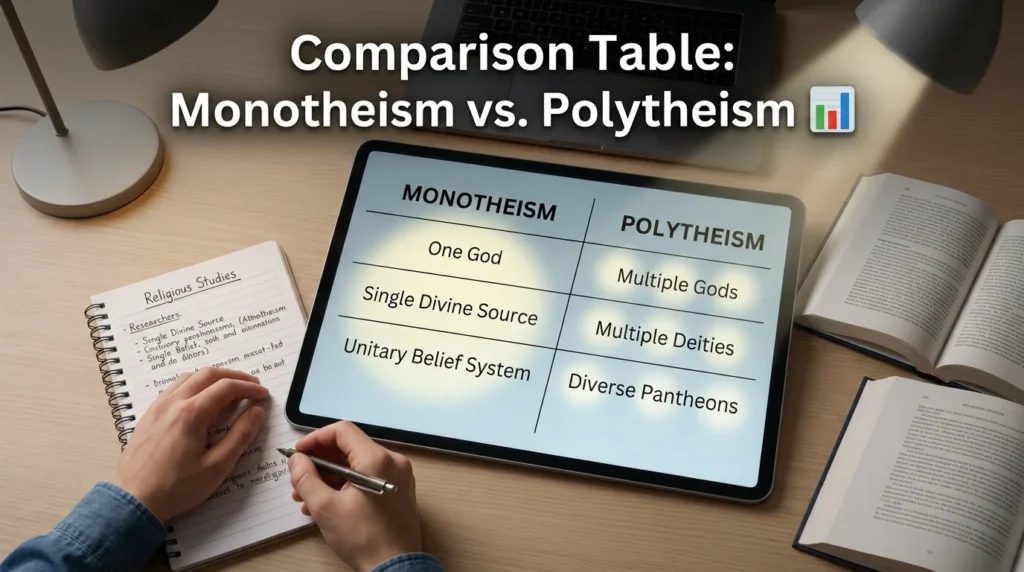
| Feature | Monotheistic | Polytheistic |
| Definition | Belief in one God only | Belief in multiple gods/deities |
| Examples of religions | Islam, Judaism, Christianity, Sikhism | Ancient Greek religion, Ancient Egyptian religion, Norse mythology |
| Islam’s position | ✅ Islam is monotheistic | ❌ Islam is NOT polytheistic |
| Core term (Islam) | Tawhid (Oneness of God) | Shirk (associating partners with God forbidden) |
| Common mistake | Confusing “Allah” for a separate deity | Assuming multiple prophets = multiple gods |
Why Do People Get Confused? 🤔
This is where things get interesting. Let’s look at the most common reasons people mistakenly think Islam might be polytheistic and why each one is a misunderstanding.
1. Confusion Over the Word “Allah”
- The mistake: Some people think “Allah” is the name of a specific, separate god perhaps a moon god or a regional deity.
- The reality: “Allah” is simply the Arabic word for “God” the same God referenced in Judaism and Christianity. Arabic-speaking Christians and Jews also use the word “Allah” when referring to God.
📌 Memory trick: Think of “Allah” the way you’d think of “Dieu” in French or “Gott” in German it’s just the word for God in that language, not a different god.
2. Mixing Up Prophets With Deities
- The mistake: Islam honors many prophets Adam, Noah, Abraham, Moses, Jesus, Muhammad and some assume this means multiple “gods.”
- The reality: Prophets in Islam are human messengers, not divine beings. Worshipping a prophet is strictly forbidden.
3. Angels, Saints, and Spiritual Beings
- The mistake: Islam acknowledges angels (like Gabriel) and jinn (spiritual beings), leading some to assume a “pantheon” of divine figures.
- The reality: Angels and jinn are created beings, not gods. They have no divine power and are not worshipped.
4. The 99 Names of God
- The mistake: Islam describes God using 99 different names or attributes (like Ar-Rahman – The Merciful, Al-Khaliq – The Creator). Some mistakenly think these are 99 separate gods.
- The reality: These are simply descriptive titles for the same single God similar to how you might describe one person as “a mother,” “a teacher,” and “a friend,” without implying three different people.
Real-Life Examples: How This Comes Up in Everyday Life
📧 In an Email or Academic Paper
“This paper explores how Islam, as a monotheistic faith, shaped religious practices across the Arabian Peninsula in the 7th century.”
💬 In a Social Media Comment
“Just saw someone claim Islam is polytheistic 🙄 that’s actually the opposite of what it teaches. Tawhid (Oneness of God) is literally the core belief.”
📰 In a News Article
“Religious scholars point out that all three Abrahamic faiths Judaism, Christianity, and Islam share monotheistic roots, despite theological differences.”
🗣️ In Everyday Speech
“Wait, is Islam like Hinduism with lots of gods?” “No, actually Islam is strictly monotheistic. It’s all about believing in just one God.”
Common Mistakes to Avoid ✍️
| ❌ Common Mistake | ✅ Correct Usage |
| “Islam has many gods like Allah and Muhammad.” | “Islam has one God, Allah; Muhammad is a prophet, not a deity.” |
| “Muslims worship a moon god.” | “Muslims worship God (Allah), the same God referenced in Judaism and Christianity.” |
| Spelling it “monotheistic” as “monothesitic” or “monotheistc” | Correct spelling: monotheistic |
| Spelling “polytheistic” as “polythestic” or “polythesitic” | Correct spelling: polytheistic |
Spelling Tip / Mnemonic 🧠
- Mono = “one” (think monorail one track)
- Poly = “many” (think polygon many sides)
So: Monotheistic = one God, Polytheistic = many gods. Easy to remember once you connect it to words you already know!
British vs. American English: Any Differences? 🇬🇧🇺🇸
Good news this is one of those rare cases where spelling and usage are identical in both British and American English:
| Term | British English | American English |
| Monotheistic | Monotheistic | Monotheistic |
| Polytheistic | Polytheistic | Polytheistic |
No regional variation here so you can use these words confidently no matter your audience. 👍
FAQs: People Also Ask ❓
1. Is Islam monotheistic or polytheistic?
Islam is strictly monotheistic. It teaches belief in one, indivisible God (Allah), with no partners or equals.
2. What is the Islamic term for monotheism?
The term is Tawhid, referring to the absolute Oneness of God the central pillar of Islamic belief.
3. Is Allah a different god from the God of Christianity and Judaism?
No. “Allah” is the Arabic word for God the same God referenced in Judaism and Christianity, especially since all three are considered Abrahamic religions.
4. Why do some people think Islam is polytheistic?
This usually comes from misunderstandings around Arabic terms, the number of prophets Islam recognizes, the existence of angels, or the “99 Names of God” none of which imply multiple deities.
5. What is “Shirk” in Islam?
Shirk means associating partners or equals with God. It’s considered the gravest sin in Islam, directly opposing the concept of Tawhid (Oneness of God).
6. Are Judaism, Christianity, and Islam all monotheistic?
Yes, all three are classified as Abrahamic, monotheistic religions, though they differ in theology, scripture, and practice.
7. What’s an easy way to remember the difference between “monotheistic” and “polytheistic”?
Remember: Mono = one (like monorail), Poly = many (like polygon). Mono = one God, Poly = many gods.
Final Thoughts:
In conclusion, Islam is a monotheistic religion centered on the belief in one God, known as Allah. The core Islamic teaching, known as Tawhid, emphasizes that Allah is unique, has no partners, and alone deserves worship. Muslims believe that associating partners with Allah, known as shirk, contradicts this fundamental principle. The Quran repeatedly calls people to worship one God and rejects the idea of multiple gods.
Understanding this distinction helps explain why Islam is classified as monotheistic rather than polytheistic. Whether exploring Islamic beliefs for study, comparison, or general knowledge, the concept of one God remains the foundation of Islamic faith and worship.

James Carter is an English language enthusiast and content writer who loves making grammar simple and easy to understand. He creates clear, beginner-friendly guides on spelling, grammar rules, confusing words, and everyday English usage. His goal is to help readers write with confidence through practical examples, easy explanations, and accurate language tips.