Have you ever wondered whether to write meantime or mean time? ⏳ You’re not alone! These two expressions look almost identical, but they are not always interchangeable.
While meantime is a common English word meaning “during the time before something else happens,” mean time is a mathematical or scientific term that refers to an average amount of time.
Because the difference is subtle, many writers accidentally use the wrong form. In this guide, you’ll learn the meanings of meantime and mean time, grammar rules, comparison tables, examples, common mistakes, memory tricks, regional usage, and FAQs.
Quick Answer
Which Is Correct: Meantime or Mean Time?
Both meantime and mean time are correct, but they have different meanings.
- Meantime = During the time before something else happens; meanwhile.
- Mean time = The average or arithmetic average of several time measurements, mainly used in mathematics, science, engineering, and statistics.
If you’re talking about waiting until something happens, use meantime.
If you’re talking about an average length of time, use mean time.
What Does “Meantime” Mean?
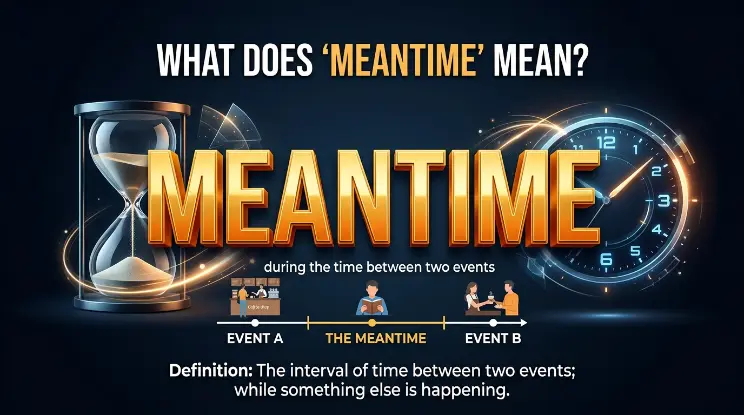
Definition of Meantime
Meantime is a noun or adverb that means:
- During the intervening period
- Until something else happens
- Meanwhile
It is commonly used in both spoken and written English.
Examples of “Meantime”
Dinner will be ready in an hour. Meantime, you can watch TV.
The repairs will take two days. In the meantime, we’ll use another office.
She is waiting for her flight. In the meantime, she’s reading a book.
The manager is busy. Meantime, please take a seat.
We’ll call you tomorrow. In the meantime, feel free to ask questions.
What Does “Mean Time” Mean?
Definition of Mean Time
Mean time is a technical term that refers to the average amount of time calculated from several measurements.
It is commonly used in:
- Mathematics
- Statistics
- Engineering
- Physics
- Reliability testing
- Manufacturing
Examples include:
- Mean time between failures (MTBF)
- Mean time to repair (MTTR)
- Mean time to recovery
Examples of “Mean Time”
The mean time required to complete the task was 18 minutes.
Engineers calculated the mean time between failures.
The report shows the mean time customers spend waiting.
Researchers measured the mean time needed for recovery.
The software reduced the mean time to repair.
Meantime Meaning
Meantime means the period of time before something happens or while you are waiting for something else to happen. It is commonly used to describe what someone can do during a waiting period. For example, “The doctor will arrive soon. In the meantime, please have a seat.” Here, meantime refers to the time spent waiting for the doctor.
Mean Time or Meantime Synonym
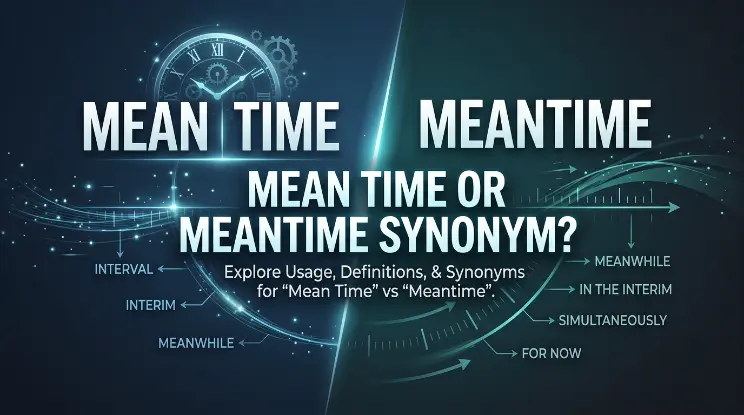
Meantime is normally written as one word when it means “during the time before something happens.” Common synonyms include meanwhile, during this time, in the interim, temporarily, and for now. For example, “In the meantime, I’ll finish my work” can also be written as “Meanwhile, I’ll finish my work.” Mean time as two separate words is generally used only when “mean” and “time” have their individual meanings.
Is “For the Meantime” Correct?
Yes, “for the meantime” is grammatically correct, but it is less common than “in the meantime.” The phrase “in the meantime” is the standard and more natural expression in everyday English. For example, “The new computer will arrive tomorrow. In the meantime, you can use this one.” You may see “for the meantime,” but “in the meantime” is usually the better choice.
Meantime vs Mean Time
Comparison Table
| Feature | Meantime | Mean Time |
| Meaning | During the waiting period | Average amount of time |
| Part of Speech | Noun / Adverb | Noun phrase |
| Everyday English | Very common | Rare outside technical fields |
| Mathematics & Science | ❌ No | Yes |
| Example | In the meantime, wait here. | The mean time was 12 seconds. |
Key Differences
The difference depends on meaning.
- Meantime refers to the period before something happens.
- Mean time refers to an average calculated time.
Meantime or Mean Time?
| Term | Correct? | Meaning | Example |
|---|---|---|---|
| Meantime | ✅ Correct | Means during the time before something else happens or until then. | The food will be ready soon. In the meantime, you can relax. |
| Mean time | ✅ Correct, but different | Usually refers to an average period of time or the literal meaning of “mean” + “time.” It is not normally used to mean “during that time.” | The mean time required to complete the task is 30 minutes. |
Why Do People Confuse Meantime and Mean Time?
Similar Appearance
The words differ only by a space.
Same Pronunciation
They sound almost identical when spoken.
Lack of Technical Knowledge
Many people are familiar with meantime but don’t realize mean time has a specific statistical meaning.
When Should You Use “Meantime”?
Correct Situations
Use meantime when talking about:
- Waiting
- Temporary situations
- Delays
- Events happening before something else
Correct Examples
I’ll finish cooking soon. Meantime, set the table.
In the meantime, keep practicing.
The website is under maintenance. In the meantime, use the mobile app.
We’ll announce the results tomorrow. Meantime, stay tuned.
When Should You Use “Mean Time”?
Correct Situations
Use mean time in:
- Statistics
- Engineering
- Scientific research
- Data analysis
- Reliability reports
Correct Examples
The mean time to complete the exam was 45 minutes.
The company improved its mean time to recovery.
Scientists measured the mean time required for the reaction.
Common Mistakes
Mistake 1: Using Mean Time Instead of Meantime
❌ Mean time, let’s have lunch.
Meantime, let’s have lunch.
Mistake 2: Writing Meantime in Technical Reports
❌ The meantime between failures is 500 hours.
The mean time between failures is 500 hours.
Mistake 3: Forgetting “In the”
Both are correct:
Meantime
In the meantime
The second form is more common in everyday English.
Easy Memory Trick
Meantime = Meanwhile
If you can replace it with meanwhile, use:
Meantime
Mean Time = Average
Remember:
Mean = Average
If you’re calculating an average, write:
Mean time
Real-Life Examples
Everyday Conversation
“I’ll be there soon. Meantime, start without me.”
Business Email
“In the meantime, please review the attached document.”
News Report
“The investigation continues. In the meantime, officials urge caution.”
Engineering Report
“The mean time between failures increased significantly.”
Technology
“Our system reduced the mean time to repair by 40%.”
Social Media
“Waiting for the weekend! Meantime, back to work. 😄”
Academic Research
“The mean time for participants to complete the survey was 12 minutes.”
British vs American English
Is There a Difference?
No.
Both British English and American English use:
- Meantime / In the meantime
- Mean time
The meanings remain exactly the same.
Usage Trends
Meantime Is Common In
- Everyday conversations
- Emails
- News articles
- Books
- Blogs
- Social media
Mean Time Is Common In
- Engineering
- Mathematics
- Statistics
- Scientific journals
- Reliability analysis
- Technical manuals
Grammar Tips
Meantime Can Replace “Meanwhile”
Examples:
Meantime, I’ll make coffee.
Meanwhile, I’ll make coffee.
Mean Time Is a Noun Phrase
Examples:
The mean time was 15 minutes.
Engineers calculated the mean time accurately.
More Example Sentences
Examples Using Meantime
Meantime, enjoy your coffee.
We’ll begin shortly. In the meantime, please be seated.
The train is delayed. In the meantime, read a magazine.
She’ll call later. Meantime, let’s finish the report.
In the meantime, everyone remained calm.
Dinner isn’t ready yet. Meantime, help with the dishes.
He waited patiently. In the meantime, he answered emails.
Meantime, life continued as usual.
Examples Using Mean Time
The mean time to solve the problem was 20 minutes.
Engineers improved the mean time between failures.
Researchers calculated the mean time for each experiment.
The mean time to recovery was reduced.
The report included the mean time for processing orders.
Frequently Asked Questions (FAQs)
Is it meantime or mean time?
Both are correct. Meantime means “during the waiting period,” while mean time refers to an average amount of time.
Is meantime one word?
Yes. Meantime is one word. The phrase in the meantime is also correct and very common.
What does mean time mean?
Mean time is the average time calculated from multiple measurements, often used in technical fields.
Can I replace meantime with meanwhile?
Yes. In many everyday sentences, meantime and meanwhile have similar meanings.
Is mean time used in everyday English?
Not often. It is mainly used in mathematics, engineering, science, and statistics.
Do British and American English use these differently?
No. Both varieties use meantime and mean time with the same meanings.
How can I remember the difference?
Remember:
Meantime = Meanwhile
Mean = Average
If you’re talking about waiting, use meantime. If you’re calculating an average, use mean time.
Conclusion
Although meantime and mean time look very similar, they have different meanings and uses. Meantime refers to the period before something else happens and is commonly used in everyday English, especially in the phrase in the meantime. Mean time, on the other hand, is a technical term that refers to an average amount of time and is mainly used in mathematics, engineering, and scientific contexts.
A simple way to remember the difference is: “Meantime = Meanwhile” and “Mean = Average.” Choosing the correct form will make your writing clearer, more accurate, and more professional.
Read More Articles
Excell or Excel: Which Spelling Is Correct? Complete Grammar2026
To Who or To Whom? The Correct Grammar Rule Explained 2026
Que or Queue: Which Word Is Correct? Complete Grammar & Usage Guide 2026
Fulfilment or Fulfillment: Which Spelling Is Correct? 2026

James Carter is an English language enthusiast and content writer who loves making grammar simple and easy to understand. He creates clear, beginner-friendly guides on spelling, grammar rules, confusing words, and everyday English usage. His goal is to help readers write with confidence through practical examples, easy explanations, and accurate language tips.